
A Certificate of Analysis (CoA) is an official laboratory document that certifies a peptide batch's purity, identity, and quality. In certificate of analysis peptide research, this document is the single most important record separating verified research material from an unlabeled compound of unknown composition. Without a CoA, a peptide vial carries no traceable proof of what it contains. Researchers relying on unverified material risk compromised assay results, failed reproducibility, and retracted publications. The two primary analytical methods underpinning every credible CoA are High-Performance Liquid Chromatography (HPLC) for purity and mass spectrometry for identity confirmation.
What does a certificate of analysis for peptide research include?
A peptide CoA is a structured document, and each section carries specific scientific weight. Knowing what to look for prevents researchers from accepting incomplete or falsified documentation.
The core components of a valid peptide analysis report are:
- Peptide name and amino acid sequence: Confirms the compound's identity at the structural level.
- Molecular formula and theoretical molecular weight: Provides the reference value against which mass spectrometry results are compared.
- HPLC chromatogram and purity percentage: The primary purity metric. A CoA document typically includes HPLC chromatogram data showing one dominant peak for the target peptide and minor peaks for impurities.
- Mass spectrometry data: Confirms peptide identity by matching observed molecular weight to theoretical mass.
- Batch number and manufacturing date: Enables traceability and batch-to-batch comparison across longitudinal studies.
- Test date: Confirms the analysis is current and not recycled from a prior batch.
- Laboratory name and accreditation: ISO 17025 accreditation is the recognized standard for testing laboratory competence.
- Impurity limits: Quantified byproduct levels, confirming synthesis quality.
The table below summarizes the key CoA fields and their research significance:
| CoA Field | Research Significance |
|---|---|
| HPLC purity % | Confirms compound meets ≥98% research-grade threshold |
| Mass spectrometry result | Validates peptide identity against theoretical molecular weight |
| Batch number | Enables traceability and longitudinal consistency checks |
| ISO 17025 lab accreditation | Confirms the testing facility meets international competence standards |
| Endotoxin level | Required for injectable peptides; safe limit is <10 EU/mg |
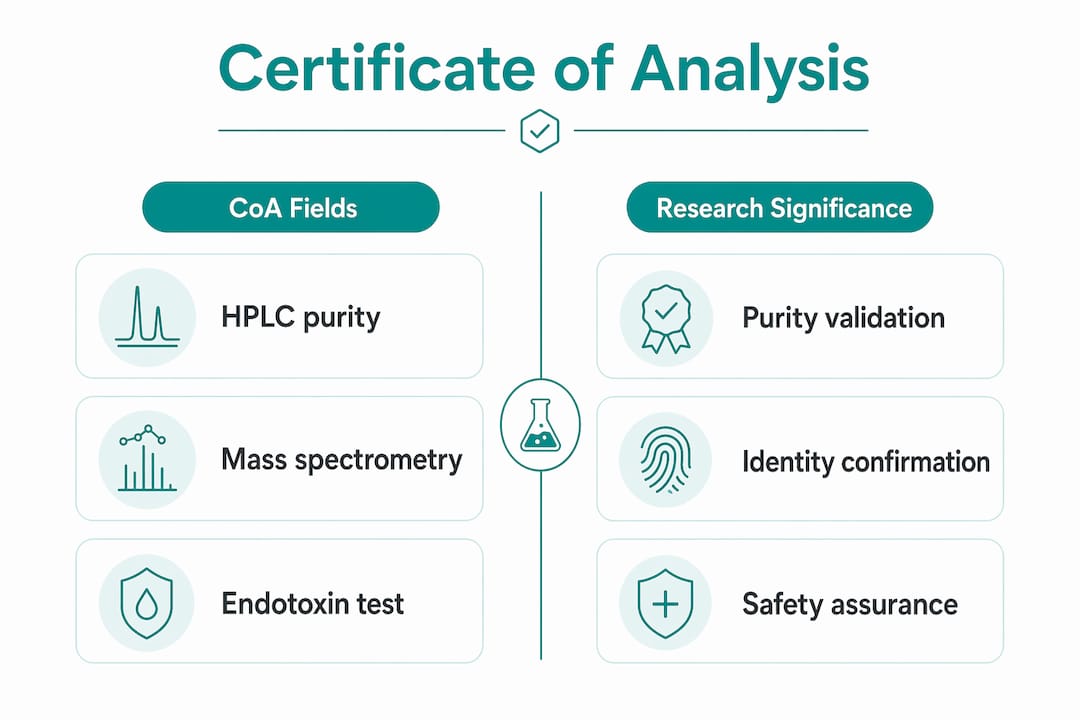
An authentic CoA transforms a peptide vial from "unlabeled white powder" to a verified research material. Absence of a CoA is a major red flag signaling low supplier credibility.
How is peptide purity and identity tested?
HPLC is the gold standard for measuring peptide purity. The method separates compounds by their interaction with a stationary phase, producing a chromatogram where each peak represents a distinct molecular species.
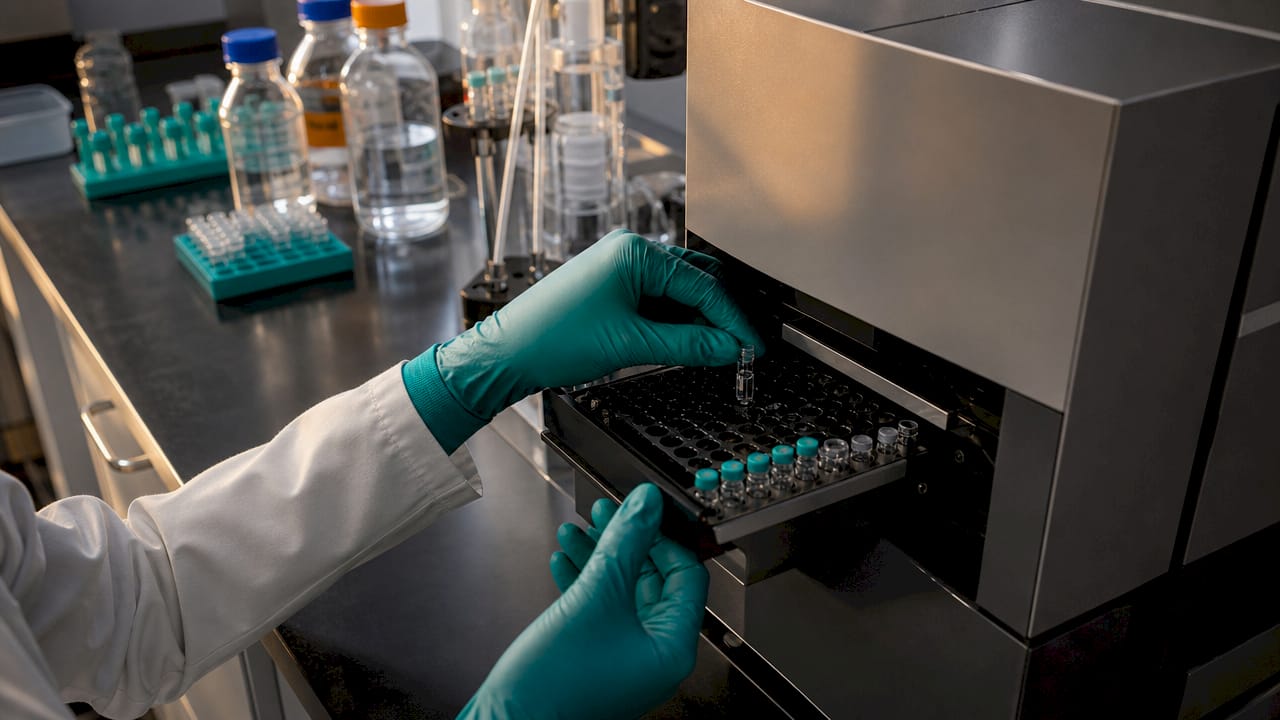
HPLC chromatograms show one dominant peak for the target peptide, with minor peaks representing impurities or synthesis byproducts. Purity is calculated as the main peak area divided by total peak area, multiplied by 100. A clean synthesis produces a single sharp dominant peak with minimal secondary signals. Any secondary peak above a defined threshold signals a quality concern that warrants investigation before the material enters an assay.
Purity thresholds define the grade of the material:
- ≥98% purity: Research-grade standard, confirmed by HPLC.
- ≥99.5% purity: Pharmaceutical-grade threshold, required for clinical applications.
- <95% purity: Raises serious quality concerns regardless of price or supplier claims.
Research-grade peptides require a minimum purity of 98%, while pharmaceutical-grade materials must reach ≥99.5%. That gap matters because even a 1–2% impurity load can alter receptor binding kinetics in sensitive in vitro assays.
Mass spectrometry validates peptide identity independently of purity. Modern LC-MS/MS instruments confirm identity by measuring molecular weight with accuracy below 5 parts per million (ppm) from the theoretical mass. A result within that tolerance confirms the correct compound. A result outside it signals a synthesis error, contamination, or a substituted compound entirely.
For injectable peptides, the CoA must also include endotoxin testing. Endotoxin levels below 10 EU/mg are the accepted safety threshold for peptides intended for injection. This test is often omitted by lower-tier suppliers, which is itself a quality signal.
Pro Tip: When reviewing an HPLC chromatogram, request the raw data file alongside the PDF report. A supplier who can provide the original instrument output file has nothing to hide about the analysis.
How do you verify the authenticity of a peptide CoA?
A CoA is only as credible as the laboratory that produced it. Verification is a structured process, not a visual check of a PDF.
-
Confirm laboratory accreditation. ISO 17025 is the international standard for testing laboratory competence. The American Association for Laboratory Accreditation (A2LA) maintains a public directory of accredited labs. Cross-reference the lab name on the CoA against that directory before accepting the document.
-
Cross-reference batch numbers and dates. The batch number on the CoA must match the batch number on the product label and the supplier's invoice. Test dates should be recent. A CoA dated years before the current shipment was not generated for that batch.
-
Contact the testing laboratory independently. Use contact information sourced from the lab's official website, not from the CoA itself. Ask the lab to confirm that the batch number and results on the document match their records. Verifying CoA authenticity requires direct lab confirmation using independently sourced contact details.
-
Scan for typographical and data inconsistencies. Legitimate laboratory documents follow consistent formatting. Mismatched fonts, altered decimal values, rounded purity figures (e.g., exactly 99.00% with no decimal variation), and missing instrument parameters are common signs of document manipulation.
-
Evaluate supplier transparency. Reputable suppliers provide CoAs proactively, not only on request. They name the testing laboratory, list the instrument used, and include the chromatogram image rather than just a purity number.
Pro Tip: A purity figure of exactly 99.00% with no decimal variation is statistically improbable from real HPLC data. Authentic results typically show values like 98.73% or 99.41%. Round numbers warrant a follow-up call to the lab.
What practical applications does a peptide CoA serve in research?
The peptide purity certificate is not a formality. It is a functional research tool that directly affects experimental design, data quality, and publication credibility.
- Assay selection and peptide suitability. Purity data determines which assays a peptide can support. A compound at 97% purity may be acceptable for a cell viability screen but unsuitable for a receptor binding study where impurities could compete at the binding site.
- Experimental documentation and reproducibility. Peer-reviewed journals increasingly require researchers to document the source and verified purity of all compounds used. A CoA provides that record. Without it, a study cannot be replicated because the exact material cannot be confirmed.
- Batch-to-batch consistency in longitudinal studies. Long-term studies require consistent compound quality across multiple procurement cycles. Batch numbers and test dates on successive CoAs allow researchers to confirm that purity and identity remained stable across the study period.
- Regulatory and grant compliance. Funding bodies and institutional review boards often require documented evidence of compound quality. A verified CoA satisfies those requirements directly and reduces administrative friction during grant reporting.
- Supporting peer-reviewed publications. Journals in pharmacology, biochemistry, and molecular biology require compound verification as part of the methods section. A CoA from an ISO 17025 accredited laboratory meets that standard without additional justification.
Peptasticlabs provides CoAs for its catalog compounds on request, with each batch verified to ≥99% purity via HPLC. Researchers sourcing from Peptasticlabs' research catalog receive documentation that satisfies journal and institutional requirements without additional verification steps.
Key Takeaways
A valid Certificate of Analysis is the definitive proof that a research peptide meets defined purity and identity standards, and no study should proceed without one.
| Point | Details |
|---|---|
| CoA components matter | Verify HPLC purity, mass spectrometry data, batch number, and ISO 17025 lab accreditation on every document. |
| Purity thresholds are fixed | Research-grade peptides require ≥98% HPLC purity; anything below 95% is unsuitable for scientific use. |
| Verification is active, not passive | Contact the testing lab directly using independently sourced contact information to confirm batch results. |
| CoAs support publication | Peer-reviewed journals require compound verification; an ISO 17025 CoA satisfies that requirement. |
| Supplier transparency signals quality | Reputable suppliers provide CoAs proactively and name the accredited laboratory that conducted the analysis. |
Why researchers cannot afford to skip CoA validation
Researchers who skip CoA validation do not save time. They borrow it from a later point in the study when results fail to replicate or a reviewer requests compound verification that cannot be produced.
The most common mistake I see in research environments is treating the CoA as a box-ticking exercise. A researcher receives a PDF, confirms the purity number exceeds 98%, and files it away. That approach misses the most important step: confirming the document is real. A fabricated CoA with a plausible purity figure is indistinguishable from a legitimate one unless you call the lab. That single phone call has saved more than one study from a retraction.
The second pitfall is ignoring batch numbers. Researchers who reorder a compound and assume the new batch matches the old one without checking the CoA introduce an uncontrolled variable into their longitudinal data. Purity can shift between batches even from the same supplier. The CoA is the only way to confirm it did not.
Strict CoA evaluation also protects institutional credibility. A study built on unverified compounds reflects on the laboratory, the institution, and the funding body. The standard for peptide research documentation has risen sharply in recent years, and journals are enforcing it. Researchers who treat CoA review as a core methodological step, not an administrative one, produce work that holds up under scrutiny.
My recommendation: build CoA review into the procurement checklist, not the post-delivery checklist. Verify the document before the order ships, not after the vial arrives.
— Tintastic
Peptasticlabs: verified peptides with full documentation
Peptasticlabs supplies over 22 research-grade compounds, each independently tested and verified to ≥99% purity via HPLC. Every batch in the catalog carries full documentation, including HPLC chromatogram data, mass spectrometry identity confirmation, and batch traceability records.
Researchers who need verified peptide research documentation for studies in metabolic function, tissue repair, cognitive performance, longevity, immunology, or cosmetic applications will find the full catalog at Peptasticlabs. CoAs are available on request for every listed compound. For researchers sourcing at volume, the wholesale program includes the same documentation standards applied to individual orders. Purity, identity, and traceability are not optional add-ons. They are standard.
FAQ
What is a Certificate of Analysis for a peptide?
A Certificate of Analysis is a laboratory document that verifies a peptide batch's purity, identity, molecular weight, and synthesis quality. It is the primary quality assurance record in peptide research documentation.
What purity level does a research-grade peptide require?
Research-grade peptides require ≥98% purity as measured by HPLC. Material below 95% purity raises serious quality concerns and is unsuitable for controlled scientific studies.
How do I confirm a peptide CoA is authentic?
Confirm the testing laboratory holds ISO 17025 accreditation, cross-reference the batch number against your order documentation, and contact the lab directly using contact details from the lab's official website, not from the CoA itself.
Why does mass spectrometry appear on a peptide CoA?
Mass spectrometry confirms peptide identity by measuring molecular weight against the theoretical value. Results within 5 ppm of the theoretical mass confirm the correct compound was synthesized.
Do injectable peptides require additional CoA testing?
Yes. CoAs for injectable peptides must include endotoxin testing, with results below 10 EU/mg to meet accepted safety standards for injection-route compounds.