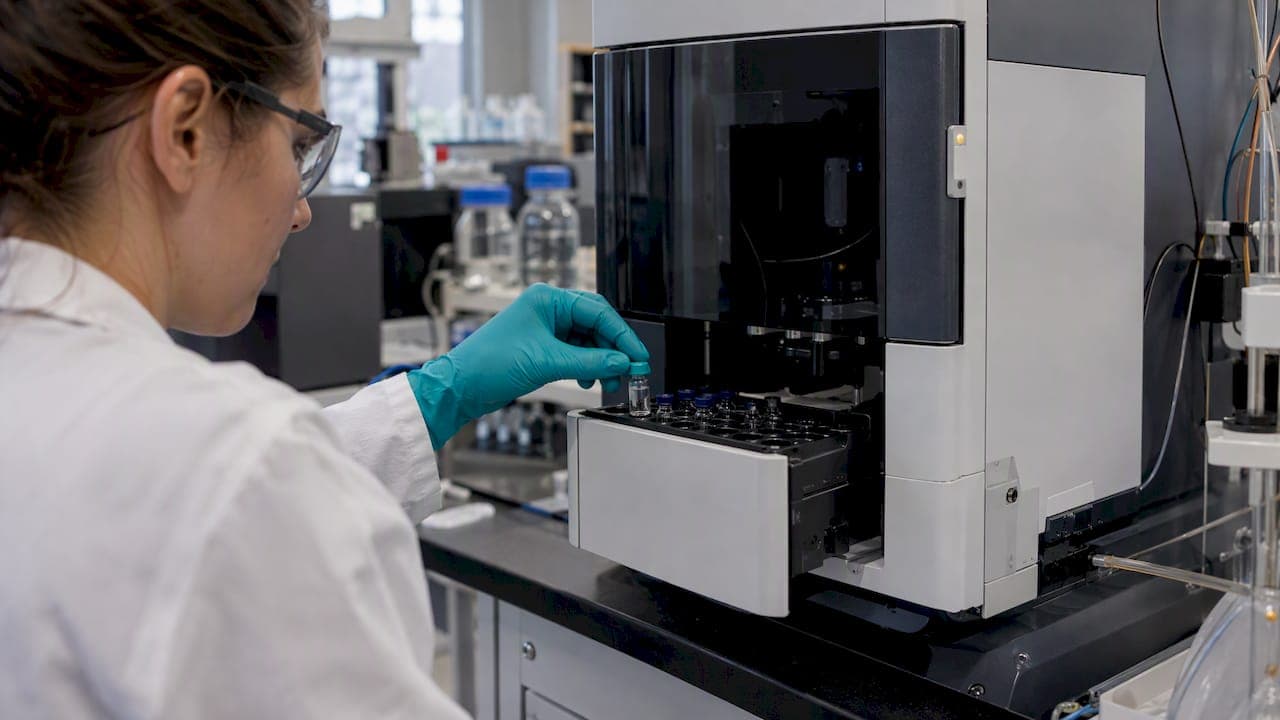
Peptide impurity profiling identifies, characterizes, and quantifies the impurities associated with a peptide drug substance. The standard workflow pairs chromatographic separation with high-resolution mass spectrometry (LC-HRMS) for identification, then confirms findings with at least one orthogonal technique such as NMR, chiral analysis, or ICP-MS. Method choice should follow a phase-appropriate, risk-based approach that holds up against TGA and ICH expectations.
TL;DR:
- Use extracted ion chromatograms or targeted mass transitions when coelution defeats UV, and switch from reversed phase to HILIC for unresolved polar or cyclic peptides.
- Use chiral analysis for diastereomers that share the target’s mass, and ICP MS for elemental residues from catalysts or reagents.
- Use impurity reference standards for calibration when available; otherwise disclose the relative response factor assumption and label the resulting quantity as an estimate.
- Glucagon methods reported detection limits of 0.01% to 0.02%, quantitation limits of 0.02% to 0.04%, R squared above 0.99, and relative standard deviation below 10%.
- Unique impurities at roughly 0.1% to 0.5% warrant immunogenicity evaluation; development stage, dose, and risk guide thresholds because small molecule limits do not translate directly.
Table of Contents
- 1. Which impurity types shape peptide impurity profiling?
- 2. How do the core analytical techniques compare?
- 3. How do you quantify impurities and validate the method?
- 4. What does the regulatory framework expect from a risk-based strategy?
- 5. What should you plan for in the lab, and what goes in the report?
- 6. What does the evidence say about validation targets?
- 7. What do case studies teach about profiling challenges and troubleshooting?
- 8. How do you control impurities during synthesis optimization?
- 9. How do you monitor impurity evolution during storage?
- 10. How do impurity profiles affect downstream biological assays?
- 11. Where does a pragmatic lab begin?
- 12. How do our batch documents support your method development?
- FAQ
- Sources
1. Which impurity types shape peptide impurity profiling?
Each impurity class calls for a different analytical response, so classify before you choose a method.
- Process-related impurities: truncated or deletion sequences, incomplete deprotection products, and coupling side products from synthesis.
- Product-related impurities: deamidation, oxidation, and other modifications that arise after synthesis.
- Diastereomeric impurities: racemized residues that share the exact mass of the target and often coelute, so mass spectrometry alone cannot flag them.
- Degradants: products of storage or stress, which follow different pathways than synthetic by-products and tend to grow over time.
- Elemental impurities: catalyst or reagent residues that require ICP-MS rather than chromatography.
Profiling matters beyond purity. Generic peptide submissions require evaluation of any unique impurity present at roughly 0.1% to 0.5% for immunogenic risk, because a small sequence change can create a new immune-relevant epitope.
2. How do the core analytical techniques compare?
No single method covers every impurity class. The practical question is what each technique resolves well and where it fails.
- RP-HPLC: the routine separation workhorse for many peptides. Long, complex, or highly polar peptides often produce coeluting impurities that RP-HPLC cannot resolve.
- HILIC and polymeric HILIC: an alternative selectivity for polar or cyclic peptides, useful when reversed-phase leaves peaks merged.
- LC-HRMS and MS/MS: the identification engine. LC-HRMS is effective for characterizing impurities that RP-HPLC fails to separate, and MS/MS sequencing confirms where a modification sits. Absolute quantitation by HRMS needs a validated strategy.
- MS quantitation modes: full-scan extracted ion chromatograms (EIC) give broad coverage, while pseudo-MRM (p-MRM) trades coverage for targeted sensitivity. Both are validated in the glucagon case study discussed below.
- NMR and chiral amino acid analysis: structural confirmation and diastereomer control. Hydrolysis with deuterated acid followed by GC-MS is a typical route for diastereomeric impurity management.
- ICP-MS: the preferred technique for trace elements, with sensitivity and dynamic range suited to USP <232>/<233> limits.
The recommended sequence is separation, then HRMS identification, then orthogonal confirmation as the impurity type demands.
Pro Tip: When a peak looks pure by UV but the mass spectrum shows a shoulder at the target mass, suspect a diastereomer and move to chiral analysis before you declare the batch clean.
3. How do you quantify impurities and validate the method?
Identification tells you what is present. Quantitation tells you how much, and it is where regulatory defensibility is won or lost.
A glucagon case study developed UPLC-HRMS full-scan and p-MRM methods and reported the following benchmarks:
Report these validation parameters for any impurity method:
- Specificity against the main peptide and known impurities
- Linearity range
- LOD and LOQ
- Intra-day and inter-day precision
- Accuracy and recovery
- System suitability criteria
TGA guidance treats pharmacopoeial methods as starting points: any modification must be validated, with specificity, linearity, LOD/LOQ and precision documented for suitability. Calibrate with impurity reference standards where you can obtain them. Where you cannot, state the assumption behind any relative response factor and flag the result as an estimate.
4. What does the regulatory framework expect from a risk-based strategy?
TGA Guidance 18 covers impurities in drug substances and products, includes notes on synthetic peptides and qualification data, and aligns with ICH principles for impurity control. Standard ICH Q3A/B limits for small molecules do not translate directly to peptides, since sequence changes can introduce new HLA-binding regions.
In practice this means:
- Early development: concentrate on process control and characterization of what the synthesis produces.
- Later development: add toxicological and immunogenicity assessment, driven by sound toxicological principles rather than fixed percentage rules.
- Qualification: document your thresholds, and supply comparative or toxicological data when an impurity exceeds them. A phase-appropriate risk assessment weighs development stage, dose, and immunogenic potential.
Global guidance on fixed acceptable peptide impurity levels remains limited, so your written rationale carries real weight.
5. What should you plan for in the lab, and what goes in the report?
Sample preparation decides data quality. Watch for matrix effects, and desalt or concentrate when signal is weak. HRMS needs far less material than NMR, so plan NMR sample amounts early.
Timelines differ by task. Identification work usually finishes sooner. Validated quantitation and orthogonal assays take longer, and outsourced ICP-MS or NMR adds scheduling time. Cost drivers include instrument time, impurity reference standard synthesis or purchase, and outsourced orthogonal testing.
A robust report or certificate of analysis contains:
- Identity confirmation of the main peptide
- An impurity list with percentages and LOD/LOQ
- Method references
- A validation summary
- Batch documentation
Pro Tip: Record the exact column, gradient, and mass spectrometer settings in the report. Reviewers cannot trust a result they cannot reproduce.
6. What does the evidence say about validation targets?
Published work gives you concrete targets to aim for.
The glucagon study reported LODs of 0.01%–0.02%, LOQs of 0.02%–0.04%, R2 above 0.99, RSD below 10%, and recoveries of 100%–120%.

Quality-control literature on synthetic peptide impurity profiling documents established workflows and common analytical pitfalls. The takeaway: set validation targets comparable to published case studies, use LC-HRMS for identification, and document orthogonal confirmation whenever a novel impurity appears.
7. What do case studies teach about profiling challenges and troubleshooting?
Recurring failures show up in the literature.
The first is coelution. In the glucagon work, impurities sharing retention time with the main peak defeated UV-based quantitation. The fix was extracted ion chromatograms and p-MRM transitions, which separate species by mass instead of retention time. If your impurity is invisible by UV, change the detection principle, not just the gradient.
The second is the invisible diastereomer. Diastereomeric impurities can be managed with reference standards and chiral amino acid analysis rather than mass alone. When an impurity matches the parent mass and retention, ask whether stereochemistry is the difference.
Practical troubleshooting steps:
- Change selectivity, for example from RP-HPLC to HILIC, before lengthening gradients.
- Confirm suspected modification sites with MS/MS rather than inferring from mass shifts.
- Run a standard of the suspected impurity to prove specificity.
- Revisit sample preparation when recovery falls outside your acceptance range.
8. How do you control impurities during synthesis optimization?
Analysis reports impurities, but process design determines them. Profile each synthesis batch and trace every recurring impurity back to a step.
- Coupling efficiency: difficult residues often produce deletion sequences. Double coupling or alternative activation at those positions reduces them.
- Protecting groups and cleavage: incomplete deprotection and cleavage side reactions generate modified species. Optimize cleavage cocktails and times, and use scavengers appropriate to the sequence.
- Racemization: control base, temperature, and activation conditions at residues prone to epimerization, then verify with chiral analysis.
- Purification: adjust the preparative gradient using the impurity map from your analytical method, so you cut fractions where the critical impurities elute.
- Raw materials: qualify amino acid derivatives and reagents, since their impurities carry into the product.
Early in development, this feedback loop between analytics and chemistry is the core of a risk-based strategy. Process knowledge reduces what you must later qualify toxicologically.
9. How do you monitor impurity evolution during storage?
Stability work asks a different question: not what the batch contains today, but what it will contain over its shelf life.
Run a stability-indicating method, meaning one validated to separate and detect degradants. Forced degradation under heat, light, oxidative, and pH stress shows which pathways matter for your sequence before real-time data exist. Oxidation of methionine and tryptophan, deamidation of asparagine, and aggregation are common signals to watch.
Good practice includes:
- Testing at defined timepoints under both long-term and accelerated conditions
- Trending each identified impurity, not only total impurities
- Using the same validated method across timepoints so results compare directly
- Controlling container, headspace, moisture, and temperature, and documenting them
- Reporting new peaks that appear over time, then identifying them by LC-HRMS and MS/MS
GMP expectations under the PIC/S guide require that controls be validated to the standard applied to authorised medicinal products.
10. How do impurity profiles affect downstream biological assays?
An impurity that is analytically minor can be biologically loud. A truncated or modified peptide may bind the same receptor with different affinity, act as an antagonist, or interfere with signaling. A potent co-eluting impurity can inflate apparent activity, while an inactive one lowers effective concentration below what the label suggests.
Consequences for interpretation:
- Dose-response curves from impure material can shift potency estimates, and results will not reproduce across batches with different profiles.
- Cell-based assays may react to impurities that are not the peptide, for example residual reagents or elemental contaminants.
- Immunogenicity readouts depend on unique impurities, which is why the regulatory focus sits at roughly 0.1% to 0.5%.
Practical advice: record the batch impurity profile alongside every assay, repeat key experiments with a second batch, and report purity method and value in publications. Quantity of peptide weighed is not quantity of active peptide, so correct for peptide content and purity before calculating concentrations.
11. Where does a pragmatic lab begin?
Match investment to development stage. Early on, a well-run RP-HPLC method with LC-HRMS identification gives you most of the decision-making value. Add chiral analysis and ICP-MS when the sequence or process puts diastereomers or elemental residues in play, and add immunogenicity orthogonal assays as you approach later-stage work.
Clear batch documentation reduces uncertainty at every stage. When a supplier provides a certificate of analysis with method references, you can compare it against your own results and catch method problems early. Treat any peptide material without traceable documentation as unqualified until you have profiled it yourself.
— Tintastic
12. How do our batch documents support your method development?
We supply independently tested research-grade peptides with batch documentation and Certificates of Analysis on request. High-purity material with traceable documentation helps you check recovery, calibration, and specificity when you build a method. Request a certificate of analysis for your validation work from our product catalogue.
This article is general information, not a substitute for advice from a qualified doctor. Consult a qualified healthcare professional about your own circumstances before acting on anything here.
FAQ
How do you do impurity profiling on a peptide?
Separate the sample by chromatography, identify impurities by LC-HRMS and MS/MS, then quantify and confirm with validated and orthogonal methods. Match each technique to the impurity class, whether synthetic, degradation, stereochemical, or elemental.
How can I test the purity of my peptides?
RP-HPLC is the routine starting point, and LC-HRMS confirms identity and flags coeluting impurities that UV cannot resolve. Add chiral analysis for diastereomers and ICP-MS for elemental impurities.
What do ICH guidelines say about impurity profiling for peptides?
ICH Q3A/B principles inform impurity control, but they were written for small molecules and do not apply directly to synthetic peptides. A phase-appropriate, risk-based approach with immunogenicity assessment is generally needed.
What purity level is acceptable for peptides?
No single fixed value applies globally. Acceptable levels depend on development phase, dose, and immunogenic risk, and unique impurities in the 0.1% to 0.5% range warrant evaluation.
Sources
- Immunogenicity of Generic Peptide Impurities: Current Orthogonal Approaches | Pharmaceutical Research | Springer Nature Link
- Guidance 18: Impurities in drug substances and drug products
- Absolute Quantitation of Coeluting Impurities in Peptide Drugs Using High Resolution Mass Spectrometry: Glucagon a Case Study in Pharmaceutical Development | Journal of the American Society for Mass Spectrometry
- AN000734: Analysis of elemental impurities in pharmaceutical products in accordance with USP General Chapters <232> and <233