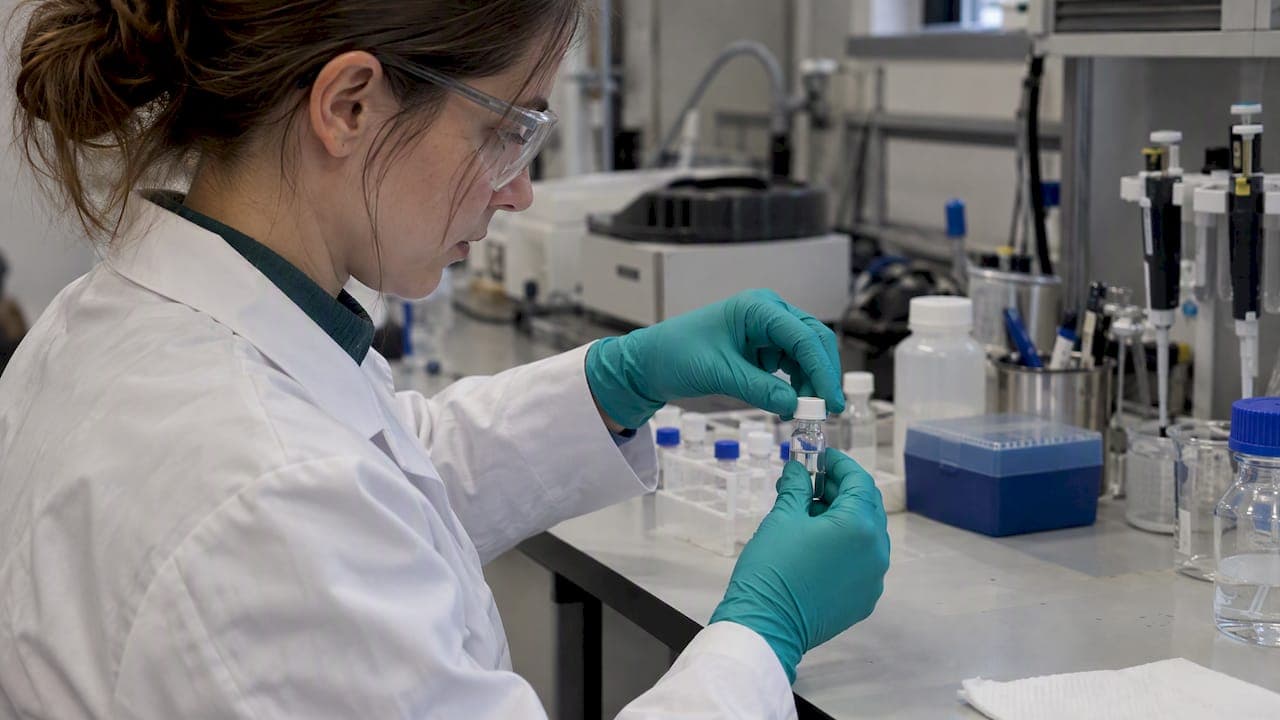
Control peptide oxidation by combining oxygen exclusion, low-temperature storage, light protection, careful buffer choice, and validated stability-indicating analytics. Pair those controls with stability testing and a Certificate of Analysis (COA) review so you can verify what is in the vial, not assume it. A checklist and a short SOP template follow at the end of this guide.
TL;DR:
- Store long term stocks lyophilized; divide each new lot into single use aliquots under inert gas, and shield them from heat, moisture, oxygen, and light.
- Choose solvent and pH for the peptide sequence; acidic conditions can reduce reactivity, but EDTA, bisulfite, and ascorbic acid require validation for each peptide.
- Do not rely on activity assays alone: pair RP HPLC with mass spectrometry, and target roughly 10% to 30% degradation in forced stress studies.
- Review each lot’s COA against incoming identity and purity results, requesting LC MS or peptide mapping for batches rich in Met, Cys, or Trp.
Table of Contents
- Why does peptide oxidation happen, and why can activity assays miss it?
- How should you store peptides to limit oxidation?
- How do you reconstitute peptides with the lowest oxidation risk?
- How should you handle, ship and thaw peptides?
- Which assays reveal oxidation, and how do you design a stress test?
- What should you require from suppliers and check on receipt?
- What does a copy-ready checklist and SOP look like?
- Why does this workflow matter for reproducible results?
- How do we support oxidation control for your lab?
- FAQ
- Sources
Why does peptide oxidation happen, and why can activity assays miss it?
Oxidation targets electron-rich side chains. Reviews of peptide formulation identify methionine and cysteine as the most vulnerable residues, with the aromatic residues His, Trp and Tyr close behind. Typical triggers and signatures:
- Met: oxidizes to the sulfoxide (+16 Da) and, under harsher conditions, the sulfone (+32 Da).
- Cys: is among the residues susceptible to oxidation.
- Trp, Tyr, His: susceptible to photo-oxidation and metal-catalyzed reactions; Tyr and Trp can also form oxidative crosslinks such as di-Tyr and di-Trp products.
- Retention shifts: oxidized Met can move a peptide on RP-HPLC in either direction, because the effect on hydrophobicity depends on sequence context and residue position.
Mechanisms include direct reaction with oxygen, photo-oxidation, and metal-catalyzed Fenton-type chemistry driven by trace iron or copper. Contaminating oxidants, pH, buffer composition and deprotonation state all modulate the rate.
Regulatory position: ICH Q5C states that activity assays alone are insufficient for stability monitoring. Oxidized species can retain, lose or alter activity, so physicochemical characterization is required.
A bioassay that still passes tells you little about heterogeneity. Long-term storage studies of an oxidized protein found mixed species at +16, +32 and +48 Da, a mixture an activity readout would not resolve.
How should you store peptides to limit oxidation?
Store peptides lyophilized whenever the workflow allows. Solid form restricts molecular mobility and dissolved oxygen, which is why we recommend lyophilized material for anything held beyond a working window.
- Package for low oxygen. Use tightly sealed vials with minimal headspace, a desiccant in sealed secondary packaging, and no repeated opening of the primary container.
- Set the temperature by duration. Keep long-term stock in a freezer, short-term working material in a refrigerator, and avoid holding solutions at room temperature.
- Exclude oxygen. Overlay with argon or nitrogen after each opening, vacuum seal where practical, and use oxygen scavengers only where validated for your peptide.
- Block light. Use amber vials or foil wrapping, and cut bench light exposure during weighing and transfer.
- Plan for climate. ICH Q1A(R2) and WHO Annex 10 recommend stress conditions including heat, humidity, light and oxidation, and zone IV regions (high heat and humidity) change long-term storage requirements. A lab in a humid climate should treat packaging integrity as part of the stability plan, not an afterthought.
- Record it. Log opening dates, headspace gas, and storage location for every vial.
Pro Tip: Split a new lot into single-use lyophilized aliquots under inert gas before the first freezer entry, so no vial is opened more than once.
How do you reconstitute peptides with the lowest oxidation risk?
Choose solvent and buffer from the sequence, not from habit. Acidic pH generally lowers the reactivity of Cys, Tyr and His, though each sequence needs its own check. Then remove the oxygen you can control.
- Degas solvents and sparge with argon or nitrogen before dissolving. Transfer under inert gas where the sequence is Met- or Cys-rich.
- Use chelators with care. EDTA suppresses metal catalysis, but formulation reviews note it can change oxidation selectivity in some systems, so confirm the effect on your peptide.
- Treat antioxidants as variables. Bisulfite and ascorbic acid can worsen certain oxidations. Test any additive against an untreated control rather than adding it by default.
- Limit time in solution. Make working stocks fresh, keep them cold and dark, and discard leftovers instead of refreezing.
- Match concentration to use. Prepare only what the experiment day needs; concentrated stocks held for weeks are the usual source of drift.
Pro Tip: Dissolve in a small volume of degassed acidic solvent first, then dilute into assay buffer immediately before use, so the peptide spends minimal time at neutral pH.
How should you handle, ship and thaw peptides?
Repeated freeze–thaw cycles expose a peptide to fresh dissolved oxygen, concentration gradients and temperature excursions each time. The fix is structural: aliquot once, thaw once.
- Aliquot by experiment. Size aliquots to a single use so no tube is thawed twice.
- Ship on a validated cold chain. Choose dry ice or cold packs according to the transit time and the sensitivity of the sequence, use validated packaging, and include a temperature logger so excursions are documented, not guessed.
- Cut bench dwell time. Keep tubes on ice, return stock to storage promptly, and work out of direct light.
- Pick contact materials deliberately. Use low-binding plastics or glass as appropriate to the peptide, and keep metal spatulas and needles out of the sample path to avoid trace metal contamination.
- Check after thawing. Inspect for turbidity or color change, then run a short LC spot-check against the receipt chromatogram before committing material to an assay.
Which assays reveal oxidation, and how do you design a stress test?
No single readout covers the problem. Combine methods and read them together.
- RP-HPLC: resolves oxidized isoforms by retention shift and quantifies purity trends across time points.
- LC-MS/MS and HRMS: confirm identity and detect +16 and +32 Da shifts.
- Peptide mapping: localizes oxidation to specific residues, which tells you which handling step to fix.
- Reduction for disulfides: a terlipressin study needed DTT reduction combined with UHPLC-HRMS/MS to characterize eleven degradation products in a disulfide-containing peptide, so build reduction into sample prep for those sequences.
For forced degradation, vary temperature, humidity, light and oxidant exposure, and justify each level. Both WHO Annex 10 and ICH Q1A(R2) describe stress testing that targets partial degradation to identify primary products and validate the method. If you see no degradation, document why the conditions were adequate.
Target range: Stress studies aim for roughly 10–30% degradation to identify degradation pathways without creating extensive secondary products.
Validate the method as stability-indicating under ICH Q2 and Q14 principles. The common pitfall is trusting a clean activity result next to a chromatogram with a new shoulder peak.
What should you require from suppliers and check on receipt?
Oxidation control starts before the vial reaches your bench. A COA tells you the state of the batch at release, and the GMP expectation is that specifications include impurity control and a defined impurity profile.
- Request a full COA: HPLC purity, mass spec identity, impurity and degradation profile, and batch documentation.
- Ask for batch-specific guidance: recommended storage, handling and reconstitution notes.
- Run incoming QC: confirm identity, then a quick LC purity check, escalating to LC-MS or peptide mapping for Met-, Cys- or Trp-rich sequences.
- Compare against the COA: a new peak at +16 Da that the COA did not show points to transit or storage damage.
- Seek independent verification when stakes are high. The TGA notes that a "Research Use Only" disclaimer does not replace independent assessment, and third-party HPLC and mass spec data narrow uncertainty about trace catalysts and impurities.
For a worked example of supplier-side COA and storage practice on a single peptide, see this GHK-Cu COA and storage guide.
What does a copy-ready checklist and SOP look like?
Use this sequence as the skeleton of your lab procedure:
- Receive: inspect packaging, review the COA, log lot and arrival temperature.
- Store: lyophilized, cold, dark, inert headspace, desiccated.
- Reconstitute: degassed solvent, chosen pH, additives only if validated.
- Aliquot: single-use volumes, label with date and lot.
- Verify: LC check at receipt and after thaw, plus LC-MS for higher-risk batches.
- Document: record deviations and results against the COA.
| Control point | Minimum action | Frequency |
|---|---|---|
| Receipt | COA review and LC identity and purity check | Every lot |
| Storage | Cold, dark, inert, desiccated | Continuous |
| Reconstitution | Degassed solvent, fresh stock | Every preparation |
| Post-thaw | Visual inspection and LC spot-check | Every thawed aliquot |
| Higher-risk lots | LC-MS or peptide mapping | Every lot |
SOP roles: the bench researcher executes steps 1 to 4, the QC lead owns step 5 acceptance criteria, and the lab manager reviews documentation.
Why does this workflow matter for reproducible results?
Oxidation is a silent variable. An unrecorded +16 Da species can shift a dose-response curve and cost weeks of repeat experiments, and the cure is cheap by comparison: controlled storage, fresh stocks and a chromatogram you trust. Activity data earns its credibility only when HPLC and LC-MS confirm what was actually in the tube.
— Tintastic
How do we support oxidation control for your lab?
We supply independently tested research peptides with batch documentation:
- HPLC and mass spec verification on each batch.
- Certificates of Analysis available on request, with traceable batch documentation.
- Clear identity and purity data.
Browse the Peptastic Labs catalogue to source verified peptides across our metabolic, cognitive, tissue repair, longevity and cosmetic science lines, then request the COA for your lot.
FAQ
What does it mean to oxidize proteins?
Protein oxidation is the addition of oxygen or loss of electrons at susceptible side chains, most often Met and Cys, and also Trp, Tyr and His. It changes mass, hydrophobicity and sometimes function. Reviews identify sulfur-containing and aromatic residues as the main targets.
Which peptides are antioxidants?
Whether a peptide acts as an antioxidant depends on its sequence and conditions. Met, Cys, Trp and Tyr are among the residues susceptible to oxidation, so consider oxidation control during storage and handling.
How do I maintain peptides?
Store them lyophilized, cold, dark and under inert gas, aliquot into single-use volumes, and reconstitute with degassed, appropriately buffered solvent. Verify with an LC check at receipt and after thawing, and keep solution time short.
What breaks down peptide bonds?
Peptide bonds can break down through pathways such as hydrolysis, while oxidation can modify side chains. Stress testing can help investigate both. Stress testing under ICH and WHO guidance exposes both pathways.
Sources
- Database
- QUALITY OF BIOTECHNOLOGICAL PRODUCTS:
- Understanding the chemical stability of peptidomimetic therapeutics using high-resolution mass spectrometry: a study of terlipressin and its degradation products - PubMed
- Designing Formulation Strategies for Enhanced Stability of Therapeutic Peptides in Aqueous Solutions: A Review
- Chromatographic behavior of peptides containing oxidized methionine residues in proteomic LC-MS experiments: Complex tale of a simple modification - PubMed