
Peptides are defined as short chains of amino acids, typically 2–50 residues long, that function as signaling molecules and protein-building blocks throughout the body. Understanding peptide types is foundational for anyone working in health research, fitness science, or clinical application. The field spans FDA-approved therapies like semaglutide and tirzepatide, tissue repair compounds like BPC-157, and emerging nootropic agents still in early-stage trials. Peptide classifications and applications vary widely by structure, mechanism, and evidence level. This guide cuts through the noise and delivers a clear, evidence-graded map of the major categories.
How are peptides classified by type and function?
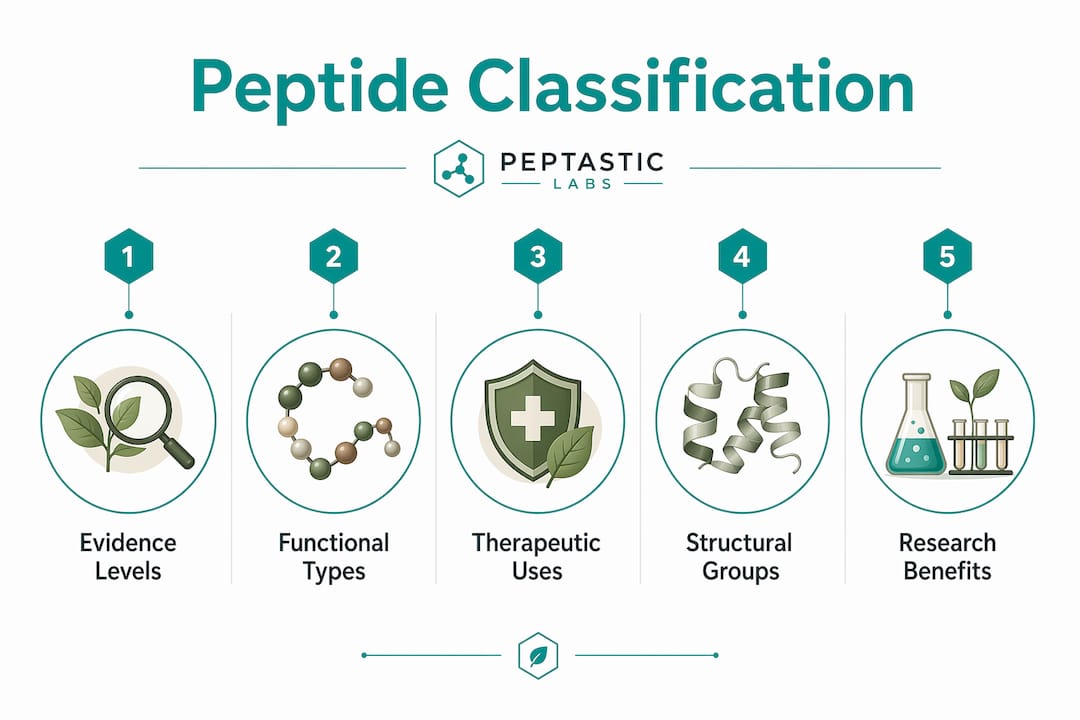
The Peptide Association proposes a 12-category functional classification system with graded evidence levels, ranging from strong evidence (FDA-approved compounds) to emerging evidence (early human data or mechanistic rationale only). This taxonomy matters because treating all peptides as equivalent is a common and consequential error. A GLP-1 receptor agonist with a decade of clinical trial data is not in the same category as a mitochondrial peptide with two rodent studies behind it.
Structural classification groups peptides by length and amino acid composition. Functional classification, the more useful framework for researchers, groups them by biological target and mechanism. The table below maps the major functional categories to their evidence level and representative compounds.

| Category | Evidence level | Representative compounds | Primary use |
|---|---|---|---|
| GLP-1 receptor agonists | Strong (FDA-approved) | Semaglutide, tirzepatide, liraglutide | Diabetes, obesity |
| Growth hormone secretagogues | Moderate to strong | Sermorelin, ipamorelin | GH modulation, body composition |
| Tissue repair peptides | Emerging to moderate | BPC-157, TB-500, GHK-Cu | Wound healing, recovery |
| Nootropic/neuroprotective | Emerging | Selank, semax | Cognitive research |
| Antimicrobial peptides | Moderate | Defensins, LL-37 | Infection defense research |
| Cosmetic peptides | Moderate | Argireline, Matrixyl | Skin aging, collagen synthesis |
| Metabolic/mitochondrial | Emerging | MOTS-c, SS-31 | Metabolic regulation research |
Researchers benefit from applying this graded framework before designing protocols. The Peptide Association's classification system makes clear that confidence in a compound should scale with the quality and volume of human data behind it.
What are the main therapeutic and scientific uses of peptides?
Peptide applications span medicine, fitness, cosmetics, and basic science. The breadth is real, but so is the variation in evidence quality across those domains.
Therapeutic peptides in medicine
GLP-1 receptor agonists have strong evidence and well-established prescribing guidelines for obesity and diabetes. Semaglutide, tirzepatide, liraglutide, and exenatide are all FDA-approved drugs in this class. That approval status means manufacturing standards, safety monitoring, and dosing protocols are formally established. Medical experts note that peptide therapy doses are significantly higher than natural endogenous production, which changes the risk-benefit profile considerably.
Growth hormone secretagogues like sermorelin and ipamorelin stimulate the pituitary to release growth hormone rather than introducing exogenous GH directly. This mechanism is considered more physiologically controlled than direct GH administration. Tesamorelin holds FDA approval for HIV-associated lipodystrophy, placing it in the moderate-to-strong evidence tier.
Tissue repair and wound healing
BPC-157 shows promise in animal and preclinical models for tissue repair, with research suggesting benefits for gastrointestinal lining protection and wound healing. Large human trials are not yet available. TB-500 (a synthetic fragment of thymosin beta-4) and GHK-Cu (a copper-binding tripeptide) follow a similar pattern: strong preclinical signals, limited human data.
Nootropic and cosmetic applications
Nootropic peptides like selank and semax are administered intranasally in research settings to study CNS delivery and cognitive effects. Peptides can be administered via injection, oral, topical, or intranasal routes, with each route affecting bioavailability and convenience differently. Cosmetic peptides such as Argireline and Matrixyl are applied topically and have moderate evidence supporting collagen synthesis and reduction of fine lines.
- GLP-1 agonists: FDA-approved, strong evidence, established dosing protocols
- Growth hormone secretagogues: moderate to strong evidence, physiologically controlled mechanism
- Tissue repair compounds (BPC-157, TB-500, GHK-Cu): emerging evidence, preclinical data only
- Nootropic peptides (selank, semax): early-stage human data, intranasal delivery studied
- Cosmetic peptides (Argireline, Matrixyl): moderate evidence, topical application
Pro Tip: Always verify the regulatory status of a peptide before including it in a research protocol. FDA approval signals manufacturing oversight and safety data. Compounds without approval require additional scrutiny of sourcing and purity documentation.
How do you safely select and handle peptides for research?
Sourcing quality is the single most controllable variable in peptide research. The grey market for peptides lacks regulatory oversight and frequently sells products without verified purity or safety documentation. In-house testing by the vendor alone is insufficient. A third-party Certificate of Analysis (CoA) from an independent laboratory is the minimum standard for trustworthy sourcing.
Storage and stability requirements
Peptides are sensitive to degradation by temperature, light, and oxidation. Lyophilized (freeze-dried) peptides require refrigeration and protection from light to maintain potency. Once reconstituted, stability drops significantly, typically to a window of weeks rather than months. Researchers must track reconstitution dates and discard expired solutions.
| Handling factor | Best practice | Risk if ignored |
|---|---|---|
| Storage state | Keep lyophilized until use | Premature degradation |
| Temperature | Refrigerate; avoid freeze-thaw cycles | Loss of potency |
| Light exposure | Store in amber or opaque vials | Oxidative breakdown |
| Reconstitution | Use bacteriostatic water; log date | Contamination, expired use |
| Sourcing | Require third-party CoA | Unknown purity, safety risk |
| Regulatory check | Verify FDA or compounding status | Legal and safety exposure |
Synthetic peptides are designed for enhanced stability and potency compared to natural peptides, but they still require precise handling protocols. The enhanced potency also means dosing errors carry greater consequence.
Pro Tip: Consult a peptide-literate physician or clinical researcher before establishing any dosing protocol. Regulatory status of peptides changes frequently as compounding pharmacy guidelines evolve. A compound legal for research use today may be reclassified within months.
What are the emerging trends and challenges in peptide research?
Many popular peptides lack high-level human clinical data and remain in "emerging evidence" categories. Experts consistently urge differentiation between FDA-approved compounds and those supported only by anecdotal reports or early-stage animal studies. This distinction is not academic. It determines whether a compound has established safety margins, known side effect profiles, and reproducible dosing data.
Current challenges in the field include:
- Dose standardization: No consensus protocols exist for most non-approved peptides. Researchers often work from animal-derived dose extrapolations.
- Regulatory flux: The FDA periodically reclassifies peptides, particularly those compounded by pharmacies. Compounds available in 2024 may face new restrictions by 2026.
- Evidence inflation: Marketing claims frequently outpace published data. Mitochondrial peptides like MOTS-c and SS-31 show mechanistic promise but have limited human trial data.
- Emerging classes: Sleep and circadian peptides, immunomodulatory compounds, and longevity-focused sequences are entering early clinical trials. Their evidence base is thin but growing.
- Bioavailability gaps: Oral peptide delivery remains technically difficult. Most research-grade compounds require injection or intranasal administration to achieve meaningful systemic exposure.
The regulatory status of peptides changes frequently as compounding pharmacy guidelines evolve. Researchers who treat the regulatory environment as static will encounter sourcing and compliance problems. Staying current with FDA guidance is a non-negotiable part of responsible peptide research.
Key Takeaways
Peptide classification by evidence level is the most critical framework for researchers, because FDA-approved compounds and emerging preclinical agents carry fundamentally different risk and reliability profiles.
| Point | Details |
|---|---|
| Evidence grading is non-negotiable | Apply the Peptide Association's 12-category system to assess confidence before any protocol. |
| FDA approval defines the gold standard | GLP-1 agonists like semaglutide have established safety data; most other peptides do not. |
| Storage determines potency | Lyophilized peptides need refrigeration and light protection; reconstituted peptides expire within weeks. |
| Third-party CoA is the sourcing minimum | Vendor-only testing is insufficient; require independent laboratory verification for every batch. |
| Regulatory status changes | Compounding pharmacy rules evolve; verify legal status of any peptide before research use. |
What researchers consistently get wrong about peptides
The most common mistake is treating peptide research as a binary: either a compound works or it does not. The actual question is always "works at what dose, in what model, with what endpoint?" Researchers who skip that framing end up citing rodent data as if it were human clinical evidence.
The second mistake is conflating bioavailability with efficacy. A peptide that survives oral delivery does not automatically produce the same effect as one administered by injection. Route of administration changes the pharmacokinetic profile entirely, and protocols built on mismatched delivery assumptions produce unreliable results.
The third mistake, and the one with the most practical consequence, is sourcing from unverified suppliers. Purity matters more in peptide research than in almost any other compound class, because impurities at the microgram level can confound results or introduce safety variables. Researchers who cut costs on sourcing end up spending more time troubleshooting anomalous data.
The responsible path is straightforward: use the evidence grading framework, verify sourcing documentation, and treat regulatory status as a live variable rather than a fixed fact. Peptides are genuinely useful research tools. They are not shortcuts, and they are not interchangeable.
— Tintastic
Peptasticlabs: research-grade peptides with full documentation
Peptasticlabs supplies over 22 independently tested compounds, each verified to ≥99% purity via HPLC and supported by third-party Certificates of Analysis. Researchers working with tissue repair compounds can access BPC-157 and sermorelin with full batch documentation. The Peptasticlabs catalog covers metabolic, cognitive, longevity, and cosmetic peptide categories. Every compound ships with traceable quality records, removing the sourcing uncertainty that compromises research integrity. For researchers who need verified compounds without the guesswork of grey-market sourcing, Peptasticlabs provides the documentation standard the field requires.
FAQ
What is the difference between FDA-approved and research peptides?
FDA-approved peptides like semaglutide have completed clinical trials, established dosing protocols, and manufacturing oversight. Research peptides lack this approval and are supported only by preclinical or early-stage human data.
How should lyophilized peptides be stored?
Lyophilized peptides require refrigeration and protection from light and oxidation. Once reconstituted, stability drops to a window of weeks, so researchers must log reconstitution dates and discard expired solutions.
What does a Certificate of Analysis confirm?
A Certificate of Analysis from an independent laboratory confirms compound identity, purity level, and absence of contaminants. Vendor-only testing does not meet the same standard of independence.
Are peptides safe for human use?
Safety depends entirely on the specific compound and its evidence base. FDA-approved peptides have established safety profiles. Non-approved peptides carry unknown risk margins and require physician oversight and verified sourcing before any human application.
What are growth hormone secretagogues?
Growth hormone secretagogues are peptides that stimulate the pituitary gland to release growth hormone naturally. Sermorelin and ipamorelin are the most studied compounds in this category, with moderate to strong evidence supporting their use in research contexts.