
Low-quality peptide products are defined by absent or falsified analytical documentation, incorrect molecular identity, and contamination levels that compromise both safety and research validity. Knowing how to spot low-quality peptide products before purchase protects your research outcomes and, in injectable applications, your physical safety. The industry standard for research-grade peptides requires HPLC purity of ≥98%, mass spectrometry identity confirmation, and endotoxin testing below 5 EU/mg. These are not optional benchmarks. They are the minimum documentation any legitimate supplier should provide, and their absence is the clearest signal of an inferior product.
What documentation and testing should you expect to verify peptide quality?
A Certificate of Analysis (COA) is the primary document for assessing peptide quality. It must contain three core analytical components: HPLC purity data, mass spectrometry identity confirmation, and endotoxin test results. Standard quality benchmarks require HPLC purity of ≥98%, identity confirmation by mass spectrometry, and endotoxin levels below 5 EU/mg for injectable peptides. A COA missing any of these three elements describes an unverified product.
The lab that issues the COA matters as much as the data itself. COAs from ISO-17025 accredited labs such as Janoshik Analytical, Anresco, Vanguard, and RIANI Labs carry recognized credibility in the peptide research market. ISO-17025 accreditation means the lab operates under internationally audited quality management standards. A COA from an unaccredited or unnamed lab provides no verifiable assurance.

Batch-specific COAs are non-negotiable. A single COA applied to multiple product batches is a red flag. Each batch has its own synthesis run, and analytical results legitimately vary between runs. The COA must reference the specific lot number on your vial.
Detecting fabricated COAs requires attention to detail. Watch for these specific warning signs:
- Identical purity values across all batches. Perfectly identical purity percentages across products, such as exactly 99.0% every time, indicate fabricated data. Authentic batches show minor variation.
- Flawless chromatograms. Real HPLC chromatograms contain minor baseline noise. A perfectly smooth trace is a fabrication signal.
- No chromatogram attached. A purity percentage without the underlying chromatogram cannot be verified.
- Rounded or suspiciously clean numbers. Legitimate analytical results rarely land on perfectly round figures.
- No QR code or verifiable link. Legitimate vendors provide QR codes linking COAs directly to independent lab databases. The absence of this feature removes a key authentication layer.
- Terms like "pharmaceutical grade" without documentation. This term is unregulated in the peptide market and functions as marketing language, not a quality standard.
Pro Tip: Request the COA before placing any order. A vendor who cannot or will not provide a batch-specific COA from a named, accredited lab should not receive your business.
For a thorough breakdown of what each COA field means and how to read chromatogram data, the 2026 COA guide from Peptasticlabs covers the full verification process.
How can physical inspection and pricing help detect inferior peptides?
Physical characteristics provide a fast, pre-purchase filter for low-grade peptide product signs. Lyophilized (freeze-dried) peptides should appear as a uniform white or off-white cake inside the vial. Discoloration, clumping, or a wet or oily appearance suggests degradation or improper lyophilization. Vial fill volume should be consistent across units from the same batch. Inconsistent fill levels indicate poor manufacturing controls.
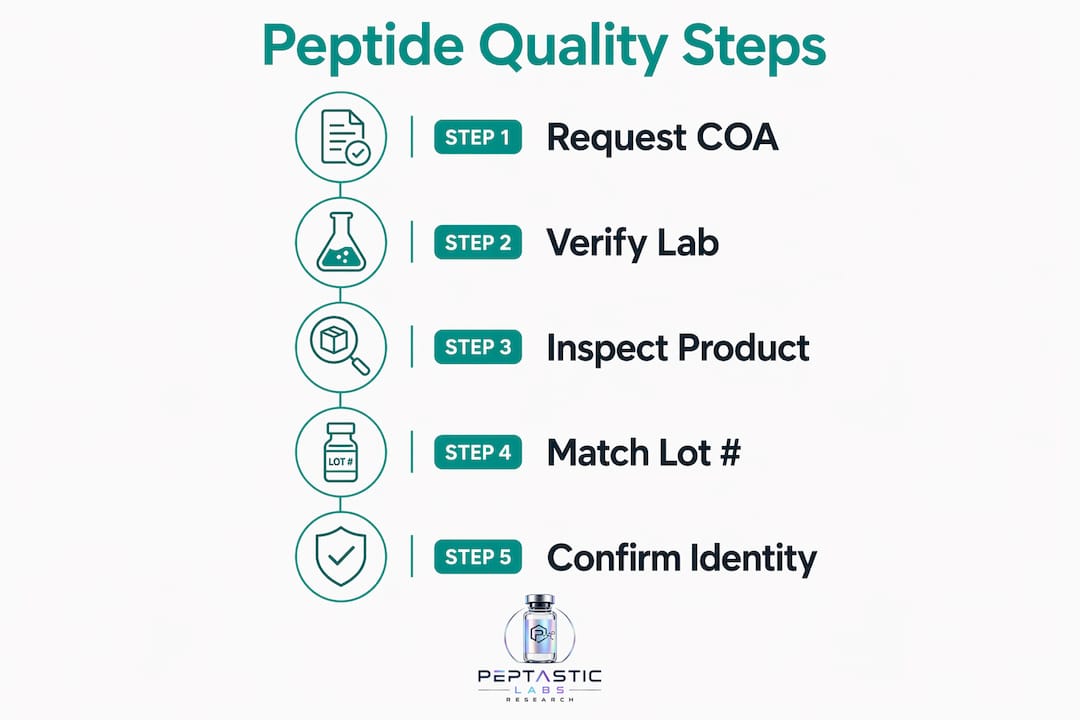
Packaging quality reflects production standards. Labels should be printed clearly, with correct compound names, lot numbers, and storage instructions. Handwritten labels, smudged printing, or missing storage guidance are low-grade peptide product signs that require no laboratory to identify. Cold-chain shipping is required for peptide stability. A vendor who ships peptides without refrigerant packs or insulated packaging is not maintaining the cold chain, and the product's integrity is already in question before it arrives.
Pricing is one of the most reliable pre-purchase signals. Consider these benchmarks and what they mean:
- Market reference price. Typical professional pricing for 5mg BPC-157 runs €25–€40 per vial. This range reflects the cost of proper synthesis, quality control testing, and documentation.
- Danger zone pricing. Prices below €12 for the same compound almost always signal that quality controls have been removed. Synthesis shortcuts, skipped testing, or outright substitution become economically necessary at that price point.
- Dramatic discounts. Pricing 40–60% below the median correlates with quality sacrifices such as incomplete synthesis or absent testing, regardless of vendor reputation claims.
- Bulk pricing without documentation. Volume discounts are legitimate. Volume discounts paired with no COA access are not.
Pro Tip: Compare the lot number printed on the vial to the lot number on the COA. A mismatch means the COA does not apply to your product, regardless of how professional it looks.
What role does independent third-party verification play in confirming peptide authenticity?
HPLC purity testing measures how clean a sample is. It does not confirm what the sample actually is. High HPLC purity does not guarantee correct peptide identity. Only mass spectrometry confirms molecular weight and authentic compound identity, making it the critical test for detecting substitution or mislabeling. A product can be 99% pure and still be the wrong molecule entirely.
Independent third-party verification addresses this gap. The layered verification approach combines physical inspection, documentary review, and independent identity testing. Each layer catches different failure modes. Physical inspection catches degradation and packaging fraud. Documentary review catches fabricated or reused COAs. Independent mass spectrometry catches molecular substitution that no other method reveals.
Approximately 30% of grey-market peptides tested contained the wrong molecule, and 65% exceeded endotoxin safety thresholds. These figures confirm that vendor-supplied documentation alone is insufficient for high-stakes applications. Independent verification is not a premium option. It is the baseline for responsible sourcing.
The process for independent testing is straightforward. You submit a sample vial to an ISO-17025 accredited lab, request mass spectrometry identity confirmation and endotoxin testing, and compare results against the vendor-supplied COA. The cost of a single independent test is a fraction of the cost of compromised research or an adverse safety event.
Prioritize independent testing in these situations:
- New vendors with no track record. First-order verification establishes a baseline before committing to larger purchases.
- High-stakes or clinical-adjacent research. Any application where a wrong compound causes data invalidation or safety risk requires identity confirmation.
- Discrepancies in vendor documentation. If the COA shows any of the fabrication signals described above, independent testing is the only way to resolve the question.
- Injectable applications. Endotoxin contamination in injectable peptides is a critical safety concern not identified through standard purity tests. LAL testing below 5 EU/mg is required.
Researchers working across metabolic, cognitive, or tissue repair applications can review current purity and testing standards to understand what verified documentation looks like in practice.
Common mistakes that lead to selecting poor-quality peptides
Most sourcing errors follow predictable patterns. Recognizing them before they occur is more efficient than correcting them after a compromised batch reaches your protocol.
- Treating purity as identity. HPLC purity confirms cleanliness, not molecular identity. Researchers who stop at purity data miss the most critical verification step.
- Relying on community reputation without documentation. Forum endorsements and social proof are not analytical data. A vendor praised in online communities can still supply unverified product.
- Ignoring lot number mismatches. Missing or mismatched lot numbers between a vial and its COA are a pervasive source of quality failure. This single check eliminates a large category of fraud.
- Skipping endotoxin and sterility review for injectables. Endotoxin contamination causes inflammatory responses that standard purity tests do not detect. Researchers using injectable peptides who do not verify endotoxin results are accepting an unquantified safety risk.
- Accepting unaccredited lab COAs. A COA from a lab with no ISO-17025 accreditation provides no independent assurance. The data is self-reported in practice.
- Using price as the only filter. Low price is a risk signal, not a disqualifier on its own. High price is not a quality guarantee either. Price must be evaluated alongside documentation, not instead of it.
- Accepting "pharmaceutical grade" claims at face value. This term carries no regulatory definition in the peptide market. Vendors who lead with this phrase and provide no supporting COA are using marketing language as a substitute for evidence.
International enforcement operations seized over 50 million doses of counterfeit pharmaceuticals and peptides between december 2024 and november 2025. That volume confirms the grey market is not a minor fringe problem. It is a large-scale supply chain risk that requires active, documented verification at the point of purchase.
Key Takeaways
Layered verification combining batch-specific COAs from ISO-17025 accredited labs, mass spectrometry identity confirmation, and endotoxin testing is the most reliable method to determine peptide product purity and protect research integrity.
| Point | Details |
|---|---|
| COA must include three tests | HPLC purity, mass spectrometry identity, and endotoxin data are all required; any missing element signals an unverified product. |
| Purity does not equal identity | Only mass spectrometry confirms the correct molecule; high HPLC purity alone cannot detect substitution. |
| Lot number verification | Always match the vial lot number to the COA lot number before use; a mismatch invalidates the documentation. |
| Price is a risk signal | Pricing 40–60% below market median correlates with removed quality controls, not a bargain. |
| Independent testing is the final check | Submit samples to an ISO-17025 lab for identity and endotoxin testing when sourcing from new vendors or for high-stakes applications. |
What I've learned from years of evaluating peptide documentation
The single most common error I see is researchers treating a high purity number as proof of product quality. A 99% HPLC result is reassuring. It is not sufficient. The question that number cannot answer is whether the compound in the vial is actually the compound on the label. Mass spectrometry answers that question. Every other verification step is secondary.
The second lesson is that documentation fraud is not rare or exotic. Fabricated COAs circulate widely, and they are often visually convincing. The tells are in the data patterns: uniform purity values across batches, pristine chromatograms with no baseline noise, lot numbers that do not match vials. These are not subtle. They are visible to anyone who knows what authentic analytical data looks like.
The economic argument for thorough verification is straightforward. A failed experiment caused by a substituted compound costs far more in time, materials, and lost data than the cost of an independent mass spectrometry test. For anyone using peptides in injectable form, the safety argument is even more direct. Endotoxin contamination is not a theoretical risk. It is a documented, measurable problem in a significant share of grey-market products.
Transparency from a supplier is not a courtesy. It is a baseline requirement. Any vendor unwilling to provide batch-specific COAs from named, accredited labs is asking you to accept their word as a substitute for evidence. That is not an acceptable standard for research or health applications.
— Tintastic
Peptasticlabs: verified peptides with full documentation
Researchers and health-conscious consumers who have worked through the verification criteria above will recognize what separates a reliable supplier from the rest. Peptasticlabs provides research-grade peptides verified to ≥99% purity via HPLC, with batch-specific Certificates of Analysis available on request from ISO-17025 accredited third-party labs.
The catalog covers over 22 independently tested compounds across metabolic, cognitive, tissue repair, longevity, immunology, and cosmetic research applications. Every compound ships with documented identity confirmation and endotoxin data. Researchers who need to review specific purity standards and testing protocols can access the full documentation framework on the Peptasticlabs research page. Verified sourcing is not a premium feature at Peptasticlabs. It is the standard.
FAQ
What is the minimum purity standard for research-grade peptides?
Research-grade peptides require HPLC purity of ≥98% as a minimum threshold. Peptasticlabs verifies its compounds to ≥99% purity via HPLC with batch-specific third-party documentation.
Can HPLC purity alone confirm a peptide is authentic?
No. HPLC purity measures sample cleanliness but cannot confirm molecular identity. Mass spectrometry is required to verify that the compound matches its label and detect any substitution.
What endotoxin level is safe for injectable peptides?
Endotoxin levels must fall below 5 EU/mg for injectable peptides, confirmed by LAL testing. Standard HPLC purity tests do not detect endotoxin contamination.
How do I know if a COA is fabricated?
Look for identical purity values across multiple batches, flawless chromatograms with no baseline noise, and lot numbers that do not match the vial. Legitimate analytical data shows minor batch-to-batch variation.
What pricing signals a low-quality peptide product?
Pricing 40–60% below the market median for the same compound almost always indicates removed quality controls. For reference, professional pricing for 5mg BPC-157 runs €25–€40; prices below €12 signal compromised quality.