
Randomized trials and a 2026 meta-analysis pooling five RCTs show tesamorelin reliably reduces visceral adipose tissue (MD −27.71 cm²) and hepatic fat (MD −4.28%) over roughly 6 months in HIV-associated lipodystrophy. Standard dosing runs 2 mg subcutaneous daily, driving substantial IGF-1 increases that require monitoring. Adverse events skew toward arthralgia, injection-site reactions, and transient early glucose changes rather than sustained metabolic harm.
TL;DR:
- Tesamorelin reliably reduces visceral adipose tissue and hepatic fat over six months, with effects sustained through at least one year in HIV-associated lipodystrophy.
- Significant effects include a mean VAT reduction of approximately 27.71 cm² and a 4.28% decrease in hepatic fat, with no notable impact on subcutaneous fat.
- The typical dose of 2 mg subcutaneous daily elevates IGF-1 by about 81%, and transient early glucose changes are common but do not lead to lasting metabolic harm.
- Long-term data shows VAT and triglyceride improvements persist, but antibody formation and safety over multiple years remain uncertain and require ongoing monitoring.
- Effectiveness relies on imaging assessments at six months for VAT and twelve months for durability, with current evidence primarily limited to HIV-positive populations.
Table of Contents
- Tesamorelin Research: Key Effect Sizes and Timelines
- Major Randomized Controlled Trials Behind Tesamorelin Research
- What the Pooled Meta-Analytic Data Tell You
- Tesamorelin Dosage Research: Safety, IGF-1, and Metabolic Monitoring
- How Tesamorelin Works: Mechanism and Pharmacokinetics
- Designing Tesamorelin Studies: Endpoints and Protocol Guidance
- Where Tesamorelin Research Still Falls Short
- Sourcing Research-Grade Tesamorelin: What Reproducibility Requires
- What the Tesamorelin Evidence Actually Tells Us
- Sourcing Tesamorelin for Institutional Research
- Sources
Tesamorelin Research: Key Effect Sizes and Timelines
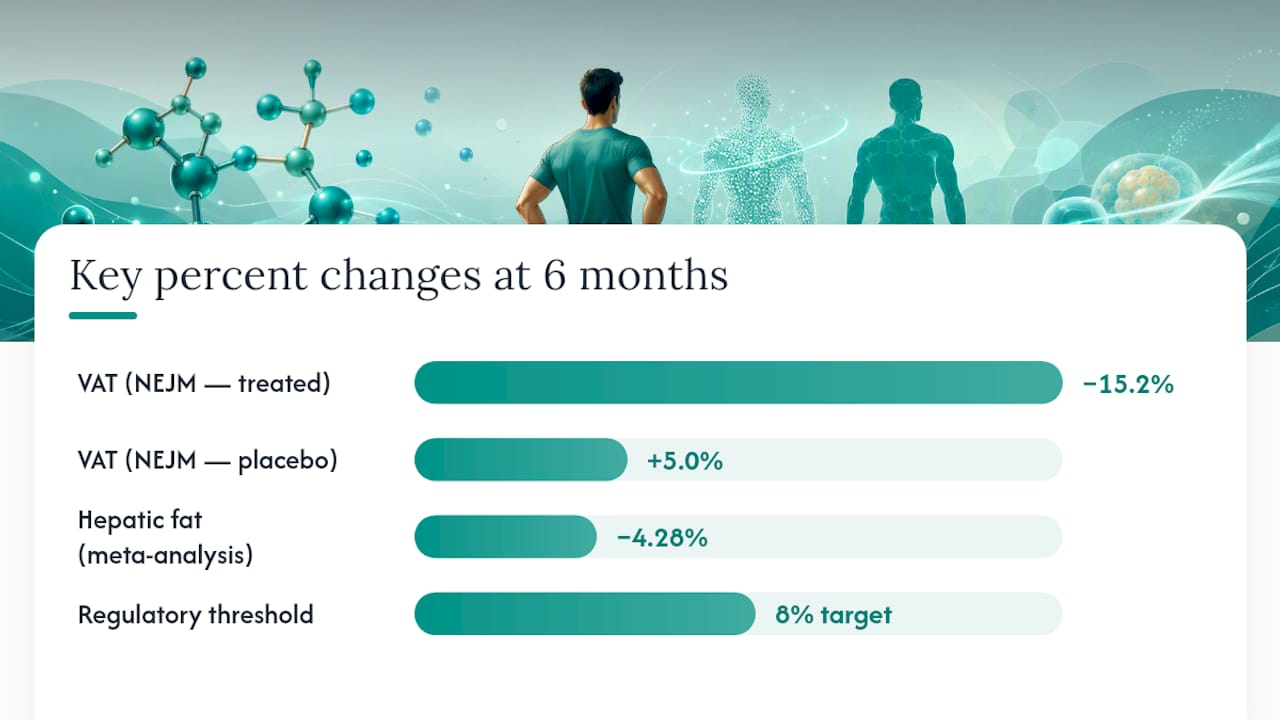
Researchers evaluating tesamorelin research need the numbers before the narrative. The 2026 meta-analysis pooling five randomized controlled trials found a mean difference of −27.71 cm² in visceral adipose tissue and −4.28% in hepatic fat, both highly significant (P < 0.001). Trunk fat dropped by a mean difference of 1.18 kg, while lean body mass climbed 1.42 kg. Subcutaneous adipose tissue showed no significant change, which matters for anyone assuming tesamorelin acts as a general fat-loss agent rather than a visceral-specific one.
The NEJM pivotal phase III trial randomized 412 patients and reported a 15.2% decrease in VAT at 26 weeks against a 5.0% increase in the placebo arm. That trial also recorded an 81% rise in IGF-1 among treated patients, a figure that anchors expectations for pharmacodynamic monitoring in newer protocols.
Most of this evidence clusters around two timepoints:
- 6 months (24 to 26 weeks): the point where VAT and hepatic fat changes become reliably measurable by CT and 1H-MRS, based on the JAMA 2014 trial.
- 12 months and beyond: covered mainly by phase III extensions and pooled long-term data, where VAT reductions and triglyceride improvements persist through 52 weeks, though outcome data thin out considerably past that mark.
Clinical significance thresholds matter here. Regulatory review of tesamorelin (marketed as Egrifta) has generally used an 8% or greater VAT reduction as a marker of meaningful response, a bar the pooled trial data clears on average, though individual response varies. Responder proportions are not uniformly reported across trials, which is itself a gap worth flagging when you are designing a study that depends on responder-based analysis rather than mean change alone.
The practical takeaway: if your study design anticipates using VAT or hepatic fat as a primary endpoint, six months is the earliest defensible readout window, and twelve months is where you get your best shot at durability data.
Major Randomized Controlled Trials Behind Tesamorelin Research
The tesamorelin evidence base rests on a small number of well-designed trials, each answering a slightly different question. Here is how the major ones stack up.
-
NEJM pivotal multicenter trial. This large phase III study randomized 412 HIV-positive adults with excess abdominal fat to tesamorelin 2 mg subcutaneous daily or placebo over 26 weeks. The primary endpoint was VAT change by CT, and the trial reported a 15.2% VAT decrease versus a 5.0% increase with placebo, alongside significant triglyceride improvements. IGF-1 rose roughly 81% in the treatment arm. Limitation: the 26-week window does not capture durability beyond half a year without the extension data described below.
-
JAMA 2014 liver-fat RCT. This smaller trial (n≈50) added hepatic fat as a co-primary outcome, measured via 1H-MRS, alongside VAT by CT. Over 6 months, median liver fat change was −2.0% with tesamorelin versus +0.9% with placebo (P = .003). Fasting glucose ticked up at 2 weeks in some patients but showed no significant group difference by 6 months, an important detail for anyone worried about sustained glycemic impairment. Limitation: sample size limits subgroup analysis by ART regimen or baseline liver fat severity.
-
Falutz pooled phase III analysis and 52-week extension. Combining multiple phase III cohorts, this pooled dataset and its open-label extension tracked patients through roughly a year of continuous exposure. VAT reductions held up, triglycerides kept improving, and IGF-1 remained elevated as expected for a GHRH analogue. Antibody formation against tesamorelin appeared in a subset of participants, though clinical consequence of these antibodies was not clearly established. Limitation: extension-phase attrition and the absence of a placebo comparator past the initial 26-week randomized period weaken causal inference for the later timepoints.
-
INSTI-era efficacy and safety analysis. A more recent analysis restricted to patients on integrase strand transfer inhibitor-based ART found median VAT change of −25 cm² versus +14 cm² with placebo (P = 0.001), and hepatic fat change of −4.2% versus −0.5% (P = 0.01), with no worsening of glycemic control. This matters for external validity, since most pivotal trial enrollment predates modern INSTI-heavy regimens. Limitation: subgroup sample sizes within this analysis are smaller than the pivotal trials, so confidence intervals run wider.
Across these trials, the endpoint architecture is consistent: CT for VAT, 1H-MRS or MRI for hepatic fat, and DXA for trunk and appendicular fat and lean mass. Inclusion criteria generally required HIV infection, stable ART, and clinical or imaging evidence of visceral fat accumulation, with exclusion of uncontrolled diabetes, active malignancy, and pituitary or hypothalamic disease given the growth hormone axis involvement.
What the Pooled Meta-Analytic Data Tell You
Single trials tell you what happened in one population. Pooled analyses tell you whether that finding replicates, and how confidently you can generalize it. The 2026 meta-analysis drawing on five RCTs is currently the strongest aggregate signal available for tesamorelin research.
Pooled Effect Snapshot: Across five randomized controlled trials, tesamorelin produced a mean VAT reduction of 27.71 cm² and hepatic fat reduction of 4.28%, both statistically robust (P < 0.001), alongside a 1.42 kg lean mass gain and no significant change in subcutaneous fat.
That last point, the null result for subcutaneous fat, is arguably the most clinically informative finding in the whole pool. It confirms tesamorelin's mechanism is genuinely visceral-selective rather than a general lipolytic effect, which has direct implications for which patient populations and endpoints make sense in future study designs.
A few practical notes on how to read this pooled evidence:
- Outcome-specific RCT contribution varies. Not every trial in the pool measured every outcome; hepatic fat data in particular come from fewer contributing studies than VAT data, since 1H-MRS access has historically been less standardized than CT.
- Heterogeneity is a real consideration. Differences in ART background, baseline VAT severity, and trial duration across the five contributing RCTs introduce heterogeneity that pooled point estimates can obscure. Readers should treat the confidence intervals, not just the mean differences, as the operative number.
- Trunk fat and lean mass findings reinforce the visceral-selective story. The 1.18 kg trunk fat reduction paired with a 1.42 kg lean mass increase suggests tesamorelin's compositional effect extends beyond raw fat volume into favorable shifts in body composition ratios.
- Certainty is moderate, not definitive. Five RCTs is a workable evidence base for a rare-disease-adjacent population like HIV-associated lipodystrophy, but it is a modest number by meta-analytic standards for broader clinical guideline-setting.
For researchers designing follow-on studies, the practical implication is straightforward: powering a trial to detect VAT change is well-supported by existing effect sizes, but powering for hepatic fat as a primary endpoint requires accounting for the smaller contributing trial base and wider uncertainty around that specific outcome.
Tesamorelin Dosage Research: Safety, IGF-1, and Metabolic Monitoring
Every major tesamorelin trial has run on the same dose regimen: 2 mg subcutaneous daily. That consistency across the NEJM pivotal trial, the JAMA hepatic fat trial, and the INSTI-era analysis is itself a research advantage. It means cross-trial comparison of safety signals is more reliable than it would be with a fragmented dosing landscape.
IGF-1 elevation is the expected pharmacodynamic signature of any GHRH analogue, and tesamorelin is no exception. The NEJM trial recorded a large increase in IGF-1 among treated patients. Clinicians and researchers commonly use a z-score threshold, often cited around z>3, as a trigger for dose reduction to reduce the risk of GH-excess effects, though this threshold functions more as clinical practice guidance than a rule embedded in every trial protocol.
Glucose findings are more nuanced than a simple "safe" or "unsafe" label suggests. The JAMA trial found transient fasting glucose increases at 2 weeks that did not persist at 6 months, and the INSTI-era analysis found no worsening of glycemic control even in a modern ART context. This pattern, an early transient signal without sustained impairment, appears consistently enough across trials to be treated as the expected trajectory rather than an anomaly.
Common adverse events reported across pooled trial data include:
- Arthralgia (joint pain), among the most frequently reported treatment-emergent events
- Injection-site reactions, expected given daily subcutaneous administration
- Peripheral edema, consistent with growth hormone axis stimulation
- Antibody formation against tesamorelin in a subset of long-term extension participants
Long-term safety data carry real limitations. The phase III pooled and 52-week extension analysis shows antibody development in some recipients without clear resolution of its clinical significance. The clinical review report filed during regulatory assessment flags IGF-1 elevation and theoretical cancer risk as areas warranting ongoing monitoring, noting that trial durations to date have not been long enough to fully characterize risk over years of exposure.
Pro Tip: If you're designing a monitoring protocol, pair IGF-1 z-score tracking with a fixed glucose recheck at 2 weeks and 3 months rather than relying on a single 6-month endpoint. The transient early glucose signal seen in the JAMA trial is easy to miss if your first glycemic check happens at the 6-month mark.
How Tesamorelin Works: Mechanism and Pharmacokinetics
Tesamorelin is a synthetic analogue of growth hormone-releasing hormone (GHRH), and its therapeutic logic starts with receptor distribution rather than a generalized metabolic effect. Visceral adipocytes carry higher GH receptor density than subcutaneous fat cells, which is the leading explanation for why tesamorelin drives measurable VAT loss while leaving subcutaneous fat largely unchanged in trial after trial, a pattern the meta-analytic pooled data confirm.

The molecule itself has one structural feature worth understanding if you are evaluating mechanism-based hypotheses: an N-terminal trans-3-hexenoyl modification that extends its half-life relative to native GHRH. This modification is what makes once-daily subcutaneous dosing pharmacologically viable, since unmodified GHRH would require a dosing frequency impractical for sustained outpatient research or clinical use.
On the pharmacodynamic side:
- Tesamorelin stimulates the pituitary to release endogenous growth hormone, which in turn drives hepatic IGF-1 production.
- IGF-1 elevation is measurable within weeks of initiation and functions as the standard pharmacodynamic biomarker in trials.
- The lag between IGF-1 elevation and measurable VAT change (typically visible by 6 months on CT) reflects the time needed for GH-mediated lipolysis to translate into imaging-detectable volume reduction.
- Fat quality changes, not just quantity, appear to accompany treatment: a 2021 study found increased fat density in both VAT and SAT independent of volume changes, suggesting tesamorelin alters adipose tissue composition at a level standard volumetric imaging alone would miss.
For researchers building mechanistic hypotheses, that fat-density finding is worth sitting with. It implies imaging protocols relying solely on volumetric CT or DXA may be underestimating the full biological effect, and that density-sensitive imaging analysis could reveal additional dose-response relationships not visible in volume-only datasets.
Designing Tesamorelin Studies: Endpoints and Protocol Guidance
Anyone planning a tesamorelin trial or mechanistic sub-study benefits from anchoring protocol decisions to what the existing evidence base has already validated, rather than reinventing endpoint selection from scratch.
- Primary endpoint selection. VAT change by CT at 6 months is the most trial-validated primary endpoint, given its use across the NEJM, JAMA, and INSTI-era studies. Hepatic fat by 1H-MRS is a strong co-primary or secondary endpoint, particularly relevant given the distinct MASLD-adjacent mechanism tesamorelin appears to engage.
- Secondary endpoints worth including. Trunk and appendicular fat and lean mass by DXA, fasting lipids (particularly triglycerides), and fat density measures if imaging resources allow density-sensitive analysis alongside standard volumetric scans.
- Monitoring schedule. Baseline labs and imaging, glucose recheck at 2 weeks, IGF-1 and metabolic panel at 3 months, full imaging and safety review at 6 months, with longer studies adding a 12-month assessment for durability.
- Inclusion and exclusion criteria. Stable ART for at least 8 to 12 weeks, imaging-confirmed visceral fat accumulation, and exclusion of uncontrolled diabetes, active malignancy, or pituitary and hypothalamic disorders given the growth hormone axis mechanism.
- Sample size planning. The Clinicaltrials offers protocol-level detail on endpoint definitions and enrollment targets that is useful as a reference point when scoping a new study's statistical power for VAT or hepatic fat outcomes.
Pro Tip: Register your protocol on ClinicalTrials.gov before enrollment begins, even for smaller mechanistic sub-studies. Reviewers increasingly expect prospective registration for any tesamorelin research claiming a primary imaging endpoint, and it also gives you a public reference point for eventual meta-analytic inclusion.
Regulatory and ethical groundwork matters as much as endpoint selection. Confirm institutional review board approval covers the investigational use context specific to your population, particularly if you are studying tesamorelin outside its established HIV-associated lipodystrophy indication. Any off-label or non-HIV population study should explicitly document the rationale for extrapolating dosing from the 2 mg daily regimen validated in pivotal trials, since the pharmacokinetic and IGF-1 response data were generated in an HIV-positive population with a specific metabolic context.
Where Tesamorelin Research Still Falls Short
The evidence base is solid for its core question, VAT and hepatic fat reduction in HIV-associated lipodystrophy, but several gaps limit how far that evidence can be extrapolated.
- Non-HIV MASLD populations remain understudied. Hepatic fat reduction in HIV-positive patients is well-documented, but whether the same mechanism and effect size hold in metabolic dysfunction-associated steatotic liver disease outside the HIV context is an open question worth prioritizing.
- Long-term cardiovascular outcomes are absent. Trials to date track imaging and metabolic markers over 6 to 12 months. Nobody has published data connecting tesamorelin-driven VAT reduction to hard cardiovascular endpoints over years of follow-up.
- Antibody clinical significance is unresolved. The phase III extension data document antibody formation without establishing whether antibodies blunt efficacy or carry any safety implication over extended use.
- Modern ART diversity needs broader trial representation. The INSTI-era analysis is a good start, but sample sizes within that subgroup remain smaller than the pivotal trials, leaving room for a dedicated, adequately powered study in contemporary ART regimens.
- Receptor-level mechanistic work is thin. The visceral-selective effect is explained by GH receptor density differences, but direct adipocyte signaling studies confirming this mechanism in human tissue samples would strengthen the biological rationale considerably.
Future studies addressing even two or three of these gaps, particularly the antibody question and non-HIV MASLD applicability, would meaningfully shift how confidently clinicians and researchers can generalize current findings.
Sourcing Research-Grade Tesamorelin: What Reproducibility Requires
Reproducible tesamorelin research depends on knowing exactly what compound went into your protocol, not assuming it.
Key documentation points relevant to research reproducibility:
- Independent, third-party purity verification beyond in-house quality checks, reducing reliance on a single testing source
- ≥99% HPLC-verified purity across the tesamorelin batch, a threshold that matters directly for dose-response consistency in imaging-endpoint studies
- Batch-specific documentation, allowing researchers to trace a specific study's material lot rather than relying on generic product claims
- Certificates of Analysis available on request, supporting the kind of material transparency that protocol review boards and journal reviewers increasingly ask for
For a compound where trial-to-trial dosing consistency (2 mg daily across the NEJM, JAMA, and INSTI-era studies) has been central to comparing effect sizes across the literature, sourcing transparency is not a minor administrative detail. It is part of what makes a new study's data comparable to the existing evidence base at all. Researchers building on published tesamorelin studies need confidence that variability in their own results reflects biology, not undocumented differences in material purity.
What the Tesamorelin Evidence Actually Tells Us
The conventional summary of tesamorelin research, that it "reduces belly fat in HIV patients," undersells what the data actually show and overstates what remains uncertain. The mechanism-specific, visceral-selective effect, confirmed by both the meta-analysis and the fat-density findings, is more scientifically interesting than a generic fat-loss narrative suggests. It also means researchers should stop treating VAT and subcutaneous fat as interchangeable outcomes in study design.
Where the field falls short is durability and generalizability. Six-month data are strong; twelve-month data are workable; anything past that is thin. The antibody question deserves more attention than it currently gets in trial discussion sections. And frankly, the absence of hard cardiovascular outcome data after nearly two decades of tesamorelin research is a gap the field should have closed by now.
If you are prioritizing one thing from this body of evidence, prioritize endpoint precision. Use CT and 1H-MRS at validated timepoints, monitor IGF-1 with a defined threshold, and do not assume older HIV-lipodystrophy data generalizes cleanly to modern INSTI-based regimens without checking the subgroup evidence first.
— Tintastic
Sourcing Tesamorelin for Institutional Research
Qualified research use tesamorelin is supplied with Certificates of Analysis and batch documentation available on request to support protocol-level material verification.

Institutions running imaging-endpoint studies, whether CT-based VAT tracking or 1H-MRS hepatic fat protocols, need material consistency they can document in a methods section. Unlike sourcing from unverified suppliers where purity claims go unchecked, Peptastic Labs backs its tesamorelin product with independent HPLC verification at ≥99% purity and batch-specific records researchers can reference directly. If your protocol also involves comparative GHRH-analogue work, the sermorelin product page carries the same documentation standard. Researchers evaluating comparative body-composition tracking methods alongside their peptide sourcing may also find the partner guide on peptides and measurable weight-loss outcomes useful for structuring imaging-based endpoints. To request a Certificate of Analysis or technical documentation for your protocol, visit Peptastic Labs and confirm your institutional approvals are in place before initiating an order.
This article is general information, not a substitute for advice from a qualified doctor. Consult a qualified healthcare professional about your own circumstances before acting on anything here.
Sources
- Body composition, hepatic fat, metabolic, and safety outcomes of Tesamorelin, a GHRH analogue, in HIV-associated lipodystrophy: A meta-analysis of randomized controlled trials
- Effect of Tesamorelin on Visceral Fat and Liver Fat in HIV-Infected Patients With Abdominal Fat Accumulation: A Randomized Clinical Trial
- Effects of tesamorelin on visceral fat and related outcomes — pooled analyses and long-term safety extension
- Efficacy and safety of tesamorelin in people with HIV on integrase inhibitors