
"AOD-9604 fat loss" refers to claims that this synthetic peptide fragment promotes lipolysis in adipose tissue. Animal studies support a mechanistic effect. Well-powered human trials did not.
The bottom line, before you read further:
- Mechanism claim: AOD-9604 is proposed to stimulate lipolysis via beta-adrenergic receptor pathways, mobilizing stored triglycerides in fat cells.
- Strongest evidence: Preclinical rodent studies, including Heffernan et al. (2001), show increased fat oxidation and reduced body fat in obese mice after chronic administration.
- Human trial outcome: A pivotal Phase IIb trial enrolling approximately 536 subjects over 24 weeks failed to meet its primary endpoint. Development was terminated.
- Regulatory status: The Therapeutic Goods Administration (TGA) has not approved AOD-9604 as a therapeutic for weight loss in Australia. It circulates in unregulated research peptide markets.
Key Takeaways
AOD-9604 produced consistent lipolytic signals in rodent models but failed its pivotal human trial, leaving it without regulatory approval or a validated clinical dose.
| Point | Details |
|---|---|
| Mechanism is plausible, not proven | AOD-9604 stimulates lipolysis via β3-adrenergic pathways in rodents; human clinical translation failed. |
| Pivotal trial enrolled ~536 subjects | The 24-week Phase IIb trial did not meet its primary endpoint; development was terminated. |
| Not TGA-approved in Australia | AOD-9604 has no approved therapeutic indication; grey-market sourcing carries purity and legal risks. |
| No validated clinical dose exists | Oral formulation challenges and trial failure mean no prescribing protocol has been established. |
| Peptasticlabs for research use | HPLC-verified, ≥99% purity, batch-documented peptides for researchers with institutional compliance needs. |
Table of Contents
- What AOD-9604 is and where the name comes from
- How AOD-9604 is proposed to drive fat loss
- What the science actually shows about AOD-9604
- Safety profile and what remains unknown
- Regulatory and legal status in Australia
- How AOD-9604 was administered in studies and why no standard dose exists
- How AOD-9604 compares with related peptides and approved treatments
- Who should consider AOD-9604 and who should not
- How to source research-grade peptides responsibly
- An honest read on where AOD-9604 research stands
- Peptasticlabs: research-grade peptides for serious investigators
- Sources
What AOD-9604 is and where the name comes from
AOD-9604 is a synthetic 16-amino-acid peptide corresponding to the C-terminal fragment of human growth hormone (hGH), specifically residues 177–191 of the hGH sequence, with a tyrosine added at the N-terminus. The full name is Tyr-hGH177-191. Its development name, Advanced Obesity Drug 9604, reflects its original purpose: a pharmaceutical candidate engineered to isolate the fat-metabolizing properties of hGH without triggering the hormone's growth-promoting or diabetogenic effects.
Full-length hGH stimulates IGF-1 production, promotes tissue growth, and can impair insulin sensitivity at pharmacological doses. AOD-9604 was designed to avoid all of that. By targeting only the C-terminal region, researchers aimed to retain lipolytic signaling while eliminating IGF-1 stimulation. Early metabolic studies confirmed no IGF-1 elevation in tested systems, which distinguished it from hGH on a key safety metric.
Key structural distinctions from full-length hGH:
- Size: 16 amino acids vs. 191 amino acids for hGH.
- Receptor interaction: Does not bind the classical GH receptor in the same way; lacks the domains responsible for IGF-1 axis activation.
- IGF-1 stimulation: Not observed in reviewed trial and preclinical settings.
- Growth effects: Not demonstrated in standard assays at therapeutic dose ranges.
Pro Tip: When evaluating any hGH fragment, the absence of IGF-1 stimulation is a meaningful safety distinction — but it does not automatically confer fat-loss efficacy in humans. Mechanism plausibility and clinical outcome are separate questions.
The C-terminus of hGH was targeted because earlier structure-activity studies identified this region as the domain most associated with lipolytic signaling, separate from the receptor-binding domains responsible for growth promotion. That rationale was scientifically coherent. Whether it translated to a viable obesity drug is a different matter entirely.
How AOD-9604 is proposed to drive fat loss
The proposed mechanism centers on lipolysis: the enzymatic hydrolysis of stored triglycerides in adipocytes into free fatty acids and glycerol. AOD-9604 is hypothesized to upregulate this process through beta-adrenergic receptor pathways, particularly the beta-3 adrenergic receptor (β3-AR), which is expressed predominantly in adipose tissue.
Heffernan et al. (2001) demonstrated that chronic intraperitoneal administration of AOD-9604 in obese mice increased fat oxidation and reduced body weight, with effects linked to increased β3-AR expression. Critically, acute lipolytic effects were still observed in β3-AR knockout mice, suggesting a secondary pathway operates alongside the receptor-dependent chronic mechanism.
The mechanistic sequence proposed in rodent data:
- Adipocyte stimulation → triglyceride hydrolysis increases.
- Free fatty acids released into circulation.
- Net fat mass reduction requires those fatty acids to be oxidized, not re-esterified back into adipose stores.
That last step is where the translation problem lives. Lipolysis and net fat loss are not the same outcome. Mobilized fatty acids can be re-esterified if energy expenditure does not increase proportionally. A biochemical signal in a cell assay or rodent model does not guarantee durable body-fat reduction in a free-living human.
Pro Tip: A peptide that increases lipolytic markers in adipocytes is not automatically a fat-loss agent. The oxidation side of the equation matters equally, and it is rarely measured in early-phase peptide studies.
Marketing claims about AOD-9604 often stop at "stimulates fat breakdown." That framing omits the oxidation requirement and the clinical evidence that spot-reduction or targeted fat loss is biologically implausible regardless of mechanism. Clinical fat-loss endpoints rely on whole-body measures such as DEXA or CT imaging, not localized adipocyte activity.
What the science actually shows about AOD-9604
Animal evidence
The preclinical dataset for AOD-9604 is coherent and reasonably well-documented. Rodent studies using obese Zucker rats and ob/ob mice showed reduced adipose accumulation and increased fat oxidation following AOD-9604 administration. The Heffernan et al. (2001) study remains the most-cited mechanistic reference, establishing the β3-AR link in obese mice over a 14-day chronic dosing period. Adipocyte cell size decreased in several rodent models, and body-weight gain was reduced relative to controls. This is a consistent animal evidence package across multiple rodent models, which justified advancing the compound to human trials.

Human clinical trials
The human evidence is where the story diverges sharply from the rodent data.
| Trial phase | Route | Subjects (approx.) | Duration | Primary endpoint | Outcome |
|---|---|---|---|---|---|
| Phase IIa (early arms) | Oral / SC | Small cohorts | 12 weeks | Weight loss vs. placebo | Modest signal in some arms |
| Phase IIb (pivotal) | Oral | ~536 | 24 weeks | Clinically meaningful weight loss | Failed; no significant benefit |
Early 12-week Phase IIa arms produced signals: one arm reported modestly greater weight loss compared to a comparator arm. Those numbers generated interest. The pivotal 24-week Phase IIb trial enrolling approximately 536 subjects, however, failed to meet its primary endpoint. Development was terminated. A review of the full development arc confirms that AOD-9604 did not produce clinically meaningful weight loss in definitive testing.
Key limitations of the evidence base:
- Publication gaps: Not all Phase II data are fully published in peer-reviewed form.
- Formulation variability: Oral peptide bioavailability is notoriously inconsistent; different formulations across trial arms complicate cross-trial comparison.
- Species differences: Rodent adipose metabolism differs from human in receptor density, thermoregulation, and energy balance dynamics.
- Floor effect in pivotal trial: All arms received an intensive lifestyle intervention, which may have compressed the detectable drug effect — but this does not overturn the null result.
- No Phase III data: Development stopped at Phase IIb. No large-scale, long-duration human safety or efficacy trial exists.
Safety profile and what remains unknown
AOD-9604 was generally well tolerated in the trials that ran. No IGF-1 elevation was reported across reviewed studies, and the compound did not produce the glucose intolerance associated with full-length hGH at the doses tested. Preclinical toxicology in a 4-week IV rat study at doses up to 10 mg/kg reported no treatment-related deaths and showed reduced body-mass gains in female animals without overt GH-type toxicities. Genotoxicology testing did not reveal clear genotoxic signals at tested limits, though those assays are not a substitute for long-term human safety data.
Known safety unknowns:
- Long-term effects: No chronic human exposure data beyond the trial durations tested.
- Carcinogenicity: Not established in humans; long-term rodent carcinogenicity studies are not publicly available in full.
- Diabetes and metabolic disease: Effects in people with type 2 diabetes or insulin resistance are not well characterized.
- Drug interactions: No systematic human pharmacokinetic interaction data.
- Pregnancy and lactation: No safety data; contraindicated by precaution.
Conservative contraindications for research-context awareness:
- Active malignancy or history of hormone-sensitive cancers.
- Pregnancy or breastfeeding.
- Uncontrolled diabetes or severe insulin resistance.
- Concurrent use of GH-axis-modifying agents without medical oversight.
The most significant practical safety concern today is not the compound's intrinsic toxicology profile from trials. It is the grey-market supply chain. Products sold as AOD-9604 through unregulated research peptide vendors have no guaranteed purity, accurate concentration, or sterility. Unknown impurities and mislabeled doses represent a real and unquantified risk that trial safety data cannot address. Aesthetic and clinical practice contexts face similar sourcing and safety considerations when evaluating unregulated peptide agents.
Regulatory and legal status in Australia
AOD-9604 is not approved by the Therapeutic Goods Administration (TGA) as a therapeutic product for weight loss or any other indication. It does not appear on the Australian Register of Therapeutic Goods (ARTG) as an approved medicine. Under Australian law, unapproved therapeutic goods may not be supplied for therapeutic use without specific authorization.
In practice, AOD-9604 is sold in Australia through online vendors as a "research chemical" or "research peptide," a label that places it outside the therapeutic goods framework but does not make it freely available for human use. Possession and importation for personal therapeutic use without a valid prescription or TGA authorization carries regulatory risk.
For researchers in Australia who intend to use AOD-9604 in legitimate preclinical or mechanistic studies:
- Institutional ethics approval is required before any animal or human research involving unapproved compounds.
- Import permits may be required depending on the compound's scheduling and the quantity imported; confirm with the TGA's Office of Drug Control before ordering.
- Research-use labeling must be accurate; products must not be represented as therapeutic.
- Storage and handling must comply with institutional biosafety and chemical management requirements.
- TGA contact: The TGA's regulatory guidance for researchers is available at Tga. Confirm current scheduling status before procurement, as classifications can change.
Pro Tip: Australian peptide research use carries specific compliance obligations that vary by compound scheduling and institutional context. Review current Australian peptide research use examples before initiating any procurement or protocol.
How AOD-9604 was administered in studies and why no standard dose exists
Human trials primarily investigated oral formulations, which offered practical advantages over injections for a weight-loss drug intended for broad use. Subcutaneous and intravenous routes were used in preclinical and toxicology studies. Oral peptide delivery, however, presents well-documented bioavailability challenges: enzymatic degradation in the gastrointestinal tract and poor mucosal absorption reduce the fraction of peptide reaching systemic circulation.
Dose ranges explored across Phase II programs varied, and some arms showed nonlinear dose-response relationships, where higher doses did not produce proportionally greater effects. That pattern, combined with formulation variability across trial cohorts, makes it impossible to extract a validated dose-response curve from the published data.
Why no clinical dosing protocol exists:
- The pivotal trial failed its primary endpoint, removing the regulatory pathway that would have produced a labeled dose.
- Oral formulation challenges were never resolved to a standard specification.
- No Phase III trial was conducted; dose optimization typically occurs across Phase II and III.
- Regulatory non-approval means no prescribing information has been issued.
- Grey-market products carry no validated concentration data, making any dose estimate unreliable.
Regarding injection frequency: in preclinical studies, chronic intraperitoneal administration was used daily over 14-day periods. Human trial schedules varied by arm and formulation. No injection schedule derived from those trials constitutes a validated clinical protocol, and any schedule circulating in fitness or bodybuilding communities is extrapolated without clinical validation.
How AOD-9604 compares with related peptides and approved treatments
Understanding where AOD-9604 sits relative to other options requires separating mechanism from evidence quality and regulatory standing.
| Parameter | AOD-9604 | Full-length hGH | Related lipolytic peptide class (e.g., tesamorelin) | Approved obesity pharmacotherapy |
|---|---|---|---|---|
| Mechanism | Lipolytic fragment; β3-AR pathway | Systemic GH effects; IGF-1 axis activation | GH-releasing hormone analog; indirect GH stimulation | Varies by agent; GLP-1, lipase inhibition, etc. |
| Human RCT evidence | Pivotal trial failed; no significant benefit | Established but off-label for fat loss | Approved for specific indications (HIV-associated lipodystrophy) | Robust; multiple Phase III trials |
| Regulatory approval (Australia) | Not approved | Not approved for fat loss | Not approved for obesity | TGA-approved agents available |
| Primary route (trials) | Oral (human); SC/IV (preclinical) | SC injection | SC injection | Oral or SC depending on agent |
| IGF-1 stimulation | Not observed in trials | Yes, dose-dependent | Indirect via GH release | Not applicable |
AOD-9604 belongs in a "research probe" category: useful for investigating adipocyte biology and lipolytic signaling, not a validated clinical weight-loss agent. Tesamorelin, as a related peptide class example, has a different clinical profile with an approved indication, though that indication is specific and not interchangeable with general obesity treatment. For clinically meaningful weight loss, metabolic research peptides with robust human RCT evidence and regulatory approval represent the appropriate clinical pathway.
Body recomposition goals that combine pharmacotherapy with structured training require a different framework entirely. Evidence-based body recomposition strategies consistently show that lifestyle and training variables account for the majority of measurable outcome variance, independent of any peptide intervention.
Who should consider AOD-9604 and who should not
AOD-9604 is appropriate only within supervised research contexts. It is not a validated clinical treatment for any population.
Research contexts where AOD-9604 may be relevant:
- Adipose biology researchers investigating lipolytic signaling pathways in cell or animal models.
- Pharmacologists studying GH fragment structure-activity relationships.
- Institutions with ethics approval and TGA-compliant procurement protocols for mechanistic probe studies.
Who should seek approved alternatives instead:
- Individuals seeking weight loss or body composition change for personal health goals.
- Clinicians treating obesity or metabolic disease in patients.
- Anyone without institutional ethics oversight and TGA-compliant sourcing.
The trial timeline is also relevant for expectation-setting. The most positive human signals emerged at 12 weeks, and the pivotal trial ran 24 weeks. Even in the arms that showed a modest early signal, the effect size was small and did not survive the larger, longer trial. Anyone expecting meaningful fat loss within weeks from a research peptide is working against both the evidence and the regulatory framework.
Peptides in adipose tissue research serve a legitimate scientific function as mechanistic probes. That function is distinct from therapeutic use, and conflating the two creates both safety and legal exposure for researchers and consumers alike.
How to source research-grade peptides responsibly
For researchers with legitimate institutional needs, procurement quality directly affects data reliability. A peptide of unknown purity or concentration produces uninterpretable results and introduces safety variables into any protocol.
Procurement checklist for research-grade peptides in Australia:
- Certificate of Analysis (CoA): Confirm HPLC-verified purity at ≥99% for the specific batch, not a generic product specification.
- Third-party testing: Independent LC-MS or HPLC results from a laboratory not affiliated with the supplier.
- Batch documentation: Traceable lot numbers, synthesis date, and stability data.
- Storage and shipping conditions: Cold-chain compliance for temperature-sensitive peptides; lyophilized vs. reconstituted specifications clearly stated.
- Research-use labeling: Products must be labeled for research use only, not for human therapeutic use.
- Regulatory paperwork: Confirm import permit requirements with the TGA's Office of Drug Control before ordering internationally.
Quality signals that distinguish reliable suppliers:
- On-demand CoA availability (not just on request after purchase).
- Published independent HPLC/LC-MS results per batch.
- Explicit stability data and recommended reconstitution protocols.
- Clear documentation of sourcing and in-house quality control steps.
Pro Tip: Never accept a supplier's self-reported purity figure without an independent third-party CoA for the specific batch you are purchasing. Batch-to-batch variation is real, and a single generic certificate does not cover subsequent production runs.
Every compound in the catalog undergoes independent third-party testing before release.
An honest read on where AOD-9604 research stands
AOD-9604 is the clearest cautionary example in the fat-loss peptide category precisely because it was designed as a drug, advanced through human trials with proper methodology, and still failed. That trajectory makes it more instructive than compounds that never left the preclinical stage.
The rodent data are real and mechanistically coherent. The β3-adrenergic receptor link identified by Heffernan et al. is a legitimate finding. What the AOD-9604 story demonstrates is that a coherent mechanism in a rodent model, even one supported by multiple independent studies, does not predict human clinical efficacy. The gap between lipolytic signaling in obese mice and durable fat-mass reduction in free-living humans is wide, and the pivotal trial crossed that gap and found nothing on the other side.
Grey-market use of AOD-9604 for personal weight loss sits at the intersection of regulatory non-compliance and evidence-free practice. The compound was tested properly and did not work as an obesity drug. Sourcing it from unverified vendors adds unknown purity and dosing risk on top of an already-negative efficacy record. For researchers, the defensible use is as a mechanistic probe of adipocyte biology, not a clinical intervention. For anyone else, approved pharmacotherapy and structured lifestyle programs represent the evidence-supported path.
Peptasticlabs: research-grade peptides for serious investigators
Researchers who need AOD-9604 or related metabolic peptides for legitimate preclinical or mechanistic work require a supplier whose documentation holds up to institutional scrutiny.
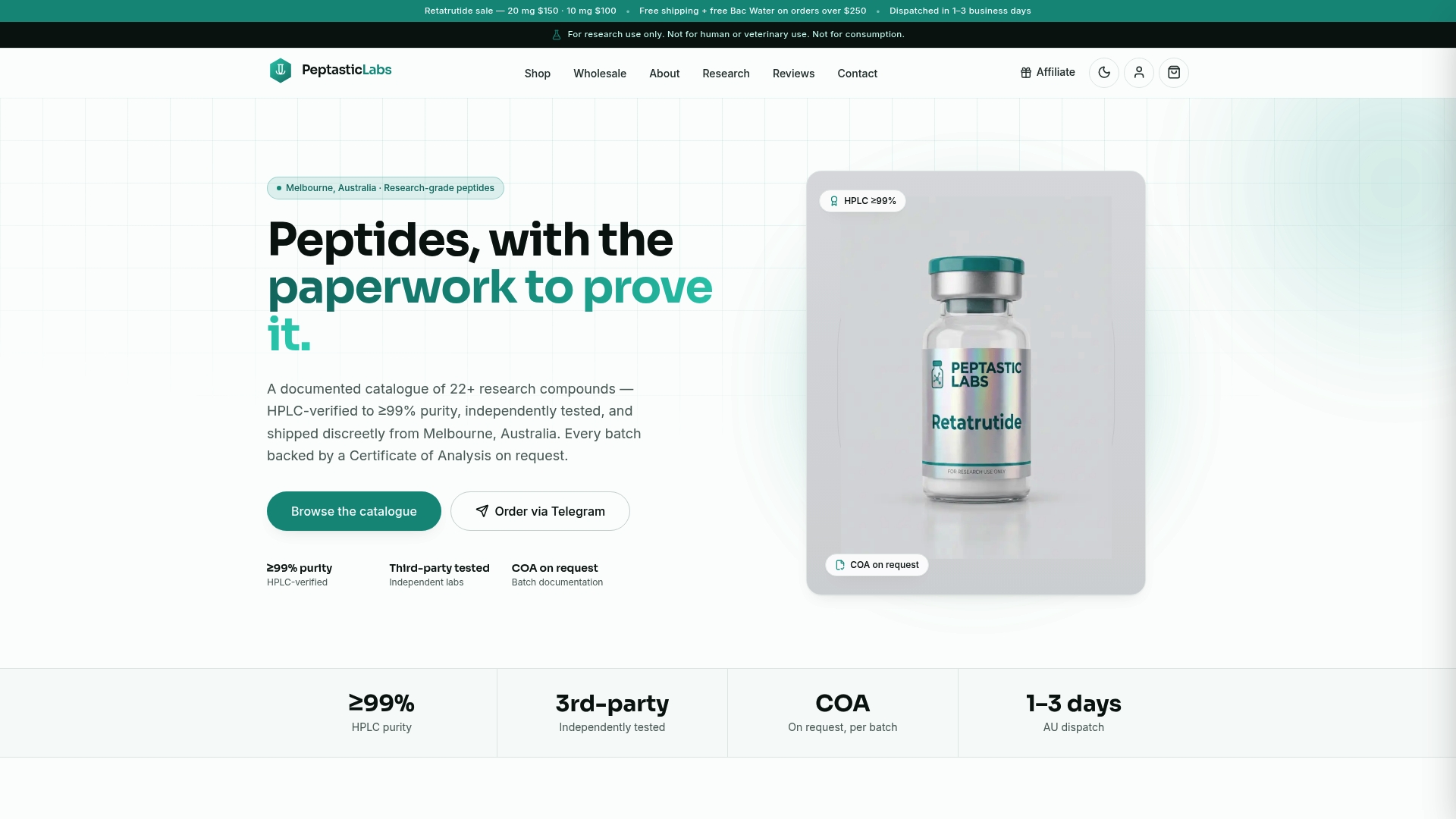
Every compound in the Peptasticlabs catalog undergoes third-party verification before release, with traceable lot numbers and stability data included. For researchers comparing metabolic peptides, the catalog covers over 22 compounds across metabolic, cognitive, tissue repair, and longevity applications. Bulk and wholesale options are available for institutional orders. Browse the catalog and request a CoA for your target compound before committing to a protocol.
Sources
- Heffernan et al. (2001) — hGH and AOD‑9604 lipolytic effects (PubMed)
- Clinical trial summaries and development history (PMC6271067)
- Review referencing AOD‑9604 development and regulatory outcome (PubMed 33567185)