
Peptides improve training performance through several well-documented pathways, including stimulating muscle protein synthesis, accelerating post-exercise recovery, and reducing central fatigue during prolonged effort. These are short-chain amino acid sequences that interact with specific receptors and signaling proteins, including mTOR and myostatin, to produce effects beyond those of individual amino acids. Clinical evidence from randomized controlled trials supports measurable gains in lean body mass, time-trial performance, and strength recovery. The regulatory picture is more complex: several synthetic peptides remain prohibited under WADA rules, and the evidence base for some compounds is still largely preclinical. What follows is a structured, evidence-ranked breakdown of how specific peptide classes affect each dimension of athletic output.
Key mechanisms by which peptides affect training outcomes:
- Upregulate muscle protein synthesis via mTOR pathway activation
- Suppress myostatin, reducing the primary brake on muscle fiber growth
- Lower pro-inflammatory cytokines (IL-6, TNF-α) post-exercise
- Shift substrate utilization toward fat oxidation during endurance work
- Reduce the tryptophan/BCAA ratio, blunting central fatigue signals
- Accelerate connective tissue repair, supporting higher training frequency
- Improve subjective muscle pump and training motivation, correlating with objective hypertrophy markers
How peptides drive muscle growth and body composition changes

Muscle hypertrophy requires two conditions: sufficient mechanical stimulus and an anabolic biochemical environment. Specific bioactive peptides address the second condition directly. Lactotripeptides (LTP) at high doses increased lean body mass (p=0.031) and post-exercise thigh circumference in resistance-trained men over four weeks, alongside a statistically significant improvement in training motivation (p=0.043). That motivational effect matters practically: athletes who train harder and more consistently accumulate more mechanical stimulus, compounding the biochemical advantage.
Myostatin suppression is the other lever. Myostatin is a negative regulator of skeletal muscle growth; when its circulating concentration drops, muscle fibers are less constrained in their hypertrophic response. The Vicia faba hydrolysate NPN_1 (PeptiStrong™) suppressed plasma myostatin expression (p=0.006) in a randomized double-blind placebo-controlled trial on healthy males, alongside concurrent increases in markers regulating muscle protein synthesis and myoblast differentiation.
Pea peptides follow a similar pathway. Animal research shows that pea peptide supplementation combined with resistance training significantly increased muscle fiber cross-sectional area, upper limb grip strength, and the ratio of fast-twitch (type II) fibers, with elevated expression of growth-signaling pathway proteins. The oligopeptide LDLPVL, isolated from pea protein, produced the most pronounced effect on C2C12 cell growth among the fractions tested.
| Peptide | Primary mechanism | Key outcome | Evidence level |
|---|---|---|---|
| Lactotripeptides (LTP) | mTOR activation, muscle pump | Increased lean mass (p=0.031), thigh circumference | Human RCT |
| NPN_1 / PeptiStrong™ | Myostatin suppression, MPS upregulation | Improved strength recovery, reduced fatigue (p=0.041) | Human RCT |
| Pea peptide (LDLPVL) | Growth-signaling pathway proteins | Increased muscle fiber CSA, grip strength | Animal model |
| IGF-1 LR3 | IGF-1 receptor activation | Strong mechanistic rationale; no additive hypertrophy proven in humans | Preclinical |
| Collagen peptides | Connective tissue synthesis, fat-free mass | 15% improvement in 1-hour time-trial performance | Human RCT |
Synthetic peptides like IGF-1 LR3 carry strong mechanistic rationale for activating muscle growth pathways, but human RCT evidence does not yet confirm additive hypertrophy beyond physiological levels. The gap between preclinical promise and clinical proof is a recurring theme across this compound class.
Can peptides genuinely improve your endurance capacity?
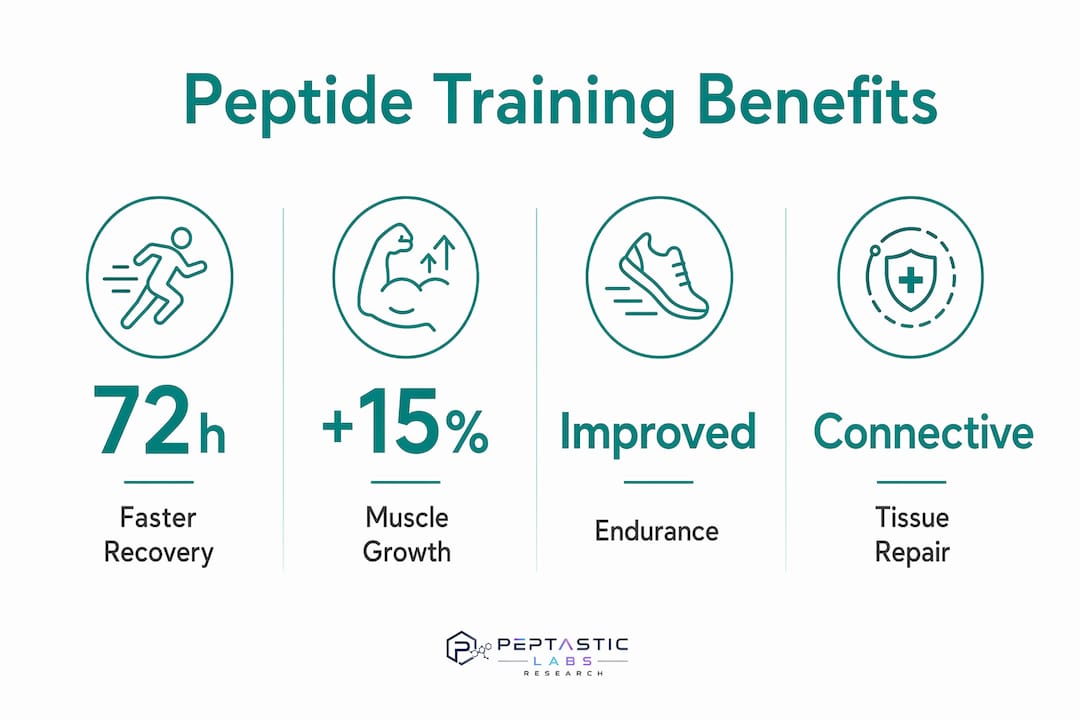
The clearest human evidence for peptides improving aerobic output comes from collagen peptide research. Daily supplementation with 15g of collagen peptides improved 1-hour time-trial performance by 15% and enhanced velocity at both aerobic and anaerobic thresholds in active men. That performance gain is not explained by metabolic improvements alone. The concurrent increase in fat-free mass and strength in collagen peptide groups suggests biomechanical efficiency, specifically improved muscle work economy, as a contributing factor.
Food-derived oligopeptides add another mechanism: fat oxidation. A randomized controlled crossover trial in young male cyclists found that oligopeptide ingestion accelerated total body triglyceride breakdown and increased the fat oxidation rate beginning just 20 minutes after ingestion, continuing through 85 minutes of prolonged exercise. By sparing glycogen stores, this shift extends the time before carbohydrate depletion limits output.
Central fatigue is a third pathway. Food-derived peptides combined with carbohydrates can lower the tryptophan/BCAA ratio after exhaustive exercise, reducing the brain's perception of fatigue and supporting sustained effort. For athletes competing in events lasting longer than 60 minutes, this neurotransmitter-level effect may be as consequential as any peripheral metabolic change.
Statistic callout: 15g of daily collagen peptide supplementation produced a 15% improvement in 1-hour time-trial performance in active men, with gains at both aerobic and anaerobic velocity thresholds.
For deeper context on how these compounds interact with aerobic capacity markers, Peptasticlabs has published a dedicated review on peptides and VO2 max research.
How peptides reduce muscle damage and speed recovery
Delayed onset muscle soreness (DOMS) reduces contractile force and limits training frequency. Peptide supplementation addresses DOMS through two parallel routes: suppressing the pro-inflammatory signaling that drives soreness, and preserving the anabolic markers that support repair.
The NPN_1 (PeptiStrong™) trial is the most controlled human evidence available. At 2.4g/day over 14 days, NPN_1 supplementation significantly improved strength recovery over the 72-hour period post-resistance exercise (p=0.027, measured by peak torque per bodyweight), reduced muscle fatigue (p=0.041), and suppressed myostatin expression (p=0.006). Plasma concentrations of myokines associated with muscle health and glycogen metabolism shifted favorably in the treatment group.
Types of muscle damage and recovery benefits supported by peptide research:
- Reduced eccentric exercise-induced force loss (peak torque recovery)
- Suppressed pro-inflammatory cytokines including IL-6 and TNF-α
- Decreased myostatin expression, reducing the inhibitory signal on muscle repair
- Increased markers of myoblast differentiation and muscle protein synthesis
- Faster restoration of fatigue index (FI) scores at 48 and 72 hours post-DOMS
- Improved training volume sustainability through reduced soreness severity
BPC-157 and TB-500 operate at the connective tissue level rather than the muscle fiber level. Preclinical models show both peptides accelerate tendon and muscle healing, and connective tissue repair via these compounds enables higher training frequency by reducing the downtime between sessions. No human RCTs have yet measured strength outcomes directly, but the tissue repair data supports their use in recovery protocols.
For a detailed breakdown of the molecular mechanisms behind peptide-driven tissue repair, the Peptasticlabs article on muscle repair and peptides covers the pathway-level evidence.
Key safety considerations and clinical guidance for peptide use
Peptides are not uniformly safe, and the risk profile varies substantially by compound class, dose, and individual health status. Growth hormone secretagogues like CJC-1295 with Ipamorelin produce dose-dependent GH increases in human trials, but no RCT has measured strength outcomes, and the long-term consequences of sustained GH elevation remain understudied. Athletes with pre-existing metabolic conditions, insulin resistance, or hormone-sensitive conditions should consult an endocrinologist before use.
Practical clinical guidance and precautions:
- Verify WADA compliance before use in any sanctioned sport; many peptides are explicitly prohibited
- Use only research-grade compounds with documented HPLC purity verification and batch-specific Certificates of Analysis
- Start at the lower end of studied dose ranges; the NPN_1 trial used 2.4g/day, collagen peptide trials used 15g/day
- Time collagen peptide intake before endurance sessions to align with the fat oxidation window observed in cycling trials
- Monitor for injection-site reactions, water retention, and transient insulin sensitivity changes with GH secretagogues
- Avoid combining multiple GH-axis peptides without clinical supervision
- Peptides are adjuncts to progressive overload, not substitutes for structured training
The legal status of peptide use in competitive sports is unambiguous for several compounds. Many synthetic peptides remain banned under WADA's Prohibited List, and athletes must verify compliance for each specific compound before use. Food-derived bioactive peptides from sources like Vicia faba or collagen generally fall outside prohibited categories, but the regulatory landscape shifts annually.
Pro Tip: When sourcing peptides for research purposes, request a batch-specific Certificate of Analysis confirming ≥99% purity via HPLC. Sourcing consistency directly influences outcome reproducibility, and compounds without third-party verification introduce variables that confound any performance assessment.
What does the latest RCT evidence actually show?
The scientific community recognizes the promise of peptides for athletic performance, but calls for more high-quality human RCTs to substantiate claims that currently rest on preclinical or mechanistic data. The trials that do exist show consistent patterns: food-derived and plant-based peptides produce statistically significant recovery and endurance benefits at modest doses, while synthetic peptides show strong mechanistic rationale without matching clinical confirmation.
| Trial | Peptide | Dose | Duration | Primary outcome | Result |
|---|---|---|---|---|---|
| NCT05159375 (RCT) | NPN_1 / PeptiStrong™ | 2.4g/day | 14 days | Strength recovery post-DOMS | Significant improvement (p=0.027) |
| Collagen peptide RCT | Collagen peptides | 15g/day | 12 weeks | 1-hour time-trial performance | 15% improvement |
| LTP resistance trial | Lactotripeptides | High-dose | 4 weeks | Lean body mass, motivation | Significant gains (p=0.031, p=0.043) |
| Cyclist crossover RCT | Food-derived oligopeptides | — | Acute | Fat oxidation rate | Increased from 20 min post-ingestion |
| CJC-1295 human trial | CJC-1295 + Ipamorelin | Variable | Acute | GH levels | Dose-dependent increase; no strength data |
The NPN_1 trial (NCT05159375) is the most methodologically rigorous entry in this table: 30 healthy males, randomized double-blind placebo-controlled design, with biomarker analysis at multiple timepoints. The collagen peptide data is also from controlled human trials, though the specific trial design details vary across publications. CJC-1295 with Ipamorelin sits at the opposite end of the evidence spectrum: confirmed GH elevation, no measured athletic outcome.
Statistic callout: In the NPN_1 double-blind RCT, 2.4g/day supplementation significantly improved strength recovery over 72 hours (p=0.027), reduced fatigue (p=0.041), and suppressed myostatin expression (p=0.006).
Research-grade quality and sourcing consistency critically influence peptide outcomes. Compounds used in the trials above were characterized bioactive peptides with defined activity, not generic protein hydrolysates. Replicating trial outcomes in practice requires the same standard of purity and batch documentation.
What peptide therapy actually delivers for workout performance
Peptide therapy, as distinct from single-compound supplementation, refers to the targeted use of specific bioactive peptides to address defined physiological gaps in an athlete's training response. The benefits documented across human trials cluster around four areas.

Muscle protein synthesis and hypertrophy support. LTP and NPN_1 both increase markers of MPS and myoblast differentiation. Combined with resistance training, this translates to greater lean mass accrual per training cycle than resistance training alone produces in matched controls.
Recovery acceleration. The 72-hour recovery window is the most consistently supported benefit across trials. Faster strength restoration means shorter mandatory rest between high-intensity sessions, which directly increases total training volume over a mesocycle.
Endurance and substrate efficiency. Collagen peptides improve time-trial performance and aerobic threshold velocity. Food-derived oligopeptides shift substrate use toward fat oxidation, extending glycogen availability. Both effects are relevant to any athlete whose sport involves sustained aerobic output.
Connective tissue integrity. BPC-157 and TB-500 support tendon and muscle healing in preclinical models. For athletes managing overuse injuries or training through high-volume phases, connective tissue repair peptides enable training continuity that would otherwise be interrupted by structural breakdown.
Peptides are adjuncts, not replacements for progressive overload. The evidence consistently shows that peptide benefits emerge in the context of structured training, not in sedentary conditions. Athletes who treat peptide therapy as a substitute for training load management will not replicate the outcomes seen in RCTs.
Potential side effects and contraindications to know before you start
Beyond the general safety profile, specific contraindications apply to individual peptide classes and warrant attention before any protocol begins.
Growth hormone secretagogues (CJC-1295, Ipamorelin, GHRP-6). These compounds elevate GH and, consequently, IGF-1. Contraindications include active malignancy or personal history of hormone-sensitive cancer, acromegaly or pituitary disorders, uncontrolled diabetes, and pregnancy. Side effects include water retention, transient insulin resistance, tingling or numbness at injection sites, and morning grogginess from GH pulses during sleep.
BPC-157. Preclinical safety data is favorable, but human trial data on long-term use is absent. Athletes with a history of gastrointestinal conditions should note that BPC-157 is under investigation for GI repair applications, meaning its systemic effects in that context are not fully characterized.
TB-500 (Thymosin Beta-4). WADA-prohibited. Potential for promoting angiogenesis raises theoretical concerns in oncology contexts. No human RCT safety data is available.
Food-derived peptides (collagen, LTP, NPN_1). The most favorable safety profile in the group. Collagen peptides at 15g/day and NPN_1 at 2.4g/day showed no adverse events in published trials. Individuals with dairy allergies should note that LTP is milk-derived.
Cross-class considerations. Stacking multiple GH-axis peptides amplifies both the intended effect and the risk of dysregulating the somatotropic axis. Combining a GHRH analog (CJC-1295) with a GHRP (Ipamorelin) is common in research protocols, but the combined effect on IGF-1 requires monitoring. Athletes with pre-existing cardiovascular conditions should obtain baseline cardiac assessment before initiating any GH-elevating protocol.
How peptide therapy compares to other performance enhancement methods
Peptides occupy a specific position in the performance enhancement spectrum: more targeted than whole protein supplementation, less potent and less risky than anabolic steroids, and more mechanistically specific than most over-the-counter ergogenics.
Versus anabolic androgenic steroids (AAS). AAS produce larger absolute gains in lean mass and strength, but carry well-documented risks including hepatotoxicity, cardiovascular remodeling, endocrine suppression, and psychological effects. Food-derived bioactive peptides produce statistically significant but more modest gains, with a substantially cleaner safety profile. Synthetic peptides like IGF-1 LR3 narrow this gap mechanistically but lack the clinical evidence to confirm equivalent outcomes in humans.
Versus whole protein supplementation. Whey and casein hydrolysates are the closest comparators to bioactive peptide fractions. The distinction is specificity: bioactive peptides are defined sequences with characterized receptor interactions, while whole protein hydrolysates deliver a broad mixture of peptide fragments. The NPN_1 trial explicitly identified two constituent peptides (HLPSYSPSPQ and TIKIPAGT) responsible for MPS upregulation and anti-inflammatory effects, respectively. That level of characterization is not possible with standard protein supplements.
Versus creatine monohydrate. Creatine has the deepest human RCT evidence base of any ergogenic compound. It improves high-intensity, short-duration output through phosphocreatine resynthesis, a mechanism entirely distinct from peptide pathways. The two approaches are complementary rather than competitive.
Versus caffeine and beta-alanine. These are acute ergogenics with well-established dose-response relationships. Peptides generally produce chronic adaptations over days to weeks rather than acute performance shifts. The exception is food-derived oligopeptides, where fat oxidation increases were detectable within 20 minutes of ingestion in the cyclist crossover trial.
The practical conclusion: peptides are most valuable when used to address a specific gap, whether that is recovery rate, connective tissue integrity, or endurance substrate efficiency, rather than as a general performance amplifier. Stacking peptides with creatine, structured nutrition, and progressive overload produces a more defensible protocol than relying on any single intervention.
Key Takeaways
Peptides improve training performance most reliably when matched to a specific physiological target, with food-derived and plant-based compounds offering the strongest human RCT support for recovery, endurance, and lean mass gains.
| Point | Details |
|---|---|
| Strongest RCT evidence | NPN_1 at 2.4g/day improved strength recovery (p=0.027) and reduced fatigue (p=0.041) over 72 hours post-exercise. |
| Endurance gains documented | 15g/day collagen peptides produced a 15% improvement in 1-hour time-trial performance in active men. |
| Myostatin suppression confirmed | NPN_1 suppressed plasma myostatin expression (p=0.006), reducing the primary brake on muscle fiber growth. |
| Synthetic peptides need more data | CJC-1295 and IGF-1 LR3 show mechanistic rationale but lack human RCT evidence for strength or hypertrophy outcomes. |
| Safety varies by compound class | Food-derived peptides carry the cleanest safety profile; GH secretagogues require medical supervision and WADA verification. |
Research-grade peptides from Peptasticlabs

Peptasticlabs supplies over 22 independently tested compounds, each verified to ≥99% purity via HPLC, with batch-specific Certificates of Analysis available on request. For athletes and researchers focused on recovery and connective tissue integrity, TB-500 is available with full third-party documentation. For metabolic and endurance applications, MOTS-c is stocked with the same purity standard. The full catalog of research-grade compounds is accessible at Peptasticlabs, with sourcing transparency built into every order.