
Peptides are defined as short chains of amino acids that act as biological signaling molecules, directing cells to produce collagen, recruit repair cells, and regulate inflammation after tissue damage. The role of peptides in muscle repair centers on two core mechanisms: stimulating collagen synthesis within muscle and connective tissue, and modulating the immune response to reduce excessive post-workout inflammation. Compounds like BPC-157, TB-500, and collagen-derived peptides each target distinct phases of the repair process. Peptasticlabs supplies HPLC-verified, research-grade peptides at ≥99% purity, giving researchers and clinicians a reliable foundation for studying these mechanisms.
How do peptides stimulate collagen synthesis in muscle tissue?
Collagen is the structural backbone of muscle, tendon, and ligament. Without adequate collagen remodeling after exercise-induced damage, tissue integrity declines and injury risk rises. Peptides accelerate this remodeling by acting as both substrate suppliers and molecular signals.
Collagen types and their roles in muscle repair
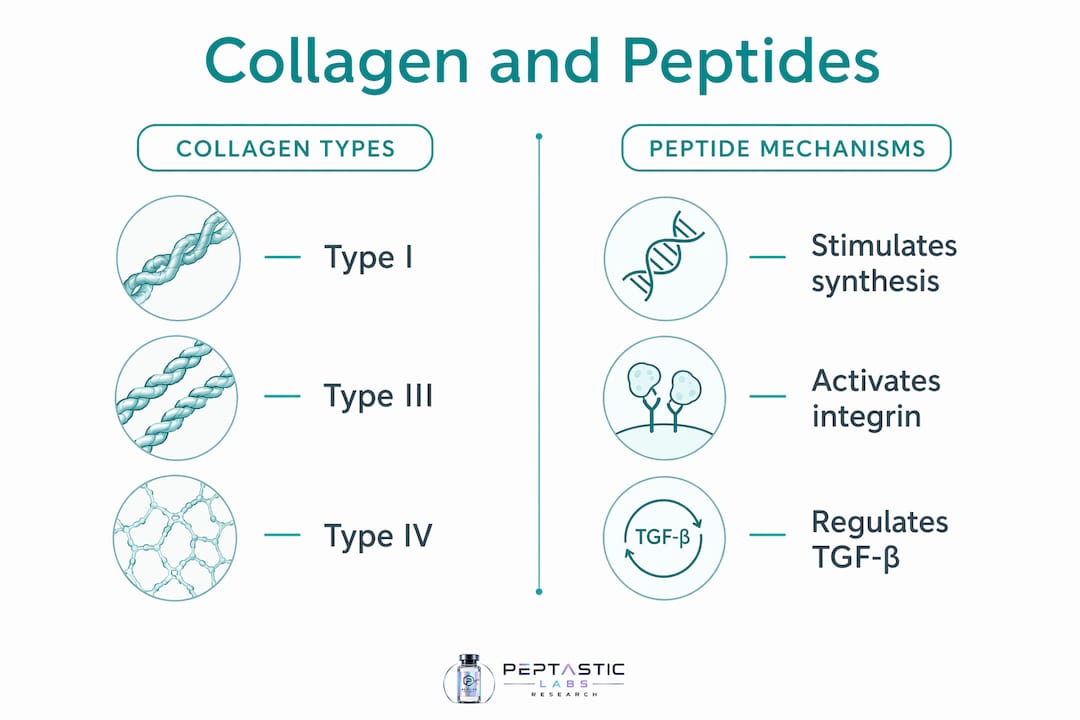
Muscle tissue contains collagen types I, III, and IV. Type I provides tensile strength in tendons and the endomysium. Type III forms the early repair scaffold after acute injury. Type IV anchors the basement membrane surrounding muscle fibers. Each type depends on fibroblast activity and adequate amino acid supply, particularly glycine and proline, to form correctly.
Collagen-derived peptides do more than supply raw amino acids. Research shows they activate integrin, DDR, and TGF-β pathways that directly stimulate fibroblast proliferation and extracellular matrix (ECM) remodeling. This receptor-mediated signaling is what separates bioactive collagen peptides from generic protein supplements.
The clinical evidence for this mechanism is specific. Supplementing with 15 grams of collagen peptides daily combined with 12 weeks of resistance training produced roughly a 3.5-fold greater increase in intramuscular collagen type I content compared to placebo. That result means collagen peptides, when paired with mechanical loading, produce a measurably different structural outcome in muscle tissue.
Fibroblasts and ECM remodeling
Fibroblasts are the primary cells responsible for depositing and organizing collagen in the ECM. Peptides recruit and activate fibroblasts at injury sites, accelerating the transition from the inflammatory phase to the proliferative phase of healing. Without adequate fibroblast activity, collagen deposition is disorganized, producing weaker scar tissue rather than functional matrix.

Pro Tip: Pair collagen peptide supplementation with resistance training sessions rather than rest days. Mechanical load activates the same fibroblast pathways that collagen peptides signal, creating a compounding effect on type I collagen deposition.
| Collagen type | Location | Peptide mechanism |
|---|---|---|
| Type I | Tendon, endomysium | Stimulated by collagen-derived di- and tripeptides via TGF-β |
| Type III | Early repair scaffold | Upregulated during acute inflammatory phase |
| Type IV | Basement membrane | Supports fiber anchorage; influenced by growth factor peptides |
What are the primary peptides used in muscle and connective tissue repair?
Several peptide classes appear consistently in research on tissue healing. They differ in mechanism, target tissue, and delivery route. Understanding these differences matters for anyone evaluating peptides for muscle recovery or rehabilitation protocols.
-
BPC-157 (Body Protection Compound 157): This 15-amino-acid peptide promotes angiogenesis and fibroblast recruitment at injury sites. Angiogenesis, the formation of new blood vessels, is critical for delivering oxygen and nutrients to healing tissue. BPC-157 also shows activity in tendon and ligament models, making it relevant to the role of peptides in ligament repair and tendon healing. Peptasticlabs lists BPC-157 as an independently tested compound verified to ≥99% purity.
-
TB-500 (Thymosin Beta-4): TB-500 enhances cell migration by upregulating actin polymerization. Actin is the cytoskeletal protein that allows cells to move toward injury sites. This mechanism makes TB-500 particularly relevant for muscle fiber regeneration and connective tissue repair. Peptasticlabs also carries TB-500 with full batch documentation.
-
Growth hormone secretagogues (GHS): Peptides like GHRP-2 and ipamorelin stimulate the pituitary to release growth hormone, which in turn activates IGF-1 pathways. IGF-1 drives satellite cell proliferation, the process by which muscle fibers regenerate after damage. These peptides produce systemic effects rather than localized tissue action.
-
Collagen-derived peptides: These are orally bioavailable fragments from hydrolyzed collagen. They act locally in connective tissue by signaling fibroblasts and providing glycine and proline for new collagen synthesis. Their oral delivery route distinguishes them from injectable peptides in terms of safety profile and regulatory status.
The distinction between systemic and localized effects matters practically. Injectable peptides like BPC-157 and TB-500 target specific injury sites when administered locally, but carry greater regulatory and safety complexity. Oral collagen peptides produce systemic amino acid availability with localized receptor signaling, making them more accessible for general fitness use.
What does current research say about peptide therapy efficacy and safety?
The evidence base for peptide therapy in muscle and tissue repair is uneven. Collagen peptides have the strongest human data. Injectable regenerative peptides have promising preclinical results but limited clinical validation.
The clinical reality: Injectable peptides for musculoskeletal recovery carry mostly Level V evidence and a Strength of Recommendation Taxonomy grade C. No completed Phase 2 or Phase 3 human trials exist for BPC-157 or TB-500 in muscle, tendon, or ligament repair. Rodent models show clear mechanistic benefits, but translating those results to human clinical outcomes remains unproven.
This gap between preclinical promise and clinical evidence is the defining challenge in this field. Researchers and clinicians must weigh the mechanistic plausibility of these peptides against the absence of controlled human trial data.
Safety and regulatory concerns add another layer of complexity. Many injectable peptides are banned substances under World Anti-Doping Agency (WADA) rules. Athletes using these compounds face antidoping violations regardless of therapeutic intent. Beyond doping concerns, unregulated peptide products frequently lack standardized dosing, verified purity, and consistent batch quality. These variables make it difficult to draw reliable conclusions from self-reported outcomes.
Pro Tip: When evaluating any peptide product for research purposes, request a Certificate of Analysis (CoA) confirming HPLC-verified purity. Products without third-party verification introduce uncontrolled variables that compromise research validity. Peptasticlabs provides CoAs on request for all compounds in its catalog.
The role of peptides in post-workout inflammation is better supported mechanistically than clinically. BPC-157 and TB-500 both show anti-inflammatory activity in animal models, but human dose-response data is absent. Collagen peptides show consistent human evidence for structural outcomes, making them the most defensible choice for fitness and rehabilitation applications at present.
How are advanced delivery systems changing peptide therapy for tissue repair?
The next generation of peptide therapy moves beyond systemic injection toward localized, stage-specific delivery. This shift addresses the core limitation of injectable peptides: systemic exposure with unpredictable tissue distribution.
-
Peptide-loaded hydrogels: Bio-engineered hydrogels enable controlled, localized peptide release with sustained delivery at the injury site. This approach maintains therapeutic concentrations in target tissue without systemic side effects. Hydrogels can be designed to degrade at rates matching the healing timeline.
-
Immune microenvironment modulation: Nano-engineered hydrogels like CAPP@IGF-1 promote macrophage polarization from pro-inflammatory M1 states to pro-reparative M2 states. This shift is critical for ordered tissue regeneration. Uncontrolled M1 activity prolongs inflammation and disrupts collagen organization.
-
Scaffold-guided stem cell differentiation: Nanotopography within engineered scaffolds provides physical cues that direct tendon stem cell differentiation toward tenocyte lineages. Combined with peptide signaling, these scaffolds produce more organized matrix remodeling than peptides alone.
-
Stage-specific intervention: Smart biomaterials respond to local injury environments, releasing different peptide payloads during the inflammatory, proliferative, and remodeling phases. This matches the biological timing of repair rather than delivering a fixed dose.
The advantage of localized delivery over systemic injection is clear: higher tissue concentrations, lower systemic exposure, and better alignment with the repair timeline. For the role of peptides in tendon healing and ligament repair specifically, localized hydrogel delivery represents a meaningful advance over current injectable protocols.
| Delivery method | Tissue targeting | Systemic exposure | Evidence stage |
|---|---|---|---|
| Systemic injection | Low | High | Preclinical/Level V |
| Localized injection | Moderate | Moderate | Preclinical/Level V |
| Peptide-loaded hydrogel | High | Minimal | Preclinical/emerging |
| Oral collagen peptides | Moderate | Moderate | Human RCT data available |
How can fitness and rehabilitation professionals apply peptide research practically?
Current evidence supports a clear hierarchy for practical peptide use. Collagen peptides have the strongest data and the lowest risk profile. Injectable peptides remain experimental and require medical supervision.
- Combine collagen peptides with resistance training. The 3.5-fold increase in intramuscular collagen type I content observed in research occurred only when supplementation was paired with mechanical loading. Collagen peptides without exercise produce a smaller structural response.
- Prioritize protein intake alongside peptide supplementation. Peptides function as signaling molecules and substrate suppliers. Insufficient total protein intake limits the raw material available for collagen synthesis regardless of peptide signaling.
- Treat injectable peptides as experimental. BPC-157 and TB-500 lack the human trial data needed to support clinical recommendations. Use them only under medical supervision and with full awareness of antidoping implications. Reviewing peptide types and uses before making protocol decisions is a practical starting point.
- Use peptides as adjuncts, not replacements. Rehabilitation fundamentals, progressive loading, adequate sleep, and nutrition, remain the primary drivers of tissue repair. Peptides enhance these processes. They do not replace them.
- Verify product quality before use in research. Unregulated products introduce purity and dosing variables that invalidate research outcomes. HPLC-verified compounds with documented batch records are the minimum standard for credible research.
Key Takeaways
Collagen peptides combined with resistance training produce measurably greater intramuscular collagen content than training alone, making them the most evidence-supported peptide intervention for muscle repair.
| Point | Details |
|---|---|
| Collagen peptides + resistance training | 15 g daily with 12 weeks of training produces a ~3.5-fold increase in collagen type I content. |
| BPC-157 and TB-500 mechanisms | Both promote fibroblast recruitment and cell migration but lack completed Phase 2 or 3 human trials. |
| Injectable peptide risks | WADA bans many injectable peptides; unregulated products carry unknown purity and dosing risks. |
| Advanced delivery systems | Peptide-loaded hydrogels enable localized, stage-specific release with minimal systemic exposure. |
| Practical application | Use peptides as adjuncts to rehabilitation fundamentals, not as stand-alone treatments. |
The gap between promise and proof in peptide research
The science of peptides for muscle and tissue repair is genuinely interesting. The mechanistic logic is sound: short amino acid chains that activate fibroblasts, stimulate collagen synthesis, and modulate macrophage behavior address the exact biological bottlenecks in tissue healing. The problem is that marketing has moved far ahead of clinical evidence.
I have seen this pattern repeatedly in emerging therapeutic areas. A compound shows strong results in rodent models. Researchers identify a plausible mechanism. The fitness and sports medicine communities adopt it widely before Phase 2 trials are complete. The result is a large population of people using compounds with uncertain human dose-response profiles and real antidoping exposure.
The honest position is this: collagen peptides are ready for practical use in fitness and rehabilitation contexts. The human evidence is there. Injectable peptides like BPC-157 and TB-500 are worth watching closely, particularly as stage-specific delivery technologies mature. But they are not ready for routine clinical recommendation. The researchers and clinicians who will get the most value from this field are those who hold both truths at once: genuine promise in the mechanism, genuine uncertainty in the human evidence.
— Tintastic
Peptasticlabs: research-grade peptides for tissue repair studies
Researchers studying muscle repair with peptide therapy need compounds that perform consistently across experiments. Batch variability, undisclosed impurities, and missing documentation are the most common sources of unreliable results in peptide research.

Peptasticlabs supplies over 22 independently tested compounds, including BPC-157, TB-500, and collagen-related peptides, each verified to ≥99% purity via HPLC and supported by Certificates of Analysis on request. Every batch undergoes in-house checks followed by third-party verification. For researchers studying the role of peptides in tissue healing, that documentation standard removes a significant variable from the experimental design. Access the full research-grade peptide catalog or review the peptide research resources to match compounds to your study protocol.
FAQ
What is the role of peptides in muscle repair?
Peptides stimulate collagen synthesis, recruit fibroblasts, and regulate inflammation to accelerate structural repair in muscle and connective tissue. They act as both signaling molecules and substrate suppliers for ECM remodeling.
Do collagen peptides actually improve muscle recovery?
Yes, when combined with resistance training. Research shows 15 g of collagen peptides daily for 12 weeks produces roughly a 3.5-fold greater increase in intramuscular collagen type I content compared to placebo.
Are BPC-157 and TB-500 safe for muscle repair?
Both peptides show promising mechanisms in preclinical models, but no completed Phase 2 or Phase 3 human trials exist. They carry antidoping risks under WADA rules and should only be used under medical supervision.
How do peptides help with tendon and ligament healing?
Peptides like BPC-157 promote angiogenesis and fibroblast recruitment at injury sites, which supports tendon and ligament repair. Advanced hydrogel delivery systems now enable localized peptide release directly at the injury site for more targeted effects.
What should I look for in a research-grade peptide product?
Require HPLC-verified purity at ≥99%, third-party testing, and a Certificate of Analysis for each batch. Products without this documentation introduce uncontrolled variables that compromise research validity.