
A peptide buying guide checklist is a structured verification tool that ensures every purchase meets documented purity, sourcing, and legal standards before any compound reaches your hands. The stakes are real: substandard peptides carry impurities, truncated sequences, and degradation risks that undermine both safety and results. This guide covers the five essential documents suppliers must provide, how to vet vendor legitimacy, which peptides suit immune support and fitness goals, and a step-by-step purchase sequence. Peptasticlabs verifies every compound to ≥99% purity via HPLC, setting the documentation standard this checklist is built around.
1. What documents to verify before buying peptides
Five documents define a high-reliability peptide supplier. 2026 guidelines require a Certificate of Analysis (COA), HPLC chromatogram, Mass Spectrometry (MS) data, Sterility/Endotoxin testing results, and a Safety Data Sheet (SDS). A vendor missing any one of these documents is a vendor worth skipping.
Certificate of Analysis (COA): The COA is the primary quality document. It must be batch-specific, meaning the batch number on the document matches the number printed on your vial. A "representative" COA reused across multiple lots signals inadequate quality control. Review the COA verification process before you place any order.

HPLC chromatogram: High-Performance Liquid Chromatography measures purity by separating peptide components and quantifying each peak. Research-grade peptides require a minimum purity of 98%, with the actual chromatogram shown. Purity below 95% indicates impurities and truncated sequences that compromise effectiveness.
Mass Spectrometry (MS) data: MS confirms the molecular weight of the compound, verifying you received the correct peptide sequence. Without MS data, there is no way to confirm molecular identity from the COA alone.
Sterility and Endotoxin testing: Injectable peptides require endotoxin testing to prevent adverse reactions including inflammation and injection-site complications. Not all vendors test for endotoxins. Presence of this test result indicates a higher-quality supplier.
Safety Data Sheet (SDS): The SDS covers handling, storage, and hazard information. It is a standard document in any regulated laboratory supply chain and should be available on request.
| Document | What It Confirms | Red Flag |
|---|---|---|
| Certificate of Analysis | Batch purity and identity | Reused or undated COA |
| HPLC chromatogram | Purity percentage with visual data | No chromatogram shown |
| Mass Spectrometry data | Correct molecular weight | Missing or generic MS report |
| Endotoxin/Sterility test | Safe for injection use | Absent for injectable compounds |
| Safety Data Sheet | Handling and storage requirements | Not available on request |
Pro Tip: Contact the testing laboratory directly, using the contact information listed on the COA, to confirm the batch number and document authenticity. Experienced buyers treat this as a standard step, not an optional one.
2. How to assess peptide supplier legitimacy
Vendor legitimacy is the second pillar of any solid purchase guide. Reliable peptide vendors display transparent business registration, a physical address, responsive customer service, and multiple payment methods with buyer protections. Vendors who accept only cryptocurrency with no verifiable contact information represent high risk.
Evaluate these signals before purchasing:
- Business registration: Confirm the company is registered in a known jurisdiction with a searchable business record.
- Physical address: A verifiable address, not a P.O. box, indicates an established operation.
- Customer service responsiveness: Send a pre-purchase question and measure response time and quality.
- Payment methods: Credit card or PayPal payments offer chargeback protections. Crypto-only payment removes all buyer recourse.
- Cold-chain shipping: Peptide sensitivity to heat and moisture makes cold-chain shipping a non-negotiable for product stability. Domestic sourcing reduces transit time and degradation risk compared to overseas dropshipping.
- Website transparency: Published lab partnerships, named staff, and clear return policies all indicate a legitimate operation.
Licensed compounding pharmacies operating under clinician oversight represent the most regulated access pathway for personal use. Compounded peptides are legal under clinician prescription but are not FDA-approved drugs. That distinction matters for both legal compliance and safety expectations.
Pro Tip: Search the vendor's business name in your state's business registry and cross-reference the address on Google Maps. A warehouse that does not exist at the listed address is an immediate disqualifier.
Learn how to identify substandard suppliers with this low-quality peptide guide before committing to any source.
3. Peptide selection for immune support and fitness goals
Matching a peptide to a specific goal is the step most buyers skip. The immune system is a multi-layered network, and effective peptide use requires matching compounds to specific immune layers rather than expecting a single compound to act as a universal booster.
The most studied immune-support peptides include:
- Thymosin Alpha-1: Approved in 35+ countries and available in the US through compounding pharmacies following the 2026 FDA reclassification. It modulates T-cell activity and carries a strong safety profile built on decades of clinical use. Best suited for general immune insufficiency and immunosenescence.
- LL-37: Offers direct antimicrobial activity but carries a short half-life and potential cytotoxicity at high doses. Currently research-only with no FDA approval. Requires careful dosing protocols.
- BPC-157: Primarily studied for tissue repair and gut health, with secondary anti-inflammatory effects relevant to immune modulation.
- KPV: A tripeptide with anti-inflammatory properties, studied in gut and skin inflammation contexts.
- VIP (Vasoactive Intestinal Peptide): Modulates immune response in inflammatory and autoimmune contexts, requiring clinician oversight given its systemic effects.
Safety profiles vary significantly across this group. Thymosin Alpha-1 is well-tolerated with decades of data. Antimicrobial peptides like LL-37 can cause cytotoxicity at elevated doses. Combining peptides without clinical guidance increases the risk of adverse effects. Baseline labs and clinician supervision are the standard for any immune-focused protocol. Read the full peptide immune modulation guide for protocol-level detail.
For fitness optimization, peptides targeting tissue repair, metabolic function, and recovery follow the same documentation requirements. The application changes; the quality verification standard does not.
4. Step-by-step peptide buying checklist for personal use
This sequence consolidates every prior section into a purchase-ready workflow.
- Define your goal. State the specific outcome you are targeting: immune support, tissue repair, metabolic function, or research documentation. A vague goal produces a vague selection.
- Identify the appropriate compound. Match the peptide to your goal using peer-reviewed literature or clinician guidance. Confirm the legal status of that compound in your jurisdiction.
- Verify the five documents. COA, HPLC chromatogram, MS data, Endotoxin/Sterility results, and SDS. Reject any vendor who cannot supply all five on request.
- Confirm batch-specific COA. The batch number on the COA must match the vial. Contact the listed laboratory to verify authenticity independently.
- Vet the vendor. Check business registration, physical address, payment options, and cold-chain shipping capability. Avoid crypto-only or anonymous vendors.
- Confirm legal access pathway. For personal use, compounding pharmacy access under a clinician prescription is the compliant route in the US. Understand that compounded peptides are not FDA-approved drugs.
- Review storage and reconstitution requirements. Most lyophilized peptides require refrigeration at 2–8°C before reconstitution and freezing at -20°C for long-term storage. Bacteriostatic water is the standard reconstitution agent.
- Establish a monitoring baseline. Get baseline labs before starting any protocol. This allows you to measure response and catch adverse signals early.
- Budget for quality, not price. The cheapest peptide on the market is rarely the most cost-effective. Impure compounds waste money and carry health risk. Quality documentation costs more to produce and is worth paying for.
- Reassess at each reorder. Request a fresh COA for every new batch. Purity can vary between lots even from the same supplier.
Pro Tip: Ask the vendor specifically whether the COA on their website is batch-specific or a "representative" sample. The answer tells you immediately how seriously they treat quality control.
Key takeaways
A thorough peptide buying guide checklist requires five verified documents, a vetted vendor with cold-chain capability, and a peptide matched to a specific, legally compliant application.
| Point | Details |
|---|---|
| Five documents are non-negotiable | COA, HPLC, MS data, Endotoxin testing, and SDS must all be available before purchase. |
| Batch-specific COA is the standard | The COA batch number must match the vial; reused COAs indicate poor quality control. |
| Vendor legitimacy has measurable signals | Business registration, physical address, and buyer-protected payment methods separate reliable vendors from risky ones. |
| Peptide selection requires goal matching | Immune-support peptides like Thymosin Alpha-1 and LL-37 differ in mechanism, safety, and legal status. |
| Legal access pathway matters | Compounded peptides require a clinician prescription and are not FDA-approved drugs. |
What I've learned about buying peptides that most guides skip
The peptide market rewards buyers who treat documentation as the product, not the packaging. Most buyers focus on the compound name and the price. The experienced ones focus on the COA batch number and the lab contact details.
The most common mistake I see is treating a COA as a checkbox rather than a verifiable document. A COA is only as credible as the lab that issued it. Calling that lab takes five minutes and eliminates the single largest fraud vector in the market.
The second mistake is underestimating cold-chain failure. A peptide that shipped at ambient temperature through a hot-climate transit hub may test at 98% purity on paper and perform at 70% in practice. Domestic sourcing with verified cold-chain handling is not a premium feature. It is a baseline requirement.
Regulatory complexity will increase, not decrease. The 2026 FDA reclassification of certain compounded peptides opened access pathways but did not simplify the compliance picture. Buyers who stay informed through clinician relationships and reputable research communities will navigate future changes better than those who rely on vendor marketing alone.
— Tintastic
Peptasticlabs: documented peptides for serious researchers
Peptasticlabs supplies research-grade peptides verified to ≥99% purity via HPLC, with full batch-specific documentation available on request. Every compound in the catalog ships with a COA, HPLC chromatogram, MS data, and Endotoxin/Sterility results, meeting the five-document standard this checklist requires.
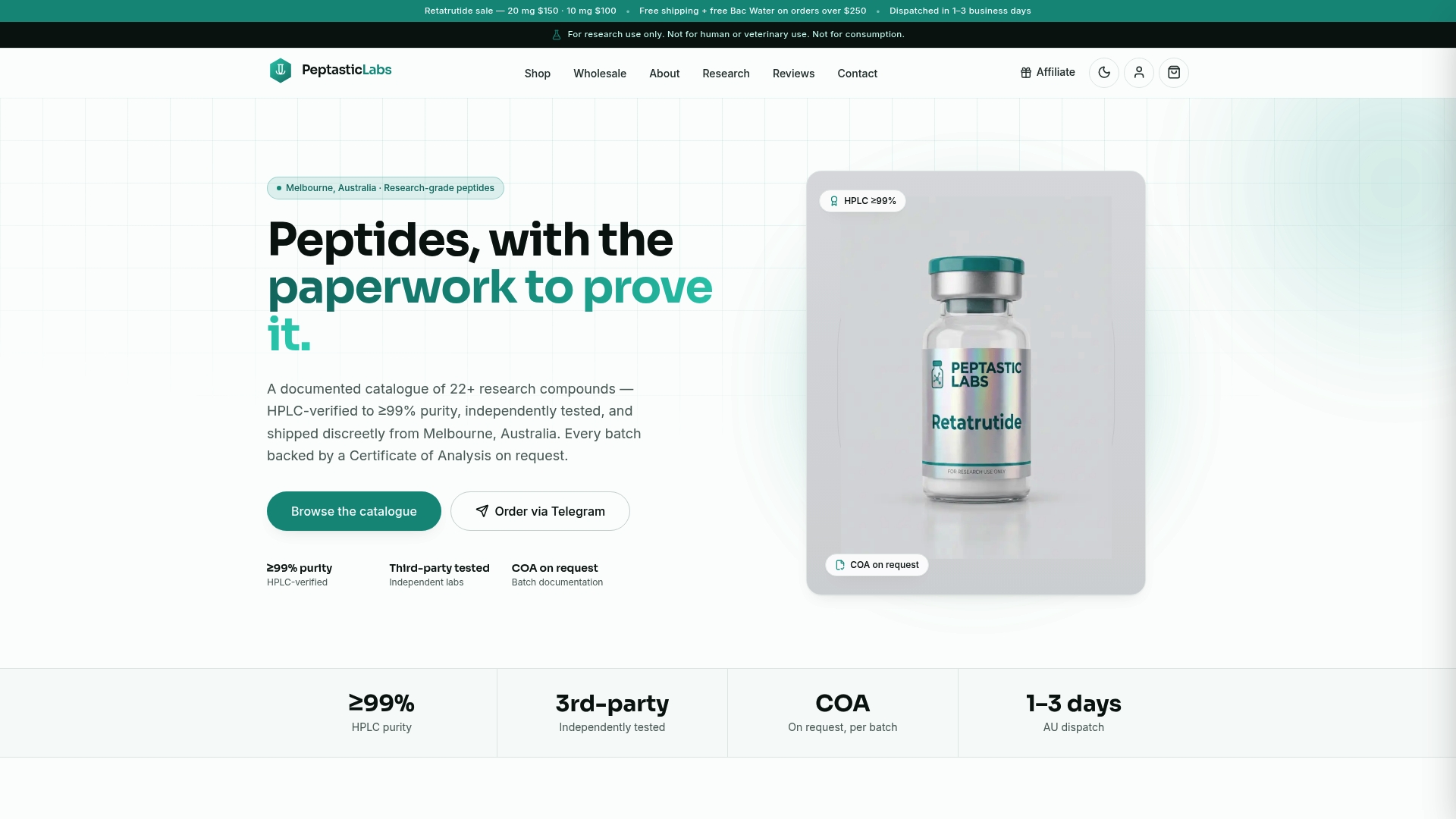
The catalog covers over 22 independently tested compounds across metabolic, cognitive, tissue repair, longevity, immunology, and cosmetic applications. Third-party verification and transparent batch documentation are standard, not optional. Researchers who need verified, traceable compounds without sourcing uncertainty can browse the full catalog or review the research-grade compound library directly.
FAQ
What is the minimum purity standard for research-grade peptides?
Research-grade peptides require a minimum purity of 98% verified by HPLC, with the actual chromatogram provided. Purity below 95% indicates impurities and truncated sequences that compromise compound effectiveness.
How do I verify a COA is legitimate?
Confirm the batch number on the COA matches the number on your vial, then contact the listed testing laboratory directly to verify the document's authenticity. Reused or undated COAs are a major red flag.
Are compounded peptides legal for personal use in the US?
Compounded peptides are legal under a clinician prescription but are not FDA-approved drugs. Access pathways vary by jurisdiction, and the 2026 FDA reclassification changed availability for specific compounds without granting formal drug approval.
Why does cold-chain shipping matter for peptides?
Peptides degrade when exposed to heat and moisture during transit. Cold-chain shipping preserves stability and efficacy, and domestic sourcing reduces the transit time and temperature exposure risk compared to overseas dropshipping.
What makes Thymosin Alpha-1 the most validated immune-support peptide?
Thymosin Alpha-1 is approved in 35+ countries, has decades of clinical use data, and modulates T-cell activity with a well-established safety profile. It is available in the US through compounding pharmacies following the 2026 FDA reclassification.