What are the main examples of Australian peptide research use?
Australian peptide research spans clinical therapeutics, native fauna bioprospecting, and regulated pharmaceutical applications. The clearest examples include Tadendocor (TDT), a chimeric natriuretic peptide derived from snake venom now under study for congestive heart failure; insulin, the foundational therapeutic peptide used in diabetes management; GLP-1 receptor agonists such as Ozempic, widely prescribed for diabetes and weight management; and Melanotan II, an unapproved synthetic peptide circulating in grey markets. Each sits at a different point on the regulatory spectrum, from fully TGA-approved to explicitly prohibited for human use.
Key peptide examples and their Australian research or clinical contexts:
- Tadendocor (TDT): Chimeric natriuretic peptide from snake venom; studied for heart failure treatment with enhanced oral stability via mini-PEGylation
- Insulin: Approved therapeutic peptide; cornerstone of diabetes management across Australian clinical practice
- GLP-1 agonists (e.g., Ozempic/semaglutide): TGA-approved; prescribed for type 2 diabetes and obesity; suppresses hunger and slows gastric emptying
- Melanotan II: Synthetic tanning peptide; unapproved by TGA; widely circulated online despite regulatory restrictions
- BPC-157: Promoted for tissue repair and gut recovery; not TGA-approved; classified as a Schedule 4 poison
- GHK-Cu: Marketed for collagen production and anti-aging; no TGA approval; human clinical evidence is limited
- JCU303: A 24-mer wound-healing peptide developed at James Cook University from the Ov-GRN-1 protein; shows faster healing rates in animal studies
The Therapeutic Goods Administration (TGA) and institutions including the ARC Centre for Innovations in Peptide and Protein Science (CIPPS) anchor Australia's formal research infrastructure in this field.
How do peptides work, and why do they matter for Australian health research?
Peptides are short chains of amino acids, typically fewer than 50 residues, that act as biological signals throughout the body. They regulate hormonal pathways, metabolic processes, immune responses, and tissue repair. Because they are smaller than full proteins, they can be synthesized with high precision and modified to improve stability or receptor selectivity.
The role of peptides in Australian health research is grounded in these functions. Insulin controls blood glucose by signaling cells to absorb glucose from the bloodstream. GLP-1 receptor agonists mimic a gut hormone that suppresses appetite and slows digestion, making them effective for both diabetes control and weight management. Natriuretic peptides like TDT act on cardiac receptors to reduce fluid overload in heart failure patients.
Peptides can be natural, extracted from biological sources, or fully synthetic. Australian researchers increasingly work with both. Native fauna venoms, for example, contain peptides shaped by millions of years of evolutionary pressure, giving them unusual stability and receptor specificity that synthetic analogs often lack. That biological resilience is a core reason Australian institutions invest heavily in venom-based peptide discovery.
Understanding peptide types and uses is foundational before evaluating any specific compound's research or clinical potential.
What is the regulatory status of peptides in Australia, and what are the safety risks?
The TGA regulates all peptide products intended for therapeutic use in Australia. Approved peptides, including insulin and GLP-1 agonists, are classified as prescription medicines and must be accessed through a qualified health professional. Unapproved peptides such as BPC-157, TB-500, and GHK-Cu are listed as Schedule 4 poisons, meaning their sale for human use is unlawful without TGA authorization.
The TGA has intensified crackdowns amid rising imports and social media-driven demand for unregulated injectable peptides. Despite this, many products remain accessible online, often shipped from overseas vendors with minimal identity verification.
"Many of the products now being advertised or sold online are not approved by the Therapeutic Goods Administration (TGA), meaning they haven't been assessed for safety, quality or effectiveness." — University of Queensland, 2026
A critical gap compounds the enforcement challenge. Clinicians report an absence of centralized peptide usage data in Australia, which makes tracking adverse events from self-prescribed compounds extremely difficult. Medical professionals face real uncertainty when patients present with complications from substances that have no established dosing protocols or long-term safety data.
The "research use only" label, commonly applied by online vendors, does not confer legal authorization for human use in Australia. These products may contain contaminants and are not manufactured to clinical-grade standards. The label is a commercial workaround, not a regulatory classification.
How are social media and grey markets driving peptide use trends in Australia?
Social media is the primary engine behind Australia's grey market peptide boom. Influencers inject peptides on camera, post referral links, and describe outcomes in terms that mirror pharmaceutical marketing without any of the clinical accountability. The products they promote, including BPC-157, TB-500, CJC-1295, and retatrutide, are largely unapproved and unassessed for human safety.
"Social media is crucial to this market and driving sales. Influencers push referral links and promote products by injecting them online and telling people how they will make their skin glow." — University of Queensland, 2026
The grey market operates through a specific mechanism. Vendors label products as "research chemicals" or "for research use only," a loophole originally exploited in the United States that does not carry legal weight in Australia. Yet the packaging, dosing instructions, and marketing language clearly anticipate human use. Sellers typically promise rapid shipping and purity claims such as "99%+ tested" without independent verification.
Current Australian usage patterns across the grey market include:
- Weight loss: GLP-1 mimetics and experimental compounds like retatrutide promoted as alternatives to prescription medications
- Muscle growth: CJC-1295 and growth hormone secretagogues marketed to fitness communities
- Anti-aging and skin repair: GHK-Cu and BPC-157 sold with collagen and rejuvenation claims
- Injury recovery: TB-500 promoted for tendon and muscle repair, despite absent human trial data
- Tanning: Melanotan II widely circulated despite TGA prohibition
Health experts warn that consumers self-experimenting with these compounds are risking their health on substances with no verified safety profile for humans. The gap between social media claims and peer-reviewed evidence is wide, and Australia currently lacks the coordinated surveillance infrastructure to track harms as they emerge.
What are the most groundbreaking examples of Australian peptide research?
Australian institutions are producing some of the most structurally novel peptide candidates in current biomedical science. The research draws on native fauna, advanced proteomics, and genomic screening to identify compounds with properties that conventional synthetic chemistry rarely achieves.
| Peptide Candidate | Source Species / Origin | Therapeutic Target |
|---|---|---|
| Tadendocor (TDT) | Snake venom (chimeric) | Congestive heart failure |
| JCU303 | Opisthorchis viverrini parasite | Chronic wound healing |
| Tarantula venom peptides | Australian tarantulas | Analgesics, ion channel modulation |
| Box jellyfish peptides | Chironex fleckeri | Cardiovascular and pain pathways |
| Platypus venom peptides | Ornithorhynchus anatinus | Metabolic and pain research |
Tadendocor represents the most clinically advanced example. Developed using a mini-PEGylation modification, TDT exhibits enhanced stability and potency compared to native natriuretic peptides, with the PEG groups extending its half-life and enabling oral delivery without losing receptor activity. That combination, oral bioavailability plus retained potency at human cardiac receptors, is rare among peptide therapeutics.
"The evolutionary resilience of native Australian venom peptides offers a unique advantage for developing stable therapeutic peptides with high efficacy." — ARC Centre for Innovations in Peptide and Protein Science (CIPPS)
James Cook University's JCU303 peptide, derived from a wound-healing protein secreted by the liver fluke Opisthorchis viverrini, showed 20% faster healing than the nearest comparator in animal studies. The peptide stimulates fibroblast migration, collagen production, and re-vascularization, with potential applications in diabetic foot ulcers, pressure ulcers, and surgical wounds.
Australian researchers also use advanced proteomic and genomic methods to screen venom libraries from tarantulas, box jellyfish, and platypus. These species produce peptides shaped by extreme evolutionary pressure, giving them structural stability that synthetic analogs rarely match. CIPPS, funded through the Australian Research Council, coordinates much of this bioprospecting work and operates as a national hub for peptide discovery. Researchers working with biospecimen and proteomic services increasingly rely on this type of infrastructure to move from venom library screening to validated therapeutic candidates.

How should researchers and consumers approach peptide use safely in Australia?
Safety in the Australian peptide context comes down to one clear distinction: TGA-approved compounds with clinical trial data versus unapproved compounds sold online with no verified human safety profile. Crossing that line without medical supervision carries real risk.
Practical guidance for researchers and informed consumers:
- Source from verified suppliers only. Research-grade peptides should carry a Certificate of Analysis (CoA) confirming purity, ideally ≥99% via HPLC, with batch-specific documentation from a third-party laboratory.
- Do not treat "research use only" as a safety endorsement. That label does not mean a compound is safe, legal, or quality-controlled for human use in Australia.
- Consult a qualified health professional before using any peptide therapeutically. Approved peptides such as insulin and GLP-1 agonists require a prescription for a reason.
- Review the CoA critically. Check that the testing method is HPLC or mass spectrometry, that the purity figure applies to the specific batch, and that the issuing laboratory is independent of the supplier.
- Monitor for adverse effects. Unregulated peptides carry unknown interaction profiles. Any injection-site reaction, systemic symptom, or unexpected physiological change warrants immediate medical review.
- Use evidence-based sources. The TGA, University of Queensland, and UNSW publish current guidance on approved and unapproved peptides. Social media influencers do not.
Pro Tip: When evaluating a peptide supplier, request the CoA before purchasing. A legitimate research-grade supplier provides batch-specific HPLC data on request, not just a generic purity claim on the product page.
Research-grade peptide standards are not uniform across suppliers. Purity claims without independent verification are common in the grey market, and "99% pure" printed on a label carries no weight without a traceable CoA from an accredited third-party lab.
Peptasticlabs: research-grade peptides for verified scientific work
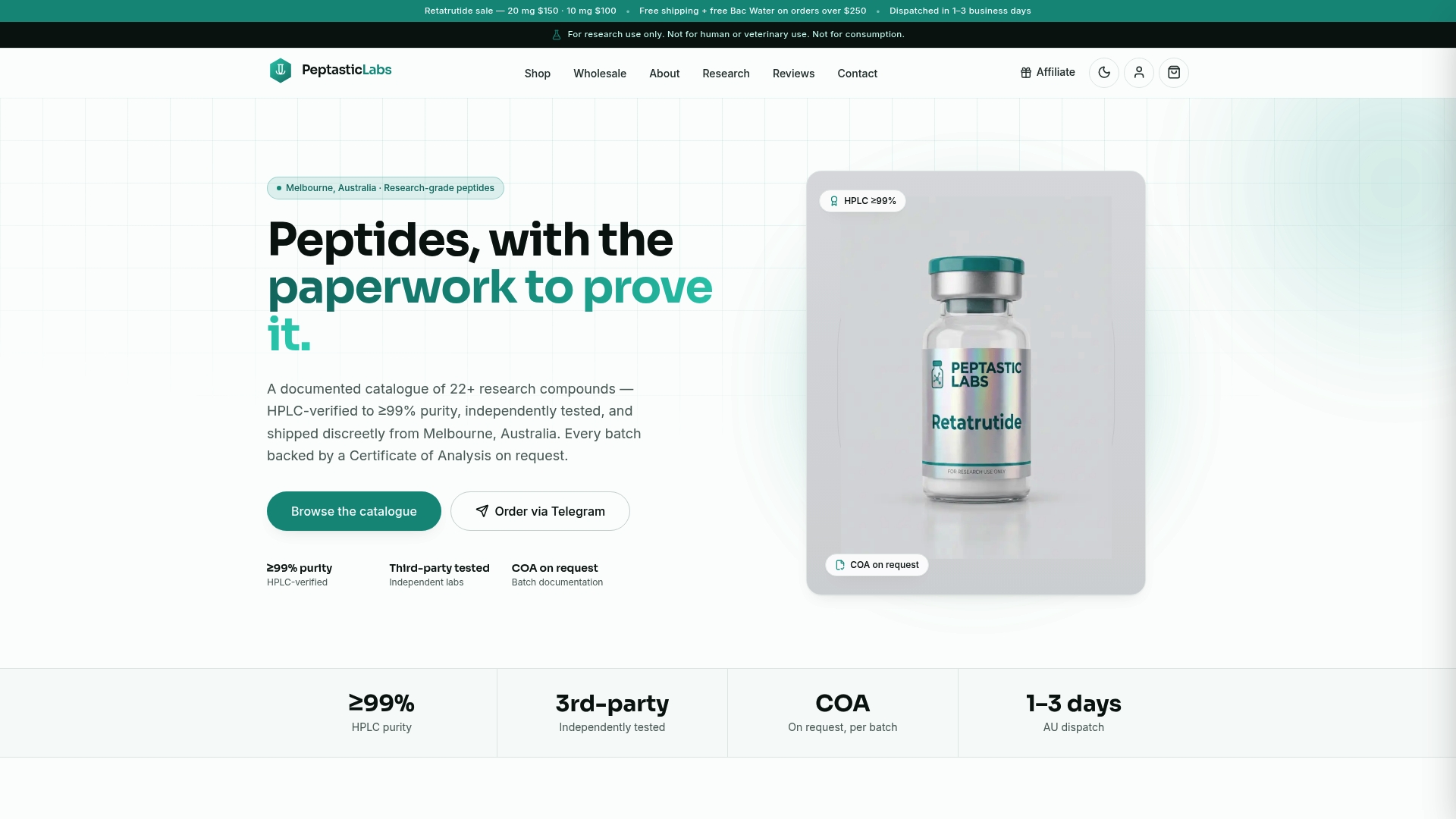
Peptasticlabs supplies over 22 independently tested peptide compounds, each verified to ≥99% purity via HPLC with full batch documentation. Certificates of Analysis are available on request, and every compound undergoes third-party verification before release. For researchers who need documented, traceable compounds across metabolic, cognitive, tissue repair, longevity, immunology, and cosmetic applications, Peptasticlabs provides the sourcing infrastructure that grey-market vendors cannot. Visit Peptasticlabs to review the current catalog and request CoA documentation.
Key Takeaways
Australian peptide research spans TGA-approved clinical compounds, groundbreaking venom-derived therapeutics, and a growing grey market of unapproved substances that carry real safety risks for self-experimenting consumers.
| Point | Details |
|---|---|
| Approved vs. unapproved peptides | Insulin and GLP-1 agonists are TGA-approved; BPC-157, Melanotan II, and TB-500 are not authorized for human use in Australia. |
| Tadendocor (TDT) significance | Mini-PEGylation gives TDT oral bioavailability and extended half-life, making it a next-generation heart failure candidate derived from snake venom. |
| Grey market risk | "Research use only" labels do not confer legal or safety authorization in Australia; products may contain contaminants absent in regulated compounds. |
| Surveillance gap | No centralized Australian database tracks peptide use patterns or adverse events, complicating clinical management of self-prescribed compounds. |
| CoA verification | Researchers should request batch-specific HPLC data from an independent laboratory before using any research-grade peptide compound. |