
Peptides are classified as Schedule 4 prescription-only medicines in Australia, meaning you cannot legally purchase, possess, or use them without a valid prescription from a registered medical practitioner. The Therapeutic Goods Administration (TGA) enforces this classification under the Australian Poisons Standard, and penalties for violations are severe. Peptide prescription requirements in Australia apply to a wide range of compounds, including BPC-157, TB-500, and CJC-1295, regardless of how they are marketed online.
What are the peptide prescription requirements in Australia?
Most peptides used in fitness, anti-aging, and tissue repair contexts are Schedule 4 controlled substances under Australian law. That classification means a registered doctor or nurse practitioner must assess you individually and issue a valid prescription before any peptide can be legally dispensed.

The TGA maintains the Australian Register of Therapeutic Goods (ARTG), which lists approved medicines. Only a small number of peptides appear on the ARTG. Insulin and GLP-1 analogues like semaglutide are ARTG-listed prescription medicines, prescribed for diabetes and weight management. Compounds popular in fitness and anti-aging, such as BPC-157, TB-500, and CJC-1295, are not ARTG-approved.
Prescribing an unapproved peptide is legally possible under specific TGA pathways, but the responsibility for safety and efficacy shifts entirely to the prescriber. That is a significant legal and professional burden. Many registered practitioners decline to prescribe these compounds because long-term safety data is limited and regulatory scrutiny has intensified since april 2026.
Which peptides can be legally prescribed?
- ARTG-approved: Insulin, semaglutide, and other GLP-1 analogues for defined clinical indications
- Prescribable but unapproved: BPC-157, TB-500, CJC-1295, and similar compounds via TGA Special Access Scheme or Authorised Prescriber pathways
- Not legally accessible without prescription: All Schedule 4 peptides, regardless of how they are labeled or marketed
Pro Tip: Before approaching a practitioner about a peptide prescription, review the TGA's Special Access Scheme criteria. Practitioners who use this pathway must document clinical justification for each individual patient.
How does compounding pharmacy supply work for peptides?
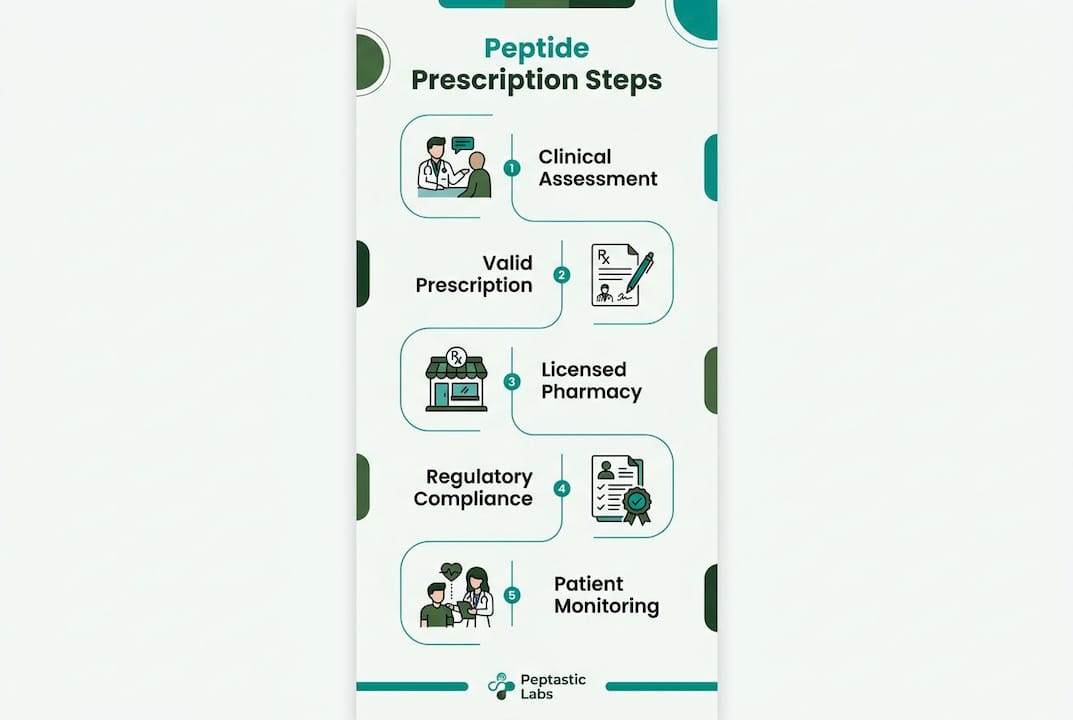
Compounding is the only legal route for dispensing most unapproved peptides in Australia. A licensed compounding pharmacy can prepare a peptide product, but only after receiving a valid prescription written for a specific patient. Anticipatory compounding is prohibited outside hospital settings, meaning pharmacies cannot prepare batches in advance for general sale.
The legal supply chain for a compounded peptide follows a strict sequence:
- A registered medical practitioner or nurse practitioner conducts an individualized clinical assessment.
- The practitioner issues a patient-specific prescription for an unapproved peptide under a valid TGA pathway.
- A licensed compounding pharmacy receives the prescription and prepares the product to order.
- The compounded medicine is dispensed directly to the named patient only.
- The pharmacist retains records and complies with TGA manufacturing standards throughout.
Any deviation from this sequence is unlawful. Compounding pharmacies that prepare peptides without a prescription, or that supply to anyone other than the named patient, face significant civil and criminal penalties.
| Supply step | Legal requirement |
|---|---|
| Clinical assessment | Individualized evaluation by a registered practitioner |
| Prescription | Patient-specific, issued under TGA-approved pathway |
| Compounding | Licensed pharmacy, no anticipatory batching |
| Dispensing | To named patient only |
| Record-keeping | Full documentation retained by pharmacist |
One major regulatory shift occurred in october 2024. Pharmacists are now prohibited from compounding GLP-1 receptor agonists entirely, regardless of prescription status. This reflects the TGA's increasing willingness to restrict compounding categories when safety concerns arise.
Pro Tip: If a compounding pharmacy offers to supply a peptide without first requesting a prescription, that is a clear legal violation. Do not proceed.
What are the import rules for peptides in Australia?
The Personal Importation Scheme allows Australians to import certain unapproved medicines for personal use, but it is not a general exemption for peptides. The scheme requires clear labeling, accurate dosage information, and proof that the product is for personal therapeutic use under medical supervision. Most peptide products sold online fail these requirements.
Common misconceptions about importing peptides include:
- "Research use only" labeling exempts the product from Schedule 4 rules. This is false. The research-use-only label carries no legal weight under Australian law.
- The Personal Importation Scheme is a loophole for buying peptides online. The scheme is not designed for general wellness or fitness use.
- Importing a small quantity for personal use is always legal. Australian Border Force seizes unlabeled or mislabeled peptides regardless of claimed personal use exemptions.
- Purchasing from an overseas website is legal if the seller claims compliance. Australian law governs the import, not the seller's country of origin.
Consumers who buy peptides online often cannot accurately assess the purity or actual contents of what they receive. Products labeled as one compound may contain entirely different substances, incorrect concentrations, or microbial contaminants. The TGA has documented hospitalizations from allergic reactions linked to unregulated peptide imports. Assuming a product is safe because it arrived in the mail is a serious health risk.
The Special Access Scheme exists for genuine therapeutic gaps, not for general wellness or fitness applications. Researchers and practitioners who want to understand what research-grade peptides actually require in terms of documentation and purity standards will find the distinction between legal research supply and personal importation is significant.
What are the penalties for illegal peptide possession in Australia?
The TGA made unregulated peptides a priority enforcement target from april 2026, citing serious health risks including hospitalizations from adverse events. Enforcement actions now include product seizures, infringement notices, and referrals for criminal prosecution.
Penalties vary by jurisdiction but are consistently severe:
- Australian Capital Territory: Fines up to $66,000 and imprisonment up to 2 years for unauthorized possession or supply
- Western Australia: Fines up to $45,000 for illegal possession or supply
- South Australia: Fines up to $10,000 for possession offenses
- All jurisdictions: Civil penalties, product seizures, and potential criminal referrals for supply offenses
These are not theoretical risks. The TGA has publicly documented enforcement actions against suppliers, gyms, and online retailers operating outside the legal framework. Purchasing peptides from social media accounts, online marketplaces, or overseas websites without a valid prescription exposes you to all of these penalties.
The health risks compound the legal ones. Unapproved peptides sourced outside regulated channels carry no verified purity standards. Peptasticlabs documents every compound to ≥99% purity via HPLC verification, with Certificates of Analysis available on request. That level of documentation is what separates research-grade supply from the unregulated market. Researchers who want to understand how to identify low-quality peptide products will find the quality gap between verified and unverified sources is substantial.
Key Takeaways
Obtaining peptides legally in Australia requires a valid prescription, a licensed compounding pharmacy, and full compliance with TGA import and supply rules.
| Point | Details |
|---|---|
| Schedule 4 classification | Most peptides are prescription-only medicines; possession without a prescription is illegal. |
| Prescriber responsibility | Practitioners who prescribe unapproved peptides bear full legal and clinical accountability. |
| Compounding rules | Pharmacies may only compound peptides against a patient-specific prescription; no anticipatory batching. |
| Import scheme limits | The Personal Importation Scheme does not exempt peptides from Schedule 4 requirements. |
| Enforcement penalties | Fines reach $66,000 and imprisonment up to 2 years depending on Australian jurisdiction. |
The regulatory gap most people miss
The most common mistake I see is treating peptide legality as a binary question. People ask "are peptides legal in Australia?" and expect a yes or no. The real answer is more specific. A peptide can be a legal prescription medicine and still be an unapproved product with no ARTG listing. That gap places every prescribing decision, every compounding order, and every import attempt in a gray zone where the practitioner or the buyer carries all the risk.
Practitioners who prescribe BPC-157 or CJC-1295 are not breaking the law outright, but they are accepting personal liability for a compound with limited long-term safety data and no approved product monograph. Most experienced practitioners I have spoken with decline to do this routinely. The ones who do prescribe these compounds typically work in specialized clinics with robust patient documentation and legal counsel on file.
For researchers and individuals seeking peptides for legitimate purposes, the path forward is clear. Work with a registered practitioner who understands TGA pathways. Use a licensed compounding pharmacy. Do not import from overseas sources without verifying every requirement under the Personal Importation Scheme. And recognize that the "research use only" label on a website is not a legal shield. The TGA and Australian Border Force treat those products as Schedule 4 medicines regardless of what the label says.
The regulatory environment will tighten further. The april 2026 enforcement push is not a temporary campaign. It reflects a sustained shift in how Australian authorities view the unregulated peptide market. Getting ahead of that shift now, through proper clinical channels and verified sourcing, is the only approach that protects both your health and your legal standing.
— Tintastic
Peptasticlabs: research-grade peptides with verified documentation
Peptasticlabs supplies research-grade peptides verified to ≥99% purity via HPLC, with third-party testing and Certificates of Analysis available for every batch. For researchers operating within Australian regulatory frameworks, that level of documentation matters. Unverified sourcing is both a legal and a health risk, and Peptasticlabs addresses both through transparent batch records and rigorous quality control. The full peptide catalog covers over 22 compounds across metabolic, cognitive, tissue repair, and longevity applications. Researchers can also access the Peptasticlabs research hub for scientific and regulatory background on individual compounds. All purchases should be made in compliance with Australian law, including valid prescription and compounding requirements where applicable.
FAQ
Are peptides legal to buy in Australia without a prescription?
No. Most peptides are Schedule 4 prescription-only medicines in Australia, and purchasing or possessing them without a valid prescription is illegal.
What peptides are approved on the Australian ARTG?
Insulin and GLP-1 analogues like semaglutide are ARTG-listed prescription medicines. Compounds like BPC-157, TB-500, and CJC-1295 are not ARTG-approved.
Can I import peptides from overseas for personal use?
The Personal Importation Scheme has strict requirements, and most online peptide products fail them. Australian Border Force seizes unlabeled or mislabeled peptides regardless of claimed personal use.
Does a "research use only" label make peptides legal to buy?
No. The research-use-only designation carries no legal weight under Australian Schedule 4 rules. A valid prescription is still required.
What are the penalties for illegal peptide possession in Australia?
Penalties include fines up to $66,000 and imprisonment up to 2 years in the ACT, with varying fines in other states including $45,000 in Western Australia.