
A research grade peptide is defined as a synthetically produced amino acid chain verified to strict purity and identity standards for exclusive use in scientific investigation, not clinical or consumer applications. These compounds are designated "Research Use Only" (RUO), a label that carries specific regulatory meaning: the peptide has not been manufactured, marketed, or sold as a drug or supplement. Purity thresholds typically start at ≥95% and frequently reach ≥99% via HPLC verification. Standards such as Certificates of Analysis (COAs) and ISO 9001-aligned quality management systems govern their production. Understanding what a research grade peptide actually is separates reliable experimental data from compromised results.
What is a research grade peptide, and how is it defined?
A research grade peptide is a short amino acid chain typically ranging from 2 to 50 residues, synthesized for laboratory investigation only. The RUO designation is the defining regulatory marker. It signals that the compound exists outside the drug approval pathway and cannot legally be promoted for therapeutic use in humans.
The term "research grade" is an industry descriptor, not a formally codified regulatory category. The recognized standard term in scientific procurement is "RUO" or "research use only" material. Both phrases appear throughout the literature, and researchers should treat them as equivalent when evaluating vendor documentation.
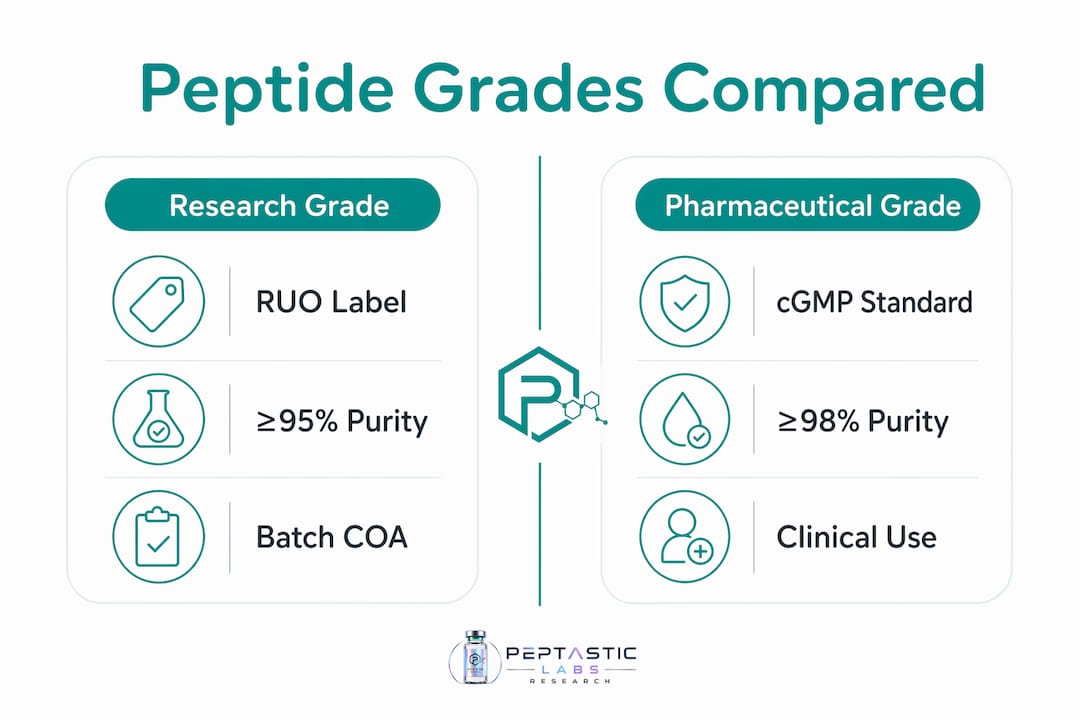
What separates a research grade peptide from a pharmaceutical grade compound is not always purity. Many RUO peptides meet or exceed the purity levels found in approved drugs. The critical difference is the absence of clinical trial data, FDA drug approval, and current Good Manufacturing Practice (cGMP) production requirements. Research peptides are subject to federal and state chemical reagent regulations, not the drug approval pathway, which also shapes their labeling and marketing requirements.
How are research grade peptides manufactured and verified?
Research grade peptides are produced through two primary methods: solid-phase peptide synthesis (SPPS) and recombinant expression. SPPS is the dominant technique for peptides under 50 residues. It builds the amino acid chain sequentially on a solid resin support, allowing precise control over sequence and modifications.
After synthesis, purification by reverse-phase HPLC removes truncated sequences, deletion products, and synthesis byproducts. This step directly determines final purity. A peptide with 95% purity after HPLC still contains 5% unknown impurities, which is why sensitive bioassays and in vivo applications demand ≥98% or higher.
Verification follows purification. The standard analytical toolkit includes:
- Mass spectrometry: Confirms molecular weight and sequence identity
- Amino acid analysis: Validates composition at the residue level
- HPLC chromatograms: Provide visual and quantitative purity data
- Endotoxin testing: Required for in vivo applications to prevent immune interference
- Sterility testing: Applied where applicable to cell culture or animal study materials
Each batch receives a Certificate of Analysis documenting peptide sequence, purity, molecular weight, synthesis date, and endotoxin levels where relevant. That document is the primary quality control artifact for any research procurement decision.
Pro Tip: Request the actual HPLC chromatogram, not just the purity percentage. A single number without the trace tells you nothing about peak shape, baseline noise, or impurity distribution.
Quality management systems such as ISO 9001 govern process consistency in research peptide production. These systems are not equivalent to cGMP, but they do impose documented procedures, traceability, and corrective action requirements that distinguish serious manufacturers from low-quality suppliers.
What regulatory standards separate research grade from pharmaceutical grade?
RUO labeling is a vendor's intended use statement, not an FDA endorsement. RUO designation means the product is not intended for clinical use and has not entered the drug approval pathway. Approved drugs require cGMP production, clinical trial data across multiple phases, and FDA review of safety and efficacy. Research peptides require none of those steps.
A common misconception is that "research grade" implies lower quality than pharmaceutical grade. The purity data often contradicts this. Many research peptides verified to ≥99% purity via HPLC exceed the purity of some approved drug formulations. The distinction is process documentation and regulatory oversight, not chemical quality.
The table below clarifies the key differences:
| Attribute | Research grade (RUO) | Pharmaceutical grade (cGMP) |
|---|---|---|
| Regulatory pathway | Chemical reagent regulations | FDA drug approval |
| Production standard | ISO 9001 / QMS | cGMP |
| Clinical use permitted | No | Yes (if approved) |
| Purity range | ≥95% to ≥99% | Varies by drug specification |
| Documentation | Batch COA, HPLC, MS data | Full regulatory dossier |
| Intended use | Laboratory research only | Human therapeutic use |
Proper RUO labeling also prevents misuse as clinical or consumer products. Vendors who market RUO peptides with therapeutic claims violate federal regulations regardless of the compound's purity.
Pro Tip: If a vendor's website makes health claims about their RUO peptides, treat that as a disqualifying red flag. It signals either regulatory ignorance or deliberate noncompliance, neither of which belongs in your supply chain.
How do you source and verify research grade peptides safely?
Sourcing research grade peptides safely requires procurement due diligence at every step. The single most important document is the lot-specific Certificate of Analysis. A COA must include HPLC traces and mass spectrometry data tied to the specific batch you are purchasing, not a generic template applied across products.
Many researchers fail procurement due diligence by accepting vendors without batch-specific documentation. That shortcut risks substandard peptide quality and compromises experimental validity before a single assay runs.
A reliable sourcing checklist covers these points:
- Confirm lot-specific COA availability. The COA must reference the exact batch number of your order, not a generic document.
- Verify HPLC purity ≥95%, ideally ≥98%. Sensitive bioassays and in vivo studies require the higher threshold.
- Check mass spectrometry data. Molecular weight confirmation validates sequence identity independently of purity.
- Assess endotoxin data. Any peptide destined for cell culture or animal studies needs documented endotoxin levels.
- Confirm lyophilized shipping. Peptides shipped in lyophilized form maintain stability far better than solution-phase shipments, which risk degradation in transit.
- Evaluate packaging and cold chain. Reliable vendors use insulated packaging and minimize transit time to preserve peptide integrity.
- Review vendor transparency. A trustworthy supplier publishes its testing methodology, lists third-party lab partners, and responds directly to documentation requests.
For researchers exploring peptide types and uses, the sourcing process varies by application. Peptides for in vivo animal studies carry stricter purity and endotoxin requirements than those used in simple binding assays. Match your purity specification to your experimental design before ordering.
Pro Tip: Ask the vendor to confirm whether third-party testing was performed on the specific lot you are ordering. In-house testing alone is not sufficient verification for high-stakes experiments.
Peptasticlabs verifies each compound in its catalog to ≥99% purity via HPLC and provides batch-specific COAs on request. That level of documentation directly addresses the most common sourcing failure point in research labs.
What are the common applications and limitations of research grade peptides?
Research grade peptides are the workhorses of modern preclinical science. Their primary uses span in vitro assays, cell culture studies, and animal models, supporting drug development pipelines and basic mechanistic research across multiple disciplines.
Key application areas include:
- Metabolic research: Peptides such as MOTS-c and Tesamorelin are studied for their roles in energy regulation and metabolic signaling
- Cognitive and neurological studies: Compounds like Semax are investigated in animal models for neuroprotective and cognitive effects
- Tissue repair and regeneration: Growth hormone-related peptides including Sermorelin and IGF-1 LR3 appear in studies examining cellular repair mechanisms
- Immunology: Peptide antigens and immune-modulating sequences are used in assay development and vaccine research
- Longevity research: Compounds targeting cellular aging pathways are studied using verified RUO materials
Purity and documentation directly affect reproducibility and validity of experimental results. A peptide with undocumented impurities introduces uncontrolled variables. That makes the COA a scientific instrument, not just a compliance document.
Limitations are equally important to understand. Research grade peptides cannot be used therapeutically in humans. They are not approved drugs. Storage requirements are strict: most peptides should be stored lyophilized at -20°C or lower, reconstituted only when needed, and used promptly after reconstitution to prevent degradation. Researchers working with the full research catalog at Peptasticlabs will find handling guidance alongside each compound's documentation.
Key Takeaways
A research grade peptide is defined by its purity verification, RUO designation, and batch-specific documentation, not by regulatory approval or clinical status.
| Point | Details |
|---|---|
| RUO designation | Means research use only; the peptide is not an approved drug and cannot be used therapeutically. |
| Purity threshold | Sensitive assays and in vivo studies require ≥98% purity confirmed by HPLC chromatogram. |
| COA is non-negotiable | Lot-specific Certificates of Analysis with HPLC and mass spectrometry data are the minimum standard for procurement. |
| Lyophilized shipping | Peptides shipped freeze-dried maintain stability; solution-phase shipments risk degradation before delivery. |
| Regulatory distinction | Research grade differs from pharmaceutical grade in process oversight and clinical approval, not necessarily in chemical purity. |
What I've learned from watching procurement go wrong
The most expensive mistake in peptide research is not a failed assay. It is ordering from a vendor who provides a polished website and a generic COA, then spending weeks troubleshooting results that were never going to replicate. I have seen this pattern repeatedly: a researcher accepts a purity claim at face value, runs a full animal study, and only requests the actual HPLC trace after the data looks wrong. By then, the batch is gone and the timeline is wasted.
The uncomfortable truth about peptide procurement is that most researchers apply less scrutiny to their reagent supply chain than they do to their statistical analysis. A p-value gets interrogated. A COA gets filed without review. That asymmetry is where experimental integrity breaks down.
What actually works is treating the COA review as a pre-experiment step, not a post-purchase formality. Verify the batch number matches your order. Pull up the HPLC chromatogram and check that the main peak is clean and the baseline is flat. Confirm the molecular weight from mass spectrometry matches the theoretical value. This takes ten minutes and eliminates the most common source of unexplained variability in peptide-based experiments.
High-quality peptides from transparent suppliers also reduce the total cost of research. Fewer failed experiments, fewer repeat orders, and cleaner data mean faster publication timelines. The upfront investment in verified materials pays back in time, not just in confidence.
— Tintastic
Peptasticlabs: verified research grade peptides with full documentation
Researchers who need verified compounds without documentation gaps will find Peptasticlabs built around that exact requirement. Every compound in the catalog is verified to ≥99% purity via HPLC, with batch-specific COAs available on request covering mass spectrometry data, purity percentages, and synthesis details.
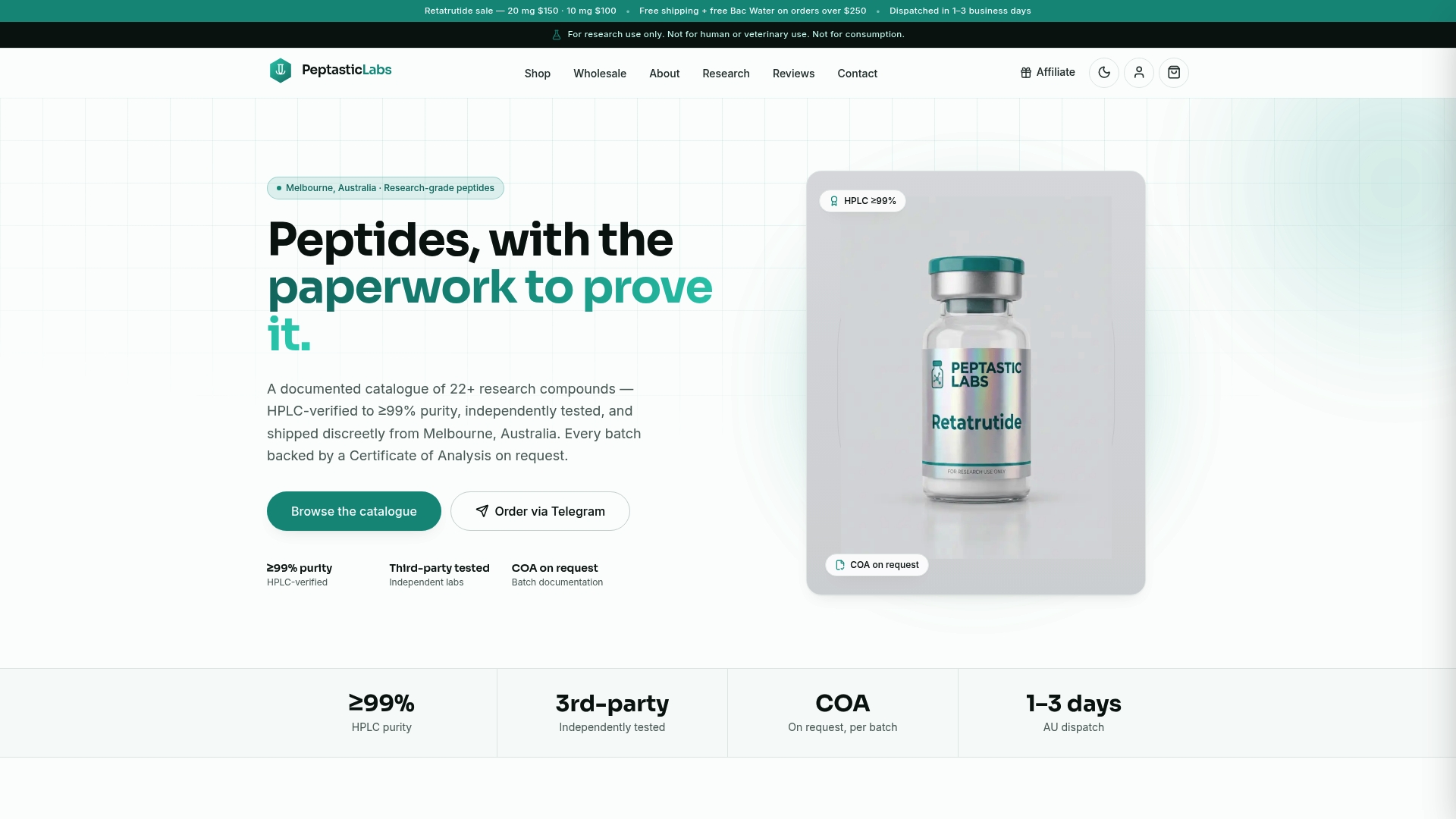
The catalog covers over 22 independently tested compounds across metabolic, cognitive, tissue repair, longevity, immunology, and cosmetic research areas. Compounds including MOTS-c, Sermorelin, and IGF-1 LR3 ship lyophilized with full documentation. Ordering is direct, support is accessible, and documentation requests receive a direct response. For researchers who require verified materials without sourcing uncertainty, Peptasticlabs is the starting point.
FAQ
What does "research use only" mean on a peptide label?
"Research use only" (RUO) indicates the peptide is intended exclusively for laboratory investigation and has not been approved by the FDA as a drug. It cannot legally be marketed or used for therapeutic purposes in humans.
What purity level is required for research grade peptides?
Purity of ≥95% is the standard minimum, but sensitive bioassays and in vivo animal studies require ≥98% or higher, confirmed by HPLC chromatogram and mass spectrometry data.
How are research grade peptides different from pharmaceutical grade?
Research grade peptides may match pharmaceutical grade in chemical purity but lack cGMP production oversight, clinical trial data, and FDA drug approval. The difference is regulatory status, not necessarily purity level.
What should a Certificate of Analysis include for peptides?
A valid COA must include the batch number, peptide sequence, molecular weight, purity percentage, HPLC chromatogram, mass spectrometry confirmation, and endotoxin data where the peptide is intended for in vivo use.
Why does lyophilized shipping matter for research peptides?
Peptides shipped in lyophilized form are significantly more stable than those shipped in solution. Solution-phase shipments risk degradation during transit, which introduces uncontrolled variables into downstream experiments.