
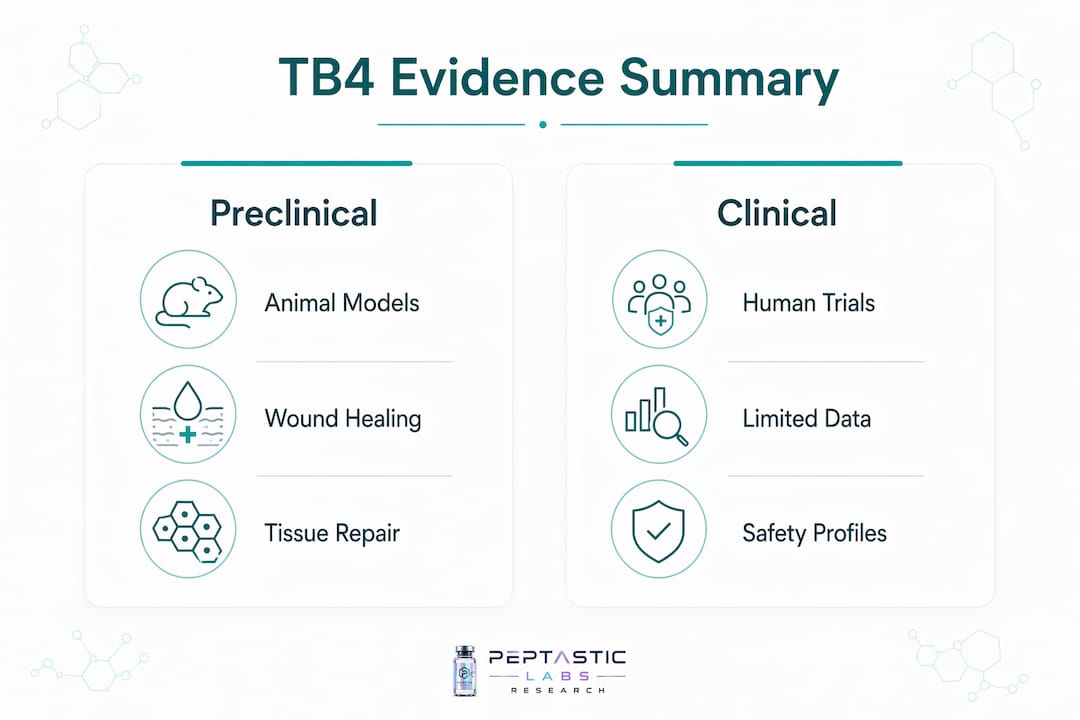
Thymosin beta-4 (TB4) is an endogenous 43-amino-acid peptide linked to tissue repair, cell migration, and angiogenesis in preclinical research — but it is not an approved sports recovery drug, and no controlled human studies have demonstrated that TB4 or its synthetic fragment TB-500 improves muscle or tendon recovery in athletes.
- Strongest human evidence: Phase 2 randomized trials for topical ophthalmic use (dry eye disease) — a narrow, route-specific indication with no direct relevance to athletic injury.
- Real-world regulatory status: Not FDA-approved for sports recovery; WADA prohibits thymosin beta-4 and all derivatives, including TB-500, at all times and by all routes of administration.
The gap between the biology and the clinical evidence is wide. Understanding where the science actually stands — and where community claims have outpaced it — is the starting point for any responsible evaluation of TB4's role in sports medicine.
Table of Contents
- What thymosin beta-4 is and how it works at a cellular level
- How athletes and clinicians consider TB4 and TB-500 for sports injuries
- What the science actually shows: animal models, human trials, and the gaps
- How TB-500 differs from full-length thymosin beta-4
- What are the known and plausible safety risks of TB4 and TB-500?
- What is the regulatory and anti-doping status for U.S. athletes?
- Community dosing protocols and why they're unreliable
- How researchers should source and verify research-grade TB4 and TB-500
- Key Takeaways
- A research-first perspective on TB4 in sports
- Peptasticlabs: research-grade peptides with verified documentation
- Useful sources
What thymosin beta-4 is and how it works at a cellular level
Thymosin beta-4 is a naturally occurring peptide encoded by the TMSB4X gene, present in virtually all nucleated human cells and found at particularly high concentrations in platelets, macrophages, and wound fluid. Its primary molecular function is sequestering G-actin (monomeric actin), which regulates the cytoskeletal dynamics that govern cell shape, motility, and division.

That actin-sequestration mechanism has downstream consequences that explain why TB4 attracts interest in tissue repair research. When cells need to migrate toward a wound, they must rapidly reorganize their actin cytoskeleton. TB4 modulates the ratio of free G-actin to polymerized F-actin, enabling faster cytoskeletal remodeling and, consequently, faster cell migration toward injury sites. Beyond cytoskeletal effects, preclinical reviews document that TB4 promotes angiogenesis (new blood vessel formation), reduces apoptosis, and modulates inflammatory signaling across multiple tissue types in animal models.
A simplified picture: an injury creates a local actin-rich wound environment → TB4 sequesters G-actin → keratinocytes and fibroblasts migrate into the wound bed → re-epithelialization and vascular ingrowth follow. This cascade is well-characterized in rodent dermal wound models. Whether it translates to human tendon or muscle at therapeutically relevant doses remains an open question.
Pro Tip: When evaluating any peptide's clinical relevance, distinguish between mechanism studies (which establish biological plausibility) and efficacy studies (which establish whether that mechanism produces a measurable benefit in the target tissue and population). TB4 has strong mechanism data and weak human efficacy data — those are not interchangeable.
How athletes and clinicians consider TB4 and TB-500 for sports injuries
The interest in TB4 for sports use centers on a specific set of injury types where faster tissue repair would have obvious performance implications. The use-cases discussed most frequently in clinical and community settings fall into several categories, each with a different evidence level.
| Use-Case | Evidence Level | Notes |
|---|---|---|
| Dermal wound closure | Preclinical (animal) | Strongest data; rat models show measurable re-epithelialization gains |
| Tendon repair / tendinopathy | Preclinical (animal) | Rodent tendon models only; no human RCT data |
| Ligament healing | Preclinical (animal) | Extrapolated from wound/tendon models; no direct human data |
| Skeletal muscle repair | Preclinical (animal) | Cardiac and skeletal muscle models in rodents; not validated in humans |
| Post-surgical recovery | None (human) | Discussed in communities; no controlled trial evidence |
| Dry eye disease | Human (Phase 2 RCT) | Topical ophthalmic formulation; not systemic; not sports-related |
| General training recovery | None | Anecdotal only |
The biological rationale for sports use is not unreasonable on its face. Faster cell migration, improved angiogenesis, and reduced local inflammation are all desirable properties in a healing tendon or muscle. The problem is that the athletic recovery claims are primarily extrapolated from rodent dermal wound models, and the translational gap between rat skin and human Achilles tendon is substantial.
Routes of administration discussed in online communities include subcutaneous injection (most common), intramuscular injection, localized injection near the injury site, and topical application. None of these routes has been evaluated in a controlled human trial for sports injury endpoints. The topical route has the most human data, but that data comes exclusively from ophthalmic trials, not musculoskeletal applications.
- Subcutaneous/intramuscular injection: Most community protocols use this route; no human efficacy data for sports injury.
- Localized injection: Theoretically targets the tissue of interest; no controlled human evidence.
- Topical application: Supported by human data only for dry eye; not validated for skin wounds or musculoskeletal tissue in humans.
What the science actually shows: animal models, human trials, and the gaps
The evidence base for TB4 spans a wide range of preclinical models and a narrow set of human trials. Reading the literature carefully requires keeping those two categories strictly separate.
Animal model findings
Rodent wound models consistently show measurable effects. In a rat full-thickness wound model, TB4 treatment increased wound re-epithelialization by a substantial increase in wound re-epithelialization at early time points,, with improved collagen deposition and angiogenesis reported across multiple studies. Cardiac models have shown reduced infarct size and improved cardiomyocyte survival. Neurological models have demonstrated neuroprotective effects. These findings are reproducible and mechanistically coherent.
Human clinical findings
The human evidence is narrow and route-specific. The most rigorous data comes from Phase 2 randomized, placebo-controlled trials of a topical TB4 ophthalmic solution for severe dry eye disease, which reported statistically significant improvements in corneal staining and symptom scores. Early-phase injectable trials for cardiac and other indications have reported acceptable safety profiles, but efficacy endpoints in those trials are not sports-related.
| Study Model | Tissue / Indication | Outcome | Evidence Strength |
|---|---|---|---|
| Rat full-thickness wound | Dermal wound | substantial increase in wound re-epithelialization | Preclinical |
| Rodent cardiac model | Myocardium | Reduced apoptosis, improved survival | Preclinical |
| Rodent tendon model | Tendon | Improved collagen organization | Preclinical |
| Human Phase 2 RCT | Dry eye (topical) | Significant symptom improvement | Clinical (narrow indication) |
| Human Phase 1/2 injectable | Cardiac / wound | Safe and well-tolerated | Clinical (safety signal only) |
| Human athletic injury | Tendon / muscle | No data | No evidence |
Critical limitations
Species differences matter significantly here. Rodent skin heals via mechanisms that differ from human tendon biology — the cell populations, vascular architecture, and mechanical loading environment are not comparable. Early-phase clinical trials report TB4 was safe and well-tolerated in topical and some injectable contexts, but long-term safety data for systemic, repeated use in healthy athletes does not exist. The absence of randomized controlled trials for sports injury endpoints means that any claim about TB4 improving athletic recovery is, at present, speculative extrapolation.
How TB-500 differs from full-length thymosin beta-4
TB-500 is not thymosin beta-4. That distinction is frequently blurred in online communities and commercial product listings, and the conflation creates real problems for anyone trying to evaluate the evidence.
Full-length thymosin beta-4 is a 43-amino-acid endogenous peptide. TB-500 is a synthetic 7-amino-acid fragment corresponding to residues 17–23 of TB4, which contains the actin-binding domain. It is sold online as a research chemical, often marketed as functionally equivalent to the full peptide.
- Mechanism coverage: Full-length TB4 engages multiple signaling pathways (actin sequestration, anti-inflammatory, angiogenic, anti-apoptotic). TB-500 targets primarily the actin-binding domain; its effects on the other pathways are not well-characterized.
- Evidence base: Virtually all peer-reviewed human data refers to full-length TB4 or proprietary formulations, not the TB-500 fragment.
- Regulatory status: WADA prohibits both thymosin beta-4 and its derivatives, which includes TB-500.
- Product quality: TB-500 sold online is an unregulated gray-market product with no standardized manufacturing requirements; sequence accuracy, potency, and sterility vary by lot.
- Intended use: Full-length TB4 is studied in controlled clinical trials for specific indications; TB-500 is marketed to consumers without clinical trial support for sports injury endpoints.
The practical implication is direct: if you read a study showing TB4 accelerated wound closure in a rodent model, that finding does not validate a gray-market TB-500 product for human tendon repair. The agent studied, the formulation, the route, and the target tissue are all different.
Pro Tip: Before citing any TB4 study to support a TB-500 product claim, verify three things: (1) whether the study used full-length TB4 or a fragment, (2) the route of administration, and (3) the target tissue. A mismatch on any of these makes the extrapolation unreliable.
What are the known and plausible safety risks of TB4 and TB-500?
Safety concerns with TB4 and TB-500 fall into two distinct categories: physiological risks tied to the peptide's mechanism, and supply-chain risks tied to the unregulated market for gray-market products.
Mechanism-related physiological risks
TB4's pro-angiogenic effects are a double-edged property. Angiogenesis supports wound healing, but uncontrolled or off-target vascular growth carries theoretical risks, particularly in individuals with pre-existing neoplastic conditions. The concern is not that TB4 causes cancer, but that promoting angiogenesis in a tissue with occult malignancy could theoretically accelerate tumor vascularization. This is a speculative risk based on mechanism, not a documented clinical finding, but it warrants disclosure.
Off-target cell migration is a related concern. The same cellular motility that drives wound re-epithelialization could, in principle, affect other cell populations. Again, this is a mechanistic extrapolation, not a confirmed adverse event from clinical trials.
Documented adverse effects
Phase 1 and Phase 2 trials in controlled clinical settings report TB4 was generally safe and well-tolerated. Reported adverse events in injectable contexts include local injection-site reactions (pain, erythema, swelling). Systemic adverse events were not significantly elevated over placebo in early-phase studies. Long-term safety data for repeated systemic use in healthy athletes does not exist.
Supply-chain hazards
| Risk Category | Specific Concern | Mitigation |
|---|---|---|
| Sequence accuracy | Incorrect amino acid sequence; fragment vs full-length mislabeling | Mass spectrometry (LC-MS) identity confirmation |
| Potency | Unknown or incorrect concentration | HPLC quantification against reference standard |
| Sterility | Bacterial or fungal contamination in injectable products | Sterility testing per USP standards |
| Endotoxin | Pyrogen contamination causing fever/systemic inflammation | Limulus amebocyte lysate (LAL) endotoxin testing |
| Adulteration | Undisclosed active compounds | Full-panel third-party analytical testing |
- Infection risk: Injecting any non-sterile product carries direct infection risk; gray-market peptides are not manufactured under pharmaceutical GMP conditions.
- Unknown systemic effects: No long-term safety studies exist for repeated systemic TB4/TB-500 use in athletes.
- Mislabeled potency: Incorrect dosing from inaccurate concentration labeling compounds all other risks.
Independent third-party HPLC verification and Certificates of Analysis are the minimum standard for distinguishing research-grade materials from inconsistent gray-market products.
What is the regulatory and anti-doping status for U.S. athletes?
The regulatory position is unambiguous. Athletes subject to anti-doping rules need to understand three distinct frameworks: WADA's prohibited list, USADA's enforcement authority in the United States, and the FDA's position on TB4 as a therapeutic agent.
WADA and USADA status
WADA classifies thymosin beta-4 and all its derivatives, including TB-500, as prohibited growth factors and growth-factor modulators. The prohibition applies at all times (both in-competition and out-of-competition) and covers all routes of administration. USADA enforces this prohibition for U.S. athletes competing under WADA-signatory sports organizations. Sport integrity authorities explicitly list TB4 and TB-500 as banned and caution athletes about gray-market sourcing.
FDA status
TB4 is not FDA-approved for any sports recovery indication. Investigational use under an Investigational New Drug (IND) application is a separate, controlled pathway available only to qualified researchers and clinical investigators, not to athletes or consumers. Compassionate use provisions apply to serious or life-threatening conditions, not athletic recovery. Consumer products sold as TB-500 have no FDA approval, no IND coverage, and no legal pathway for human use outside of a registered clinical trial.
Actionable steps for athletes
- Do not use TB4 or TB-500 if you are subject to anti-doping testing under any WADA-signatory organization.
- If you have been prescribed a peptide-based therapeutic by a physician, contact your national anti-doping authority (USADA in the United States) to determine whether a Therapeutic Use Exemption (TUE) applies before use.
- Consult your team physician or sports medicine clinician before using any peptide product, regardless of how it is marketed.
- Verify the prohibited status of any new compound at GlobalDRO.com or directly through USADA before administration.
- Understand that a "research chemical" label does not exempt a substance from anti-doping rules; WADA prohibits the substance, not a specific product formulation.
Community dosing protocols and why they're unreliable
Community forums and online groups have developed detailed TB-500 and TB4 protocols that circulate widely. These protocols typically describe dosing ranges, injection frequencies, and cycle lengths. They are presented here for informational context only, not as recommendations.
Typical community protocol (anecdotal only — not a clinical recommendation):
- Loading phase: higher-frequency injections over 4–6 weeks
- Maintenance phase: reduced frequency injections over 4–8 weeks
- Dosing ranges cited in forums vary considerably; no standardized dose exists
- Routes most commonly described: subcutaneous or intramuscular injection
These protocols are unreliable for several compounding reasons. There are no standardized dosing guidelines derived from controlled human trials. Batch inconsistency in gray-market products means the actual dose delivered per injection is unknown. Community protocols are built on anecdote, not pharmacokinetic data. And the agent being used (TB-500 fragment) is not the agent studied in the clinical literature (full-length TB4).
Safer, evidence-supported recovery alternatives
Athletes seeking accelerated recovery have several options with substantially stronger evidence:
- Structured progressive loading: Tendon and ligament rehabilitation protocols using eccentric loading have strong RCT support for conditions like Achilles tendinopathy.
- Physiotherapy and manual therapy: Evidence-based for soft-tissue injury management across multiple tissue types.
- Platelet-rich plasma (PRP): Mixed but growing evidence for specific tendon and ligament indications; used within regulated clinical settings.
- Sleep and nutrition optimization: Protein timing, total caloric adequacy, and sleep quality have well-documented effects on muscle protein synthesis and tissue repair.
- Cold/compression therapy: Supported for acute injury management and post-exercise recovery.
Pro Tip: Clinicians and researchers who want to evaluate investigational peptides ethically should do so within a registered research protocol: IRB approval, informed consent documentation, pre-approved batch verification (HPLC, COA, endotoxin report), and prospective adverse event tracking. This is the only framework that generates reliable data and protects participants.
How researchers should source and verify research-grade TB4 and TB-500
For qualified researchers conducting controlled studies, the sourcing decision directly affects data reliability. A peptide with incorrect sequence, unknown potency, or endotoxin contamination does not just introduce experimental noise — it can produce false results and harm research subjects.
Procurement checklist
- HPLC certificate: Confirms purity and quantifies the target compound against a reference standard; minimum ≥99% purity for research-grade materials.
- Mass spectrometry (LC-MS) identity confirmation: Verifies the correct amino acid sequence; critical for distinguishing TB4 from TB-500 and from degradation products.
- Certificate of Analysis (COA): Batch-specific document summarizing all analytical results; request this before approving any lot for in-lab use.
- Endotoxin report: LAL or recombinant Factor C (rFC) test result; mandatory for any injectable research application.
- Sterility documentation: Confirms absence of microbial contamination.
- Storage conditions and stability data: Confirms appropriate cold-chain handling and shelf-life parameters.
- Batch documentation: Traceability from synthesis through QC to shipment.
Why independent third-party verification matters
In-house QC by the manufacturer is necessary but not sufficient. Independent HPLC verification and COAs are the only reliable way to confirm identity and purity for research use, because the manufacturer's own testing has an inherent conflict of interest. Third-party labs with no commercial relationship to the supplier provide the objective confirmation that research protocols require.
Peptasticlabs supplies research-grade peptides verified to ≥99% purity via HPLC, with full batch documentation and Certificates of Analysis available on request. Each compound in the catalog undergoes independent third-party testing, covering identity, purity, and batch traceability. For researchers sourcing TB4 or related peptides, this documentation standard reduces the sourcing uncertainty that undermines reproducibility in peptide research. The COA documentation process and what each analytical result means for your research protocol are covered in detail in Peptasticlabs's technical resources.
Institutional procurement should include a research-use-only agreement, confirmation that the supplier provides test reports per lot (not just per product line), and a pre-purchase review of the most recent COA for the specific batch being ordered.
Key Takeaways
Thymosin beta-4 has a well-characterized preclinical mechanism but no controlled human evidence supporting its use for athletic injury recovery, and it is prohibited under WADA at all times.
| Point | Details |
|---|---|
| Evidence vs. hype | No controlled human trials support TB4 or TB-500 for athletic tendon, muscle, or ligament recovery. |
| Regulatory standing | WADA prohibits thymosin beta-4 and all derivatives, including TB-500, at all times and by all routes. |
| TB4 vs. TB-500 | TB-500 is a 7-AA synthetic fragment; most human research uses full-length 43-AA TB4 — they are not interchangeable. |
| Safety and sourcing | Gray-market TB-500 carries sequence, potency, sterility, and endotoxin risks; independent HPLC and COA verification are required for research use. |
| Research-grade supply | Peptasticlabs provides HPLC-verified, ≥99% purity TB4 with batch-specific COAs for qualified researchers. |
A research-first perspective on TB4 in sports
The conversation around thymosin beta-4 in athletic contexts has a persistent structural problem: the most compelling data (rodent wound models, Phase 2 ophthalmic trials) gets cited to support claims that the data does not actually address (human tendon repair, muscle recovery, performance enhancement). This is not unique to TB4 — it is a pattern across the peptide research space — but TB4 is a particularly clear example because the gap between preclinical promise and clinical validation is so wide and so well-documented.
What gets underestimated is how much the route and tissue type matter. The dry eye trials are genuinely encouraging science. They tell us that topical TB4 can produce measurable clinical effects in human corneal epithelium. They tell us almost nothing about what systemic injection of a gray-market TB-500 fragment does to a human Achilles tendon. Treating those as equivalent is not a minor extrapolation — it is a category error.
The responsible position, from a research standpoint, is to take the preclinical biology seriously, fund the human trials that are missing, and in the meantime supply researchers with verified materials that can generate reliable data. That is where the field actually moves forward. Community protocols built on anecdote and unverified products do not contribute to that progress; they create noise and, in some cases, harm.
Peptasticlabs: research-grade peptides with verified documentation
Researchers who need TB4 or related peptides for controlled studies face a sourcing environment where quality is inconsistent and documentation is often absent. Peptasticlabs addresses that directly: every compound in the catalog is independently tested to ≥99% purity via HPLC, with batch-specific Certificates of Analysis, mass spectrometry identity confirmation, and full traceability documentation available before purchase.
All products are supplied for research use only. No medical claims are made, and no products are intended for human therapeutic use outside of registered research protocols. For institutional purchasing, bulk orders, or pre-purchase documentation review, contact the Peptasticlabs sales team directly. Qualified researchers can request COAs, HPLC reports, and endotoxin data for any specific batch before committing to an order. Browse the full catalog and request documentation at peptasticlabs.com.
Useful sources
The following primary sources, regulatory guidance documents, and research reviews support the claims in this article.
- Thymosin Beta-4 Substance Education — Sport Integrity Australia: Anti-doping guidance listing TB4 and TB-500 as prohibited; practical athlete education resource.
- Progress on the Function and Application of Thymosin β4 — Frontiers in Endocrinology: Comprehensive review of preclinical mechanism data across tissue types; useful for understanding the biological rationale.
- TB-500 and Thymosin Beta-4: Separating the Trials from the Hype — Aminoscope: Evidence-focused review distinguishing full-length TB4 from the TB-500 fragment and summarizing the human clinical data.
- TB-500 and Athletic Recovery: Research vs Hype — RethinkPeptides: Direct analysis of the evidence gap for athletic recovery claims; source for the wound-model re-epithelialization figures.
- What Is Thymosin Beta-4? Uses, Benefits, Safety, FDA Status, and Evidence — Peptide Portal: Covers WADA prohibition status, FDA regulatory position, and supply-chain quality considerations.
- Advances in the Basic and Clinical Applications of Thymosin β4 (PDF): Conference summary covering Phase 1/2 safety data for injectable and topical formulations.
- PubMed: TB4 Mechanisms and Targeted Applications: Primary literature on condition-specific and route-specific clinical development directions.