
Third-party peptide testing is independent laboratory verification of a peptide's identity, purity, and quantity, conducted by a lab with no financial relationship to the vendor. The result is an outside audit that removes the conflict of interest built into every vendor-issued Certificate of Analysis. For researchers working with compounds where batch accuracy directly affects experimental outcomes, this distinction is not academic. A substantial portion of vendor samples fail independent purity or quantity tests when submitted to external labs, based on broad dataset observations.
The core benefits of independent verification are direct:
- Confirmed identity: Mass spectrometry confirms the compound is the labeled molecule, not a structurally similar substitute.
- Verified purity: HPLC quantifies the fraction of the sample that is the target peptide versus impurities.
- Accurate quantity: Dose quantification reveals whether a vial contains the labeled milligrams, the most common shortfall in the research peptide market.
- Contamination screening: Endotoxin (LAL) testing detects bacterial contamination invisible to standard purity assays, critical for injectable compounds.
The principal methods used are high-performance liquid chromatography (HPLC) and mass spectrometry (MS), often submitted together as a combined panel. Janoshik Analytical, based in the Czech Republic, is the most widely cited independent lab for research peptide submissions in 2026. Peptasticlabs independently tests multiple compounds and makes Certificates of Analysis available on request, setting a documented standard for research-grade sourcing.
Table of Contents
- What analytical methods does third-party peptide testing use?
- How to read and interpret a peptide Certificate of Analysis
- How to choose a trusted third-party peptide testing lab
- What are the risks of skipping independent peptide verification?
- How Peptasticlabs approaches independent verification
- Key Takeaways
What analytical methods does third-party peptide testing use?
Each assay in a third-party panel answers a distinct question. Understanding what each test does, and what it cannot do, is the foundation of reading any Certificate of Analysis accurately.

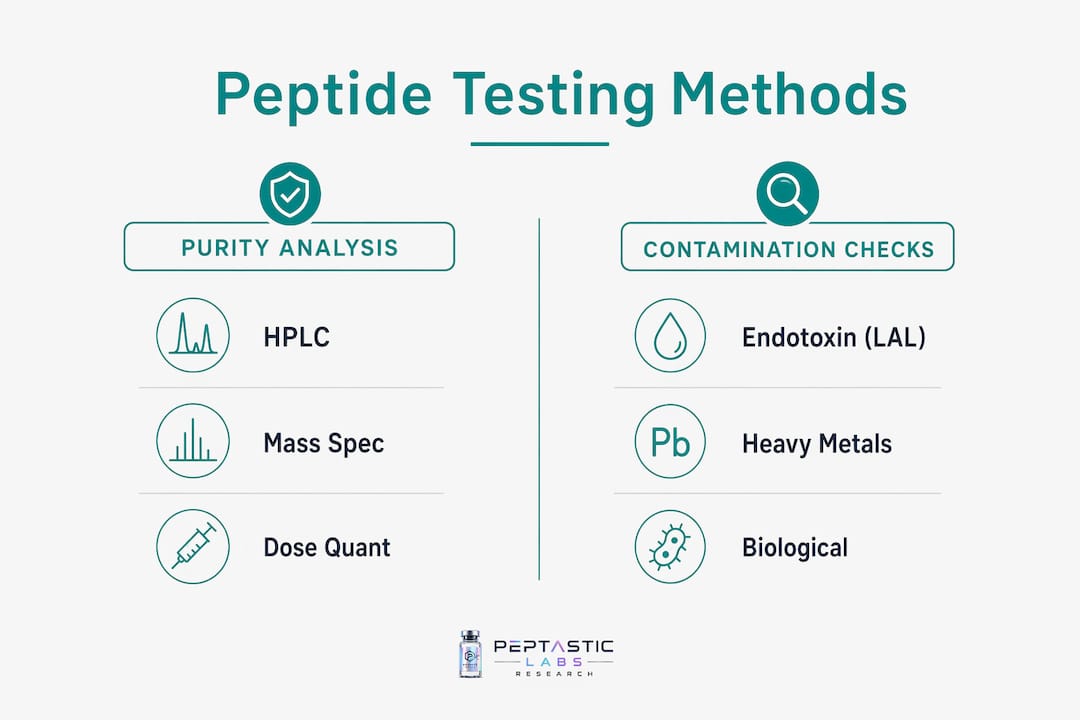
HPLC: purity quantification
High-performance liquid chromatography separates sample components and reports the fraction that is the target peptide. The output is a chromatogram showing peaks for the main compound and any impurities. The headline purity percentage comes from integrating those peaks. Reading the chromatogram itself, including peak shape, baseline noise, and impurity peak sizes, requires analytical skill beyond glancing at the percentage. A clean 99% result with a well-resolved main peak and flat baseline is more meaningful than a 98.5% result with a cluttered baseline and poorly resolved shoulders.
Mass spectrometry: identity confirmation
Mass spectrometry confirms molecular identity by measuring the molecular weight of the compound. A sample can be 99% pure and still be the wrong peptide entirely. HPLC purity does not confirm amino acid sequence; MS does not either, fully, but it does confirm the molecular weight matches the labeled compound. Combined, HPLC and MS form the minimum credible testing baseline for any research peptide.
Dose quantification: content vs. purity
Purity and quantity are separate measurements. A vial labeled 5 mg that actually contains 3 mg of peptide will show high HPLC purity while still delivering the wrong dose. Dose quantification, where the lab measures actual milligrams present, is the assay Peter Magic, founder of Janoshik Analytical, identifies as highest value alongside identity confirmation.
Endotoxin (LAL) testing: biological contamination
Endotoxin testing detects bacterial contamination that HPLC and MS cannot find. Modern research peptides are produced by solid-phase synthesis, not bacterial fermentation, so endotoxin contamination was historically considered unlikely. Janoshik's founder originally held that view, then reversed it publicly after his lab documented samples causing local reactions including swelling, itching, and pain in injected material. Endotoxin testing is now considered situationally important, particularly for any compound administered by injection.
Heavy metals: low priority for peptides
ICP-MS instruments are sensitive enough to detect trace metals in almost any substance, including drinking water. Per Magic's published guidance, heavy metal contamination is not a meaningful risk in peptide samples because metals have no route into solid-phase synthesis. Labs that market heavy metal panels as a primary safety feature are emphasizing a low-risk assay over the identity and dose tests that actually matter.
Cost and turnaround in 2026
Testing costs vary by assay:
| Assay | Typical cost | What it confirms |
|---|---|---|
| HPLC purity only | ~€30–40 | Purity % with chromatogram |
| Mass spectrometry only | ~€40–50 | Molecular weight, compound identity |
| HPLC + MS combined | ~€60–80 | Purity and identity together |
| Bacterial endotoxin (LAL) | ~€60–100 | Injectable safety, pyrogen contamination |
| Full profile (HPLC + MS + endotoxin) | ~€140–180 | Complete third-party verification |
Typical turnaround times at certain labs range from several days to a couple of weeks after sample arrival. Combined HPLC and MS at approximately €60–80 is the standard recommendation for most research submissions.
Sample preparation and submission requirements
Most independent labs require a small amount of dry lyophilized powder per submission. Reconstituted samples are accepted by some labs but dry powder is preferred for stability during shipping. The submission process typically involves:
- Ordering the test online and specifying compound name, expected molecular weight, and assay selection.
- Transferring a small, representative portion into a clean labeled vial with the submission ID.
- Shipping with tracking, declared as "chemical sample, non-hazardous, for laboratory analysis."
- Awaiting the PDF Certificate of Analysis, delivered by email when results are complete.
How to read and interpret a peptide Certificate of Analysis
A Certificate of Analysis is only as useful as the researcher reading it. Most buyers focus on the purity percentage and miss the two numbers that actually determine whether the vial contains what it claims.
Key COA components
- Identity (mass spec): Confirms the molecular weight matches the labeled compound. No identity result means no verified compound.
- Dose quantification: Reports actual milligrams present, not the number printed on the vial label.
- HPLC purity %: Quantifies the fraction that is the target peptide. High purity does not confirm sequence or identity.
- Endotoxin level: Relevant for injectable compounds; should include an actual measured value, not just a pass/fail stamp.
- Batch/lot number: Must match the number on the physical vial. A COA from a different batch is not documentation for the vial in hand.
Interpreting chromatograms and mass spec data
The chromatogram behind the purity percentage carries more information than the number alone. A well-resolved main peak with a clean baseline and minimal impurity peaks supports the reported figure. Impurity peaks that are poorly resolved, or a baseline that rises between peaks, can indicate the numeric purity is optimistic. For HPLC chromatogram interpretation, the shape and baseline matter as much as the integrated percentage.
Mass spec data should show a measured molecular weight within ±0.5 Da of the theoretical value for the labeled compound. A discrepancy larger than that indicates a different compound than labeled.
COA red flags
- No mass spectrometry result included, only HPLC purity.
- No named testing lab, or a lab that cannot be verified against its own public database.
- Batch number absent or mismatched with the physical vial.
- "Injectable grade" stamp with no actual endotoxin measurement behind it.
- Recycled or AI-generated chromatogram graphics, a problem labs themselves have flagged.
- Generic purity percentage with no chromatogram attached.
For a detailed breakdown of COA red flags and interpretation, Peptasticlabs publishes a dedicated 2026 guide covering each component.
Pro Tip: Submit samples blinded, meaning without disclosing the vendor name to the lab. This removes any possibility of unconscious bias in handling or reporting, and is the standard recommended by Peter Magic of Janoshik Analytical for neutral, defensible results.
Cross-checking COA data against vendor claims
When an independent COA arrives, compare it directly against the vendor's document for the same batch. An HPLC purity difference of approximately 1% between labs is normal, attributable to different columns, gradients, and integration software. A gap of several percentage points is a failed verification. If the independent molecular weight does not match the vendor's mass spec result, the compound identity is in question.
How to choose a trusted third-party peptide testing lab
Lab selection determines whether a test result is defensible or just another document. Three criteria separate credible independent labs from those that add no real verification value.
Independence from the vendor
A genuinely independent lab has no ownership, funding, or commercial relationship with the peptide vendor. Three factors confirm independence: no financial connection to the vendor, public verification infrastructure such as online databases or report authentication portals, and documented methodology. A static PDF with no verification pathway may be fabricated.
ISO/IEC 17025 accreditation
ISO/IEC 17025 is the international standard for testing and calibration laboratory competence. Accreditation under this standard validates that a lab's methods are accurate, precise, and reproducible. For research peptide testing, accreditation is not universal across all labs that accept submissions, but it is the strongest available credential for methodological rigor.
Public COA databases
Labs that publish results in a searchable public database allow researchers to cross-reference a vendor's claimed COA against the lab's own records. Janoshik Analytical operates this model, making it possible to verify that a COA presented by a vendor matches the actual result the lab issued. A COA that cannot be authenticated against the lab's own system is unverifiable.
Recognized labs for research peptide submissions
Janoshik Analytical is a commonly chosen lab for individual researcher submissions, known for peptide specialization and operating a public result database. Larger contract analytical organizations such as EAG Laboratories, Intertek, and SGS offer pharmaceutical-scale testing with correspondingly higher costs, typically appropriate for institutional or regulatory contexts rather than single-vial verification.
Logistical considerations
- Chain of custody: Minimize handoffs between sample and lab. Each transfer point is a potential source of mix-up or degradation.
- Cold chain: Thermally sensitive peptides that degrade in transit will produce a low purity result that reflects shipping conditions, not vendor synthesis quality.
- Blinded submission: Submitting without vendor identification is the recommended practice for neutral, unbiased results.
- Sample integrity: Use a representative portion of the received vial, unaltered, to ensure the tested sample reflects what was actually delivered.
For researchers evaluating low-quality peptide indicators before purchase, Peptasticlabs provides a 2026 guide covering vendor transparency and COA authenticity signals.
What are the risks of skipping independent peptide verification?
The consequences of relying solely on vendor-supplied documentation are concrete and documented. They fall into three categories: wrong compound, wrong dose, and biological contamination.
Common risks without third-party validation
- Mislabeled peptides: A vial labeled as one compound may contain a structurally similar but distinct molecule. HPLC purity will appear normal; only mass spectrometry catches the substitution.
- Underdosing: Vendors may fill vials below the labeled mass. Without dose quantification from an independent lab, underdosing is invisible.
- Endotoxin contamination: Even in solid-phase synthesized peptides, contamination has caused documented local reactions. For injectable research compounds, an undetected endotoxin load poses a direct biological hazard.
- Overcontaminated batches: High impurity loads from failed synthesis steps can pass visual inspection and even basic in-house testing while failing independent HPLC.
The conflict of interest in vendor testing
The structural problem with in-house documentation is straightforward: the party certifying quality is the party profiting from the sale. Even a scrupulous vendor cannot fully remove that conflict from self-reported data. Third-party testing routes the question to a lab with no stake in the answer.
Impact on research reproducibility
Research protocols built on mischaracterized materials produce results that cannot be reproduced. If a compound used across a multi-month study was underdosed or substituted, every data point from that period is compromised. The cost of discovering this after the fact, in time, reagents, and lost data, exceeds the cost of periodic independent verification by a wide margin.
Risk mitigation cadence
A practical verification schedule does not require testing every vial. The recommended pattern: test the first batch from any new vendor, test the first batch of any new compound from an existing vendor, spot-check annually for compounds used in long-running protocols, and test immediately when a batch produces unexpected results. For researchers concerned about peptide therapy misconceptions that affect sourcing decisions, independent testing data provides the clearest correction to unsupported vendor claims.
How Peptasticlabs approaches independent verification
Peptasticlabs operates on the principle that vendor claims require outside confirmation. Every compound in the Peptasticlabs catalog is independently tested, with purity confirmed by HPLC and batch-specific Certificates of Analysis available on request for each batch.
The quality control process covers:
- Over 22 research-grade compounds spanning metabolic, cognitive, tissue repair, longevity, immunology, and cosmetic research applications.
- HPLC-verified purity for each compound, with batch-specific documentation rather than generic product-level claims.
- Third-party verification through independent labs, removing the conflict of interest inherent in self-reported quality data.
- Extensive batch documentation that allows researchers to trace specific vials to specific test results.
- Certificates of Analysis on request, providing the underlying data rather than a summary badge or checkmark system.
Researchers who need to verify peptide sequence integrity before committing to a protocol will find Peptasticlabs' documentation structure built for exactly that use case. The catalog covers compounds across multiple research domains, each with the same documentation standard applied regardless of compound type or price point.
For researchers ready to source independently verified compounds, the Peptasticlabs catalog lists current batch availability with full documentation access.
Key Takeaways
Third-party peptide testing is the only verification method that removes vendor conflict of interest, combining HPLC purity, mass spectrometry identity, and dose quantification to confirm what is actually in a research vial.
| Point | Details |
|---|---|
| Identity and dose are critical | Mass spec and dose quantification confirm compound and quantity; purity alone is insufficient. |
| 40% failure rate documented | Independent testing of 6,100 samples found nearly 40% failed purity or quantity benchmarks. |
| Combined HPLC + MS testing costs typically fall within a moderate price range. This panel is generally recommended as a minimum for research peptide verification. | |
| Blinded submission prevents bias | Submitting without vendor identification keeps lab results fully neutral and defensible. |
| Peptasticlabs verifies purity by HPLC for all catalog compounds, with batch-specific COAs available on request. |