
Control compounds are defined reference substances used in peptide studies to confirm that observed experimental effects are real, not artifacts of assay conditions, solvent interference, or procedural error. Understanding why control compounds matter in peptide studies is the foundation of reproducible, publication-worthy research. The European Medicines Agency (EMA) and leading academic journals now treat control documentation as a baseline requirement, not an optional step. Peptasticlabs supplies HPLC-verified compounds at ≥99% purity specifically to support the kind of rigorous control protocols that modern peptide research demands.
Why control compounds matter in peptide studies
Control compounds serve as the experimental baseline against which all peptide-driven effects are measured. Without them, you cannot distinguish a true biological response from background noise, solvent toxicity, or assay failure. That distinction is not trivial. 74% of reviewed studies lacked sufficient positive control methodological detail, which directly undermines reproducibility across the field. That figure means the majority of published peptide data cannot be independently verified by another lab.
The standard industry term for this practice is "experimental control design," and it encompasses every reference substance or condition included alongside the test peptide. The role of controls in peptides goes beyond simple comparison. Controls act as embedded quality checks at every stage of the assay, from reagent preparation through final data readout. When a control fails, it signals a problem with the assay itself, not the peptide under investigation.

What types of control compounds are used in peptide studies?
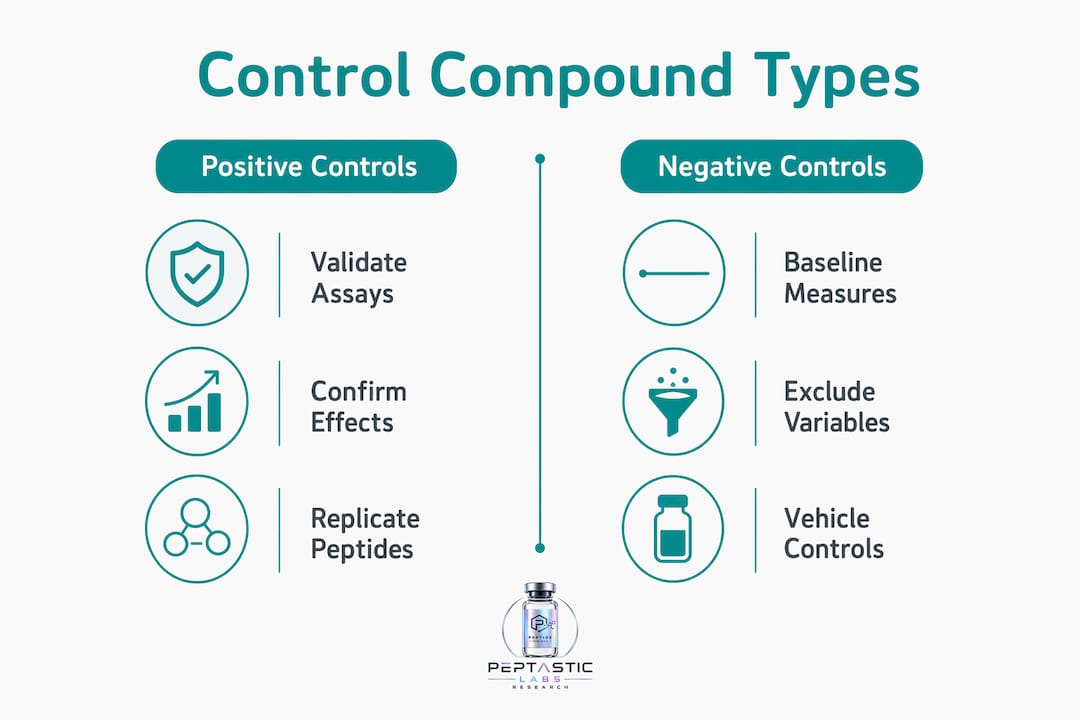
Each category of control addresses a specific source of experimental error. Using only one type leaves blind spots in your data interpretation.
- Positive controls: A compound with a known, documented biological effect run alongside the test peptide. Positive controls validate assay accuracy and separate true biological effects from assay failure or interference. If your positive control does not produce its expected signal, the assay result for your test peptide is unreliable regardless of what it shows.
- Negative controls: A sample containing no active compound, confirming that the assay baseline is clean. Negative controls identify non-specific effects, background fluorescence, or contamination that could inflate or suppress the test signal.
- Vehicle controls: A sample containing only the solvent or carrier used to dissolve the peptide, with no active ingredient. Vehicle controls confirm that DMSO, acetic acid, or any other reconstitution medium is not itself driving a biological response.
- Internal controls: Compounds added to every sample to confirm that the workflow itself is functioning correctly. Internal controls confirm that a negative result reflects a true absence of signal rather than an inhibited reaction or failed extraction step.
Understanding peptide types and their applications helps you select the most appropriate positive control for each assay class, since a control that is biologically irrelevant to your target pathway adds no interpretive value.
Pro Tip: Always run your vehicle control at the same volume and concentration as the highest solvent load in your test peptide wells. A mismatch in solvent concentration between test and vehicle wells is one of the most common sources of artifactual signal.
How does improper use of controls affect peptide study reliability?
The consequences of weak control design are measurable and severe. Interaction-driven variance accounted for 38% of total signal change in multi-peptide models where controls were improperly applied. That means more than a third of the observed signal in those studies was noise, not biology.
"Interaction-driven variance accounted for 38% of total signal change in multi-peptide models when improper controls were used, and 74% of 50 reviewed studies lacked sufficient positive control methodological details, undermining reproducibility."
The practical consequences extend beyond statistical variance. Without a functioning positive control, you cannot tell whether a flat dose-response curve means the peptide is inactive or the assay is broken. False negatives of this type have caused researchers to abandon biologically active compounds prematurely. False positives, generated when vehicle effects go undetected, lead to wasted follow-up experiments and, in some cases, retracted publications.
Many journals now reject manuscripts that lack validated positive controls, treating their absence as a fundamental data integrity failure. This is not a stylistic preference. It reflects a field-wide recognition that control documentation is inseparable from the validity of the scientific claim. The significance of controls in studies has moved from best practice to hard requirement in peer-reviewed peptide research.
What advanced control strategies improve multi-peptide model accuracy?
Standard control design covers chemical composition. Advanced control design covers everything else that can drive a signal: mixing order, diffusion rates, temporal sequencing, and microheterogeneity. In multi-peptide formulations, these physical and temporal variables are as biologically relevant as the compounds themselves.
Controls must replicate not just chemical composition but also the physical and temporal conditions of the experiment, including mixing order and solubility dynamics. A control prepared in a different sequence than the test formulation will not accurately represent the baseline condition. This is a common oversight in labs transitioning from single-peptide to multi-peptide models.
The table below contrasts standard and advanced control approaches across key experimental variables.
| Variable | Standard approach | Advanced approach |
|---|---|---|
| Chemical composition | Matched to test compound | Matched to test compound |
| Mixing order | Not controlled | Replicated exactly from test protocol |
| Diffusion and solubility | Assumed equivalent | Verified per formulation |
| Analytical confirmation | Single method (e.g., HPLC) | Orthogonal methods (HPLC + mass spec) |
| Microheterogeneity | Ignored or unreported | Characterized and documented upstream |
| Impurity thresholds | Supplier certificate accepted | In-house verification against EMA standards |
Microheterogeneity requires orthogonal analytics and upstream control strategies to fully characterize peptide identity and purity before biological assays begin. Treating microheterogeneity as a product characteristic rather than a contamination event changes how you design controls from the start of synthesis, not just at the assay stage.
EMA guidelines require peptide-related impurities to be identified above 0.5% and qualified above 1.0% as of june 2026. Applying these thresholds to your control compound selection gives your impurity management a regulatory anchor that strengthens both internal validity and external credibility.
Controls treated as active hypotheses require the same analytical justification as experimental arms. That mindset shift is the single most impactful change a lab can make to its control strategy.
Pro Tip: When using orthogonal methods, run mass spectrometry alongside RP-HPLC on your control compound at the start of each new lot. A purity number alone does not confirm molecular identity. Both data points together do.
How can researchers implement robust control protocols in peptide studies?
Practical implementation of strong control compound protocols follows a defined sequence. Each step builds on the previous one, and skipping any step introduces a gap that will surface as unexplained variance later.
- Verify purity on receipt. Supplier purity statistics can mask impurities and lot-to-lot variation. Run in-house RP-HPLC on every new lot of control compound before it enters any assay. This establishes your own dose-response baseline independent of the supplier's summary statistic.
- Document lot numbers and batch data. Record the Certificate of Analysis for every control compound used. A detailed Certificate of Analysis links your experimental results to a specific, traceable batch. Without this, lot-to-lot variation becomes an invisible confound.
- Justify your control selection in writing. State explicitly why each control is appropriate for the target, assay format, and peptide class under study. Reviewers and collaborators need this justification to evaluate your methodology independently.
- Replicate physical conditions. Prepare control samples using the same mixing sequence, temperature, and timing as your test formulation. Physical preparation conditions affect early signaling and interaction outcomes in multi-peptide systems.
- Apply EMA impurity thresholds as a screening filter. Before finalizing a control compound for use, confirm that known impurities fall below the 0.5% identification threshold. Any impurity above that level requires characterization before the compound enters a biological assay.
- Validate interlaboratory comparability. If your study involves multiple sites or time points, run the same positive control at each site and each time point. Consistent positive control performance across sites confirms that observed differences in test peptide response are biological, not procedural.
Peptasticlabs provides Certificates of Analysis on request for every compound in its catalog, supporting steps 2 and 5 directly. Researchers working with mTOR pathway peptides or other signaling-sensitive systems benefit from this documentation when justifying control selection to journals or institutional review boards.
Key Takeaways
Control compounds are the structural backbone of valid peptide research: without positive, negative, vehicle, and internal controls properly documented and physically replicated, no peptide study result can be independently verified or trusted.
| Point | Details |
|---|---|
| Controls define experimental validity | Every observed peptide effect requires a matched control to confirm it is biological, not artifactual. |
| 74% of studies lack adequate positive controls | This gap directly prevents reproducibility and is now a common cause of manuscript rejection. |
| Physical replication is as critical as chemical matching | Mixing order, diffusion rates, and timing must mirror test conditions in every control sample. |
| EMA sets the impurity identification floor | Impurities above 0.5% must be identified; above 1.0% they must be qualified before use. |
| On-receipt RP-HPLC verification is non-negotiable | Supplier purity certificates are summary statistics that can conceal lot-to-lot variation. |
The case for treating controls as first-class experimental citizens
Most researchers I have worked alongside treat control compounds as administrative overhead. They run them because journals require them, not because they have thought carefully about what each control is actually testing. That mindset produces technically compliant but scientifically weak data.
The 38% signal variance figure from multi-peptide interaction studies is not an outlier finding. It is a predictable consequence of treating controls as passive references rather than active hypotheses. When you design a control, you should be asking: what specific alternative explanation does this control rule out? If you cannot answer that question for each control in your panel, the control is not doing its job.
The labs producing the most reproducible peptide data right now are the ones that have moved control design upstream. They characterize microheterogeneity at the synthesis stage, apply orthogonal analytics before any biological assay runs, and document every physical preparation variable. That is not excessive rigor. It is the minimum standard for data that will survive independent replication.
The cultural shift required here is straightforward: controls deserve the same experimental attention as the test compound. When that becomes the default, the reproducibility problem in peptide research shrinks considerably.
— Tintastic
Peptasticlabs: verified compounds for rigorous peptide research
Researchers who take control compound protocols seriously need a supplier whose documentation matches that standard.
Peptasticlabs offers a catalog of over 22 research-grade peptides, each independently tested and verified to ≥99% purity via HPLC. Certificates of Analysis are available on request for every batch, giving you the traceability documentation that rigorous control protocols require. Third-party verification and detailed batch records support both in-house RP-HPLC confirmation and EMA-aligned impurity screening. Researchers can browse the full verified peptide catalog to identify compounds suited for positive control, test compound, or reference standard roles across metabolic, cognitive, tissue repair, and immunology study designs.
FAQ
What is a control compound in peptide research?
A control compound is a reference substance included in a peptide study to confirm that observed effects are attributable to the test peptide rather than to assay conditions, solvents, or procedural error. Controls include positive, negative, vehicle, and internal categories, each ruling out a different source of experimental artifact.
Why do positive controls matter more than negative controls?
Positive controls validate assay accuracy by confirming the system can detect a known biological effect. Negative controls confirm baseline cleanliness, but a clean baseline in a broken assay still produces meaningless data. Both are required, but a missing positive control is the more common cause of irreproducible results.
How does lot-to-lot variation affect control compound reliability?
Supplier purity certificates are batch-level summary statistics that can conceal impurity profiles and variation between lots. Running in-house RP-HPLC on every new lot of control compound establishes an independent purity baseline and prevents undetected variation from confounding dose-response data.
What EMA impurity standards apply to peptide control compounds?
EMA guidelines as of june 2026 require peptide-related impurities to be identified above 0.5% and qualified above 1.0%. Applying these thresholds to control compound screening aligns your experimental controls with regulatory-grade quality benchmarks.
How many control types should a peptide study include?
A well-designed peptide study includes at minimum a positive control, a negative control, and a vehicle control. Studies using complex multi-peptide formulations or molecular diagnostic workflows should also include internal controls to confirm workflow integrity at every sample level.