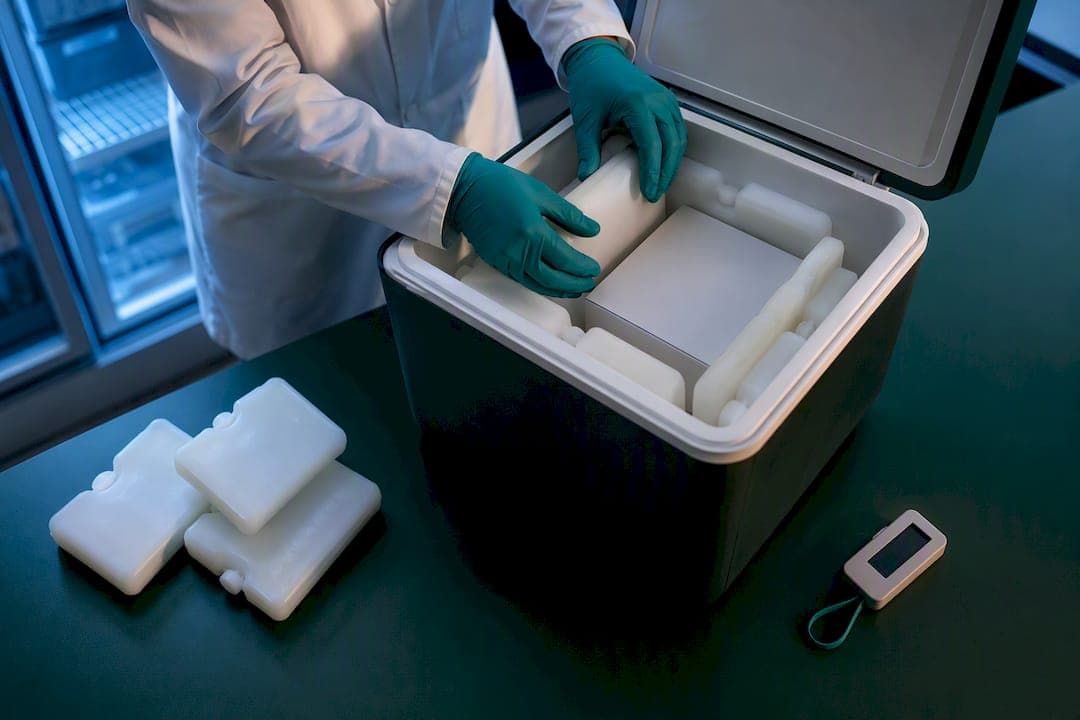
Pick the temperature band the peptide's stability data requires. For most refrigerated peptides that means 2°C to 8°C, but frozen and controlled-room-temperature formulations exist and demand their own packout. Confirm the requirement against the Certificate of Analysis or stability report, then qualify a packout and a calibrated logger to that exact band before you ship anything. For small-parcel routes with unpredictable handoffs, default to a validated active container or a qualified third-party logistics provider.
TL;DR:
- Confirm the specific temperature requirements for each peptide shipment using the Certificate of Analysis or stability report, as most only need 2°C to 8°C, but exceptions exist.
- Use route-specific qualification with calibrated data loggers to verify whether passive or active cold-chain systems are necessary, especially for long or unpredictable transit lanes.
- Match the coolant type—gel packs, PCM, or dry ice—to the target temperature band and control the conditioning process meticulously to prevent damage or over-freezing.
- Record comprehensive validation data, including logger files and packout details, and retain documentation to support stability-based disposition decisions in case of excursions.
- Request batch-specific Certificates of Analysis from suppliers to enable rapid, evidence-based responses to borderline shipments rather than unnecessary quarantine or discard.
Table of Contents
- What Temperature Band Does Your Peptide Cold Chain Actually Need?
- How Do Passive and Active Cold-Chain Systems Compare?
- Which Coolant Fits Your Peptide Shipment?
- How Should You Monitor and Validate a Peptide Shipment?
- Lyophilized vs Reconstituted Peptides: Different Rules Apply
- What SOP Elements Should a Peptide Supplier Provide?
- What Actually Causes Cold-Chain Failures in Peptide Shipping?
- Get Batch-Documented Peptides Built for Defensible Cold-Chain Decisions
- Sources
- FAQ
What Temperature Band Does Your Peptide Cold Chain Actually Need?
Researchers default to 2°C to 8°C out of habit, and it is a reasonable starting assumption. It is not universal. Some lyophilized peptides tolerate brief excursions into ambient territory without measurable loss, while certain reconstituted formulations degrade meaningfully within hours above their target band.
A decision checklist keeps this from becoming guesswork:
- Confirm the band first. Check the CoA, stability report, or supplier technical sheet before assuming 2°C to 8°C applies.
- Measure the lane. Estimate transit hours, number of handoffs, and customs or courier dwell time before choosing a system.
- Match the format to the risk. Short, predictable metro lanes suit passive refrigerated packouts; long or variable lanes need active, setpoint-controlled containers; frozen payloads need dry ice; multi-site or high-volume operations often justify a specialist 3PL.
- Ask vendors for evidence, not promises. Request packout qualification data, the logger model and calibration status, and the carrier's stated cutoff times before committing to a lane.
Skipping the first step is the most common mistake in peptide storage guidelines work. Teams pick a shipping method they've always used, without checking whether the specific compound in that shipment actually needs it.
How Do Passive and Active Cold-Chain Systems Compare?
Passive systems rely on insulation and a preconditioned coolant charge to hold temperature for a fixed window, typically 24 to 96 hours depending on design. Active systems use powered, setpoint-controlled compartments that hold a target temperature independent of ambient conditions, extending well beyond what any passive box can sustain.
The trade-offs come down to four factors:
- Autonomy duration. Passive systems degrade as the coolant charge exhausts; active units run as long as they have power.
- Conditioning effort. Passive packouts demand precise pre-conditioning of every coolant element; active units need less manual prep but more setup checks.
- Cost and carrier acceptance. Active containers cost more to rent or buy and some carriers restrict battery-powered units on certain routes.
- Handling complexity. Passive boxes are simpler for staff to assemble correctly under time pressure; active units require training on setpoint controls and battery status checks.
WHO's technical supplement on temperature-controlled transport frames qualification as a route-specific exercise: profile the actual lane, run a sample packout with a calibrated data logger under worst-case seasonal conditions, and document pass/fail criteria before that packout ships live material.
Pro Tip: Run your packout qualification in the hottest and coldest months your lane will actually see, not just the season you happen to be testing in. A packout that passes in April can fail in a July heat spike on the same route.
Which Coolant Fits Your Peptide Shipment?
The coolant should match the thermal budget, not the lowest achievable temperature. Gel packs and water-based refrigerants work well for standard 2°C to 8°C shipments and are the default choice for most metro and regional lanes. Phase-change material (PCM) packs hold a narrower band and resist freeze-through better than plain gel, which matters when a payload cannot tolerate even a brief dip below 0°C. Dry ice belongs only with genuinely frozen formulations, since it sublimates at roughly −78.5°C and will over-freeze a chilled payload if placed in direct contact.
| Coolant type | Target band | Conditioning need | Key handling constraint |
|---|---|---|---|
| Gel packs | 2°C to 8°C | Pre-freeze or pre-chill 24 hours ahead | Must not touch vials directly |
| PCM packs | Narrow chilled band, no-freeze buffer | Pre-condition to rated onset temperature | More expensive per unit than gel |
| Dry ice | Frozen (below −78.5°C) | No pre-conditioning; used as-is | Requires venting, hazard labeling, and carrier declaration |
Conditioning rules that prevent avoidable damage:
- Pre-freeze or pre-chill every coolant element on the schedule the packout qualification specifies, never on a shortcut.
- Keep frozen refrigerants like dry ice physically separated from chilled payloads inside the same parcel.
- Wrap vials or vials trays so no coolant surface makes direct contact with product.
- Check carrier rules on dry ice quantity limits and required hazard marking before dispatch, since regulations vary by carrier and mode.
How Should You Monitor and Validate a Peptide Shipment?
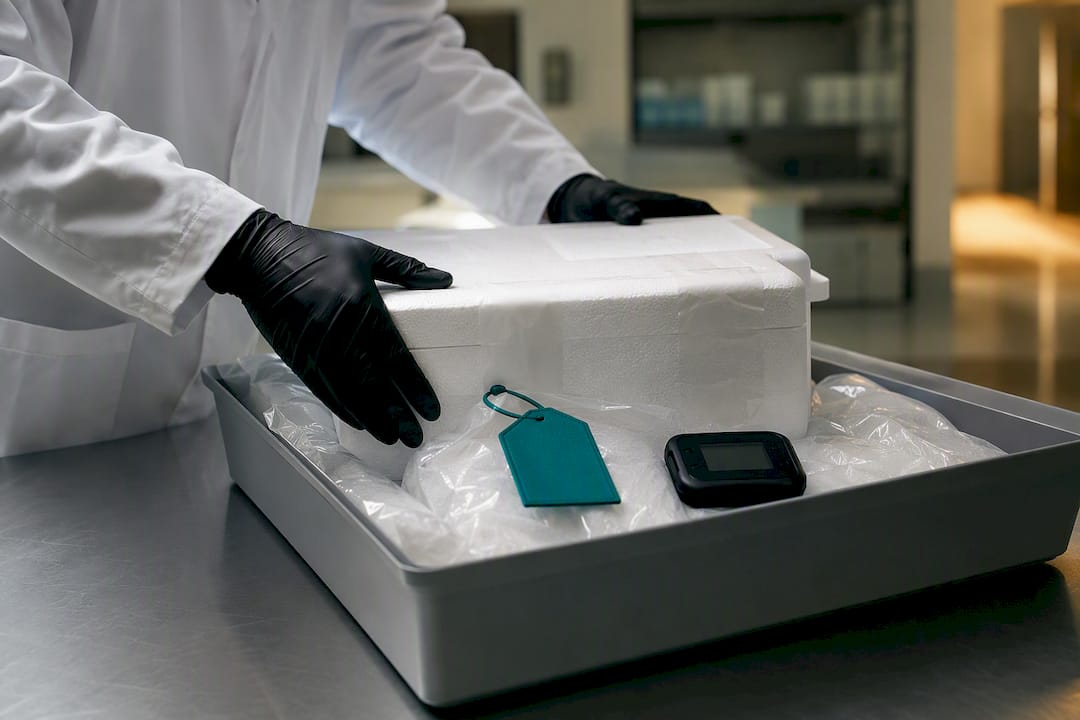
Monitoring evidence is what turns a shipping decision into a defensible one. A calibrated electronic data logger, not a color-change threshold sticker, is what lets a receiving lab distinguish an actual excursion from a brief handling blip. Single-use loggers suit one-way shipments; reusable units with current calibration certificates make more sense for recurring lanes. Most cold-chain guidance recommends a five-minute recording interval as a practical default for parcel-scale shipments.
Records worth retaining for every shipment:
- The downloaded logger file, showing the full time-temperature profile from dispatch to arrival.
- The packout specification and coolant conditioning record used for that shipment.
- Dispatch and arrival timestamps, matched against the logger's own clock.
- The relevant SOP version and, where applicable, the route qualification report that packout was tested against.
Cold chain fact: Strive for 5, Australia's national vaccine storage guidance, aims for a target storage point of +5°C within the +2°C to +8°C range and sets out a structured breach protocol rather than automatic disposal on excursion.
Receiving an out-of-spec shipment does not mean discarding it. Quarantine the material immediately, preserve the logger and all packing materials intact, and document the full time-temperature profile before contacting the supplier for a stability-based disposition decision. That sequence protects sample value that a reflexive discard would destroy.
Lyophilized vs Reconstituted Peptides: Different Rules Apply
Lyophilized peptides carry very low water content, which slows several degradation pathways compared to solution form. That does not make them immune to damage. Heat, humidity, oxygen exposure, and light still degrade freeze-dried material over time, and stability behavior differs by formulation, so a generic shelf-life assumption is not safe to apply across compounds.
Reconstituted peptides face a shorter usable window and greater vulnerability to freeze-thaw cycling and oxidation once in solution. Build your SOPs around that difference:
- Store lyophilized stock and reconstituted solutions in physically separated locations, never in the same rack tray.
- Label every reconstituted vial with the exact reconstitution timestamp, not just the date.
- Enforce a one-freeze, one-thaw rule for solutions, since repeated cycling accelerates aggregation and loss of activity.
- Set a maximum time-at-temperature limit for reconstituted material based on the specific compound's stability data, not a rule of thumb borrowed from a different peptide.
Teams that skip the segregation step are the ones who eventually pull a reconstituted vial off a shelf next to lyophilized stock and can't say how long it sat unrefrigerated. Reviewing lyophilized peptide storage temperature guidance before setting up a rack layout avoids that exact failure.
What SOP Elements Should a Peptide Supplier Provide?
That documentation matters directly for cold-chain decisions: a receiving lab facing a borderline excursion needs the manufacturer's own stability data to make a defensible call, not a guess.
Copy-ready SOP elements worth adapting into your own receiving process:
- A receiving checklist covering seal integrity, vial condition, logger ID, and arrival timestamp before anything moves into storage.
- A one-freeze-one-thaw rule enforced at the point of reconstitution, logged against the vial label.
- A conditioning record for every coolant element used, kept alongside the shipment's logger file.
Pro Tip: Request the CoA and any available stability notes before you place an order, not after an excursion forces the question. Having that reference on file in advance cuts your excursion response time from days to minutes.
Teams building out a full receiving process can also check how to assess a batch-tested peptide supplier for a broader documentation checklist.
What Actually Causes Cold-Chain Failures in Peptide Shipping?
Most losses trace back to inconsistent coolant conditioning, late afternoon dispatch that misses transit windows, and weak receiving checks that skip logger review. Fixes are unglamorous: standard packout kits, a hard morning dispatch cutoff, conditioned staging areas, and a documented escalation path. Once volume or lane variability outgrows what a small team can condition reliably, move to a specialist 3PL or an active container.
— Tintastic
Get Batch-Documented Peptides Built for Defensible Cold-Chain Decisions
Some peptide suppliers provide Certificates of Analysis and batch documentation that can be handed directly to a receiving team when a shipment needs a stability-based disposition call. That paperwork is the difference between quarantining a borderline shipment for review and discarding it out of caution.
Every compound across the Metabolic, Cognitive & Neuro, Tissue & Repair, Longevity, and Cosmetic Science lines ships with independent HPLC verification to ≥99% purity, so your cold-chain evidence pairs with product-level purity data rather than a bare label claim. If your lab is setting up a new packout or refreshing SOPs for an existing lane, browse the full catalog and request a Certificate of Analysis for any batch before your next order ships.
Sources
- Storing, handling and administering vaccines | Australian Government Department of Health, Disability and Ageing
- Temperature-controlled transport operations by road and by air (WHO TRS No. 961 Annex 9 technical supplement)
- Pharmaceutics stability modeling case study
FAQ
Can I Buy Retatrutide in Australia?
Availability depends on the supplier and the product's intended research classification, so check current listings directly with the vendor rather than assuming blanket availability. Peptastic Labs lists current research-grade compounds and their documentation status on its catalog page.
Why Keep Peptides in the Fridge?
Refrigeration slows the chemical degradation pathways that break down peptide structure over time, particularly oxidation and hydrolysis. Most refrigerated peptides target the 2°C to 8°C range, though the exact requirement is compound-specific and should be confirmed against stability data.
What Are the Top Peptides Researchers Order?
Demand varies by research area, spanning metabolic, cognitive, tissue repair, longevity, and cosmetic science applications rather than one single dominant compound. Peptastic Labs organizes its catalog into these categories so researchers can find HPLC-verified options relevant to their specific study.
What Are Cold Chain Drugs?
Cold chain drugs are pharmaceutical or biologic products, including many peptides, that must stay within a validated temperature range from manufacturing through storage and transport to preserve stability and activity. Losing that temperature control, known as an excursion, triggers quarantine and a stability-based assessment rather than automatic disposal, per Australian guidance.