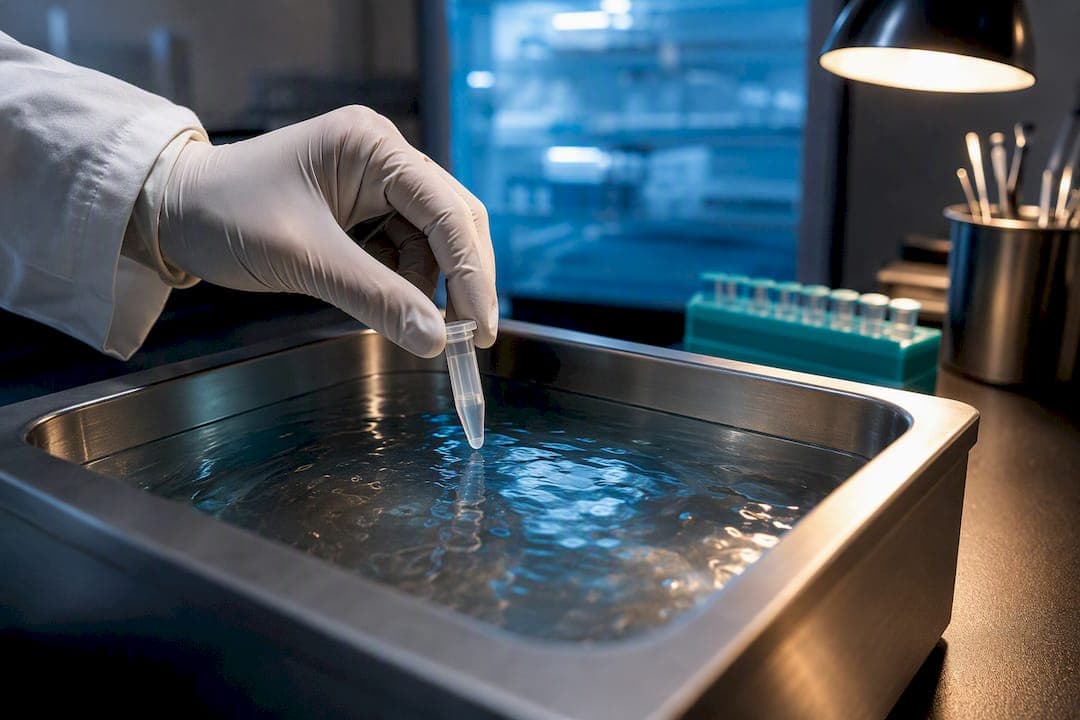
Freeze-thaw damage occurs at the phase transition, not during frozen storage, so the single most reliable safeguard is aliquoting before the first freeze. Reconstituted peptide should be split into single-use volumes immediately, with lyophilized powder held cold and undisturbed for long-term storage. Every additional freeze-thaw cycle on the same material adds risk that cannot be undone later.
TL;DR:
- Peptides are most vulnerable during the freeze-thaw transition, with cryoconcentration causing localized concentration spikes that promote aggregation.
- Limit each sample to a single freeze and thaw cycle by aliquoting immediately after reconstitution and avoiding refreezing original vials.
- Use cryoprotectants like trehalose or glycerol at validated ratios, and store in low-binding containers to minimize surface adsorption and aggregation risks.
- Rapid thawing at room temperature in a water bath or fingertip warmer is preferred to slow, uneven warming that can cause localized stress.
- Lyophilized peptides stored desiccated at deep freezing temperatures remain stable for years, while reconstituted solutions require careful storage and prompt analysis to detect degradation.
Table of Contents
- What Happens to Peptides During Freeze-Thaw Cycles?
- How Many Freeze-Thaw Cycles Can a Peptide Tolerate?
- Best Practices for Handling Peptides Through the Freeze-Thaw Process
- What Is the Right Way to Thaw a Peptide Aliquot?
- Lyophilized Powder vs. Reconstituted Solution: Storage Timelines
- How Do You Know If a Thawed Peptide Has Degraded?
- A Single-Use Aliquot SOP for Routine Peptide Storage
- Managing Freeze-Thaw Trade-offs When Peptide Supply Is Limited
- Sourcing Peptides With Documentation That Supports Storage Decisions
- Sources
What Happens to Peptides During Freeze-Thaw Cycles?
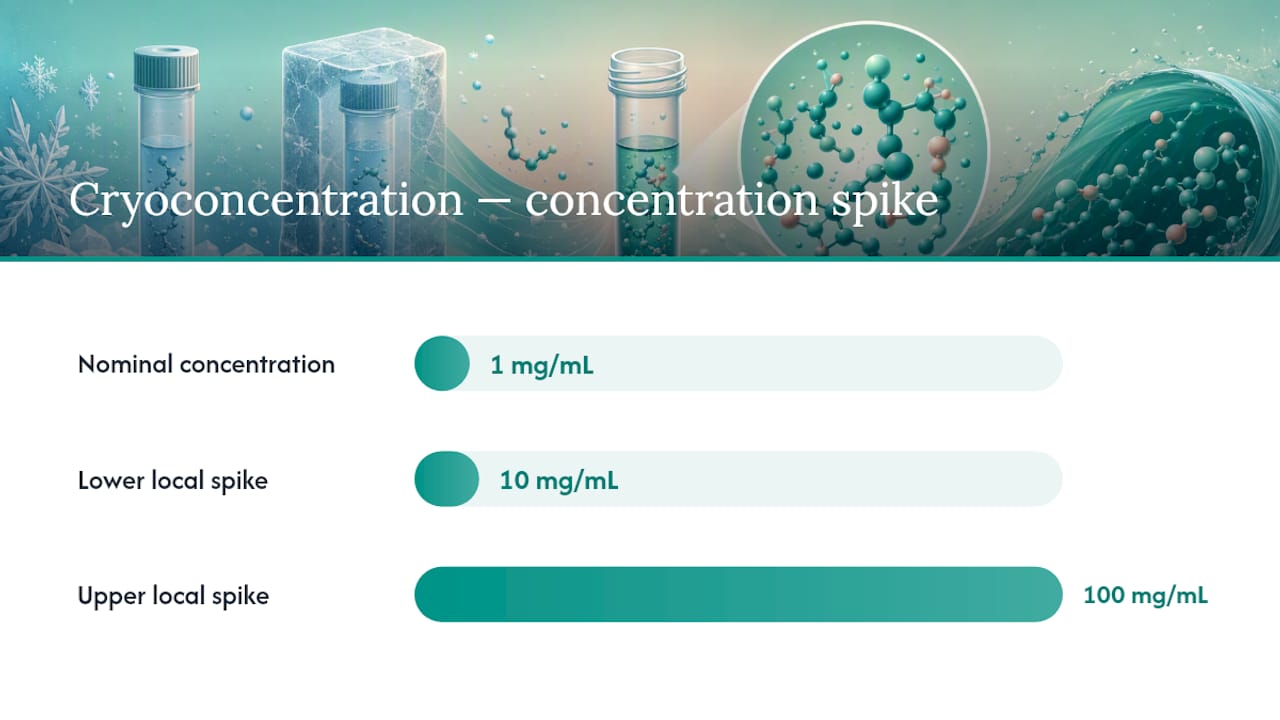
Ice formation does not damage peptides uniformly. As water crystallizes, dissolved peptide and buffer salts get excluded from the growing ice lattice and concentrated into shrinking channels of unfrozen liquid. This process, cryoconcentration, can push local peptide concentration up by roughly 10 to 100 times normal levels before the sample fully solidifies.
That crowding does three things at once:
- It forces peptide molecules into close, sustained contact, which drives aggregation.
- It shifts local pH as buffer salts crystallize at different rates than water, sometimes swinging conditions far from the intended range.
- It creates ice-liquid and air-liquid interfaces that peptides adsorb onto, unfolding partially and exposing hydrophobic patches that promote further aggregation.
None of this happens while the sample sits quietly at -80 °C. The damage is concentrated in the seconds to minutes it takes to freeze and thaw, and formulation reviews consistently identify these transition windows as the primary stress events. That is why the relevant metric for peptide stability is never storage duration alone. It's the number of freeze-thaw transitions the sample has been through.
Cryoconcentration by the numbers: a peptide solution that starts at 1 mg/mL can experience localized concentrations equivalent to 10 to 100 mg/mL in the last unfrozen liquid channels before full solidification, a spike large enough to trigger aggregation in sequences that are otherwise perfectly stable at their nominal concentration.
How Many Freeze-Thaw Cycles Can a Peptide Tolerate?
There is no universal number, but the pattern across formulation studies is consistent enough to build a rule around. Many peptides show measurable aggregation after several freeze-thaw cycles, while more sensitive sequences degrade noticeably after a single cycle. DSC-based stress testing shows that tolerance depends heavily on excipient choice and peptide-to-excipient ratio, not just the peptide itself.
Certain structural features lower tolerance further:
- Sequences containing cysteine, methionine, or tryptophan oxidize and aggregate more readily under freeze-thaw stress.
- Low-concentration solutions suffer disproportionately from cryoconcentration because the relative crowding effect is larger.
- Some approved biologic formulations carry explicit "do not freeze" label instructions, which is direct evidence that certain peptide and protein formulations cannot tolerate even one freeze-thaw event.
The operational rule that avoids guesswork entirely: design every workflow so each aliquot experiences exactly one freeze and one thaw. If you cannot answer "how many cycles has this vial seen?" with certainty, treat it as compromised.
Best Practices for Handling Peptides Through the Freeze-Thaw Process
Reducing freeze-thaw damage comes down to sequencing decisions correctly, mostly at the moment of reconstitution.
- Aliquot immediately after reconstitution. Split the full reconstituted volume into sterile, single-use cryovials before anything goes into the freezer. Label each vial with peptide ID, concentration, and reconstitution date before freezing, not after.
- Leave the master vial alone. Avoid refreezing the original reconstituted vial, especially one mixed with bacteriostatic water. Refreezing redistributes the benzyl alcohol preservative unevenly and defeats the purpose of aliquoting in the first place.
- Add a cryoprotectant where validated. Trehalose or sucrose at 5 to 10%, or glycerol at 10 to 20% v/v, can measurably delay aggregation onset. DSC comparisons on a glucagon model found lactose outperformed trehalose at the tested ratios, and that higher excipient-to-peptide ratios pushed aggregation onset later across the board.
- Choose low-binding containers. Siliconized or low-binding polypropylene tubes reduce surface adsorption losses for small volumes. Cap tightly and keep headspace to a minimum.
- Match temperature to timeline. Use -80 °C for long-term storage when feasible, -20 °C for medium-term needs, and insulate vials inside frost-free freezers, which cycle temperature during automatic defrost and impose small unplanned freeze-thaw stress on anything stored near the coils.
Pro Tip: Store aliquots in the back or bottom of the freezer, away from the door and defrost coil. Frost-free units swing several degrees during automatic defrost cycles, and vials near the airflow path take the brunt of it.
What Is the Right Way to Thaw a Peptide Aliquot?
Speed matters more than temperature here. Rapid, controlled thawing shortens the time a sample spends at the ice-liquid interface, where recrystallization and interfacial stress do the most damage. For a small aliquot, a room-temperature water bath or fingertip warming works well, and lab handling guidance confirms that small volumes thaw in minutes this way, while larger vials thaw unevenly and risk transient concentrated layers.
Avoid slow bench thawing at room air, and never use a bath above 30 °C or a microwave, both of which introduce uneven heating and localized overheating.
- Thaw only the single aliquot needed for that day's work.
- Invert gently to mix once liquid. Do not vortex.
- Use the aliquot promptly and discard what remains rather than refreezing it.
Lyophilized Powder vs. Reconstituted Solution: Storage Timelines
Powder form is the more forgiving state by a wide margin. Lyophilized peptide kept desiccated, protected from light, and stored at -20 °C or -80 °C is commonly stable for years, with no freeze-thaw exposure at all until reconstitution.
Once reconstituted, the clock changes:
- Refrigerated at 2 to 8 °C, most reconstituted peptides hold for days to a few weeks.
- Aliquoted and frozen, reconstituted peptide can remain viable for months, with -80 °C outlasting -20 °C.
- If bacteriostatic water was used, the 28 to 30 day sterility window tied to the benzyl alcohol preservative is often the real limiting factor behind the popular "30 day rule," not peptide chemistry itself.
How Do You Know If a Thawed Peptide Has Degraded?
A short analytical panel tells you whether an aliquot is fit for use before you commit an experiment to it. HPLC flags purity loss and new degradation products. Size-exclusion chromatography (SEC) detects aggregates by size. DSC reveals shifts in thermal behavior that indicate structural stress, and DSC-based screening is fast enough to compare formulations without running full freeze-storage studies.
Simple bench checks catch obvious problems without instrumentation:
- Visual clarity and turbidity, since new haze often means aggregation.
- Particulate inspection against a light source.
- An unexpected drop in assay signal relative to the same peptide's earlier lot.
Set a clear discard threshold in advance, such as any new SEC aggregate peak or a substantial purity drop by HPLC, and document the result either way.
A Single-Use Aliquot SOP for Routine Peptide Storage
- Reconstitute using the validated solvent and target concentration; record the lot number and Certificate of Analysis on file, following documented reconstitution guidance.
- Prepare sterile, low-binding cryovials sized for single-use volumes; label each with peptide ID, concentration, and date.
- Freeze aliquots immediately in an upright rack; log the freezer unit and shelf position.
- Thaw one aliquot per use, apply it within its validated window, and discard any leftover volume rather than refreezing it.
Pro Tip: Link every aliquot's label back to its original COA and lot number in your notebook. When an assay result looks off months later, that traceability is the fastest way to rule out a storage problem.
Managing Freeze-Thaw Trade-offs When Peptide Supply Is Limited
Scarce or costly peptide sometimes forces a controlled refreeze rather than an ideal single-use aliquot. When that happens, validate on a small representative subset first, since every additional cycle adds risk that compounds rather than resets. Log every temperature excursion and freeze-thaw event in the experimental record, and where results genuinely matter, test tolerance directly rather than assuming it.
— Tintastic
Sourcing Peptides With Documentation That Supports Storage Decisions
Freeze-thaw discipline only works if you trust what went into the vial in the first place. Peptasticlabs supplies independently tested peptides verified to 99% purity or higher by HPLC, with batch documentation and Certificates of Analysis available on request.
Knowing the exact purity and lot history behind a peptide helps you judge how much margin you have before a freeze-thaw cycle matters, and how much doesn't apply if the starting material was already compromised. For labs building a reconstitution and aliquoting SOP around a specific compound, that documentation is the starting reference point, not an afterthought added after a stability problem shows up. Review the current catalog and request a COA for your compound at Peptasticlabs before your next reconstitution run.
Sources
- Protein destabilization and cryoconcentration during freezing — PMC6373418
- Practical aspects of freezing and thawing in protein handling — PubMed 30529434