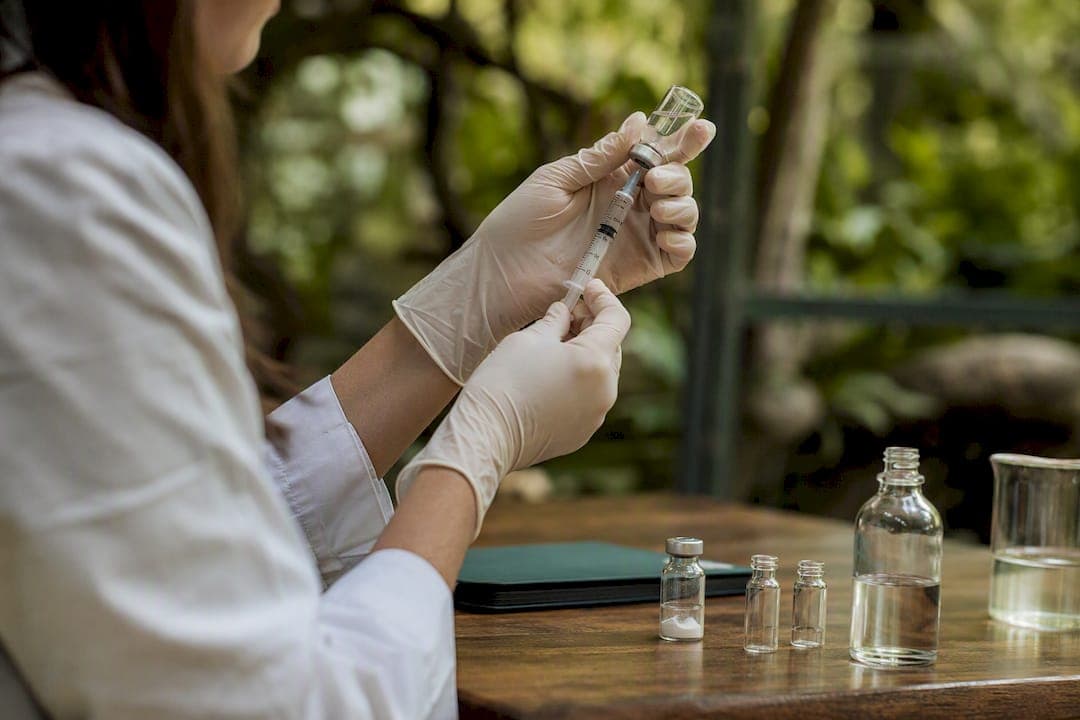
Bacteriostatic water is used with peptides because its preservative, 0.9% benzyl alcohol, suppresses bacterial growth inside a reconstituted vial, allowing that same vial to be punctured and drawn from repeatedly while reducing contamination risk. That single property changes how a peptide vial gets handled in practice.
- It supports multiple withdrawals from one vial instead of forcing single-use disposal.
- It reduces the chance of introducing bacteria each time a needle enters the stopper.
- It's the default diluent for most standard research peptides, though not all.
Bacteriostatic water is not approved for use in neonates, and not every peptide tolerates benzyl alcohol. Check compatibility before you reconstitute.
Key Takeaways
| Point | Details |
|---|---|
| Composition matters | Bacteriostatic water contains 0.9% (9 mg/mL) benzyl alcohol, not a sterilizing agent. |
| Preservative has limits | It's bacteriostatic, not bactericidal, so aseptic technique remains mandatory every time. |
| Check compatibility first | Some peptides need saline or acidic vehicles; cloudiness signals a mismatch. |
| Track the puncture date | Mark first use and follow the label's beyond-use window, commonly 28 days refrigerated. |
| Know the contraindications | Avoid benzyl alcohol products in neonates; watch for hypersensitivity in adults. |
Table of Contents
- What Is Bacteriostatic Water, Exactly?
- Bacteriostatic Vs. Bactericidal: How the Preservative Actually Works
- Why Peptides Specifically Get Reconstituted With It
- How to Reconstitute Peptides With Bacteriostatic Water
- Storage Rules and Signs a Vial Should Be Discarded
- Safety Limits and Compatibility Cautions Worth Knowing
- A Note From Peptastic Labs
- Sources
What Is Bacteriostatic Water, Exactly?
Bacteriostatic Water for Injection, USP, is sterile water with one addition: benzyl alcohol, added specifically as a preservative rather than an active ingredient. The standard concentration is 0.9%, or 9 mg per milliliter, and the solution typically carries a pH around 5.7, within a labeled range of 4.5 to 7.0. That's the specification worth memorizing if you're comparing suppliers or reading a Certificate of Analysis.
Two things follow from this composition:
- Because it contains a preservative, it's supplied in multi-dose vials meant for repeated entry.
- Plain sterile water for injection contains no preservative and is meant for a single use, then discarded.
Mixing those two up is one of the more common errors in peptide handling, and it's an easy one to avoid once the distinction is clear.
Bacteriostatic Vs. Bactericidal: How the Preservative Actually Works
Benzyl alcohol is bacteriostatic, not bactericidal. That distinction is the whole point of the name, and it matters practically: bacteriostatic means it slows or halts bacterial reproduction, while bactericidal would mean it kills bacteria outright. Benzyl alcohol works by disrupting microbial cell membranes and interfering with basic metabolic processes, which keeps bacterial counts from climbing between uses.
It has real limits, though.
- It doesn't sterilize the vial or its contents on contact.
- Some organisms, and virtually all spores, aren't reliably controlled by benzyl alcohol.
- Aseptic technique is still required every single time, regardless of what preservative is in the water.
- Highly sensitive peptides or cell-based assay work can show interactions with benzyl alcohol, so it isn't automatically the right chemical environment for every compound.
Think of the preservative as a backstop, not a substitute for clean handling. Aseptic technique still carries the weight of preventing contamination.
Why Peptides Specifically Get Reconstituted With It
Peptides arrive lyophilized, meaning freeze-dried into a stable powder, and that powder has to be turned into a liquid before it's usable. Bacteriostatic water solves three problems at once for that step: it prevents bacterial growth after repeated punctures, it supports the multi-dose workflow most researchers actually need, and it's chemically compatible with the majority of common peptides at that 0.9% benzyl alcohol concentration.
Sterile water, by contrast, only makes sense if you're going to use the entire vial in one sitting. No preservative means no protection for whatever solution remains after the first draw.
Compatibility isn't universal, though. Some peptides need an acidic solution or a saline-based vehicle instead, and cloudiness after mixing is the clearest warning sign that the diluent doesn't match the compound. A properly reconstituted peptide solution should look clear.
Pro Tip: Before defaulting to bacteriostatic water, check the peptide's documentation or Certificate of Analysis. A two-minute check beats discovering incompatibility after the vial is already mixed.
How to Reconstitute Peptides With Bacteriostatic Water
Reconstitution is mechanical, and getting the sequence right matters more than getting it fast.
- Confirm the peptide's specific reconstitution instructions and inspect both the vial and its COA before opening anything.
- Wipe the rubber stopper with a 70% isopropyl alcohol swab and let it air-dry fully.
- Use a new, sterile syringe and needle for this step, and for every future entry into the vial.
- Draw the bacteriostatic water and inject it slowly down the inside wall of the vial, not directly onto the peptide powder.
- Gently roll or swirl the vial to dissolve the powder. Never shake it; agitation can damage the peptide's structure.
- Withdraw doses using clean technique each time, swabbing the stopper before every entry.
The volume of bacteriostatic water you add determines the final concentration, so choose it based on what concentration you actually need, rather than an arbitrary round number.
A few habits prevent avoidable problems: avoid introducing air bubbles during the draw, never return unused solution from a syringe back into the vial, and never freeze a reconstituted solution. Keep it away from direct light and temperature swings, since both can degrade peptide structure over time.
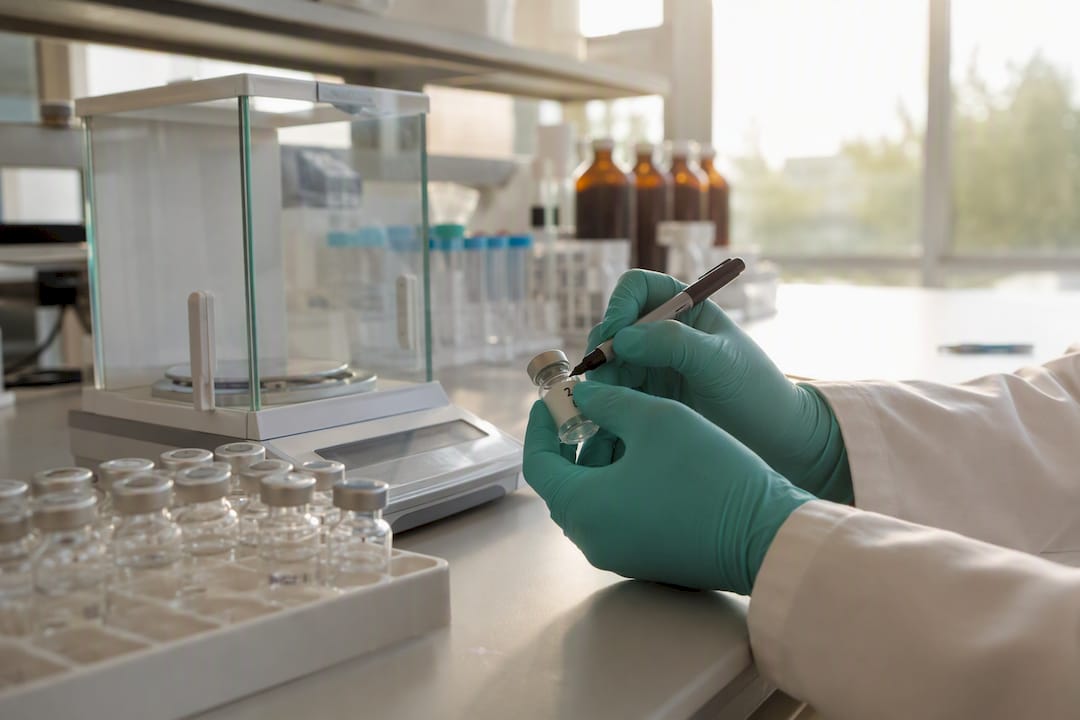
Pro Tip: Write the first-puncture date directly on the vial label the moment you reconstitute it. That single habit is what sets your beyond-use date, and most labs default to a 28-day window when the vial is refrigerated, though the product label always governs.
Storage Rules and Signs a Vial Should Be Discarded
Refrigerate reconstituted peptide vials at 2 to 8°C, never freeze them, and keep them out of direct light. Unopened bacteriostatic water carries its own shelf life printed on the packaging, but once a vial is punctured, the clock changes entirely.
Most lab guides converge on a 28-day in-use window for benzyl-alcohol-preserved multi-dose vials stored cold, though the peptide's own intrinsic stability can shorten that further. Always defer to the manufacturer's label over any general rule of thumb.
Watch for these signs that a vial has gone bad:
- Cloudiness or visible haze in a solution that was clear before.
- Any particulate matter floating in the liquid.
- A color change from the original appearance.
- An unexpected or off odor.
If any of those show up, discard the vial and contact the supplier rather than guessing. Mark the first-puncture date on the vial itself and in your lab log the moment you reconstitute.
Safety Limits and Compatibility Cautions Worth Knowing
Benzyl alcohol carries a well-documented contraindication: it's linked to severe toxicity in neonates, a condition historically called "gasping syndrome." Preservative-free sterile water is the appropriate choice for infant use, full stop.
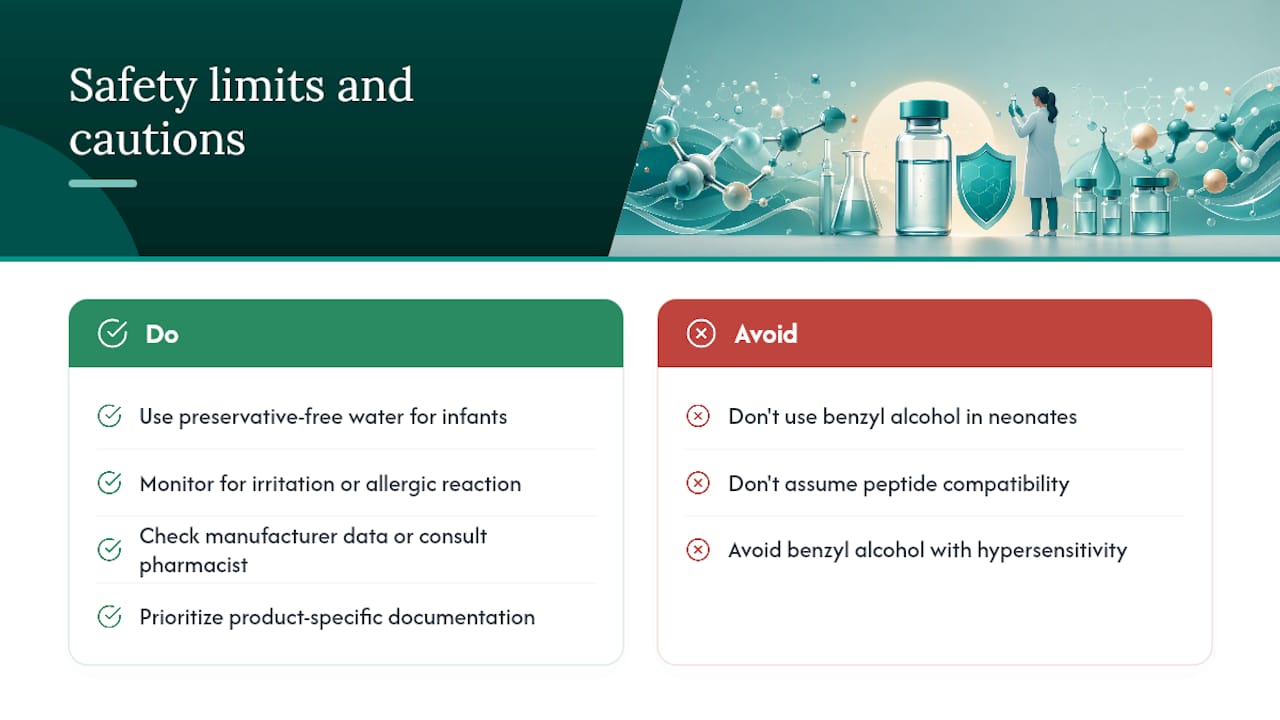
Beyond that specific population, benzyl alcohol can trigger hypersensitivity reactions in some individuals. Watch for unusual irritation or allergic response, and involve a clinician if anything unexpected shows up.
There's also a peptide-specific caution worth taking seriously. Compounding experts and lab guides note that benzyl alcohol can promote aggregation in certain sensitive proteins, altering thermal stability in ways that compromise the compound. This isn't universal, but it's common enough to justify checking before you assume compatibility.
Verify against manufacturer data or consult a compounding pharmacist before reconstituting a peptide you haven't worked with before. When labeling and COA information conflict with general practice, the product-specific documentation wins.
A Note From Peptastic Labs
Tintastic, writing on behalf of Peptastic Labs, draws on the company's own HPLC-verified batch testing and Certificate of Analysis practices to inform this guidance. For unusual peptides or any clinical question, consult product documentation and a pharmacist directly.
Sources
- Dailymed - Bacteriostatic Water for Injection, USP (labeling)
- emc (UK) product information — benzyl alcohol safety notice