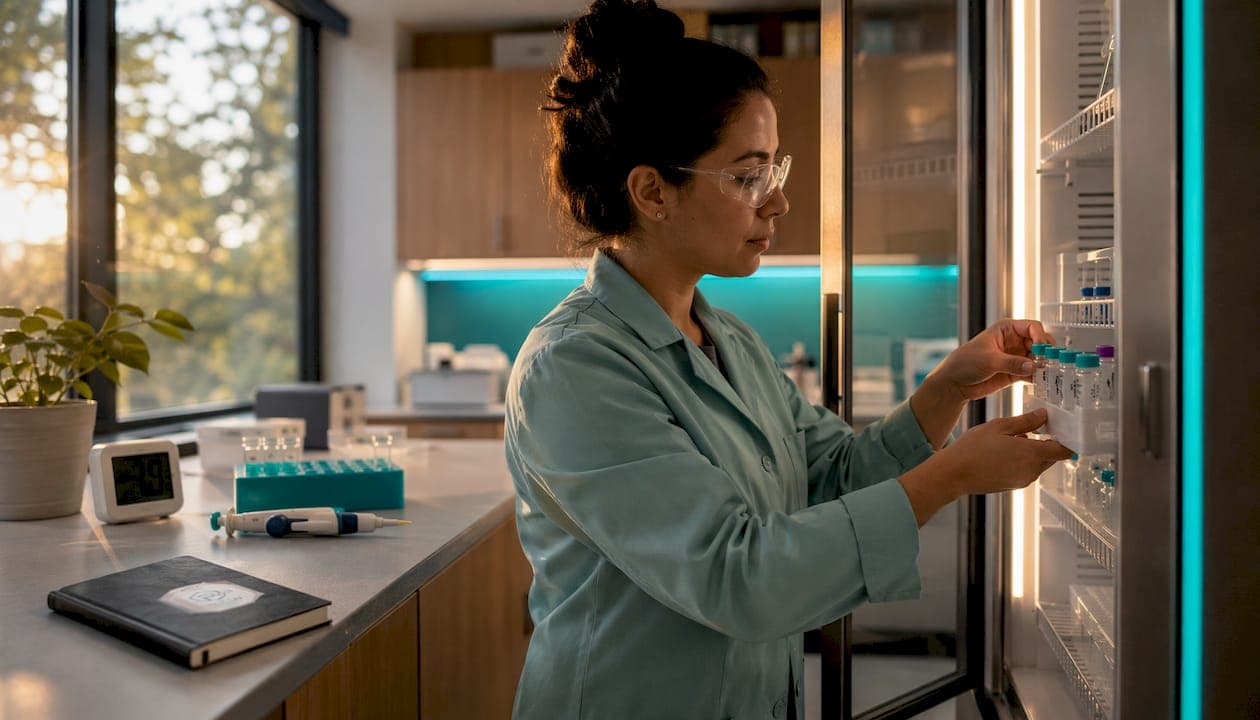
Store lyophilized peptides at –20 °C to –80 °C in sealed, desiccated vials. Reconstituted peptides go to 2–8 °C immediately, and if you used bacteriostatic water (0.9% benzyl alcohol), plan to use or discard within about one month. To avoid peptide degradation during storage, the two most common failures are temperature excursions on dry stock and failing to aliquot reconstituted solutions before freezing. Both are preventable with the checklist below.
Immediate lab checklist:
- Store dry peptides in the original sealed vial with desiccant at –20 °C (standard) or –80 °C (maximal longevity)
- Avoid frost-free freezers — their automatic defrost cycles create repeated temperature swings
- Let frozen vials equilibrate to room temperature before opening to prevent condensation
- Label every vial with reconstitution date, solvent, and concentration at the moment of reconstitution
- Aliquot reconstituted solutions into sterile single-use cryovials before freezing; never refreeze a thawed aliquot
- Verify supplier COA: HPLC purity ≥99%, mass confirmation, and documented storage conditions
Pro Tip: Keep a printed "peptide handling" card laminated and posted near your freezer. Ad-hoc decisions made under time pressure are where most storage errors originate.
Table of Contents
- Why do peptides degrade? The mechanisms that drive storage decisions
- How should you store lyophilized peptides for maximum shelf life?
- How do you store reconstituted peptide solutions safely?
- Aseptic handling and reconstitution technique
- How should you ship peptides to maintain cold-chain integrity?
- How do you know if a peptide has degraded?
- What should a reliable supplier's QC documentation include?
- Key Takeaways
- Building a lab culture that protects peptide integrity
- Peptasticlabs: research-grade peptides with documented QC
- Useful sources for deeper reading
Why do peptides degrade? The mechanisms that drive storage decisions
Peptide degradation proceeds through both chemical and biological pathways, and each one responds differently to storage conditions. Chemical routes include hydrolysis (peptide bond cleavage by water), oxidation (particularly at methionine, cysteine, and tryptophan residues), deamidation (asparagine and glutamine converting to aspartate and glutamate), and aggregation. Microbial contamination adds a biological dimension once a vial is punctured.
Temperature is the dominant variable across all chemical pathways. Reaction rates increase exponentially with temperature per Arrhenius kinetics — dropping from 25 °C to –20 °C does not merely slow degradation linearly; it suppresses it by orders of magnitude. That is why cold-chain consistency matters so much: repeated thermal excursions accumulate damage faster than a single brief warm event.
Sequence composition determines which pathway dominates. Methionine-containing peptides oxidize readily in the presence of dissolved oxygen. Asparagine-rich sequences deamidated measurably even at refrigerator temperatures over weeks. Peer-reviewed comparative work, including Tran et al. (PMC 2012), confirms these sequence-dependent stability differences across solvent and temperature conditions.
Bacteriostatic water (BAC water) addresses microbial risk through benzyl alcohol's preservative action. It does not stop chemical degradation. A peptide reconstituted in BAC water and stored at 2–8 °C is protected from bacterial growth for about one month — but hydrolysis and oxidation continue throughout that window, especially if the sequence is vulnerable.
Continuous temperature control is not a precaution — it is the primary mechanism by which chemical reaction rates are suppressed. Every degree of uncontrolled warming accelerates degradation kinetics in a non-linear way.
How should you store lyophilized peptides for maximum shelf life?
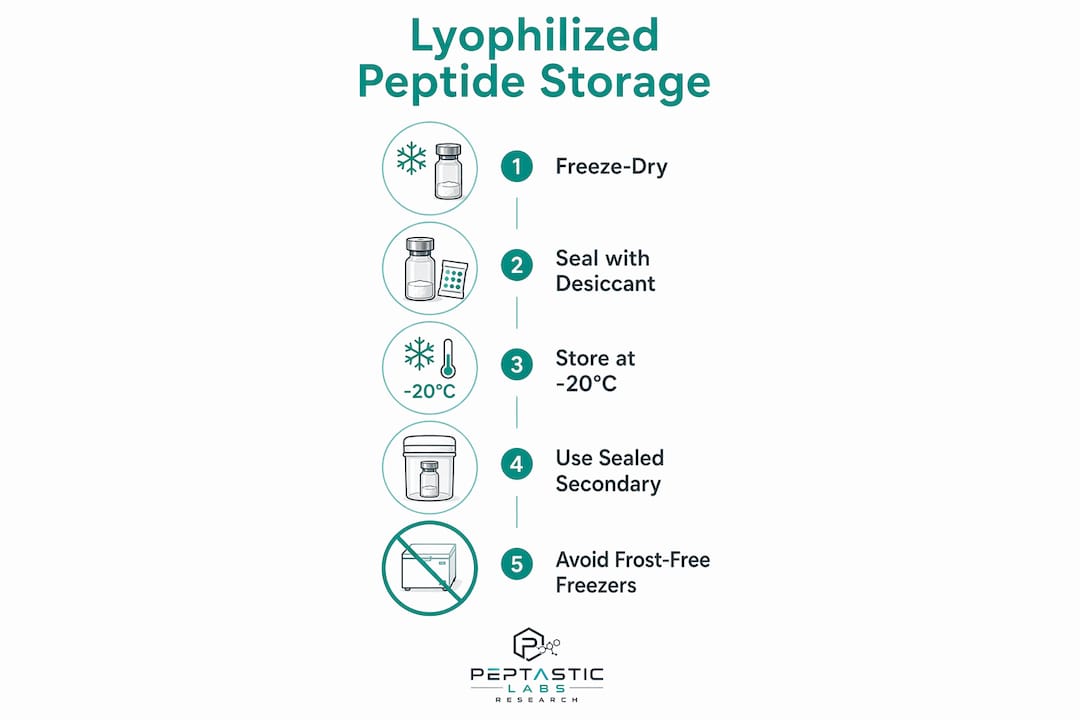
Lyophilized peptides are the most stable form available. The freeze-drying process reduces residual moisture to below 1%, creating a glassy solid matrix where hydrolysis and most other chemical reactions are effectively arrested. Stored correctly, lyophilized stock at –20 °C typically remains stable for one to two years or more; at –80 °C, documented stability extends further for many sequences.
Storage conditions by temperature:
| Temperature | Recommended use | Typical stability window |
|---|---|---|
| –80 °C | Long-term archival stock | Multi-year for most sequences |
| –20 °C | Standard long-term storage | about one to two years or more |
| 2–8 °C | Short- to medium-term working stock | Several months |
| Room temperature | Temporary only | 1–4 weeks |
Procedural steps for dry peptide storage:
- Keep peptides in the original manufacturer vial — do not transfer to a secondary container unless necessary.
- Add a fresh desiccant packet to the storage container or desiccator before sealing.
- Allow frozen vials to reach room temperature fully before opening — condensation on a cold vial introduces moisture directly into the powder.
- Reseal immediately after any use; minimize the time the vial is open.
- For oxidation-prone sequences (methionine, cysteine, tryptophan), request nitrogen or argon headspace from the supplier, or use sealed ampoules.
Freezer selection matters. Frost-free (auto-defrost) units cycle through temperature swings that can reach several degrees above the set point repeatedly. A dedicated chest freezer or laboratory-grade unit with manual defrost maintains a far more stable thermal environment. Sigma-Aldrich technical guidance explicitly recommends –80 °C for long-term storage and cautions against moisture and light exposure.
Pro Tip: Store vials inside a sealed secondary container (a zip-lock bag with desiccant works) within the freezer. This adds a moisture barrier and makes vials easier to locate without prolonged freezer-door opening.
How do you store reconstituted peptide solutions safely?
Reconstituted peptides are chemically and microbiologically fragile. The moment you add solvent, hydrolysis begins and microbial risk opens. The choice of solvent and the aliquoting strategy determine how long the solution remains usable.
Solvent selection:
- Bacteriostatic water (0.9% benzyl alcohol): extends multi-dose sterility to approximately 28–30 days after first puncture; preferred for multi-dose use at 2–8 °C
- Sterile water: no preservative; use within 24 hours or aliquot and freeze immediately
- Acetic acid (0.1–1%): used for peptides insoluble in aqueous solvents; check sequence compatibility
- DMSO: for hydrophobic sequences; freeze aliquots at –20 °C; avoid repeated freeze-thaw
Aliquoting protocol (recommended for any solution intended for freezing):
- Reconstitute the full vial with the chosen solvent at the target concentration.
- Sterile-filter through a 0.22 µm membrane if the application requires it.
- Divide into sterile, labeled single-use cryovials at the intended dose volume.
- Label each cryovial: peptide name, lot number, solvent, concentration, reconstitution date, and aliquot number.
- Freeze aliquots at –20 °C or –80 °C immediately.
- Thaw one aliquot at a time; never refreeze a thawed aliquot.
Freezing a full reconstituted vial without aliquoting causes ice-crystal formation that damages the peptide physically and distributes benzyl alcohol unevenly through the solution. The aliquot-before-freezing protocol is the only reliable way to preserve solution-phase peptides long term.
Sequence-specific exceptions apply. Copper-binding peptides and highly oxidation-prone sequences may require shorter use windows than the 28–30 day standard, per manufacturer notes and comparative stability data from Tran et al.
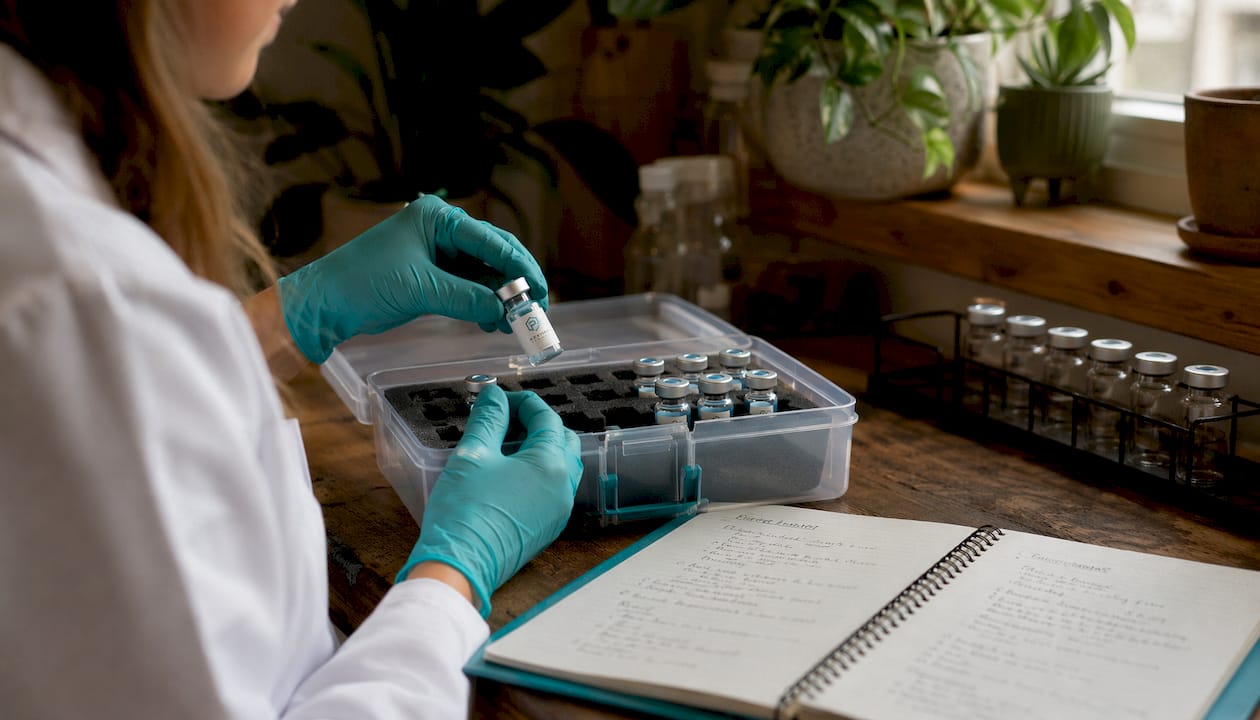
Pro Tip: Buy vial sizes matched to your typical experiment volume. A vial you can use within 28 days avoids the aliquoting step entirely and reduces handling-related contamination risk.
Aseptic handling and reconstitution technique
Every puncture of a vial septum introduces contamination risk. Reducing the number of punctures and maintaining strict aseptic technique during each one is the most direct way to protect both sterility and chemical integrity.
Step-by-step transfer protocol:
- Warm frozen vials slowly (room temperature, not warm water) before opening.
- Swab the septum with 70% isopropyl alcohol and allow it to dry fully before inserting a needle.
- Use a sterile needle for each withdrawal; never reuse a needle between vials.
- Swirl gently to dissolve — do not shake, which introduces air bubbles and promotes oxidation.
- Minimize headspace oxygen by working quickly and recapping immediately.
- Record the puncture date on the vial label at the moment of first use.
Contamination risk factors to control:
- Touching the rubber stopper after swabbing (re-contaminates the surface)
- Using a single needle for multiple withdrawals across sessions
- Leaving vials uncapped on the bench during preparation
- Working under bright light with oxidation-sensitive sequences
For critical preparations, a laminar flow hood or biosafety cabinet provides the most controlled environment. For routine bench work, a disinfected surface, PPE, and disciplined technique are the minimum standard. The five most common handling errors that destroy peptides in practice include light exposure, unlabeled vials, and repeated punctures — all preventable with a written protocol.
Pro Tip: Maintain a simple aliquot thaw log near the freezer. Record the date, aliquot ID, and researcher initials each time a vial is removed. This creates an audit trail and catches repeated-thaw errors before they compromise data.
How should you ship peptides to maintain cold-chain integrity?
The cold chain does not pause during transit. Lyophilized peptides ship well with cold packs or dry ice; reconstituted aliquots require validated temperature monitoring throughout. Use overnight or priority shipping whenever possible, and avoid scheduling shipments over long weekends or holidays.
Packaging checklist:
- Insulated shipper validated for the target temperature range
- Dry ice for –20 °C to –80 °C targets; cold packs for 2–8 °C
- Vials secured upright in a rack or foam insert to prevent breakage
- Temperature data logger placed adjacent to the samples (not against the coolant)
- Tamper-evident outer seal on the shipper
Shipping protocol steps:
- Pre-chill the insulated shipper before loading samples.
- Place the temperature logger probe at sample level, not at the coolant surface.
- Include a packing slip with handling instructions: "Keep refrigerated," "Do not X-ray," and recipient contact for expedited pickup.
- Retain the shipping manifest and temperature log as part of the batch QC record.
- On receipt, download the logger data before unpacking and document any excursions.
CDC cold-chain guidance emphasizes that cumulative thermal stress from repeated temperature excursions accelerates biomolecule degradation far more than a single brief event. Frequent door openings during packing or receipt inspection count as excursions — keep them brief and deliberate.
Pro Tip: Ship lyophilized forms to the destination lab whenever possible and reconstitute on-site. This eliminates the most fragile part of the cold chain entirely.
How do you know if a peptide has degraded?
Degradation is often invisible. A peptide solution can look clear and colorless while having lost significant potency through hydrolysis or oxidation. Visual checks are a starting point, not a verification.
Visual and physical signs that warrant immediate discard:
- Cloudiness, particulate matter, or visible precipitation
- Unexpected color change (yellowing often signals oxidation)
- Gel formation or unusual viscosity
- Any vial with a documented temperature excursion above the specified limit
Analytical verification protocol:
| Check | Method | What to request |
|---|---|---|
| Purity confirmation | HPLC | Retention time, purity % vs. original COA |
| Identity confirmation | LC-MS | Molecular weight match to theoretical |
| Degradation products | HPLC + MS | New peaks, mass shifts indicating hydrolysis or oxidation |
When a research-critical peptide produces unexpected assay results, run HPLC and mass spectrometry before concluding the biology is the problem. Analytical failures traced back to degraded stock are a documented source of irreproducible results in peptide research.
Immediate action steps for a suspect vial:
- Quarantine the vial — label it "SUSPECT — Do Not Use."
- Pull the original COA and compare the lot number, purity, and storage conditions.
- Check the temperature log for the freezer or refrigerator where the vial was stored.
- Contact the supplier with the lot number and documented storage history before re-ordering.
- Run a retained QC aliquot from the same lot if one exists.
Pro Tip: When a new lot arrives, set aside one aliquot as an internal QC reference. Run baseline HPLC on it immediately. Future checks then have an in-lab reference point rather than relying solely on the supplier's COA.
What should a reliable supplier's QC documentation include?
A credible supplier provides documentation that lets you verify stability claims independently, not just accept them. The Certificate of Analysis (COA) is the primary document — but its value depends entirely on what it contains.
COA checklist — minimum required fields:
- Lot number and synthesis date
- HPLC chromatogram with purity percentage (≥99% is the research-grade standard)
- Retention time under stated HPLC conditions
- Molecular weight confirmation via mass spectrometry
- Moisture content (relevant to lyophilized stability)
- Recommended storage conditions (temperature, solvent, and shelf life)
- Synthesis method and any modification notes
JPT Peptide Technologies and Sigma-Aldrich both publish technical notes specifying storage conditions by sequence type, including explicit guidance on –20 °C versus –80 °C and solvent compatibility. These manufacturer references are the baseline against which supplier claims should be evaluated. Tran et al.'s comparative stability study provides peer-reviewed evidence that storage conditions produce sequence-dependent outcomes — meaning a generic "store at –20 °C" statement on a COA is necessary but not sufficient for sequences with known vulnerabilities.
A COA that lists only a purity percentage without an HPLC chromatogram, retention time, and mass confirmation is incomplete. Lot-level verification requires all three data points — not just the headline number.
Lab record-keeping should mirror supplier documentation: temperature logs for every freezer and refrigerator, reconstitution logs tied to lot numbers, aliquot inventories, and any in-house HPLC or MS results. Peptasticlabs's research documentation provides COA examples and purity standards that illustrate what complete supplier documentation looks like in practice.
Pro Tip: Request the HPLC chromatogram as a raw file or image, not just the purity percentage. A single-number summary cannot reveal co-eluting impurities or baseline drift that a chromatogram makes visible.
Key Takeaways
Proper peptide storage requires freezing dry stock at –20 °C to –80 °C, refrigerating reconstituted solutions at 2–8 °C, aliquoting before freezing any solution, and verifying every lot against a complete COA with HPLC and MS confirmation.
| Point | Details |
|---|---|
| Dry peptide storage | Seal with desiccant and store at –20 °C (12–24+ months) or –80 °C for maximal longevity. |
| Reconstituted solutions | Refrigerate at 2–8 °C; use within about one month with bacteriostatic water, or within 24 hours with sterile water. |
| Aliquot before freezing | Divide reconstituted solutions into single-use cryovials before freezing; never refreeze a thawed aliquot. |
| Analytical verification | Run HPLC and LC-MS on suspect vials; compare retention time and purity % to the original COA. |
| Peptasticlabs sourcing | Peptasticlabs supplies HPLC-verified compounds at ≥99% purity with COAs available, supporting lot-level verification. |
Building a lab culture that protects peptide integrity
Good storage is a lab habit, not a one-off setup. The protocols above only hold if they are embedded in standard operating procedures that every researcher follows consistently, not just the person who set them up.
Assign explicit responsibility for freezer maintenance: one person per lab unit checks temperature logs weekly and replaces desiccants on a set schedule. Run COA checks on every new lot before it enters the working inventory — not after an experiment fails. Include storage verification as a line item in experimental pre-registrations so that storage conditions become part of the reproducibility record, not an afterthought.
The most common failure mode is not ignorance of the rules. It is the ad-hoc decision made under time pressure — a vial left on the bench too long, a reconstitution date not recorded, a frost-free freezer used simply because the lab freezer was full. Written SOPs and physical reminders at the point of use close that gap.
Peptasticlabs: research-grade peptides with documented QC
Researchers who need traceable, QC-backed compounds get a direct advantage from sourcing through Peptasticlabs. Every compound in the catalog is HPLC-verified at ≥99% purity, with Certificates of Analysis available on request — covering lot number, HPLC chromatogram, mass confirmation, and recommended storage conditions. That documentation supports the kind of lot-level verification this article describes.
For labs working with multi-dose protocols, Peptasticlabs also supplies bacteriostatic water formulated for research use, with handling guidance aligned to the 28–30 day sterility window. All products are for research use only. Review the COAs and stability statements on the research page, or contact Peptasticlabs directly to request stability data for a specific lot before ordering.
Useful sources for deeper reading
These are the primary references supporting the protocols in this article, ordered by authority and practical relevance.
Core references:
- Tran et al., "A Comparative Study of Peptide Storage Conditions" (PMC 2012) — peer-reviewed stability data across temperatures and solvents; the foundational reference for sequence-dependent storage behavior
- Sigma-Aldrich Handling and Storage Guidelines — manufacturer technical note covering –20 °C/–80 °C recommendations, moisture control, and equilibration before opening
- CDC Vaccine Storage and Handling Toolkit — cold-chain principles applicable to peptide storage; covers continuous temperature monitoring and thermal excursion documentation
- Peptasticlabs Research Page — COA format examples, purity standards, and stability documentation for research-grade peptides
| Source | Best used for |
|---|---|
| Tran et al. (PMC 2012) | Sequence-specific stability data and solvent comparisons |
| Sigma-Aldrich technical note | Manufacturer-backed temperature and handling recommendations |
| CDC cold-chain toolkit | Temperature monitoring protocols and excursion documentation |
| Peptasticlabs research page | COA interpretation and supplier QC benchmarks |
Peer-reviewed stability studies and manufacturer technical notes are not interchangeable. Use Tran et al. for sequence-specific evidence; use Sigma-Aldrich and JPT technical notes for handling procedures. Both are required for a complete storage SOP.