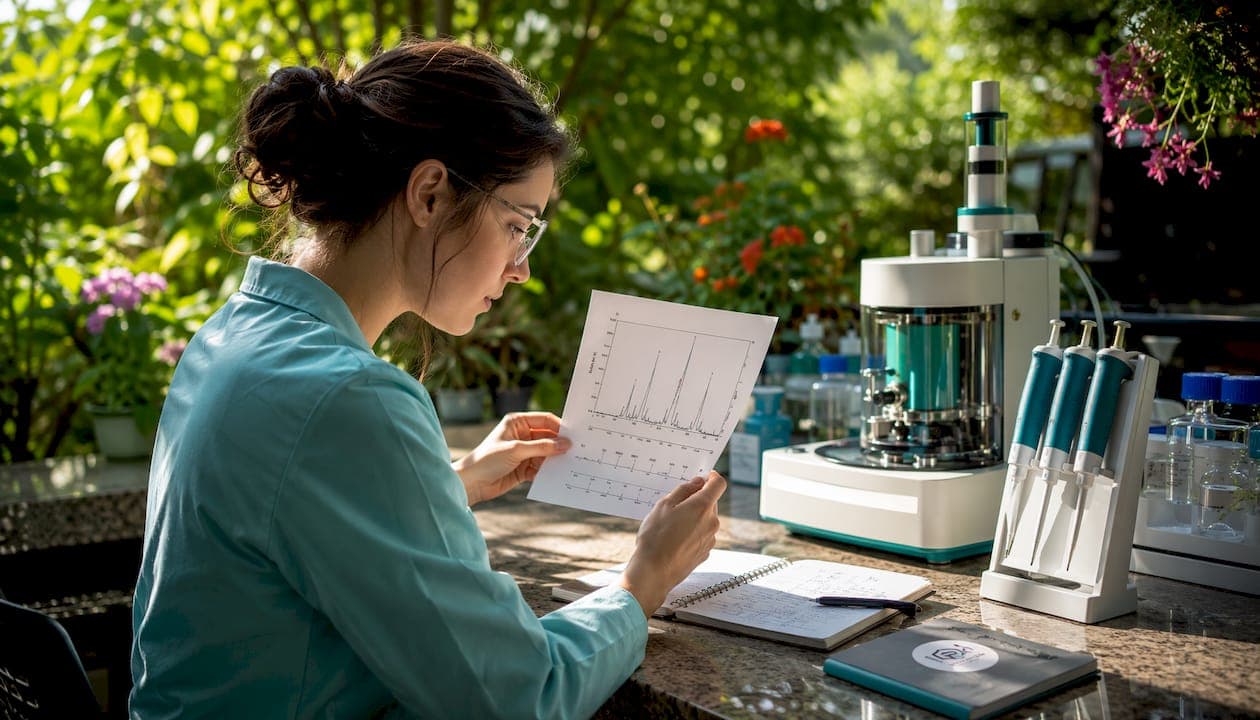
Peptide purity standards research establishes the analytical criteria and regulatory thresholds that determine whether a peptide compound is fit for scientific use. Two distinct measurements define purity: chromatographic purity, reported as HPLC area percent, and absolute peptide content, the actual mass fraction of peptide in a given powder. These are not interchangeable. A compound can register 98% by reversed-phase HPLC and still contain only 70–80% peptide by mass once trifluoroacetate (TFA) counterions and residual moisture are factored in.
The mass balance approach is the benchmark for purity assessment, quantifying peptide content by subtracting all measurable impurities including peptide-related impurities, counterions, moisture, and residual solvents from total mass. U.S. Pharmacopeia (USP) employs this two-step method to assign values to reference standards, and it consistently produces the lowest inter-laboratory variability of any single-method approach. Impurities affect more than a purity number; they alter biological activity, skew dose-response curves, and introduce immunogenic risk in therapeutic contexts.
Key facts every researcher should have at the outset:
- Chromatographic purity (HPLC area percent) measures UV-absorbing peaks relative to total integrated area, typically at 214 nm.
- Absolute peptide content measures actual peptide mass per total powder mass, and is always lower than HPLC area percent.
- Mass balance is the USP-endorsed method for value assignment, incorporating HPLC impurities, counterion load, water content, residual solvents, and inorganic residues.
- Impurity thresholds under FDA guidance for synthetic peptides set identification at 0.10% and removal above 0.5%.
- Peptasticlabs verifies each compound to ≥99% purity via HPLC with third-party confirmation and batch-specific Certificates of Analysis (COAs).
What U.S. regulatory guidelines say about peptide purity
U.S. regulatory oversight of peptide purity operates across two distinct tracks: compendial standards enforced through USP, and FDA guidance documents targeting therapeutic applications. Researchers working with research-use-only (RUO) material operate largely outside mandatory numerical thresholds, but the compendial framework still provides the most defensible benchmarking available.
USP <621> Chromatography defines system suitability, allowable column and gradient adjustments, and reporting requirements for chromatographic methods used in drug-substance and drug-product testing. It is the most commonly cited chromatographic standard on research-peptide COAs, even when the peptide itself carries no USP monograph. The December 2022 revision expanded permitted column and gradient adjustments without full revalidation, giving laboratories more flexibility while maintaining method integrity.
The FDA's 2021 guidance for abbreviated new drug applications (ANDAs) covering synthetic peptide drug products represents the most explicit numerical framework for impurity control in current U.S. regulatory documents:
"New impurities present at greater than 0.5% of the drug substance should be removed because of potential immunogenicity risk that an ANDA cannot adequately address. Impurity identification is recommended at thresholds as low as 0.10%." — FDA 2021 ANDA Synthetic Peptide Guidance
This guidance applies specifically to ANDA submissions referencing five recombinant DNA-origin products: glucagon, liraglutide, nesiritide, teriparatide, and teduglutide. It does not extend to all synthetic peptides, but its thresholds are widely adopted as a quality benchmark across the field.
Key regulatory distinctions for U.S. researchers:
- RUO peptides: No U.S. regulation mandates specific purity thresholds, impurity profiles, or analytical methods for material labeled "for research use only, not for human use." Vendor purity claims for RUO peptides are commercial representations, not regulatory compliance statements.
- Therapeutic-grade peptides: Subject to USP monograph requirements, ICH Q6A specifications, and FDA guidance thresholds where applicable.
- Documentation expectations: Batch-specific COAs with HPLC chromatograms, identity confirmation, and counterion characterization represent best practice for both categories. Detailed COA components support reproducibility and regulatory audit readiness.
- International comparison: The European Medicines Agency (EMA) synthetic peptides guideline and ICH Q6A provide parallel frameworks; U.S. researchers referencing these standards should note that FDA ANDA guidance thresholds are product-specific, while ICH Q6A applies more broadly to new drug substances.
How analytical testing methods verify peptide purity
Reversed-phase HPLC is the primary tool for chromatographic purity assessment. The method separates peptides by hydrophobicity on a C18 column, with UV detection at 214 nm capturing the peptide bond absorbance across virtually all amino acid sequences. Software integrates the UV trace and reports each peak as a percentage of total integrated area. That HPLC area percent is the number most commonly printed on synthetic-peptide COAs.
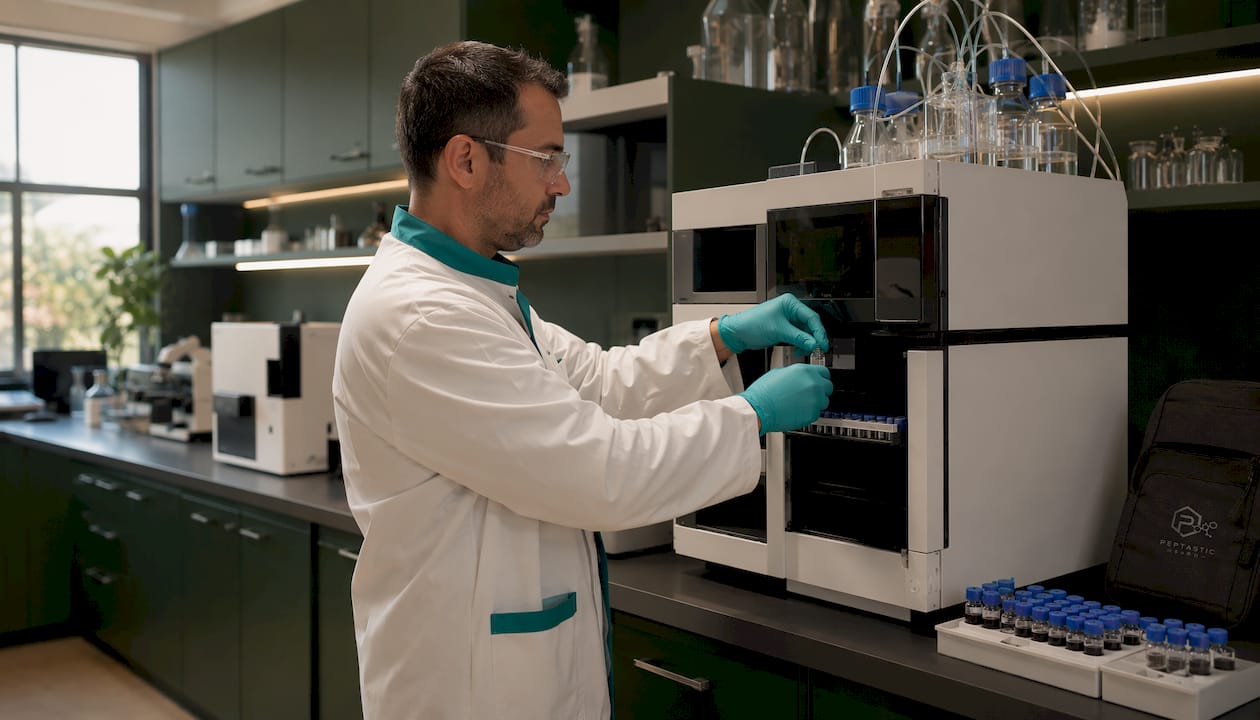
HPLC purity is necessary but not sufficient. A peptide that elutes as a single sharp peak at the expected retention time can still be the wrong compound. Mass spectrometry confirms identity by measuring molecular mass, making it the second required analytical leg of any complete purity verification workflow. ESI-MS and MALDI-TOF are both used; ESI-MS is standard for most synthetic peptides in the 500–5,000 Da range.
Complementary methods add further resolution:
- Amino acid analysis (AAA): Hydrolyzes the peptide and quantifies constituent amino acids, providing an orthogonal measure of peptide mass purity independent of chromatographic separation.
- Quantitative NMR (qNMR): Measures absolute peptide content against an internal standard; increasingly used alongside mass balance for high-value reference standards.
- Residual solvent testing (GC): Accounts for synthesis solvents such as DMF and acetonitrile that may persist in the final powder.
- Residue on ignition: Quantifies inorganic impurities not captured by chromatographic or spectroscopic methods.
- Karl Fischer titration: Determines residual moisture content, critical for accurate mass balance calculations.
The mass balance calculation integrates all of these inputs. USP's equation separates HPLC-measured impurities (as area percent) from counterion and moisture contributions (measured gravimetrically), producing a purity value expressed as milligrams of peptide per milligram of material on an anhydrous basis.
| Method | What it measures | Primary output |
|---|---|---|
| RP-HPLC (214 nm) | Chromatographic purity | Area percent |
| ESI-MS / MALDI-TOF | Molecular identity and mass | Confirmed MW |
| Amino acid analysis | Peptide mass content | mg peptide / mg powder |
| qNMR | Absolute content vs. internal standard | mg peptide / mg powder |
| Karl Fischer titration | Residual moisture | % water by mass |
| GC headspace | Residual solvents | ppm per ICH Q3C |
| Residue on ignition | Inorganic impurities | % ash |
A COA that reports only HPLC area percent, without identity confirmation or content determination, leaves the researcher unable to verify actual peptide mass. For quantitative work, that gap translates directly into dosing error.
Pro Tip: When evaluating a COA, check that the HPLC report includes the column type, mobile phase composition, gradient program, run time, and detection wavelength. Without those parameters, the area percent figure cannot be independently reproduced or compared across lots.
How purity requirements change across research applications
Not every experiment demands the same purity specification. The appropriate threshold depends on what the assay is actually measuring and how sensitive it is to non-peptide mass.
For antibody generation and immunization studies, moderate HPLC purity levels are often acceptable because the immune response is driven by peptide sequence recognition rather than precise molar dosing. Impurities at these levels rarely generate confounding antibody populations, provided identity is confirmed by mass spectrometry.

Receptor-binding assays and dose-response studies require a different standard entirely. When you are calculating IC50 or EC50 values, the assumed peptide concentration must reflect actual peptide mass, not total powder mass. A mass balance or absolute content validation is the only way to confirm that the concentration you prepared matches what is in the assay well. Using HPLC area percent alone in quantitative work introduces systematic error proportional to the gap between chromatographic purity and actual peptide content.
In vitro cell-based assays sit between these two poles. Cytotoxicity studies and proliferation assays are moderately sensitive to impurities; TFA counterions at high concentrations can independently affect cell viability, making counterion exchange or acetate-form peptides preferable for these applications.
Practical guidance by application type:
- Antibody generation: ≥70% HPLC purity with mass spec identity confirmation; mass balance not required.
- Receptor-binding / quantitative assays: ≥95% HPLC purity plus absolute content determination via AAA or mass balance; TFA counterion exchange recommended.
- In vitro cell assays: ≥90% HPLC purity; acetate or HCl salt form preferred to avoid TFA cytotoxicity artifacts.
- Structural studies (NMR, X-ray): ≥98% HPLC purity with full mass balance; counterion and moisture characterization required.
- Reference standard preparation: Full mass balance per USP two-step protocol; multi-laboratory characterization for value assignment.
Batch-to-batch variability is a real operational concern even from suppliers with rigorous internal QC. Synthesis is a stochastic process within tolerances, and impurity profiles, counterion content, and absolute peptide content can shift between lots. For workflows requiring quantitative comparability across experiments, on-receipt verification with an in-house RP-HPLC check and a confirmatory mass spectrum is a defensible standard practice. Researchers sourcing peptides for research-grade applications should define release criteria in writing before the material arrives, not after.
Quality control and stability practices that preserve purity over time
Peptide powders are hygroscopic. Water uptake after lyophilization can substantially increase apparent mass while reducing the actual peptide fraction, which means a vial weighed on day one and day thirty may yield different effective concentrations if storage conditions are not controlled. USP has shifted many peptide reference standards from powdered to lyophilized forms specifically to eliminate the need for users to determine counterion content and residual moisture prior to each use.
Stability studies for peptide reference standards address three primary variables: storage temperature, moisture exposure, and light. Lyophilized material stored at or below -20°C in sealed, desiccated vials shows the most consistent purity profiles over time. Accelerated stability studies at elevated temperature and humidity are used to predict shelf life and establish retest intervals.
Key quality control and stability practices:
- Lyophilization: Reduces moisture content to minimize hygroscopic variability; preferred format for reference standards and long-term storage.
- Moisture monitoring: Karl Fischer titration performed at time of use, not just at release, accounts for any water uptake during storage or shipping.
- Counterion exchange: Converting TFA salt to acetate or HCl form reduces non-peptide mass and eliminates TFA-related cytotoxicity in cell-based assays.
- Batch-specific COAs: Each lot tested independently; purity values from one batch do not carry over to another.
- In-process QC checkpoints: Intermediate purity checks during synthesis and purification catch impurity accumulation before final release.
- Residual solvent testing: GC analysis per ICH Q3C limits confirms that synthesis solvents are below acceptable daily exposure thresholds.
- Stability-indicating methods: HPLC methods validated to detect degradation products, not just the main peak, provide a true picture of compound integrity over time.
For researchers verifying peptide purity post-shipment, the minimum defensible check is an in-house RP-HPLC run against a known standard, combined with visual inspection of the lyophilized cake for signs of moisture uptake or discoloration. If the compound will be used in quantitative assays, a confirmatory mass spectrum and, where feasible, an AAA-based content determination should precede use. The peptide therapeutic development process relies on exactly these verification steps at each stage of the supply chain.
How Peptasticlabs approaches peptide purity and research-grade quality
Peptasticlabs operates a multi-stage quality assurance process covering sourcing, in-house testing, third-party verification, and documentation. Every compound in the catalog is verified to ≥99% purity via HPLC, with mass spectrometry confirmation of molecular identity. Batch-specific COAs are available on request and include HPLC chromatograms, identity data, and batch traceability information.
The quality assurance framework at Peptasticlabs reflects the same principles that USP and FDA guidance documents establish for therapeutic-grade material, applied to research-grade supply:
- HPLC-verified purity: Each batch tested by reversed-phase HPLC with UV detection; area percent reported with method parameters.
- Mass spec confirmation: ESI-MS or equivalent used to confirm molecular weight and rule out misidentification.
- Third-party testing: Independent laboratory verification supplements in-house QC, providing an orthogonal check on purity and identity claims.
- Batch-specific COAs: Documentation is lot-specific; researchers receive data for the exact material shipped, not a representative lot.
- Transparency in reporting: COA data includes the analytical parameters needed to assess what the purity figure actually represents, supporting the kind of critical interpretation that quantitative research requires.
Peptasticlabs also maintains educational resources to help researchers interpret COA data correctly, including guidance on the distinction between chromatographic purity and absolute peptide content. Understanding peptide sequence integrity alongside purity data gives a complete picture of compound quality before any assay begins.
Pro Tip: When you receive a COA from any supplier, check the date of the HPLC analysis relative to the shipment date. A COA generated months before shipping does not account for any degradation or moisture uptake during storage and transit. Request a recent, batch-specific COA and confirm the HPLC method parameters are fully disclosed.
Researchers sourcing compounds for various research applications will find Peptasticlabs' catalog of numerous independently tested compounds structured around these documentation standards. The commitment to third-party verification and accessible COA data addresses the most common failure point in peptide procurement: the gap between a supplier's purity claim and the actual compound quality in the vial.
Key Takeaways
The mass balance approach, combining HPLC impurity data with counterion, moisture, and residual solvent measurements, is the most reliable method for assigning true peptide content and should be the standard for any quantitative research application.
| Point | Details |
|---|---|
| Two purity metrics exist | HPLC area percent and absolute peptide content are distinct; a 98% HPLC result can correspond to 70–80% peptide by mass. |
| FDA impurity thresholds | FDA 2021 ANDA guidance sets low identification and removal thresholds for impurities in synthetic peptide drug products. |
| RUO peptides lack mandated thresholds | No U.S. regulation imposes numerical purity requirements on research-use-only material; vendor claims are commercial, not regulatory. |
| Application drives purity specification | Quantitative assays require mass balance or AAA-based content validation; antibody generation studies can use lower HPLC purity thresholds. |
| Peptasticlabs verification standard | Each compound verified to ≥99% HPLC purity with third-party testing and batch-specific COAs available on request. |
Source your research peptides with verified documentation
Researchers who need compounds that meet the analytical standards described in this article can review Peptasticlabs' full catalog and quality documentation directly.
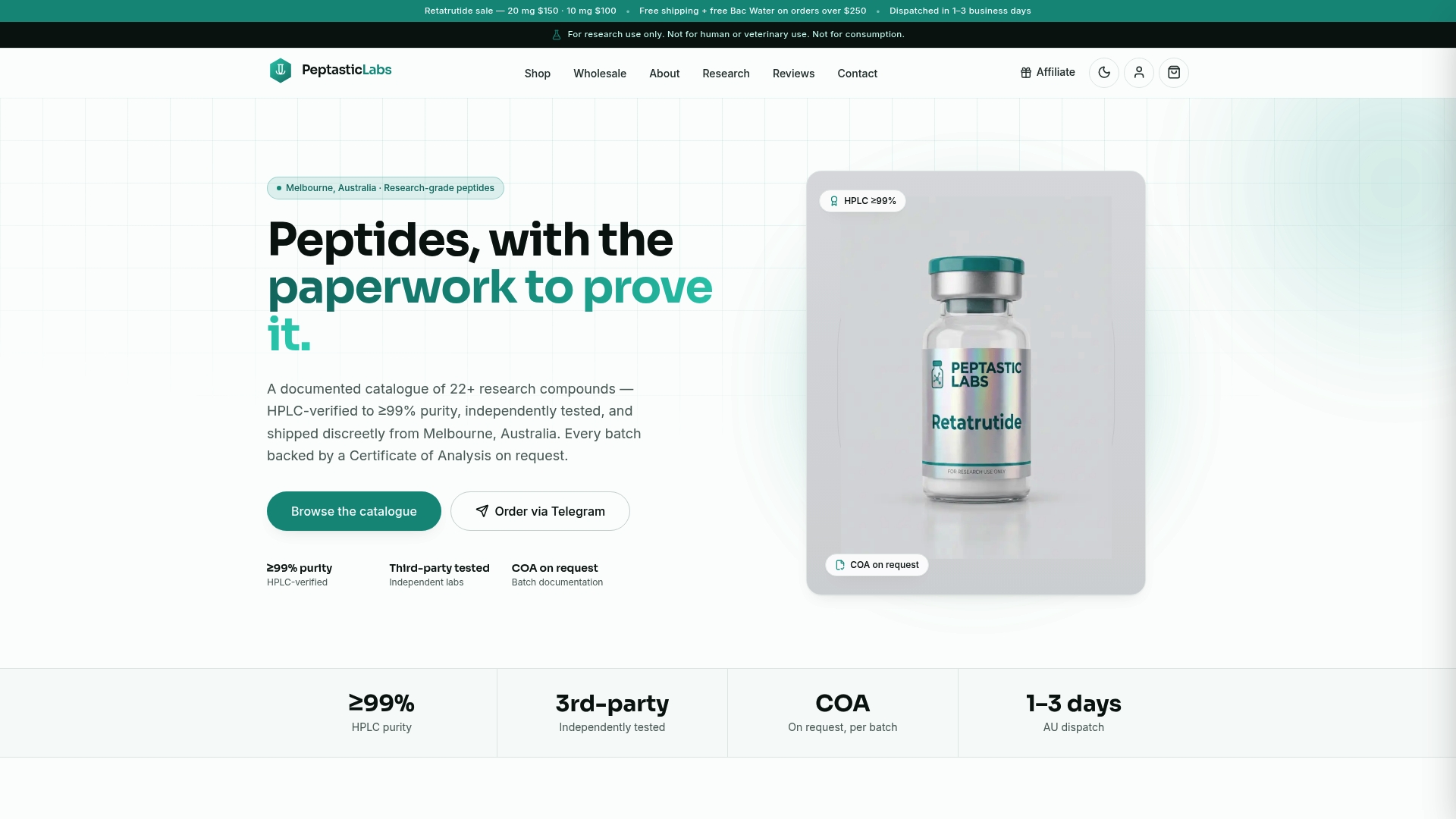
Peptasticlabs provides research-grade peptides verified to ≥99% purity, with batch-specific COAs, mass spec identity confirmation, and third-party testing across a catalog of over 22 compounds. Researchers can also browse the full peptide catalog to review available compounds by application area, or consult the peptide buying checklist before placing an order to confirm that documentation requirements align with your study protocol.