
A complete peptide batch documentation package must provide a single, traceable batch identifier that matches across the vial label, the batch-specific Certificate of Analysis (COA), and the packing list, supported by HPLC purity data with chromatogram and an LC-MS identity confirmation. Without that three-way alignment, no COA can demonstrate that the reported analytical results apply to the material in your hands. Understanding batch documentation for peptide studies starts with this principle: the document and the vial are inseparable.
First checks on receipt of a peptide shipment:
- Batch number match: Verify the lot/batch ID is identical on the vial label, the COA, and the packing list. Any discrepancy is a traceability break.
- HPLC chromatogram present: Confirm the COA includes a chromatogram, not just a purity percentage, with method parameters (column, gradient, detection wavelength).
- Identity confirmation: Check for an LC-MS result showing observed versus theoretical molecular mass. If mass spec was not performed, the COA should state that explicitly.
- Storage and handling instructions: Confirm temperature, light sensitivity, and reconstitution guidance are listed on both the vial and the COA.
- Analyst sign-off: A dated QC signature or electronic equivalent confirms the data was reviewed before release.
Peptasticlabs provides COAs and supporting analytical data on request, offering a practical model of this documentation standard for researchers evaluating suppliers.
Table of Contents
- Why does batch control matter for reproducible peptide research?
- What should every peptide batch record and COA contain?
- How do you read and evaluate a batch-specific COA and analytical reports?
- What QC assays should you expect, and what do acceptance ranges look like?
- How do you implement digital batch tracking in the lab?
- How do you integrate batch documentation into procurement and receiving?
- What do batch testing and COA generation typically cost in the U.S.?
- What does a completed batch record template look like?
- How does Peptasticlabs document batches, and what can researchers model from it?
- Key Takeaways
- The documentation gap that most labs still haven't closed
- Peptasticlabs supports documented, verified research-grade peptides
- Useful sources for deeper reading
Why does batch control matter for reproducible peptide research?
Batch documentation protects experimental integrity by linking every analytical result to the exact material used in an experiment. Without it, lot-to-lot variability is routinely misattributed to experimental error. A shift in EC50 between two assay runs may reflect a genuine biological signal, or it may reflect a purity difference between two peptide lots that were never individually characterized.
Consider a common scenario: a cell-based assay run in January produces a half-maximal effective concentration of 50 nM. The same assay repeated in March with a new peptide vial returns 120 nM. If both vials share only a product name and no batch-specific COA, the researcher has no way to determine whether the shift reflects biology or a change in peptide purity, sequence integrity, or endotoxin load. That ambiguity can cost months of follow-up work.
USP peptide reference standards and documentary guidance exist precisely to give labs a validated framework for confirming that supplier purity and identity claims are fit-for-purpose in their specific assay context. ICH and EMA guidance similarly require batch analyses and comparability assessments across production runs. Treating each lot as a distinct, documented entity is the minimum standard for auditable science.
Pro Tip: When a new peptide lot arrives, log it as a separate reagent entry in your lab notebook or LIMS before opening the vial. Retroactive lot tracking after an assay failure is far more time-consuming than a 60-second intake record.
- Assign a unique internal accession number to each lot on receipt.
- Attach the COA and any raw analytical files to that accession record immediately.
- Record the lot number in every experiment that uses material from that vial.
- Flag any lot where the COA batch number does not match the vial label before use.
What should every peptide batch record and COA contain?
A COA that lists only a purity percentage is not a batch record. A complete batch record ties identifiers, analytical evidence, and logistics into a single auditable document. Batch-level traceability connects the product, the batch, and the documentation so you can follow a vial back to its raw test data.
| Field | Expected Content | Red-Flag Examples |
|---|---|---|
| Batch/Lot ID | Unique alphanumeric identifier | Missing, generic "Lot 1," or mismatched across documents |
| Product name and sequence | Full amino acid sequence or IUPAC name | Sequence absent; only trade name listed |
| Net mass / vial content | Quantity in mg with tolerance | Rounded to whole number only; no tolerance stated |
| Date of analysis | Specific calendar date | "2025" with no month or day |
| HPLC purity | % by area with chromatogram and method | Percentage only; no chromatogram attached |
| LC-MS identity | Observed vs. theoretical mass | No mass data; "identity confirmed" with no values |
| Endotoxin result | EU/mg or EU/mL with method (LAL) | Absent for cell-based or in vivo applications |
| QC sign-off | Analyst name and date | Unsigned; undated; electronic signature with no audit trail |
| Storage conditions | Temperature, light, humidity | "Store cold" with no specific temperature range |
| Shelf-life / retest date | Explicit expiration or retest date | No date; "stable indefinitely" |
| Raw material lot numbers | Supplier lot IDs for amino acid building blocks | Absent; "proprietary" with no further detail |
| Packing list alignment | Batch number matches COA and label | Packing list references a different lot number |
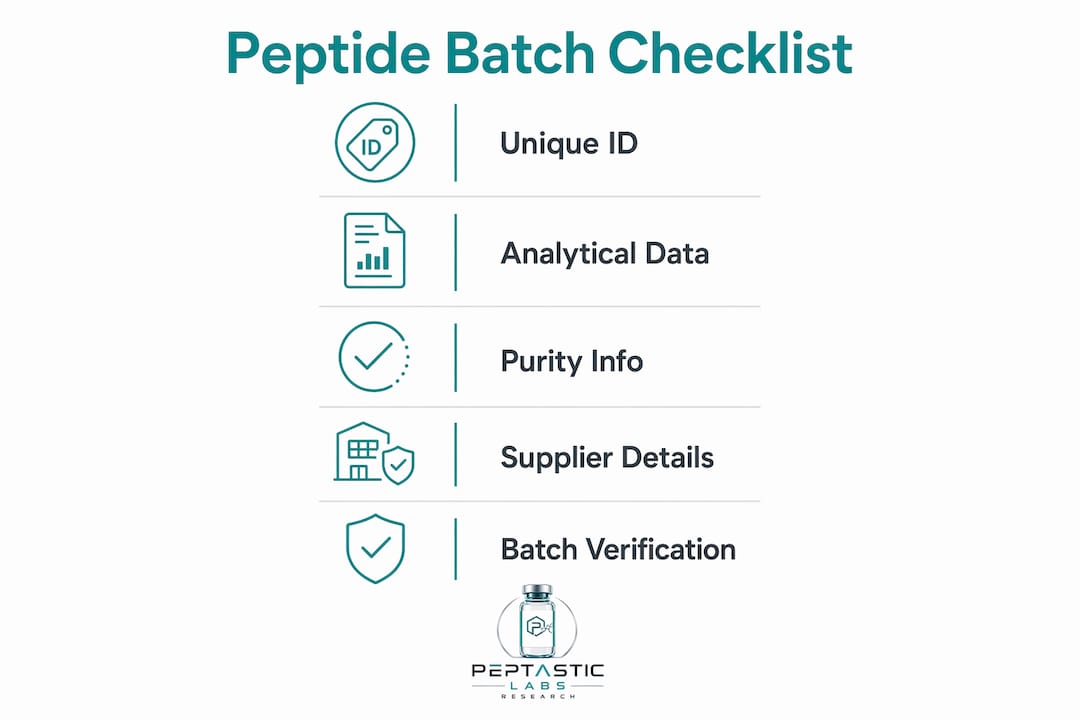
EMA guidance on synthetic peptide development requires that newly observed impurities be assessed and discussed across batches. A COA that omits a related substances or impurity profile is incomplete under that standard, even for research-grade material where regulatory filing is not the immediate goal.
Pro Tip: Run a three-way alignment check every time: vial label batch number, packing list batch number, and the batch number on the independent laboratory report. Any break in that chain means the COA may not describe the material you are actually using.
- Synthesis method summary (e.g., solid-phase peptide synthesis conditions at a high level) confirms the production route.
- Purification details (e.g., reverse-phase HPLC conditions) indicate the expected impurity profile.
- Residual solvents data, when applicable, supports safety assessment for cell-based work.
How do you read and evaluate a batch-specific COA and analytical reports?
Start with the identifiers before reading any analytical values. Confirm the COA batch number, the test date, the analyst sign-off, and the method references. If any of those four fields are missing, the document cannot be verified as batch-specific.
Chromatogram review checklist:
- Baseline is flat and stable before and after the main peak.
- Peak integration boundaries are clearly marked with no ambiguous shoulder peaks absorbed into the main area.
- Retention time is stated and consistent with the method's expected range.
- Method parameters are listed: column type and dimensions, mobile phase composition, gradient profile, flow rate, and UV detection wavelength.
- A reference standard run is included or referenced, particularly when the COA claims a specific purity threshold.
LC-MS identity confirmation works by fragmenting the peptide and using fragment m/z patterns to infer sequence. When reviewing a mass spectrum, match the observed monoisotopic or average mass to the theoretical value calculated from the amino acid sequence. A difference within ±0.5 Da for small peptides (under 2,000 Da) is generally acceptable; larger peptides may show wider tolerances depending on instrument resolution. Check for common adducts (sodium, potassium) that can shift the observed mass, and confirm that multiply charged ions are consistent with the expected charge state distribution.
Red flags to act on immediately:
- COA lists purity but no chromatogram is attached or available on request.
- Chromatogram file lacks a sample ID or batch number in the header.
- LC-MS report shows a mass value with no annotation of theoretical mass or delta.
- Batch numbers differ between the COA, the chromatogram header, and the mass spec report.
- Test date predates the stated synthesis date.
- Analyst sign-off is absent or undated.
When any of these flags appear, request third-party peptide testing from an independent contract laboratory before using the material. Ask the independent lab to confirm purity by HPLC, identity by LC-MS, and endotoxin level if the application involves cells or animals. Specify that the independent report must reference the same batch number as the supplier COA.
Pro Tip: Ask the supplier for the raw chromatogram data file (e.g., .cdf or instrument-native format) in addition to the PDF. Raw files cannot be edited after acquisition, which makes them a stronger traceability record than a PDF export.
What QC assays should you expect, and what do acceptance ranges look like?
Research-grade peptides are not subject to the same release specifications as pharmaceutical drug substances, but the analytical methods used to characterize them are the same. Knowing what each method measures, and what a passing result looks like, lets you assess whether a batch is fit for your specific application.
Core analytical methods:
- HPLC purity: Reports percent by peak area at a specified UV wavelength (typically 214 nm or 220 nm for peptide bond absorbance). A common research-grade threshold is ≥95% purity; Peptasticlabs verifies its compounds to ≥99% purity by HPLC. Purity figures are not directly comparable across different columns or gradients without matching method parameters.
- LC-MS identity: Confirms molecular identity by matching observed mass to theoretical. Accepted as the standard identity confirmation method for synthetic peptides.
- Amino acid analysis (AAA): Quantifies individual amino acid residues after hydrolysis; used when absolute quantity (rather than relative purity) is required. Less common on standard COAs but available from specialized labs.
- Endotoxin testing (LAL assay): Limulus Amebocyte Lysate test measures endotoxin in EU/mg or EU/mL. For cell-based assays, a common threshold is <1 EU/mg; for in vivo work, thresholds are typically more stringent and application-dependent.
- Stability testing: Evaluates degradation under defined storage conditions over time. Relevant for long-term studies or when a peptide will be stored for months before use.
USP analytical reference materials provide validated standards that labs can use to confirm that their in-house methods produce results comparable to compendial benchmarks, which is particularly useful when verifying supplier purity claims against your own HPLC system.
Pro Tip: If your experiment involves cell culture or animal dosing, do not accept a COA that omits endotoxin data. Request the full LAL assay result, including the method sensitivity (EU/mL detection limit) and whether kinetic turbidimetric or gel-clot format was used. The method matters for interpreting the result.
How do you implement digital batch tracking in the lab?
Paper-based lot tracking fails at scale. A single researcher managing five peptide compounds across three experiments can maintain a spreadsheet; a group running 20 compounds across multiple projects needs a more structured approach. Centralized, versioned documentation systems reduce the risk of using the wrong lot and speed up the process of writing methods sections and responding to reviewer queries.
- Standardize labels: Every vial label must carry the batch/lot ID, product name, net mass, storage temperature, and a QR code or barcode linking to the COA PDF.
- Link COAs in a central repository: Store COA PDFs and raw analytical files in a shared folder or LIMS, named with the batch ID as the primary identifier.
- Create an electronic accession log: Record each lot on receipt with date, quantity, storage location, and a link to the COA. This is the audit trail entry point.
- Map lots to experiments: Every experiment record (notebook page, ELN entry, or data file) must reference the lot ID of each peptide used.
- Version control for replacement batches: When a lot is exhausted and replaced, log the new lot as a separate entry and note any analytical differences between lots in the experiment record.
Tool options by lab scale:
- Small labs (1–5 researchers): A shared spreadsheet with a QR code generator (e.g., Google Sheets with a QR add-on) covers basic traceability at minimal cost.
- Medium labs: A lightweight LIMS such as Benchling or Quartzy provides structured lot tracking, document attachment, and audit trails without enterprise-level overhead.
- Larger groups: Commercial ELN/LIMS integrations (e.g., LabArchives, IDBS) support multi-user audit trails, role-based access, and automated retention policies.
Pro Tip: Adopt a consistent file naming convention for COA PDFs: [BatchID][ProductShortName][DateOfAnalysis].pdf. This format makes files sortable by lot, searchable by product, and unambiguous when shared across a group. Apply the same convention to raw chromatogram files.
How do you integrate batch documentation into procurement and receiving?
Batch documentation checks belong at two points in the procurement cycle: before the purchase order is placed, and at the moment the shipment arrives. Waiting until an experiment is underway to discover a documentation gap costs far more time than a pre-order checklist.
Pre-order procurement checklist:
- Confirm COA availability for the specific batch you will receive (not a representative or historical COA).
- Verify which analytical methods are included (HPLC, LC-MS, endotoxin) and request method details.
- Ask whether independent third-party testing is available and whether the independent report will reference the same batch number.
- Clarify lead time for batch-specific documentation if it is not shipped with the product.
- Review the peptide buying guide checklist for additional procurement criteria.
Receiving SOP (numbered steps):
- On receipt, do not open vials until documentation is in hand.
- Match the batch number on the vial label to the COA and the packing list. All three must be identical.
- Scan or photograph the vial label and packing list; save files to the accession log with the receipt date.
- Quarantine the shipment until the COA review is complete and the three-way alignment is confirmed.
- Log the lot into the LIMS or tracking spreadsheet with storage location and quantity.
- Release the lot for use only after QC sign-off by the responsible researcher or lab manager.
Lot-to-experiment mapping template:
| Field | Entry |
|---|---|
| Product name | BPC-7 (example) |
| HPLC purity (COA) | ≥99% |
| LC-MS identity confirmed | Yes |
| Endotoxin result | <1 EU/mg |
| Storage location | Freezer B, Box 3, Position A4 |
What do batch testing and COA generation typically cost in the U.S.?
Budget and timeline expectations vary by test type, lab capacity, and whether the work is performed in-house or by an independent contract laboratory. The figures below reflect typical ranges in the U.S. research market; actual quotes will depend on sample complexity, turnaround requirements, and volume.
| Test | Typical Turnaround | Indicative Cost (Low) | Indicative Cost (High) |
|---|---|---|---|
| HPLC purity (single method) | 3–5 business days | — | — |
| LC-MS identity confirmation | 3–7 business days | — | — |
| Endotoxin (LAL assay) | 2–5 business days | — | — |
| Full independent panel (HPLC + LC-MS + endotoxin) | 5–10 business days | — | — |
| Expedited turnaround | 1–2 business days | Add 50% | Add 50% |
Factors that drive cost or delay:
- Custom method development (non-standard columns, novel gradients) adds both cost and time.
- Stability studies require multiple time-point analyses and extend timelines by weeks to months.
- Sample preparation complexity (e.g., matrix removal, lyophilized vs. solution samples) affects analyst time.
- Independent lab capacity constraints during peak periods can extend standard turnaround by 2–5 days.
- Requesting raw data files in addition to PDF reports may incur a small additional fee at some labs.
What does a completed batch record template look like?
A practical batch record template gives researchers a fixed structure to complete on receipt and reference throughout an experiment's lifecycle. The naming convention is as important as the fields: a well-formed batch ID prevents collisions and makes records searchable years later.
Recommended batch ID naming convention:
[SupplierCode]-[ProductSKU]-[YYYYMMDD]-[SequentialLot]
Example: PL-BPC7-20240315-001
This format encodes the supplier, the compound, the date of analysis, and the sequential lot number. It sorts chronologically, avoids ambiguity when multiple lots of the same compound are in use, and maps directly to COA file names.
Completed batch record example (illustrative, not real customer data):
| Field | Value |
|---|---|
| Supplier batch ID | PL-BPC7-20240315-001 |
| Product name / sequence | BPC-7 / Gly-Glu-Pro-Pro-Pro-Gly-Lys (example) |
| Net mass (vial) | — ± 0.1 mg |
| HPLC purity | ≥99% by area (214 nm, C18 column, ACN/water gradient) |
| LC-MS observed mass | 802.4 Da (theoretical: 802.4 Da) |
| Synthesis method | Fmoc SPPS, RP-HPLC purification |
| Raw material lot numbers | AA-Fmoc-Gly, AA-Fmoc-Glu |
| QC analyst / date | J. Smith |
| Storage conditions | -20°C, desiccated, protected from light |
| Retest date | March 2026 |
| Packing list batch number | PL-BPC7-20240315-001 (confirmed match) |
Field explanations for methods sections:
- HPLC purity field supports the methods statement: "Peptide purity was ≥99% by area (RP-HPLC, C18, 214 nm)."
- LC-MS field supports: "Identity was confirmed by LC-MS; observed mass 802.4 Da, consistent with theoretical."
- Endotoxin field supports: "Endotoxin content was <1 EU/mg by LAL assay."
Pro Tip: When writing a methods section, copy the HPLC method parameters and LC-MS mass values directly from the COA into your notebook at the time of receipt. Reconstructing those details from memory six months later, when a reviewer asks, is error-prone and time-consuming.
How does Peptasticlabs document batches, and what can researchers model from it?
Peptasticlabs provides independently tested compounds across its catalog, with each compound verified to ≥99% purity by HPLC. COAs are available on request and include supporting analytical data. The documentation package researchers can request covers:
- Batch-specific COA with HPLC purity, LC-MS identity, and analyst sign-off
- HPLC chromatogram with method parameters
- LC-MS identity report with observed and theoretical mass values
- Packing list with matching batch number
The Peptasticlabs research page describes the QC framework in detail, including in-house checks and third-party verification. That combination, in-house QC plus independent confirmation, is the documentation model researchers should apply when evaluating any supplier.
Supplier transparency checklist researchers can apply to any vendor:
| Criterion | What to ask | Acceptable answer |
|---|---|---|
| Batch-specific COA | "Is the COA specific to the lot I will receive?" | Yes, with matching batch number |
| HPLC chromatogram | "Is the chromatogram included or available?" | Included or available on request |
| LC-MS identity | "Is mass spec confirmation available?" | Yes, with observed vs. theoretical mass |
| Independent testing | "Is third-party testing available?" | Yes, from a named independent lab |
| Endotoxin data | "Is endotoxin testing available for cell-based work?" | Yes, with method details |
| Packing list alignment | "Does the packing list reference the same batch number?" | Yes, confirmed |

Key Takeaways
A complete peptide batch documentation package requires a single traceable batch ID matching across the vial label, COA, and packing list, supported by HPLC and LC-MS data that can be independently verified.
| Point | Details |
|---|---|
| Three-way batch alignment | Vial label, COA, and packing list must all carry the same batch number before use. |
| COA minimum content | A valid COA includes HPLC chromatogram with method, LC-MS identity, analyst sign-off, and storage conditions. |
| Endotoxin for cell work | Request LAL assay data with method details for any cell-based or in vivo application. |
| Digital lot tracking | Log each lot in a LIMS or spreadsheet on receipt; map lot IDs to every experiment record. |
| Peptasticlabs as a model | Peptasticlabs provides batch-specific COAs with HPLC and LC-MS data, verified to high purity, available on request. |
The documentation gap that most labs still haven't closed
The reproducibility problem in peptide research is not primarily a methods problem. It is a materials documentation problem. Labs invest significant effort in assay optimization, statistical design, and data analysis, then record the peptide used as "Compound X, 1 mg/mL" with no lot number, no purity reference, and no identity confirmation. When the assay fails to replicate, the investigation starts from zero.
The cultural shift required is modest in practice: treat each peptide lot as a distinct reagent with its own identity, the same way a cell biologist treats a cell line passage number. The documentation overhead is a few minutes per lot. The payback is a methods section that can be reproduced, a data set that survives peer review, and an audit trail that protects the lab's credibility.
Rigorous batch documentation does not require a pharmaceutical-grade QMS. It requires a consistent intake procedure, a named storage location for COA files, and a habit of recording lot numbers in experiment records. Those three practices, applied consistently, close the gap between research that replicates and research that does not.
Peptasticlabs supports documented, verified research-grade peptides
Researchers who need a supplier that models the documentation practices described here can request batch-specific COAs and supporting analytical data directly from Peptasticlabs. Each compound in the catalog is independently tested and verified to ≥99% purity by HPLC, with LC-MS identity confirmation and packing list alignment included as standard.
The documentation package available on request includes: batch-specific COA, HPLC chromatogram with method parameters, LC-MS identity report, and a packing list referencing the same batch number. For researchers planning cell-based or in vivo work, endotoxin data is available on request. Visit Peptasticlabs to request COAs or review the full compound catalog and supporting documentation.
Useful sources for deeper reading
Researchers who want to go further on batch documentation standards, analytical method validation, and regulatory context will find the following sources authoritative and directly applicable.
| Source | What it covers | Why it matters for batch documentation |
|---|---|---|
| USP Peptide Standards | Reference materials and documentary standards for peptide analysis | Provides validated benchmarks for HPLC and identity methods |
| EMA Guideline on Synthetic Peptides | Batch analysis, comparability, and impurity assessment requirements | Regulatory context for batch records and impurity profiles |
| FDA Q2(R1) Analytical Validation | Validation of analytical procedures (accuracy, precision, specificity) | Supports method validation requirements cited in COAs |
| ACS Analytical Chemistry (quality management) | Peer-reviewed argument for batch documentation as reproducibility infrastructure | Backs the core claim that lot-level documentation prevents misattribution of variability |
| WUMO Peptide Shipment Checklist | Buyer-focused checklist for shipment document verification | Practical reference for procurement and receiving SOPs |
| Catalyst Science: Batch-Level Traceability | Traceability principles connecting product, batch, and documentation | Explains the logic behind three-way alignment checks |
| Peptasticlabs Research Page | Publisher's QC framework and documentation practices | Model for in-house plus independent testing documentation |
| COA Guide for Peptide Research | Field-level COA interpretation for researchers | Practical companion to the COA evaluation section above |
Which sources to cite in methods sections or procurement policies:
- Cite USP peptide standards when defending HPLC or identity method choices.
- Cite FDA Q2(R1) when justifying analytical method validation requirements in a procurement policy.
- Cite EMA synthetic peptide guidance when addressing impurity assessment or batch comparability requirements.
- Reference the ACS peer-reviewed article when making the case to a lab manager that batch documentation is a reproducibility requirement, not an administrative burden.