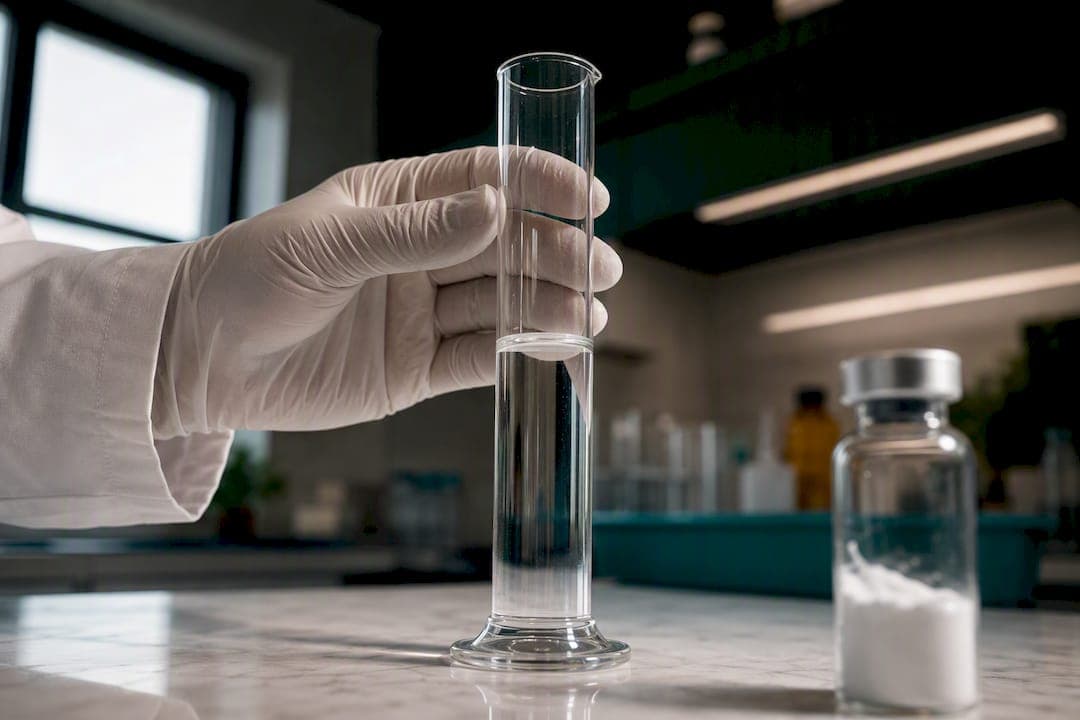
For most multi-dose research peptides, reconstitute with bacteriostatic water and pick a diluent volume that produces clean syringe-unit math. Add the solvent slowly down the vial wall at an angle, never shake, and let it dissolve on its own. The formula and worked examples below let you calculate exact micrograms, milliliters, and units before you draw a single dose.
TL;DR:
- Use bacteriostatic water for multi-dose vials and carefully select diluent volume to ensure clear syringe readings and precise dosing.
- Inject water slowly down the vial wall at an angle and avoid shaking to prevent peptide denaturation and clumping.
- Reconstitute with accurate math, considering dead space, needle gauge, and unit calculations to achieve the desired dose without errors.
- Store reconstituted peptides in the fridge for up to 28 days, avoiding freeze-thaw cycles and labeling clearly for safety and reference.
- Protect peptides from light and oxidation by storing in opaque packaging and minimizing exposure during handling.
Table of Contents
- What Is Peptide Reconstitution and Why the Solvent Choice Matters
- How Do You Reconstitute a Lyophilized Peptide Step by Step?
- How Do You Calculate Peptide Reconstitution Dosing?
- How Long Does Reconstituted Peptide Last in Storage?
- Why Is My Reconstituted Peptide Cloudy or Not Dissolving?
- Peptastic Labs Proof Points and Further Lab Resources
- How Do You Protect Peptides From Light and Oxidation?
- A Lab Habit Worth Adopting
- Get Reconstitution-Ready Supplies With Full Batch Documentation
- Sources
What Is Peptide Reconstitution and Why the Solvent Choice Matters
Peptide reconstitution is the process of converting a lyophilized (freeze-dried) peptide back into a liquid solution suitable for precise dosing in research applications. Get the supplies and solvent selection right before you touch a syringe.
Supplies checklist
- Lyophilized peptide vial, brought to room temperature
- Bacteriostatic water (0.9% benzyl alcohol) or sterile water, depending on use case
- U-100 insulin syringe with 29–31G needle
- Alcohol swabs (isopropyl alcohol)
- Sharps container rated for laboratory use
- Fine-point permanent marker for labeling
- Calculator or reconstitution calculator
Bacteriostatic water is the correct default for any vial you plan to draw from more than once. Its 0.9% benzyl alcohol content inhibits microbial growth and supports refrigerated use for roughly 28 days. Sterile water, by contrast, carries no preservative and should be treated as single-use only, drawn and used immediately, never stored for a second dose. For hydrophobic peptides that resist water entirely, a small volume of DMSO or dilute acetic acid can pre-dissolve the peptide before you dilute with bacteriostatic water, though you should confirm compatibility with any downstream assay first. Let the vial warm to room temperature before you start. Injecting cold water into a cold vial often produces condensation and localized clumping that looks like a solubility failure but is really a temperature mismatch.
Pro Tip: Keep your bacteriostatic water and lyophilized vials in the same refrigerator shelf so both reach room temperature at the same rate before reconstitution.
How Do You Reconstitute a Lyophilized Peptide Step by Step?
Reconstituting lyophilized peptides rewards a fixed, repeatable sequence. Skipping steps or rushing the addition is where most cloudiness and dosing errors originate.
- Sanitize your workspace and the vial stopper. Wipe both with an alcohol swab and let them air-dry for 15 to 30 seconds. Injecting through a wet stopper can push residual alcohol into the vial.
- Calculate your diluent volume before you draw anything. Decide on a target concentration first, then pick a bacteriostatic water volume that produces round, easy-to-read syringe units for your typical dose. This single planning step, emphasized across reconstitution guides, saves you from repeated fractional-unit math every time you dose.
- Draw the bacteriostatic water slowly into your syringe, expelling any air bubbles.
- Insert the needle at an angle and let the water run down the inside wall of the vial, not straight onto the lyophilized cake. A direct stream onto the powder disturbs the peptide structure and increases the odds of visible clumping.
- Equalize pressure. As you inject, vial pressure builds. Some labs pause partway through, draw back slightly on the plunger to relieve that pressure, then finish the injection in a second slow pass.
- Remove the needle and swirl the vial gently between your palms. Never shake. Shaking introduces mechanical shear that can denature the peptide and cause aggregation, a well-documented cause of turbidity.
- Label immediately with peptide name, final concentration in mg/mL, reconstitution date, and discard date.
- Refrigerate at 2–8°C without delay.
Pro Tip: Write the computed units-per-dose directly on the vial label, not just the concentration. Whoever draws the next dose should never have to redo your math.
How Do You Calculate Peptide Reconstitution Dosing?
The entire calculation reduces to one chain: milligrams to micrograms, micrograms per milliliter, milliliters per dose, then units on a U-100 syringe. The formula looks like this:
mcg/mL = (peptide mg × 1,000) ÷ bacteriostatic water (mL) mL per dose = desired mcg ÷ mcg/mL Units on a U-100 syringe = mL per dose × 100
Notice how Example A lands on a clean 10 units per dose, while Example B needs a slightly less tidy 15. That is the practical argument for choosing your diluent volume with the math in mind before you reconstitute, rather than after.
A few things affect the real-world accuracy of this math:
- Dead space in standard syringes can hold a small residual volume that never gets injected; low dead-space syringes minimize this loss.
- Needle gauge (29–31G is standard for subcutaneous research applications) affects draw speed but not your unit calculation.
- Manual arithmetic errors are common enough that pairing your protocol with a reconstitution calculator is worth the extra 30 seconds, especially when you are running several compounds with different concentrations in the same session.
How Long Does Reconstituted Peptide Last in Storage?
Once mixed with bacteriostatic water, most research peptides remain stable for approximately 28 days under refrigeration at 2–8°C, though this is a general guideline, not a universal rule. Peptide-specific degradation rates vary, so check the batch Certificate of Analysis for compound-specific stability data before you assume the default window applies.
- Store the vial upright in the main body of the refrigerator, away from the door where temperature fluctuates more.
- Avoid freezing reconstituted solution. Freeze-thaw cycles stress peptide structure through repeated ice crystal formation and can accelerate aggregation.
- If long-term storage is unavoidable, aliquot the reconstituted solution into smaller single-use volumes before freezing, so you thaw only what you need once.
- Label every vial with concentration, reconstitution date, and discard date. This is a small habit that prevents mixups in labs where multiple people draw from the same fridge.
Why Is My Reconstituted Peptide Cloudy or Not Dissolving?
Cloudiness after reconstitution almost always traces back to one of three causes: mechanical shear, temperature mismatch, or solvent incompatibility. Here is how to work through it.
- Let it rest first. Fine particulate or slight haze immediately after mixing often clears within a few minutes as the peptide fully hydrates. Set the vial down and check again before you assume a problem.
- If haze persists, refrigerate and check again in an hour. Some peptides dissolve more slowly at room temperature than expected.
- If particulate matter remains or the solution shows a color change, discard the vial. That is not a texture problem, it is a sign of degradation or contamination, and no amount of swirling fixes it.
- For peptides that resist dissolving entirely, a small percentage of DMSO or dilute acetic acid added before the bacteriostatic water can improve solubility for hydrophobic sequences, though you should verify compatibility with your assay first. Peptastic Labs' solubility guide walks through compound-specific cases in more detail.
- For peptides prone to gelation at high concentration, add diluent in small increments, roughly half a milliliter at a time, swirling between each addition until the gel breaks, then recalculate your concentration against the new total volume.
The fatal errors worth memorizing: shaking the vial, directing the diluent stream straight onto the lyophilized cake, grabbing sterile water for a vial you intend to reuse, and skipping stopper sanitization before you insert the needle. Any one of these can force a discard.
Peptastic Labs Proof Points and Further Lab Resources
That documentation matters here specifically because default storage and solvent guidance are generalizations, and your actual compound may behave differently.
- Request the Certificate of Analysis for your specific batch before deviating from the 28-day storage guideline.
- Consult the Peptide Solubility Guide for compounds that resist standard bacteriostatic water reconstitution.
- Review the Needle Gauge and Syringe Guide if you are unsure which draw setup fits your typical dose volume.
- Check the storage and degradation guide for freeze-thaw specifics and labeling templates.
CoA-backed documentation removes the guesswork that usually surrounds peptide sourcing, and it is worth reviewing before you assume your compound follows textbook stability rules.
How Do You Protect Peptides From Light and Oxidation?
Peptide degradation does not stop at temperature and shaking. Light exposure and oxidation are two separate stress pathways that quietly compromise a vial long before it looks visibly wrong.
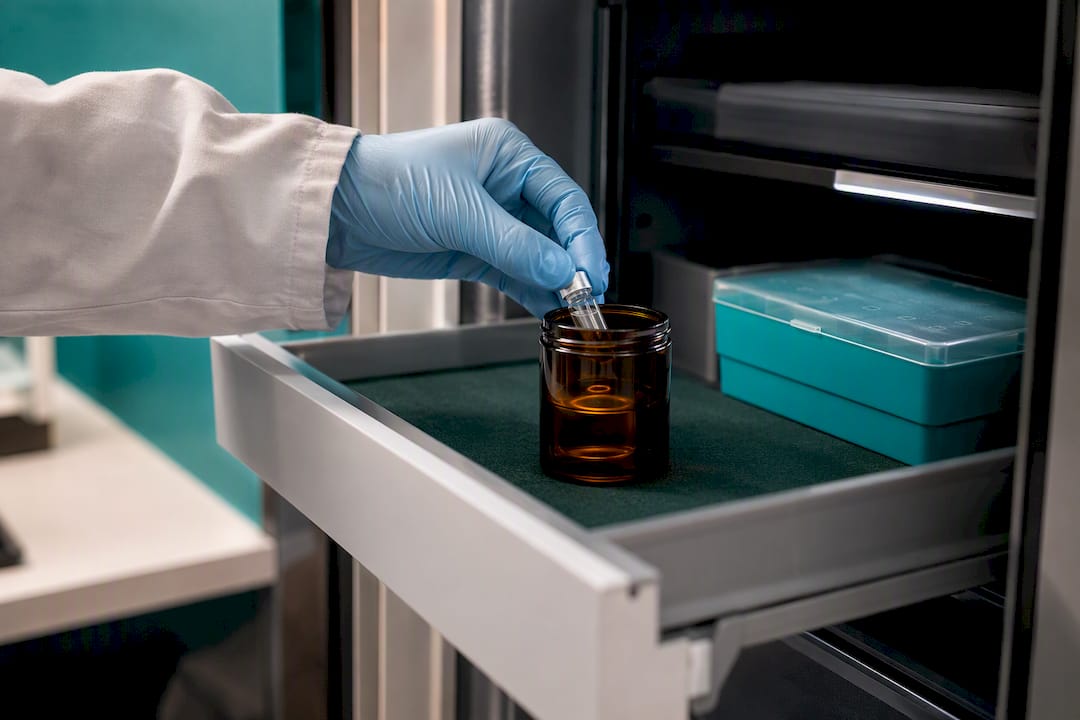
Many peptide sequences contain amino acids, particularly methionine, cysteine, and tryptophan, that are chemically vulnerable to oxidation. Exposure to ambient light, especially UV and bright fluorescent lab lighting, accelerates this process and contributes to the broader degradation pathways that also include hydrolysis and aggregation. The practical response is straightforward: store both lyophilized and reconstituted vials in their original amber or opaque packaging whenever possible, and keep them in a closed refrigerator drawer rather than an open shelf under direct light.
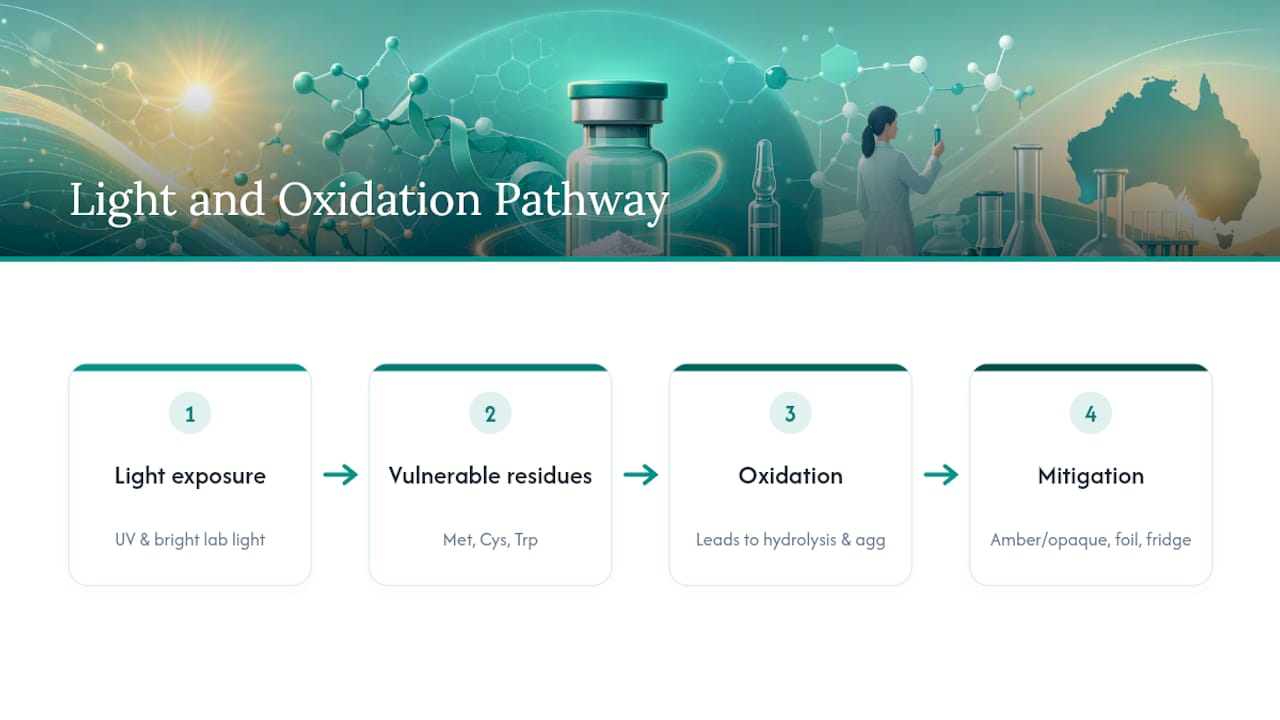
If your lyophilized peptide arrived in a clear vial, wrap it in foil or store it inside a light-blocking box before refrigeration. Once reconstituted, minimize the time the vial spends outside the refrigerator during dosing sessions. A few minutes on the counter under lab lighting is unlikely to cause meaningful damage, but leaving a vial out for hours during a long experiment session is not a habit worth forming.
Oxidation risk also compounds with pH. Peptide stability generally holds up best in a mildly acidic to neutral pH range, and reconstitution with the wrong solvent, or excessive exposure to co-solvents like DMSO, can shift the peptide's local pH environment enough to accelerate breakdown. This is another reason to confirm solvent compatibility against the batch CoA rather than assuming every peptide tolerates the same reconstitution approach. When in doubt, minimize light exposure, minimize time at room temperature, and treat pH deviations as a stability risk worth checking rather than ignoring.
A Lab Habit Worth Adopting
Every vial we reconstitute gets its diluent volume and computed units logged on the label and in a master spreadsheet before the needle ever goes back in the sharps container. It sounds tedious until the day someone else in the lab needs to draw a dose from a vial you mixed three weeks ago.
On dead space: a low dead-space syringe paired with a 31G needle consistently gives tighter draw precision for small-volume doses than a standard syringe and 29G pairing. The difference shows up most on the smallest calculated doses, where a fraction of a unit lost to dead space actually matters.
— Tintastic
Get Reconstitution-Ready Supplies With Full Batch Documentation
Precise math means little if the peptide itself is uncertain.
Every catalogue listing includes batch documentation, and Peptastic Labs also stocks bacteriostatic water alongside its peptide range, so your solvent and your compound come from a source you can verify. Compounds like CJC-1295 with Ipamorelin and BPC-157 are available with full documentation for researchers who want to skip the sourcing uncertainty entirely. If your protocol involves a compound-specific reconstitution question, Peptastic Labs' technical team takes direct inquiries on solvent selection and stability. Browse the full catalogue to see current stock and CoA availability before your next order.
Sources
- How to Reconstitute Peptides: Ultimate Guide with Visual Diagrams + Calculator
- Peptide Reconstitution Calculator: The Complete Guide to
- Peptide stability — ScienceDirect