
Before you weigh or reconstitute a research peptide, confirm a lot-specific Certificate of Analysis (COA) that pairs an HPLC chromatogram and full method details with mass-spectrometry identity data for the exact lot on your vial, then calculate net peptide content before setting any dose. Research-grade vials carry "for research use only" disclaimers rather than FDA prescribing sections, so the COA is your primary quality document.
Pre-acceptance checklist:
- Lot number on vial label matches lot number on COA exactly, including leading zeros or suffixes
- HPLC purity ≥ stated specification, with chromatogram image and method conditions (column, gradient, detection wavelength, run time)
- MS data present: observed molecular weight within ±1 Da (low-resolution) or <5 ppm (high-resolution) of theoretical
- Net peptide content or mass-balance stated, with salt/counterion form identified (TFA, acetate, or free base)
- Storage conditions, expiry date, and testing date visible on label or COA
Reject or quarantine any lot missing a lot-specific COA, reporting HPLC purity without MS identity confirmation, or showing a lot-number mismatch between vial and documentation.
Table of Contents
- What belongs on a research-grade peptide label and COA?
- How do you verify peptide identity from MS data?
- How do you evaluate HPLC purity claims and read chromatograms?
- Common red flags when decoding peptide labels and COAs
- What should you ask vendors, and how do you document the response?
- When should you request independent third-party testing or reject a lot?
- Key Takeaways
- Why strict COA verification reduces experimental variability
- Peptasticlabs: lot-specific documentation for every research order
- References and useful sources
What belongs on a research-grade peptide label and COA?
Every field on a credible COA serves a specific verification function. Understanding each one lets you distinguish a complete document from a template with numbers filled in.

Lot/batch identifier. The lot number is the traceability pivot: a COA missing an exact lot reference cannot be used to verify the vial in hand. Confirm character-for-character match before any other check.
Product identifiers. These include the peptide sequence in single-letter or three-letter code, any chemical modifications (C-terminal amidation, N-terminal acetylation, phosphorylation, PEGylation), and a CAS number or internal catalog code. The theoretical molecular weight calculated from the sequence is the reference value you will compare against MS data.
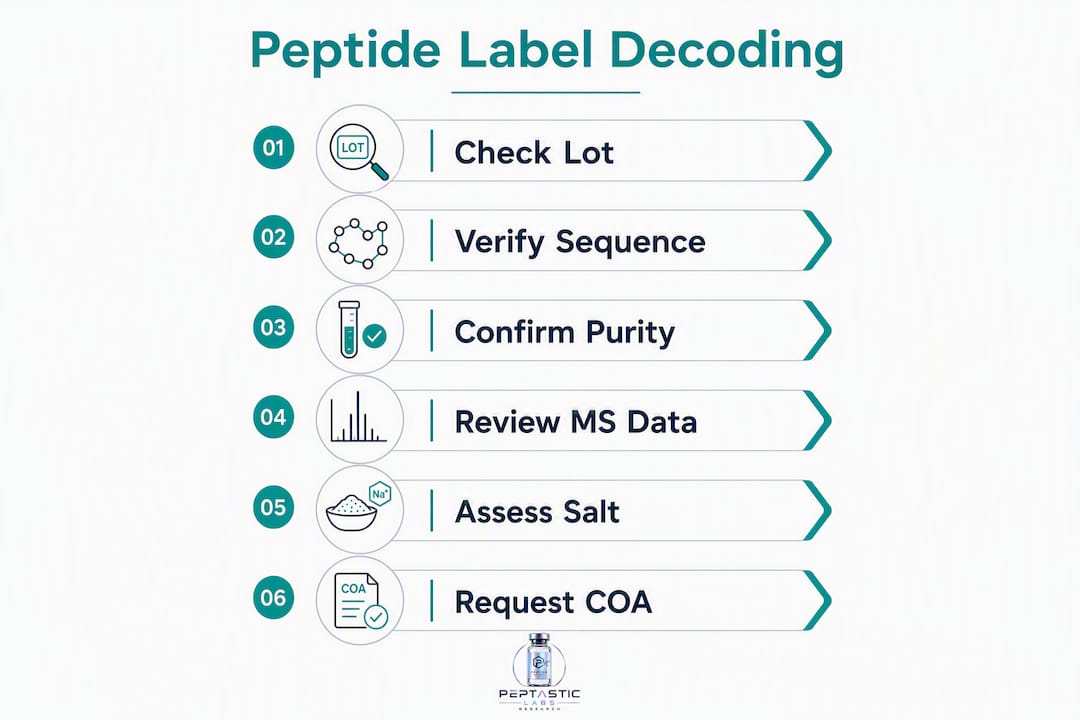
Analytical results. A credible COA must include HPLC purity with chromatogram, full HPLC method conditions, and MS data confirming expected molecular weight. Both are required; neither substitutes for the other.
Mass-balance and salt form. HPLC area percent is not absolute peptide content. Counterions and residual water can reduce net peptide mass substantially: a peptide reported as 98% by HPLC may contain only 70–80% peptide by mass after accounting for TFA counterions and moisture. The COA should state the counterion form (TFA, acetate, free base) and ideally a peptide-content value from amino-acid analysis.
Supporting fields. The table below maps each COA field to its minimum acceptable standard for research-grade material.
| COA Field | Minimum Acceptable Standard | Required for Cell/Animal Work? |
|---|---|---|
| Lot/batch number | Exact match to vial label | Yes |
| Peptide sequence | Full sequence with modification notation | Yes |
| HPLC purity % | ≥ stated spec, with chromatogram + method | Yes |
| MS identity | Observed vs theoretical mass, stated error | Yes |
| Peptide content/mass-balance | Net peptide % or amino-acid analysis | Strongly recommended |
| Salt/counterion form | TFA, acetate, or free base declared | Yes |
| Testing date | Within 12–18 months | Yes |
| Expiry/retest date | Stated on label or COA | Yes |
| Endotoxin | EU/mg or EU/mL limit stated | Yes |
| Residual solvents | Stated or declared not tested | Situational |
| Appearance | Visual or physical description | Yes |
| Storage conditions | Temperature, light, moisture | Yes |
Research-grade vials do not require FDA prescribing-information sections; their absence is expected. What is not acceptable is a COA with no lot reference, no chromatogram, or no MS data.
How do you verify peptide identity from MS data?
HPLC and MS answer different questions: HPLC quantifies relative purity, while MS confirms molecular identity. A sample can be 99% pure by HPLC area percent and still be the wrong peptide. MS is the identity check; HPLC is the purity check. Both are necessary.
Step-by-step MS verification:
- Confirm the peptide sequence and all modifications listed on the label.
- Calculate the theoretical monoisotopic or average molecular weight from the sequence using a tool such as the ExPASy ProtParam calculator or Peptide 2.0.
- Locate the observed mass on the COA (reported as [M+H]⁺, [M+2H]²⁺, or neutral mass).
- Calculate the mass error: |observed – theoretical| ÷ theoretical × 10⁶ for ppm, or simple Da difference for low-resolution instruments.
- Confirm the error is within ±1 Da for low-resolution ESI-MS or <5 ppm for high-resolution instruments (Orbitrap, Q-TOF).
- If charge states are shown, verify that the isotope envelope pattern is consistent with the expected peptide mass.
Mass comparison example: Theoretical [M+H]⁺ = 1,425.74 Da. Observed [M+H]⁺ = 1,425.73 Da. Mass error = 0.01 Da. Acceptable at low resolution. If observed = 1,427.74 Da (error = 2.00 Da), investigate further — a +2 Da shift can indicate incomplete deprotection or oxidation.
When MS/MS (tandem MS) data appear on a COA, they provide sequence-level confirmation: fragment ions (b- and y-series) map back to individual amino acids. A COA that lists MS/MS fragments and assigns them to the sequence is the strongest identity proof available. If the COA only states "MS confirmed" with no observed mass value, treat it as insufficient and request the raw report.
How do you evaluate HPLC purity claims and read chromatograms?
HPLC purity is a relative measure: the percent reported is the area of the main peak divided by total integrated area under UV absorbance, typically at 214 nm. Method parameters directly determine that number, so a purity percent without method details is not independently verifiable.
Method parameters to request and verify:
- Column type and dimensions (e.g., C18, 150 × 4.6 mm, 5 µm)
- Mobile phases (typically water/acetonitrile with 0.1% TFA or formic acid)
- Gradient profile (start and end % organic, ramp rate)
- Detection wavelength (214 nm detects the peptide bond; 280 nm is selective for Trp/Tyr)
- Flow rate and total run time
A short run time or a gradient that does not reach high organic content can leave late-eluting impurities off the chromatogram entirely. HPLC area-percent is computed from UV absorbance integration, and peaks eluting after the run ends or below the detection threshold can be omitted, biasing the purity number upward.
When reading a chromatogram, look for: a single dominant peak with symmetrical shape, baseline resolution from adjacent peaks, a flat baseline before and after the main peak, and no late-eluting shoulders. Co-eluting impurities appear as peak shoulders or asymmetric tailing. Baseline drift or integration artifacts can inflate the reported area percent.
Pro Tip: Request the raw chromatogram PDF and the full HPLC method report, not just the purity percentage. If a vendor provides only a number with no chromatogram or method, the claim cannot be independently assessed.
Net peptide mass calculation. Because residual TFA can be 10–40% by mass for peptides with multiple basic residues, dosing from nominal vial mass without a peptide-content correction introduces systematic error. The working formula:
Net peptide mass (mg) = Vial mass (mg) × HPLC purity (decimal) × Peptide content factor (if available)
If peptide content from amino-acid analysis is stated (e.g., 78%), apply it directly. Without it, treat the HPLC percent as an upper bound, not an absolute.
Common red flags when decoding peptide labels and COAs
The most consequential documentation gaps in peptide procurement follow a consistent pattern:
- Purity percent with no chromatogram or method. No column, no gradient, no wavelength — the number is unverifiable and should be treated as a marketing claim.
- HPLC-only COA, no MS. Purity without identity confirmation means you cannot rule out a correctly purified wrong peptide.
- Missing or mismatched lot number. A COA without a lot number matching the vial label invalidates the analytical data for that vial.
- Round-number purities (100.0%) or stale testing dates. A reported purity of exactly 100.0% is analytically implausible. Testing dates more than 12–18 months prior without a retest record raise stability questions.
- No salt form or peptide-content declaration. When dosing precision matters, an undeclared counterion form forces assumptions that compound across dilution steps.
- Missing endotoxin or residual solvent data for cell or animal work. These are not optional for in vitro or in vivo experiments; their absence is a rejection criterion for those use cases.
For a broader procurement-stage checklist, the low-quality peptide product guide covers additional sourcing signals.
What should you ask vendors, and how do you document the response?
Pre-order vendor checklist:
| Item to Request | Minimum Acceptable Evidence |
|---|---|
| Lot-specific COA | PDF with lot number matching vial label |
| HPLC chromatogram + method | Column, gradient, wavelength, run time stated |
| MS report | Observed vs theoretical mass, stated error |
| Peptide content/mass-balance | Amino-acid analysis or declared peptide % |
| Salt/counterion form | TFA, acetate, or free base declared |
| Testing date | Within 12–18 months of order |
| Third-party accreditation | ISO/IEC 17025 lab name or analyst signature |
| Endotoxin data (if cell/animal) | EU/mg limit and method stated |
| Storage and expiry | Temperature and light conditions on label |
Third-party reports from ISO/IEC 17025-accredited labs are stronger trust signals than unsigned or template COAs. An in-house COA with a named analyst and instrument details is acceptable; a generic template with no instrument identification is not.
Sample COA request email:
Subject: Lot-specific COA request — [Peptide Name], Order #[XXXX]
We are preparing to use [Peptide Name], Lot [XXXX], in a [brief assay description] experiment. Before accepting this lot, we require: (1) the lot-specific COA as a PDF, (2) the full HPLC chromatogram with method conditions (column, gradient, detection wavelength, run time), (3) the MS report showing observed vs theoretical molecular weight and stated mass error, and (4) peptide content or mass-balance data if available. Please confirm whether testing was performed in-house or by a third-party accredited laboratory. We will file this documentation with our order record for traceability.
Documentation steps:
- Save the COA PDF with a filename that includes lot number and receipt date.
- Cross-reference the lot number against the packing slip and vial label before filing.
- Log the HPLC purity, MS observed mass, and testing date in your lab inventory system.
- Attach the COA to the corresponding purchase order in your procurement records.
The COA assessment guide provides additional field-by-field criteria for evaluating documentation completeness.
When should you request independent third-party testing or reject a lot?
Not every documentation gap requires rejection, but some do. The decision follows a clear hierarchy.
- Request third-party testing when: the vendor provides an HPLC-only COA with no MS data; the observed mass deviates by more than ±1 Da (low-res) or 5 ppm (high-res) without explanation; peptide content is absent and the assay is dosing-critical; unexpected peaks appear in the chromatogram without assignment; or the work is subject to GLP, IND-enabling, or institutional ethics review.
- Commission specific tests based on the gap: LC-MS for identity + purity per peak; amino-acid analysis for net peptide content; Karl Fischer titration for water content when mass-balance is critical; endotoxin (LAL assay) for any cell or animal work.
- Hold the lot while awaiting third-party results. Do not consume material from a lot under documentation review.
- Reject outright when: the vendor refuses to provide a lot-specific COA; lot numbers persistently mismatch; sterility or endotoxin data are absent and required for the intended use; or mass discrepancies remain unexplained after follow-up.
Pro Tip: For third-party testing options including LC-MS and amino-acid analysis, confirm turnaround time before placing the lot on hold — typical LC-MS turnaround at a contract lab is 3–7 business days, which affects experiment scheduling.
Typical vendor response to a COA request is 1–3 business days. If a vendor cannot produce a lot-specific COA within that window, escalate to third-party testing or source an alternative lot.
Key Takeaways
A research-grade peptide lot is only acceptable when the lot number, HPLC chromatogram with full method, MS identity match, and net peptide content are all confirmed before use.
| Point | Details |
|---|---|
| Lot-number match is mandatory | The COA lot number must match the vial label exactly; any mismatch invalidates the documentation. |
| HPLC purity requires method context | A purity percent without column, gradient, and detection wavelength cannot be independently verified or compared across lots. |
| MS confirms identity, HPLC confirms purity | Both are required; a 99% pure sample by HPLC can still be the wrong peptide without MS confirmation. |
| Calculate net peptide mass before dosing | TFA counterions and residual water can reduce actual peptide content to 70–80% of nominal vial mass. |
| Peptasticlabs supplies lot-specific COAs on request | Each lot includes HPLC-verified purity (≥99%) and paired MS documentation, supporting full traceability before experiment use. |
Why strict COA verification reduces experimental variability
The standard advice in peptide procurement is to "check the COA." What that phrase obscures is the difference between a COA as a document and a COA as verified evidence. A PDF with a purity number and a lot number is not evidence until you have confirmed the lot matches the vial, the HPLC method is stated, the MS observed mass aligns with theoretical, and the peptide content has been accounted for in your dosing calculation.
The practical consequence of skipping any one of those steps is not just a failed experiment. It is a failed experiment whose cause is invisible in the data. Systematic under-dosing from unaccounted TFA mass, or a sequence error undetected because MS was not requested, produces results that look like biological variability. That is the real cost of incomplete documentation: it moves the error from the procurement record into the scientific record.
Peptasticlabs built its QC workflow around paired HPLC and MS documentation at the lot level precisely because institutional customers need that traceability. Every compound in the catalog is verified to ≥99% purity by HPLC, and lot-specific COAs are available on request. That documentation standard is not a differentiator for its own sake; it is the minimum a bench researcher needs to trust the material before the first pipette step.
Peptasticlabs: lot-specific documentation for every research order
Researchers who have worked through the verification checklist above know exactly what documentation a lot needs before it is acceptable. Peptasticlabs supplies that documentation as standard: every compound in the catalog is independently tested, HPLC-verified to ≥99% purity, and supported by lot-specific COAs available on request. The catalog covers metabolic, cognitive, tissue repair, longevity, immunology, and cosmetic research applications, with bulk and wholesale options for institutional orders.
To request a lot-specific COA or MS report before placing an order, contact Peptasticlabs directly through the research peptides catalog. Specify the peptide name, catalog number, and the documentation you require (HPLC chromatogram, MS report, peptide content data), and the team will confirm availability for the current lot before shipment.
References and useful sources
The following sources were cited in this article and provide authoritative background for HPLC method standards, COA field interpretation, and MS identity verification.
- HPLC Analysis and Purification of Peptides — PMC — Peer-reviewed reference covering column chemistry, separation mechanisms, and method development for peptide HPLC. Background authority for chromatogram interpretation guidance.