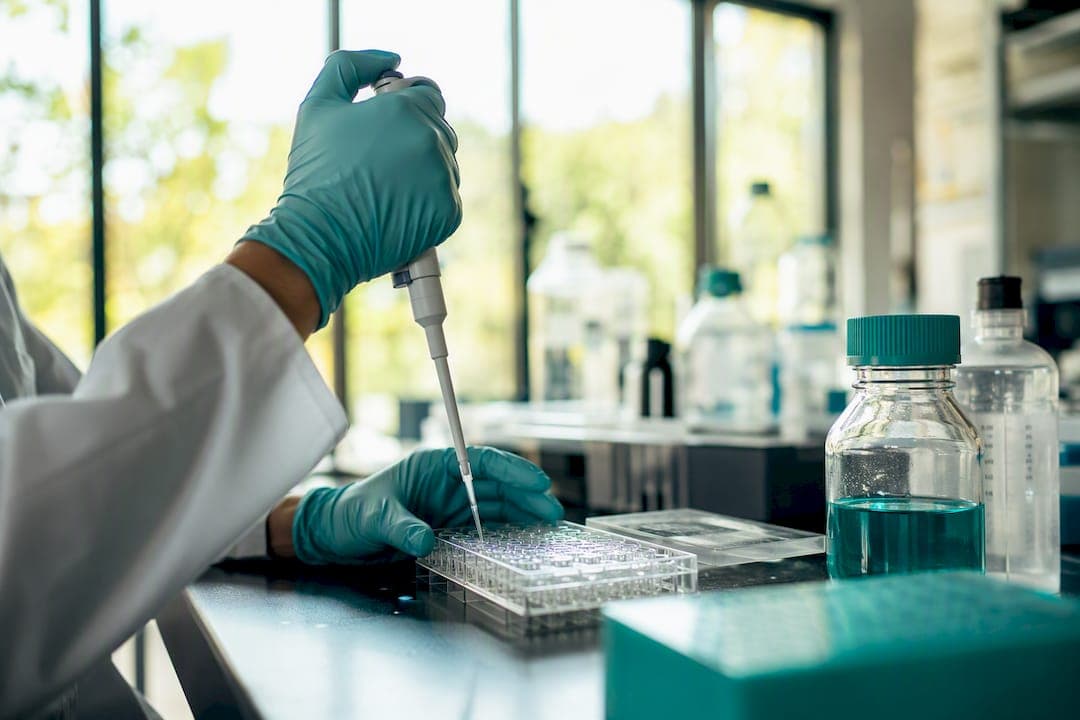
A BMP-2 peptide is a short, epitope-derived fragment synthesized to mimic a functional region of full-length bone morphogenetic protein 2, rather than the complete ~100 amino acid dimeric ligand. For most preclinical and mechanistic research, a well-engineered BMP-2-derived peptide is a viable alternative: localized, tunable, and lower in systemic risk, though it typically needs chemical stabilization to approach the receptor affinity of the native protein.
Choose peptide over full-length BMP-2 when:
- You need localized delivery with minimal systemic exposure.
- Your work targets a specific receptor interface (type I, type II, or coreceptor).
- Cost, storage, or batch consistency matter more than maximal osteoinduction.
Key Takeaways
BMP-2-derived peptides work as tunable, lower-systemic-risk research tools when stabilized through cyclization or stapling to recover native-like receptor affinity.
| Point | Details |
|---|---|
| Definition matters | A BMP-2 peptide is a short epitope fragment (commonly knuckle 73–92 or redefined 84–102), not the full dimeric protein. |
| Mechanism is receptor-dependent | Peptides trigger Smad1/5/8 signaling only when the target cell expresses matching ALK/BMPRII receptors. |
| Evidence stage | In vitro and animal data are strong; human clinical trials for peptide mimetics remain rare. |
| Stabilization drives affinity | Disulfide stapling and cyclization can improve binding more than threefold over linear epitope peptides. |
| Sourcing quality controls | Peptastic Labs supplies ≥99% HPLC-purity peptides with COA and batch documentation on request. |
Table of Contents
- What Is a BMP-2 Peptide Compared to Full-Length BMP-2?
- How Does BMP-2 Peptide Binding Trigger Bone Formation?
- What Evidence Supports BMP-2 Peptides in Bone Regeneration?
- BMP-2 Peptides vs Full-Length Recombinant BMP-2: Which Should You Use?
- How Do You Stabilize a BMP-2 Peptide for Better Affinity?
- What Dosing and Delivery Systems Work for BMP-2 Peptide Research?
- What Are the Safety and Regulatory Considerations for BMP-2 Peptides?
- What Should You Require From a BMP-2 Peptide Supplier?
- When Should You Choose a Peptide Over Full-Length BMP-2?
- Where to Source Research-Grade BMP-2 Peptides
- Frequently Asked Questions
- Sources
What Is a BMP-2 Peptide Compared to Full-Length BMP-2?
Full-length BMP-2 is a disulfide-linked homodimer, each monomer roughly 100 amino acids, belonging to the TGF-β superfamily of growth factors that drive bone and cartilage formation across multiple organ systems. A BMP-2-derived peptide, by contrast, is a short linear or cyclized sequence pulled from one functional surface of that dimer, most commonly the "knuckle" epitope.
The traditional knuckle region spans residues 73 to 92, but redefined mapping work has proposed an alternative window closer to the later region of the knuckle epitope, and the exact boundary matters because a few residues in either direction change which receptor interface the peptide actually engages.
Researchers typically encounter three synthetic construct types:
- Linear epitope peptides copied directly from knuckle, wrist, or elbow regions.
- Cyclized or disulfide-stapled variants that lock the peptide into a native-like fold.
- Receptor-derived competing peptides designed to block rather than activate signaling.
Sequence callout: when citing a construct in a protocol or paper, report the residue range (for example, "knuckle 73–92" or "redefined 84–102") rather than a bare sequence string. Flanking residues change local conformation, so the range alone tells another lab what binding behavior to expect.
How Does BMP-2 Peptide Binding Trigger Bone Formation?
BMP-2-derived peptides work by mimicking a native epitope closely enough to engage BMP receptor type I and type II subunits, which assemble into a heterotetrameric complex that phosphorylates Smad1/5/8 and drives osteogenic gene transcription. The active ligand, whether full protein or peptide mimetic, is fundamentally a signal that recruits and locks together two receptor pairs.
Different epitope regions map to different halves of that receptor sandwich. The knuckle interface tends to engage type I receptors (ALK2, ALK3, ALK6), while the wrist region contacts type II receptors (BMPRII, ActRIIA), and elbow-adjacent sequences influence coreceptor binding. Get the epitope wrong for your target interface and you get no signal, or worse, an unintended one.
This is where pleiotropy complicates interpretation. The same peptide can behave as an agonist in one cell type and an antagonist in another, depending entirely on which receptor subunits that cell expresses.
- Osteoblast precursors expressing high ALK3/ALK6 typically respond as expected.
- Cells with skewed BMPRII expression may show blunted or paradoxical responses.
Pro Tip: Run qPCR or flow cytometry on your cell model's ALK1/2/3/6 and BMPRII expression before you draw conclusions from a peptide dose-response curve. A "non-responsive" result is often a receptor-expression problem, not a peptide-potency problem.
What Evidence Supports BMP-2 Peptides in Bone Regeneration?
BMP-2-derived peptides produce reproducible osteoinductive signals in vitro and encouraging bone-repair results in animal models, but clinical trial data remains sparse compared to the decades of evidence behind recombinant BMP-2. That gap defines where the field currently stands: strong mechanistic and preclinical support, thin translational proof.
In vitro, the standard readouts are consistent across labs:
- Alkaline phosphatase (ALP) activity as an early osteogenic marker.
- Alizarin Red staining for mineralization at later time points.
- Runx2 and Osterix expression by qPCR to confirm lineage commitment.
In vivo, researchers most often report critical-size defect bridging and peri-implant bone formation in rodent or rabbit models, measured by micro-CT bone volume and histomorphometry.
The core translational tension is this: peptide mimetics deliver localized, tunable regenerative signals with reduced systemic exposure in preclinical models, but almost none have advanced through the controlled human trials that established full-length rhBMP-2 as an FDA-approved clinical option.
When you evaluate a published study, check three things before trusting the headline result: sample size (rodent studies are frequently small), whether the model is load-bearing or non-load-bearing, and whether endpoints extend past 8 to 12 weeks. Short observation windows can miss delayed heterotopic ossification or resorption.
BMP-2 Peptides vs Full-Length Recombinant BMP-2: Which Should You Use?
Peptides give you tunability and a lower systemic risk profile; full-length rhBMP-2 gives you proven, high-magnitude osteoinduction backed by regulatory history. Most researchers do not have to choose absolutely. The decision depends on what the experiment or application actually demands.
| Dimension | BMP-2-derived peptide | Full-length recombinant BMP-2 |
|---|---|---|
| Epitope/sequence | Short knuckle, wrist, or elbow fragment | Complete ~100 aa dimer, both interfaces intact |
| Stability/modifications | Often requires cyclization or stapling | Native fold, no modification needed |
| Purity & QC | HPLC purity, mass spec ID, COA per batch | Same QC standard, higher production cost |
| Intended use | In vitro, preclinical, biomaterial design | Preclinical through approved clinical use |
| Delivery compatibility | Flexible across scaffolds, coatings, hydrogels | Established collagen sponge carriers |
| Evidence level | In vitro, strong; animal, growing; clinical, rare | Extensive clinical and animal data |
- Production and storage costs run lower for synthetic peptides than for recombinant protein manufacturing.
- Lot-to-lot variability is easier to control with peptide synthesis QC than with cell-expressed recombinant protein.
- Full-length rhBMP-2 carries documented heterotopic ossification and inflammation risk at supraphysiologic doses; peptides reduce but do not eliminate off-target signaling.
Pro Tip: If your experiment's goal is mechanistic (isolating a single receptor interaction), start with a peptide. If the goal is maximal bone volume in a load-bearing defect model, full-length BMP-2 remains the better-characterized tool.
How Do You Stabilize a BMP-2 Peptide for Better Affinity?
A linear epitope peptide rarely holds the same three-dimensional shape it had inside the full protein, and that lost conformation is usually why binding affinity drops. Structural constraints, most often cyclization or disulfide stapling, are what recover native-like folding and push affinity back toward useful ranges.
Common chemical strategies include:
- Head-to-tail cyclization to restrict backbone flexibility.
- Single or multiple disulfide bonds engineered at strategic residue pairs.
- Hydrocarbon stapling across an alpha-helical turn.
- Non-natural amino acid substitutions to resist proteolysis.
- PEGylation to extend half-life in solution or in vivo.
Redesign work on the knuckle epitope illustrates the payoff concretely: shifting the window from the traditional 73–92 range to a redefined 84–102 sequence produced more than a threefold affinity improvement, and cyclic variants built on that redefined sequence pushed gains further still, into sub-micromolar binding in one reported case. Disulfide stapling of intrinsically disordered epitope segments is the mechanism behind most of that improvement.
The trade-off is synthesis complexity and cost, plus a modest immunogenicity question mark that linear peptides mostly avoid.
What Dosing and Delivery Systems Work for BMP-2 Peptide Research?
There is no universal concentration, but published in vitro work commonly clusters in the low nanomolar to low micromolar range depending on peptide affinity, while in vivo dosing is typically set empirically against a full-length BMP-2 positive control in the same defect model. Always cite your source concentration rather than assuming a published range transfers directly to your peptide variant.
Delivery vehicle choice affects release kinetics as much as the peptide itself:
- Collagen matrices, the legacy carrier for rhBMP-2, work adequately for peptides but release quickly.
- Hydrogels (alginate, gelatin methacryloyl) allow tunable, sustained release profiles.
- Titanium or implant coatings suit peri-implant bone formation studies.
- Controlled-release microspheres extend exposure windows for longer in vivo timelines.
Standard endpoints: ALP activity, Runx2/Osterix expression, and Alizarin Red staining in vitro; bone volume and tissue mineral density by micro-CT, mechanical testing, and histomorphometry in vivo.
Before you run the experiment:
- Reconstitute peptide per the supplier's Certificate of Analysis, and record storage temperature and freeze-thaw cycles.
- Calculate final concentration against molecular weight, not stock volume alone.
- Include a full-length BMP-2 positive control and a scrambled or inactive peptide negative control in every plate.
Pro Tip: Test release kinetics from your scaffold in a cell-free buffer system before running the full biological assay. It is far cheaper to discover a burst-release problem in PBS than in a six-week animal study.
What Are the Safety and Regulatory Considerations for BMP-2 Peptides?
Full-length rhBMP-2 carries documented adverse effects, including heterotopic bone formation and inflammation, largely tied to its systemic and supraphysiologic dosing in clinical use. Peptide mimetics reduce systemic exposure through localized delivery, but that does not make them risk-free, particularly at high local concentrations or with novel delivery vehicles.
Documented rhBMP-2 complications include ectopic bone growth beyond the intended site, postoperative swelling, and, in spinal applications, radiculitis. Locally delivered peptides have a shorter safety track record, so absence of reported complications reflects limited use, not proven safety.
Research-grade material is for research use only. Any translation toward clinical application requires clinical-grade manufacturing, formal toxicology work, and institutional and regulatory approval, none of which a research peptide purchase satisfies on its own.
Before any animal work, confirm:
- Endotoxin testing below your institution's threshold.
- Sterility verification appropriate to the delivery route.
- Immunogenicity screening if repeated dosing is planned.
- IACUC or equivalent institutional approval on file.
What Should You Require From a BMP-2 Peptide Supplier?
Before you order, require HPLC purity data, mass spectrometry identity confirmation, a Certificate of Analysis, and endotoxin and sterility results for every batch. Anything less leaves you guessing about what is actually in the vial.
Supplier evaluation checklist:
- Purity threshold appropriate to your use, generally ≥95% for exploratory in vitro work and ≥99% for anything feeding into a publication or in vivo study.
- Batch-specific COA, not a generic product-line document.
- Mass spec confirmation of molecular identity, not just purity percentage.
- Endotoxin and sterility data if the peptide will touch cells or animals.
- Independently tested purity data (not solely in-house).
- Transparent batch documentation available on request, not buried behind a sales call.
- Clear reconstitution, storage, and shelf-life guidance for each peptide variant.
Peptastic Labs verifies its catalog to ≥99% purity by HPLC and provides Certificates of Analysis on request, alongside batch documentation that lets you trace exactly which lot produced your data.
Pro Tip: Ask for stability data at your intended storage temperature before you commit to a large order. A peptide that degrades at 4°C when you need it stable for a six-week study is a wasted purchase, not just an inconvenience.
When Should You Choose a Peptide Over Full-Length BMP-2?
In practice, the decision comes down to what you are trying to prove. Peptides suit mechanistic studies isolating one receptor interface, localized biomaterial design work, and any protocol where minimizing systemic BMP exposure matters more than raw osteoinductive magnitude. Full-length BMP-2 still makes sense when the goal is established clinical-model efficacy or maximal bone formation in a system where the safety and approval pathway is already built.

That choice increasingly hinges on how mature your peptide's stabilization chemistry and delivery vehicle are, not on the epitope alone. A well-stapled cyclic peptide in a tuned hydrogel can now approach outcomes that would have required full-length protein a decade ago, and designer cyclic constructs paired with targeted delivery are where the field's next real gains will likely come from.
Where to Source Research-Grade BMP-2 Peptides
Peptastic Labs supplies independently tested, research-grade peptides verified to ≥99% purity by HPLC, with Certificates of Analysis and batch documentation available on request for every compound in the catalog.
Practical procurement support matters as much as the peptide itself when you are planning a study timeline. Peptastic Labs offers:
- Custom synthesis options for non-standard epitope constructs or stabilized variants.
- Bulk and wholesale ordering for labs running multi-arm or long-duration studies.
- COA on request for every batch, covering purity and identity confirmation.
- Technical support for planning concentration ranges and delivery-vehicle compatibility.
If you are evaluating peptide types beyond BMP-2 derivatives, the guide on peptide types and research uses covers how classification affects handling and storage decisions. For a closer look at how synthetic peptides diverge from naturally expressed proteins in stability and behavior, see why synthetic peptides differ from natural ones.
Browse the full research-grade peptide catalog to check current availability and request documentation before your next order.
Frequently Asked Questions
What is a BMP-2 peptide used for in research? A BMP-2 peptide is used to study osteogenic signaling mechanisms, test biomaterial scaffold designs, and induce localized bone formation in preclinical models without the systemic exposure of full-length protein.
Is a BMP-2 peptide as effective as full-length BMP-2? Generally not without engineering. Linear epitope peptides show lower intrinsic receptor affinity than the full dimer, though cyclized or stapled variants can approach comparable activity in specific assays.
What is the knuckle epitope in BMP-2? It is the region traditionally mapped to residues 73–92 of BMP-2 that engages type I receptors; redefined mapping proposes an alternative window near residues 84–102 with improved binding characteristics.
Are BMP-2 peptides approved for clinical use? No. BMP-2-derived peptides are research-use compounds. Clinical translation requires clinical-grade manufacturing and regulatory approval that research-grade peptides do not carry.
What purity level should I require for BMP-2 peptide research? Most labs require at least 95% purity for exploratory in vitro work and 99% or higher, HPLC-verified with a Certificate of Analysis, for any data intended for publication or in vivo studies.
This article is general information, not a substitute for advice from a qualified doctor. Consult a qualified healthcare professional about your own circumstances before acting on anything here.
Sources
- BMP-2 roles in bone formation and pleiotropic signaling (PMC7557435)
- BMP receptor binding and Smad pathway activation (PubMed 11714695)
- Revisiting BMP-2 knuckle epitope and redesigning epitope-derived peptides (Journal of Peptide Science / DOI 10.1002/psc.3309)