
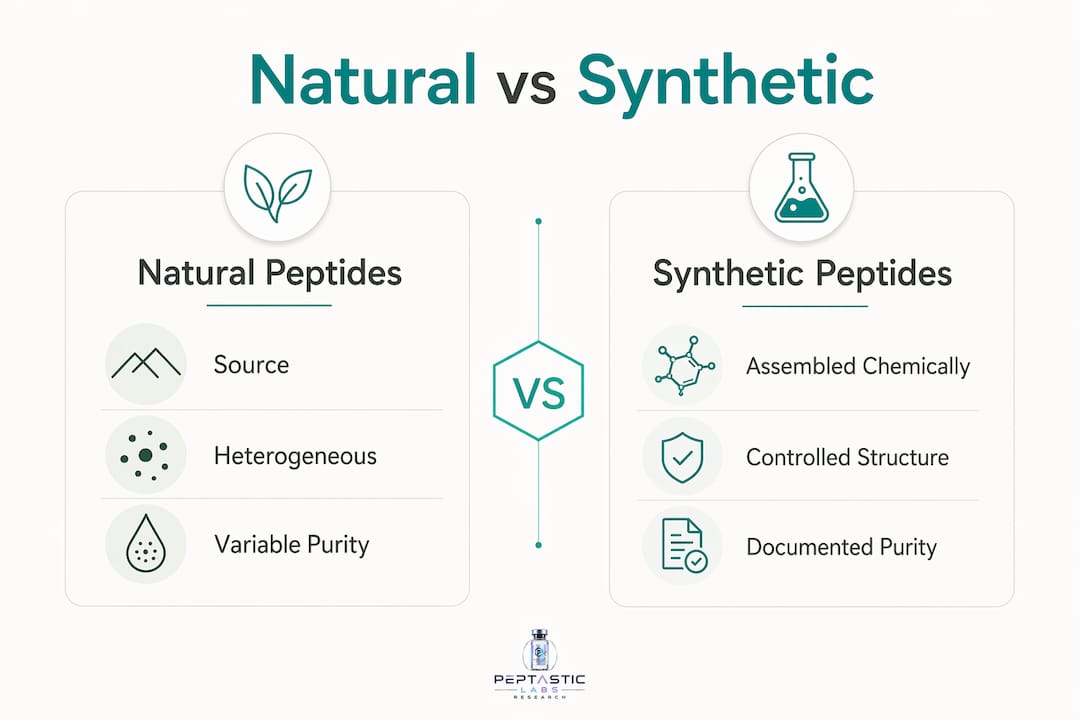
Synthetic peptides differ from natural peptides primarily in origin, sequence control, purity, and regulatory classification. A synthetic peptide is assembled or expressed under defined laboratory conditions, giving researchers precise control over sequence, length, modifications, and batch consistency. Natural peptides originate from biological organisms and typically arrive as heterogeneous mixtures with variable post-translational modifications. That distinction has direct consequences for reproducibility, potency, and how the FDA classifies the material.
The practical implications break down into three areas:
- Reproducibility: Sequence-defined synthetic peptides with documented QC are essential for research assays; natural extracts are poor substitutes when exact sequence or dose-response data is required.
- Regulatory classification: Collagen peptides sold as dietary supplements occupy a different regulatory category than therapeutic synthetic peptides like semaglutide (Ozempic), which follows the FDA drug approval pathway. Research-only designations apply to a third category entirely.
- Quality verification: Every lot, synthetic or natural, should carry a Certificate of Analysis (COA) reporting HPLC purity, mass confirmation by spectrometry, and residual solvent data. Suppliers like Peptasticlabs verify each compound to high purity via HPLC and provide COAs on request.
Table of Contents
- What exactly is a peptide, and how do the categories map?
- How are synthetic peptides made, and what does that control enable?
- How are natural peptides sourced, and why are they heterogeneous?
- What structural features actually differ between the two types?
- How do structural differences translate into functional outcomes?
- What does rigorous QC look like, and what should a COA show?
- How does U.S. regulatory classification affect access and safety?
- Which peptide type fits your research or health goal?
- What should you ask a peptide supplier before ordering?
- Key Takeaways
- The distinction that actually changes experimental outcomes
- Peptasticlabs: research-grade peptides with full QC documentation
- Useful sources
What exactly is a peptide, and how do the categories map?
A peptide is a chain of roughly 2–50 amino acids linked by peptide bonds. Sequence and length together determine how the molecule behaves, which receptor it binds, and how it is metabolized. The broad label "peptide" covers chemically distinct classes that should not be conflated:
- Collagen peptides (hydrolysates): Fragments produced by enzymatic or acid hydrolysis of collagen-rich tissue. Dominated by glycine, proline, and hydroxyproline. Sold as dietary supplements for skin and joint support.
- Signaling/bioactive peptides: Specific sequences that act on defined receptors (e.g., GLP-1 receptor agonists, growth hormone secretagogues). Sequence identity is critical for activity.
- Therapeutic peptides: Engineered or semi-synthetic molecules approved as drugs. Semaglutide is a modified GLP-1 analog with a fatty acid chain added to extend half-life.
- Research reagents: Sequence-defined synthetic peptides used in assays, binding studies, and mechanistic work. Not intended for human administration.
Conflating collagen hydrolysates with receptor-targeting synthetic peptides is a common mistake among consumers and even some clinicians. The regulatory and evidentiary expectations for each class differ substantially, which is why category boundaries matter before evaluating any evidence or making a purchase.
How are synthetic peptides made, and what does that control enable?
Two main production routes exist for defined synthetic peptides: chemical solid-phase peptide synthesis (SPPS) and recombinant expression.
SPPS: stepwise chemical assembly
- Anchor the C-terminal amino acid to a solid resin support.
- Deprotect the resin-bound residue's amine group.
- Couple the next protected amino acid using an activating reagent.
- Repeat deprotection and coupling iteratively for each residue.
- Cleave the completed chain from the resin and remove side-chain protecting groups.
- Purify by preparative HPLC; confirm identity by mass spectrometry.
SPPS is the dominant method for research-grade peptides up to roughly 50 residues. It allows incorporation of non-natural amino acids, D-isomers, N- or C-terminal caps, PEGylation, and cyclization at defined positions.
Recombinant expression

Longer or disulfide-rich peptides are sometimes expressed in bacterial, yeast, or mammalian host systems, then released by proteolytic cleavage. This route is preferred when folding or post-translational modification by the host is required for activity.
Post-synthesis analytical verification
After synthesis, identity and purity are confirmed by:
- HPLC: Quantifies purity as percent area under the main peak; detects co-eluting impurities.
- Mass spectrometry (MS): Confirms observed mass against theoretical mass; flags truncated sequences or incomplete deprotection.
- Amino acid analysis: Verifies composition.
- Peptide mapping: Used for larger or more complex sequences to confirm primary structure.
These analytical steps are what make a synthetic peptide's purity and identity documentable in a way that natural extracts rarely match.
How are natural peptides sourced, and why are they heterogeneous?
Natural peptides are obtained through extraction, hydrolysis, or isolation from biological tissue. Collagen peptides, the most commercially significant example, are produced by enzymatic or acid hydrolysis of bovine, porcine, or marine collagen; see more on the differences between synthetic and natural supplements. The result is a mixture of di-, tri-, and oligopeptides, with Pro-Hyp and Pro-Hyp-Gly detectable in plasma after ingestion. No two hydrolysis batches are identical.
Post-translational modifications (PTMs) are intrinsic to biologically derived material. Common PTMs in natural peptides include:
- Hydroxylation: Proline hydroxylation in collagen is essential for triple-helix stability; it cannot be replicated without enzymatic machinery.
- Glycosylation: Sugar moieties attached to serine or threonine residues alter solubility, receptor binding, and immunogenicity.
- Phosphorylation: Regulates signaling peptide activity in vivo.
- Disulfide bonds: Formed enzymatically in the endoplasmic reticulum; critical for folded structure in many natural peptides.
Batch variability in natural extracts stems from species differences, tissue source, animal age, processing conditions, and digestion efficiency. For nutritional applications, that variability is often acceptable. For research assays requiring dose-response precision, it is not.

What structural features actually differ between the two types?
The molecular distinctions between synthetic and natural peptides go beyond origin. Several specific structural features can differ, each with measurable consequences:
- Post-translational modifications: Present in natural material by default; added selectively in synthetic peptides only when designed in.
- Non-natural amino acids: Synthetic chemistry allows incorporation of beta-amino acids, D-isomers, or unnatural side chains not found in ribosomally translated sequences.
- Stereochemistry (D/L): All ribosomally produced peptides use L-amino acids. Replacing one or more with D-isomers in a synthetic peptide resists protease cleavage and extends half-life.
- PEGylation and lipidation: Polyethylene glycol or fatty acid chains attached to extend circulation time. Semaglutide carries a C18 fatty diacid chain that binds albumin, extending its half-life compared to native GLP-1's very short duration.
- Cyclization: Head-to-tail or side-chain cyclization increases conformational rigidity and protease resistance.
- Terminal capping: Acetylation of the N-terminus or amidation of the C-terminus reduces charge and improves stability.
| Dimension | Natural peptides | Synthetic peptides |
|---|---|---|
| Source | Organism (tissue, secretion, hydrolysate) | Chemical synthesis (SPPS) or recombinant expression |
| Typical modifications | PTMs from biosynthesis (glycosylation, hydroxylation, phosphorylation) | Designed modifications (D-isomers, PEGylation, cyclization, caps) |
| Expected purity | Variable; mixture of fragments | Defined; ≥95–99% by HPLC for research grade |
| Detection methods | Amino acid profiling, hydroxyproline assay, MS | HPLC, MS, amino acid analysis, peptide mapping |
How do structural differences translate into functional outcomes?
Structure drives function. The modifications that distinguish synthetic peptides from natural sequences have direct biological consequences.
Receptor specificity and potency: Semaglutide's fatty acid modification does not change GLP-1 receptor binding directly, but it dramatically extends plasma half-life, enabling once-weekly dosing. Native GLP-1 is cleared within minutes by dipeptidyl peptidase-4 (DPP-4). Therapeutic peptide development increasingly favors rational design to improve pharmacokinetics and reduce toxicity compared with raw natural extraction.
-
Stability: D-amino acid substitutions and cyclization reduce protease susceptibility. A synthetic peptide engineered with D-residues at cleavage sites can survive gastrointestinal transit or extended plasma exposure that would degrade its natural counterpart.
-
Bioavailability: Oral collagen hydrolysates are absorbed as di- and tripeptides; injectable signaling peptides bypass first-pass metabolism entirely. Route of administration is partly dictated by the peptide's structural vulnerability to digestion.
-
Metabolism: Natural peptides are metabolized by the same proteases that process dietary protein. Synthetic modifications shift that metabolic profile, sometimes requiring new safety characterization.
-
Immunogenicity: Natural extracts may carry residual proteins or glycans that trigger immune responses. Engineered synthetic peptides can reduce immunogenic potential by eliminating non-peptide contaminants, though novel non-natural residues can themselves introduce new immunogenic risk. Researchers evaluating peptide immune modulation should account for both directions of that risk.
What does rigorous QC look like, and what should a COA show?
Quality control is where synthetic and natural peptides diverge most practically for researchers. HPLC and mass spectrometry are the core analytical tools for confirming peptide identity and purity; a COA that omits either is a red flag.
A research-grade COA should include:
- Purity (% area by HPLC): ≥95% is a minimum for most research applications; ≥99% is standard for high-confidence assays.
- Observed mass by MS: Must match theoretical mass within instrument tolerance. Discrepancy indicates truncation, incomplete deprotection, or wrong sequence.
- Residual solvents: Limits set by ICH Q3C guidelines; relevant for any injectable or cell-based application.
- Peptide content: Accounts for water and counterion mass; corrects for the fact that lyophilized powder is not 100% peptide by weight.
- Endotoxin / microbiology: Required for any in vivo or cell-culture application to avoid confounded results.
| COA Field | What to check |
|---|---|
| Purity (% area, HPLC) | ≥95% minimum; ≥99% for high-confidence research |
| Observed mass (MS) | Matches theoretical mass within instrument tolerance |
| % Area by HPLC | Single main peak; inspect impurity profile for co-eluting species |
| Residual solvents | Within ICH Q3C limits for the application |
| Endotoxin (EU/mg) | Required for in vivo or cell-culture use |
Third-party verification adds a layer of independence that in-house testing alone cannot provide. For in vitro testing methods and activity assays, the COA is the starting point, not the endpoint, of quality evaluation.
How does U.S. regulatory classification affect access and safety?
The FDA treats collagen peptides as dietary ingredients regulated under the Dietary Supplement Health and Education Act (DSHEA). Manufacturers do not need pre-market approval, but they cannot make disease treatment claims. Therapeutic synthetic peptides like semaglutide are regulated as drugs under the Federal Food, Drug, and Cosmetic Act, requiring clinical trial evidence, a New Drug Application, and post-market surveillance. Research-only peptides occupy a third category: not approved for human use, not sold as supplements, and subject to institutional oversight (IRB, IACUC) when used in studies.
The same amino acid sequence can sit in different regulatory buckets depending on the intended use and the claims made. A peptide sold as a "research chemical" with no human-use claims is not automatically safe for self-administration, and the absence of FDA drug approval does not mean the compound is unregulated.
Practical safety guidance for U.S. researchers and informed consumers:
- Demand a COA for every lot before use.
- Avoid unregulated injectable products sold without clinical oversight or institutional protocols.
- Consult a licensed clinician before using any peptide therapeutically.
- Verify that a supplier's research-grade designation is consistent with your intended application.
Many bioactive signaling peptides such as BPC-157 have strong preclinical data but limited large-scale human RCT evidence, while collagen peptides have a larger human trial footprint for skin and joint outcomes. Regulatory status and evidence base are not the same thing.
This article is general scientific information, not medical or legal advice. Confirm current regulatory status with the FDA or a qualified professional for your specific situation.
Which peptide type fits your research or health goal?
The choice between synthetic and natural peptides follows directly from the intended application.
Choose a defined synthetic peptide when:
- Exact sequence identity is required for reproducibility across experiments.
- The assay involves receptor binding, dose-response curves, or mechanistic studies.
- Stability over the assay duration is critical (consider D-isomers or cyclized variants).
- Regulatory documentation for a drug development program is needed.
- Injectable administration is planned (purity and endotoxin data are non-negotiable).
Choose a natural peptide or hydrolysate when:
- Broad nutritional support is the goal (collagen hydrolysates for joint or skin outcomes).
- The application tolerates batch-to-batch variation in fragment distribution.
- Oral administration is the route and bioavailability of specific di/tripeptides is acceptable.
Short application examples:
- Research assay: A receptor-binding study for a GLP-1 analog requires a synthetic peptide with confirmed sequence, ≥99% HPLC purity, and MS-verified mass. A collagen hydrolysate is not a substitute.
- Therapeutic: Semaglutide exemplifies how rational synthetic modification of a natural sequence produces a clinically approved drug with a defined pharmacokinetic profile.
- Nutritional supplement: Collagen hydrolysates with documented Pro-Hyp content are appropriate for joint and skin support studies with human subjects. The role of peptides in muscle repair illustrates how these two categories serve different biological endpoints.
Selection checklist:
- Purpose: research, therapeutic, or nutritional?
- Route of administration: oral, injectable, or topical?
- Required purity: ≥95% or ≥99%?
- Regulatory status: supplement, drug, or research reagent?
- Supplier documentation: COA, MS data, stability data available?
What should you ask a peptide supplier before ordering?
Supplier evaluation follows a consistent framework regardless of peptide type. Request the following before any purchase:
- COA with HPLC purity chromatogram and MS data for the specific lot.
- Method descriptions: which HPLC column, mobile phase, and MS instrument were used.
- Stability data: shelf life as lyophilized powder and post-reconstitution degradation profile. Reconstituted peptides can degrade rapidly once in solution; cold chain and pH conditions matter.
- Storage and reconstitution instructions: solvent compatibility, recommended concentration, freeze-thaw guidance.
- Endotoxin and microbiology results for any compound intended for in vivo or cell-culture use.
- Chain-of-custody documentation: batch number, synthesis date, and testing date.
Reading a COA correctly requires matching the observed mass to the theoretical mass within instrument tolerance, checking that the HPLC % area reflects a single dominant peak with a clean impurity profile, and confirming residual solvent values fall within ICH Q3C limits.
Peptasticlabs verifies each compound in its catalog to ≥99% purity via HPLC, provides third-party testing, and supplies COAs on request. The catalog covers over 22 independently tested compounds across metabolic, cognitive, tissue repair, longevity, immunology, and cosmetic research areas.
Pro Tip: For collagen-derived peptides, request hydroxyproline content data on the COA. Hydroxyproline is a collagen authenticity marker that confirms the source material is genuine collagen rather than a cheaper gelatin or mixed protein hydrolysate. Its absence from a collagen COA is a red flag. For synthetic research peptides, the equivalent check is the MS observed mass: if it is missing or does not match the theoretical value, do not use the lot.
A practical peptide buying checklist can help structure these supplier conversations before committing to a purchase.
Key Takeaways
Synthetic peptides differ from natural peptides in origin, structural control, purity documentation, and regulatory classification, and matching the right type to the intended application is the single most consequential decision a researcher or informed buyer makes.
| Point | Details |
|---|---|
| Source and control | Synthetic peptides are assembled under defined conditions; natural peptides are extracted or hydrolyzed from organisms with inherent batch variability. |
| Structural modifications | Synthetic chemistry enables D-isomers, PEGylation, cyclization, and non-natural residues; natural peptides carry biosynthetic PTMs like glycosylation and hydroxylation. |
| Purity and QC | Research-grade synthetic peptides should meet ≥99% purity by HPLC with MS mass confirmation; natural hydrolysates require hydroxyproline assay for collagen authenticity. |
| Regulatory classification | The FDA distinguishes collagen peptide supplements (DSHEA), approved therapeutic peptides (NDA pathway), and research-only reagents; intended use determines the category. |
| Peptasticlabs | Peptasticlabs supplies over 22 HPLC-verified compounds at ≥99% purity with COAs and third-party testing, covering metabolic, cognitive, tissue repair, and immunology research. |
The distinction that actually changes experimental outcomes
The synthetic-versus-natural framing is useful, but it obscures the more operationally important question: is the sequence defined, and is the purity documented? A natural peptide with a known sequence and a clean COA is more useful for a binding assay than a synthetic peptide with a vague purity claim and no MS data. The category label matters less than the documentation behind it.
What gets underestimated is how often researchers accept a supplier's purity claim at face value. A stated "98% purity" means nothing without the HPLC chromatogram showing where that number came from. An impurity peak co-eluting with the main peak, or a residual solvent above ICH limits, can confound a cell-based assay in ways that are nearly impossible to diagnose after the fact. The COA is not a formality. It is the primary evidence that the compound in the vial matches the sequence on the label.
The other underappreciated point is stability. Lyophilized peptides are generally stable for months to years under proper storage. Once reconstituted, the clock starts. Researchers who reconstitute a full vial, store it at 4°C for three weeks, and then run an assay are not necessarily testing the same compound they started with. Stability data from the supplier, combined with aliquoting and freeze-thaw protocols, are what separate a controlled experiment from an ambiguous one.
Peptasticlabs: research-grade peptides with full QC documentation
Researchers who need sequence-defined compounds with verified purity have a concrete option in Peptasticlabs. The catalog covers over 22 independently tested peptides across metabolic, cognitive, tissue repair, longevity, immunology, and cosmetic research categories. Every compound is HPLC-verified to ≥99% purity, with third-party testing available and COAs provided on request. Storage and reconstitution guidance is included with each product, addressing the stability considerations that matter most for in vitro and preclinical work.

This is not a claim that Peptasticlabs is the only supplier worth considering. The QA checklist in this article applies to any vendor. Peptasticlabs is an example of what rigorous documentation looks like in practice: batch-specific COAs, MS-confirmed identity, and transparent sourcing. Researchers should verify each lot independently regardless of supplier reputation.
To review available compounds, request a COA, or inquire about specific research applications, visit Peptasticlabs.
Useful sources
- FDA — Dietary Supplements: Primary U.S. regulatory source for supplement vs. drug classification, labeling requirements, and DSHEA framework.
- PMC — Synthetic Peptides and Peptidomimetics review: Peer-reviewed overview of SPPS methods, rational design principles, and pharmacokinetic modification strategies; best for synthesis and functional consequence sections.
- Genome.gov — Peptide terminology: Accessible educational overview of peptide definition and amino acid chain classification; useful for grounding category distinctions.
- Peptides.wiki — Natural vs. Synthetic Peptides Guide: Practical primer on SPPS vs. recombinant production and research reproducibility considerations.
- FormBlends — Peptides vs. Collagen Peptides: Covers collagen hydrolysate composition, Pro-Hyp plasma detection, reconstitution stability, and hydroxyproline as an authenticity marker.
- Peptide Register — Collagen vs. Bioactive Signaling Peptides: Evidence comparison between collagen peptide RCT data and preclinical-only signaling peptide literature; useful for calibrating evidence claims.
- PubMed — PMID 25450771: Peer-reviewed research relevant to peptide pharmacology and modification strategies.
- PubMed — PMID 28720325: Additional peer-reviewed literature on peptide therapeutics and structural modification.