
A peptide amino acid chain is defined as a short polymer of amino acids linked by covalent peptide bonds, typically containing 2 to 50 residues. This structure sits between free amino acids and full proteins in the biomolecular hierarchy. Understanding what a peptide amino acid chain is, how it forms, and what it does is foundational knowledge for anyone working in biochemistry, molecular biology, or research-grade peptide science. Peptasticlabs works exclusively with these compounds, supplying HPLC-verified sequences for metabolism, tissue repair, immunology, and related research fields.
What is a peptide amino acid chain, and how does it differ from a protein?
A peptide is defined as a short polymer of approximately 2 to 50 amino acid residues. Proteins, by contrast, typically exceed 50 residues and adopt complex tertiary or quaternary structures. This size distinction matters in research because peptides are easier to synthesize, characterize, and modify than full proteins.
Amino acids are the monomer units. Each carries an amino group, a carboxyl group, and a unique side chain that determines its chemical character. The sequence of those side chains defines what the peptide does biologically. Change one residue and you can alter binding affinity, stability, or receptor selectivity entirely.

The term "peptide" covers a wide functional range. Dipeptides contain two residues. Oligopeptides contain a handful. Polypeptides approach the protein threshold. Researchers use these distinctions to set expectations about molecular weight, solubility, and analytical method selection before synthesis begins.
How are peptide amino acid chains chemically formed and structured?
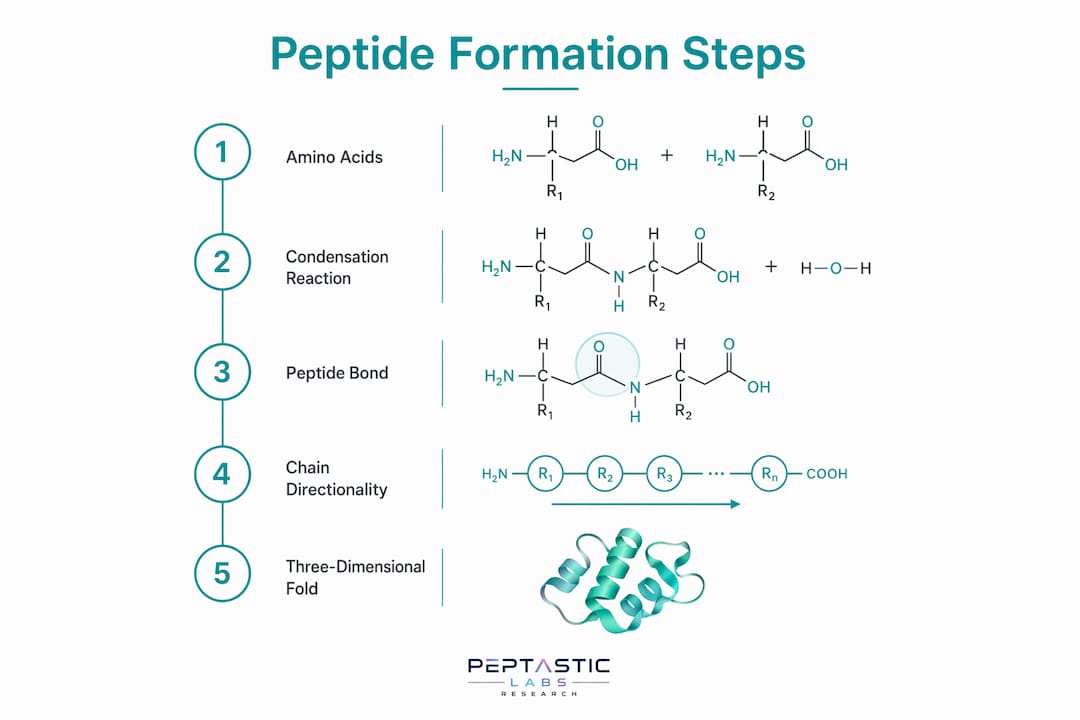
Peptide bond formation occurs through a condensation reaction. The carboxyl group of one amino acid reacts with the amino group of the next, releasing a water molecule and forming a covalent amide bond. This reaction repeats sequentially to build the chain.
The peptide bond carries partial double-bond character due to resonance delocalization of electrons across the nitrogen-carbon-oxygen system. That resonance restricts rotation around the bond. The result is a planar, rigid unit at each linkage point in the backbone.
This rigidity has direct structural consequences:
- The backbone cannot rotate freely at peptide bonds, only at the phi and psi angles flanking each alpha carbon.
- Planarity constrains the conformational space available to the chain.
- These constraints drive predictable secondary structures such as alpha helices and beta sheets.
- Folding into those structures is what converts a linear sequence into a functional molecule.
Directionality is fixed. Peptide chains read from N-terminus to C-terminus, with the free amino group at one end and the free carboxyl group at the other. This convention is not arbitrary. Ribosomes synthesize peptides in the N-to-C direction, and all sequence databases, synthesis protocols, and analytical reports follow the same orientation.
Pro Tip: When ordering a synthetic peptide, always confirm that the supplier's sequence notation matches the N-to-C convention. A reversed sequence is a different molecule with different biological activity.
What conventions are used to represent peptide sequences in research?
Researchers document peptide sequences using two standard code systems. The three-letter code (e.g., Gly-Ala-Val) is common in chemistry literature and patent filings. The one-letter code (e.g., GAV) is preferred in computational databases such as UniProt and NCBI because it is compact and machine-readable.
| Feature | Three-letter code | One-letter code |
|---|---|---|
| Example | Gly-Ala-Val | GAV |
| Primary use | Chemistry, patents, lab reports | Databases, bioinformatics, sequence alignment |
| Readability | High for chemists | High for computational tools |
| Space efficiency | Low | High |
Both systems write sequences from N-terminus to C-terminus. Choosing between them depends on context. A synthesis order form typically uses three-letter codes. A BLAST search uses one-letter codes.
Linear notation has real limitations. Sequence notation does not capture modifications such as acetylation, amidation, phosphorylation, or cyclic structures. These modifications significantly alter charge, stability, and receptor binding. A peptide written as "Ac-GAV-NH2" carries an N-terminal acetyl group and a C-terminal amide. That notation must be explicit, or the sequence is ambiguous.
Key notation rules researchers apply in practice:
- Write modifications at the terminus where they occur (N-terminal or C-terminal).
- Use parentheses or brackets to denote side-chain modifications.
- Flag disulfide bridges between cysteine residues explicitly.
- Confirm cyclic structures with a separate structural annotation.
Pro Tip: When submitting a peptide sequence for synthesis, include both the one-letter string and a written description of all modifications. Ambiguity at the order stage causes batch errors that HPLC alone may not catch.
What functional roles do peptide chains serve in biological systems?
Peptide chains are not passive structural units. They serve as signaling molecules, enzyme substrates, receptor ligands, and structural components across virtually every biological system. The amino acid sequence determines all of these roles.
Christian Anfinsen's thermodynamic hypothesis states that a peptide's amino acid sequence encodes all information needed to fold into its biologically active three-dimensional shape. This principle means the sequence is the function. A single amino acid substitution can abolish activity, redirect binding, or create a new pharmacological profile entirely.
Biologically active peptides operate across several functional categories:
- Hormonal signaling. Oxytocin is a nine-residue peptide that regulates social bonding, uterine contraction, and lactation. Its activity depends entirely on its cyclic disulfide structure and specific sequence.
- Metabolic regulation. Peptides such as glucagon-like peptide-1 (GLP-1) modulate insulin secretion and appetite. Their short sequences bind specific G-protein-coupled receptors with high selectivity.
- Immune modulation. Antimicrobial peptides disrupt bacterial membranes through charge and amphipathicity encoded in their sequence. Researchers studying peptide function in immune regulation rely on sequence-verified compounds to draw valid conclusions.
- Tissue repair. Growth factor-derived peptides promote cell migration and proliferation at wound sites. Sequence integrity is critical because truncated variants often show no activity.
The difference between peptides and proteins is not just size. Proteins typically fold into stable globular or fibrous structures that persist independently. Peptides often require receptor binding or membrane interaction to adopt their active conformation. That distinction shapes how researchers design experiments and interpret results.
How are peptide chains applied in modern research and biotechnology?
Synthetic peptides are used across metabolism, tissue repair, and immunology research. They are distinct from anabolic steroids in both mechanism and structure. Peptides act as signaling molecules. Steroids are cholesterol-derived hormones. Conflating the two misrepresents the pharmacology and the research intent.
Researchers working with synthetic peptide chains rely on several quality and analytical standards:
- Purity verification. HPLC is the primary method for assessing purity. Peptasticlabs verifies each compound to ≥99% purity via HPLC before release.
- Identity confirmation. Mass spectrometry confirms peptide identity and detects truncation or deletion impurities that HPLC may miss. MS/MS fragmentation maps the sequence directly.
- Batch documentation. Certificates of Analysis document purity, sequence, and analytical method for each batch. Peptasticlabs provides these on request.
- Sequence verification. Amino acid analysis cross-checks composition against the theoretical sequence. This step catches substitution errors that mass spectrometry alone may not resolve.
Emerging research areas apply peptide chains to cognitive function, longevity pathways, and cosmetic tissue remodeling. Each application demands the same analytical rigor. A peptide used in a metabolic study must carry the same documentation standards as one used in an immunology assay.
Spotting low-quality peptide products before they enter a study is a practical skill. Suppliers who cannot provide mass spectrometry data alongside HPLC traces are not meeting the minimum standard for research-grade material. Researchers should request both before committing to a source.
Pro Tip: Always request the mass spectrometry report alongside the HPLC trace. HPLC alone cannot differentiate a truncated impurity from the full-length target peptide.
Key Takeaways
A peptide amino acid chain is a short, directional polymer whose sequence encodes its three-dimensional structure, biological function, and research utility, making sequence verification the single most critical quality step in peptide science.
| Point | Details |
|---|---|
| Core definition | Peptides contain 2–50 amino acid residues linked by covalent peptide bonds. |
| Structural rigidity | Peptide bond resonance restricts rotation, driving predictable folding into helices and sheets. |
| Sequence notation | Use N-to-C direction; annotate all modifications explicitly in both three-letter and one-letter formats. |
| Sequence encodes function | Anfinsen's hypothesis confirms one amino acid change can eliminate or redirect biological activity. |
| Analytical verification | Mass spectrometry and HPLC together confirm identity and purity; neither method alone is sufficient. |
Why sequence precision matters more than researchers expect
Researchers entering peptide science often underestimate how much work a single sequence string represents. The letters look simple. The chemistry behind them is not.
What I find consistently underappreciated is the gap between a synthesized peptide and a biologically active one. Anfinsen's hypothesis tells us the sequence encodes the fold. What it does not tell you is that pH, ionic strength, and the presence of chaperone proteins all influence whether that fold actually forms under experimental conditions. A peptide that looks correct on paper and passes HPLC may still fail to achieve its active conformation in a cell-free assay.
The second misconception I see regularly is treating linear sequence notation as complete documentation. It is not. Acetylation at the N-terminus, amidation at the C-terminus, and disulfide bridges between cysteines all change the molecule's behavior. None of those features appear in a plain one-letter string. Researchers who skip explicit modification annotation create reproducibility problems that take months to diagnose.
My practical advice: treat the Certificate of Analysis as a starting point, not an endpoint. Cross-reference the mass spectrum against the theoretical molecular weight. Check that the HPLC trace shows a single dominant peak. And if you are working with a modified peptide, confirm the modification experimentally before running your primary assay. Sequence precision is not a formality. It is the foundation of valid data.
— Tintastic
Peptasticlabs: research-grade peptide chains, verified and documented
Peptasticlabs supplies over 22 independently tested peptide compounds for researchers working in metabolic, cognitive, tissue repair, longevity, immunology, and cosmetic applications. Every compound is verified to ≥99% purity via HPLC and confirmed by mass spectrometry before release.

Certificates of Analysis are available on request for every batch. Researchers can review documented peptide standards before ordering, and the full catalog covers a range of sequences from BPC-157 for tissue repair research to Tesamorelin for metabolic studies. For researchers who need sequence-verified, analytically documented compounds, Peptasticlabs provides the documentation trail that professional research demands.
FAQ
What is a peptide amino acid chain?
A peptide amino acid chain is a short polymer of 2 to 50 amino acids linked by covalent peptide bonds formed through condensation reactions. It occupies the structural tier between free amino acids and full proteins.
How does a peptide bond form?
A peptide bond forms when the carboxyl group of one amino acid reacts with the amino group of the next, releasing a water molecule. This condensation reaction creates a covalent amide linkage that is rigid due to resonance.
What is the difference between a peptide and a protein?
Peptides typically contain fewer than 50 amino acid residues, while proteins exceed that threshold and adopt stable, complex three-dimensional structures. Functionally, peptides often act as signaling molecules, whereas proteins serve structural and enzymatic roles.
Why does amino acid sequence matter so much?
Anfinsen's thermodynamic hypothesis establishes that the amino acid sequence encodes all information needed for a peptide to fold into its active shape. A single residue change can eliminate biological activity entirely.
How do researchers verify synthetic peptide identity?
Researchers confirm synthetic peptide identity using mass spectrometry combined with HPLC. Mass spectrometry detects truncation and deletion impurities that HPLC alone cannot resolve, making both methods necessary for research-grade validation.