
FOXO4-DRI is a D-retro-inverso senolytic peptide that selectively induces apoptosis in senescent cells by disrupting the FOXO4–p53 interaction, with effects documented across chondrocytes, endothelial cells, Leydig cells, and fibroblasts in preclinical models. The evidence base is strongest in cell culture and mouse studies, including Baar et al.'s 2017 foundational Cell paper, Huang et al.'s 2021 chondrocyte work, and Zhang et al.'s 2020 testicular aging model. No published human clinical trials exist as of 2026, and dosing, pharmacokinetics, and immunogenicity in humans remain undefined.
TL;DR:
- FOXO4-DRI reliably induces apoptosis in senescent cells across multiple tissue types in preclinical models, with functional improvements like increased testosterone and better vascular function observed in mice.
- Its mechanism involves displacing p53 from FOXO4, allowing p53 to relocate to mitochondria and trigger apoptosis, resistance to proteases is enhanced by D-amino acids, extending stability.
- No human clinical trials are available yet, and key translational hurdles include unknown pharmacokinetics, biodistribution, and immunogenicity in humans, which prevents clinical application at this time.
- Reproducibility relies on high-quality reagent sourcing and matching senescence induction methods, with current studies focused on cell lines and animal models rather than human subjects.
- Future research needs more comprehensive safety, toxicity, biodistribution, and immune response studies before FOXO4-DRI can be considered a viable candidate for human testing.
Table of Contents
- FOXO4-DRI Research: Key Findings Across the Primary Literature
- How Does FOXO4-DRI Work? The FOXO4–p53 Mechanism
- Experimental Models and Methods Used in FOXO4-DRI Studies
- Tissue-by-Tissue Results: Where FOXO4-DRI Shows Effects
- Safety Data and Translational Gaps in FOXO4-DRI Research
- Sourcing Research-Grade FOXO4-DRI for Reproducible Results
- What FOXO4-DRI Research Still Needs to Answer
- Where to Get Research-Grade Peptides for Senescence Studies
- Sources
- FAQ
FOXO4-DRI Research: Key Findings Across the Primary Literature
The preclinical record on FOXO4-DRI spans five major studies, each targeting a different tissue system but converging on the same molecular logic: force p53 out of the senescent cell's nucleus, and the cell kills itself.
Baar et al. (2017) established the model in Cell, showing that FOXO4-DRI selectively triggered apoptosis in senescent cells while sparing proliferating controls. In aged and chemotherapy-damaged mice, the peptide restored fur density, improved renal function, and increased running endurance. This paper set the template every subsequent study has followed: demonstrate FOXO4–p53 disruption biochemically, confirm selective killing of senescent cells, then check whether a whole organ or organism benefits functionally.
Huang et al. (2021, PMC8116695) moved the question into human tissue, treating in vitro expanded human chondrocytes with FOXO4-DRI. Senescence-associated beta-galactosidase (SA-β-Gal) positivity and other senescence markers dropped after treatment, confirmed through quantitative PCR and viability assays. The functional payoff was more nuanced than in the mouse work. Marker clearance did not automatically translate into restored cartilage-forming capacity, a gap worth flagging for anyone assuming senolysis and tissue regeneration are the same outcome.
Zhang et al. (2020, PMC7053614) targeted senescent Leydig cells, the testosterone-producing cells that decline with age. Aged mice given intraperitoneal FOXO4-DRI showed reduced interstitial SA-β-Gal activity, lower p53, p21, and p16 levels in testicular tissue, and a measurable rise in serum testosterone. This is one of the few FOXO4-DRI studies with a clear systemic hormonal endpoint rather than a purely histological one.
Kong et al. (2025, Communications Biology) applied the peptide to keloid fibroblasts, a fibrotic tissue type where senescent cells are believed to drive persistent scarring. The mechanism centered on nuclear exclusion of phosphorylated p53 at serine 15 (p53-pS15), which pushed senescent fibroblasts toward apoptosis while leaving non-senescent fibroblasts largely unaffected in organ-culture models.
A 2026 study in Frontiers in Bioengineering and Biotechnology examined endothelial cell senescence, reporting that FOXO4-DRI worked through the p53/BCL-2/Caspase-3 pathway. Co-immunoprecipitation and western blot confirmed reduced FOXO4–p53 binding alongside increased phospho-p53, BAX, and cleaved caspase-3. Aged mice in the same study showed improved aortic function, connecting a cell-level mechanism to a vascular outcome.
Taken together, the pattern across these five studies is consistent:
- Senescent cells across at least four distinct tissue types respond to FOXO4-DRI with markers of selective apoptosis.
- Non-senescent or low-passage control cells consistently show minimal response, supporting a selectivity claim rather than generalized cytotoxicity.
- Functional improvement (hormone levels, vascular function, running endurance) has been reported in mouse models, but functional recovery in human tissue systems (chondrocytes) has been harder to demonstrate.
- Every study to date uses cell lines or animal models. None involves a human clinical cohort.
That last point matters more than it might seem. A peptide can clear senescent markers reliably in a dish and still face an entirely separate set of translational hurdles in a living human body, from biodistribution to immune recognition of a synthetic D-amino acid sequence.
How Does FOXO4-DRI Work? The FOXO4–p53 Mechanism
FOXO4-DRI's activity centers on a single molecular chokepoint: the transcription factor FOXO4 and its grip on p53 inside senescent cells.
In a senescent cell, FOXO4 expression rises and the protein binds p53, sequestering it inside PML nuclear bodies. This keeps p53 away from the mitochondria, which blocks the intrinsic apoptosis pathway and lets the senescent cell persist rather than die. It is a survival mechanism the cell essentially builds for itself, and it is exactly what makes senescent cells so stubborn in aging tissue.
FOXO4-DRI competes directly with endogenous FOXO4 for p53 binding. Because it is a D-retro-inverso peptide (its amino acid sequence reversed and built from D-amino acids rather than the natural L-form), it mimics the binding geometry of native FOXO4 while resisting the proteases that would normally degrade it within minutes. Structural work from Bourgeois et al. (2025) in Nature Communications mapped this interaction precisely, showing that FOXO4 binds the disordered transactivation domain (TAD) of p53, and that phosphorylation of this region increases binding affinity specifically in senescent contexts.
Once FOXO4-DRI displaces p53 from FOXO4, phosphorylated p53 (p53-pS15) is excluded from the nucleus. Freed from nuclear sequestration, p53 relocates to the mitochondria, where it activates BAX and triggers caspase-3 cleavage, the executioner step of intrinsic apoptosis. The Frontiers 2026 endothelial study and Kong et al.'s keloid fibroblast work both confirm this same p53-pS15 nuclear exclusion step using independent tissue systems, which strengthens confidence that this is a general mechanism rather than a cell-type quirk.
Why the D-retro-inverso design matters for lab work:
- Standard L-peptides are typically cleared from circulation within minutes by serum and tissue proteases.
- D-amino acid backbones resist most protease recognition sites, extending functional half-life substantially.
- This stability is why FOXO4-DRI can be dosed intermittently (every other day in several mouse protocols) rather than requiring continuous infusion.
- The tradeoff is that D-peptides can behave differently in terms of immune recognition, a variable discussed further below.
Pro Tip: If you're designing a co-immunoprecipitation protocol to confirm FOXO4–p53 disruption, pair it with a phospho-specific p53-pS15 antibody and nuclear/cytoplasmic fractionation. Co-IP alone tells you binding changed; fractionation tells you whether that change actually relocated p53 to where apoptosis gets triggered.
The chemical identity of FOXO4-DRI is on record with PubMed, listing CAS number 2460055-10-9 and a molar mass around 5,358.15 g/mol for the D-enantiomer sequence. Having a fixed chemical reference point matters when you're comparing peptide lots or verifying a synthesis against published work.
Experimental Models and Methods Used in FOXO4-DRI Studies
Reproducing FOXO4-DRI results starts with matching the induction method and cell type to what's actually been published, since senescence phenotypes vary meaningfully depending on how they were triggered.
- Senescence induction methods. Published work uses ionizing radiation, hydrogen peroxide (H2O2) exposure, and replicative population doubling (PD) to push cells into a senescent state before treatment. Each method produces a somewhat different senescence phenotype, so matching your induction protocol to the study you're replicating matters more than researchers sometimes assume.
- Cell lines and primary cultures. IMR90 fibroblasts, HUVEC endothelial cells, TM3 Leydig cell lines, primary human chondrocytes, and keloid-derived fibroblasts all appear across the literature. Primary cells, unlike immortalized lines, tend to show more variable baseline senescence, which argues for larger n values and tighter passage-number controls.
- Concentration and dosing regimens. In vitro work typically reports micromolar-range FOXO4-DRI concentrations, with exact values varying by cell type and exposure duration in each publication. In vivo, Zhang et al.'s aged-mouse protocol used intraperitoneal dosing at 5 mg/kg every other day across three doses, a regimen that has become something of a reference point for other mouse studies in this space.
- Core assays and readouts. SA-β-Gal staining remains the workhorse senescence marker, usually paired with p16 and p21 expression analysis. Mechanistic confirmation relies on co-immunoprecipitation for FOXO4–p53 binding and western blot for p53-pS15. Apoptosis confirmation typically comes from TUNEL staining and Annexin V/flow cytometry. In vivo studies add functional endpoints: fur density scoring, renal function markers, and serum testosterone in the Leydig cell work.
- Controls that separate signal from noise. Every credible FOXO4-DRI study includes matched non-senescent or low-passage control cells, a dose-response curve rather than a single concentration, a vehicle-only arm, and histology on non-target tissue to check for off-target effects.
Pro Tip: Don't skip the vehicle-only control even in pilot experiments. FOXO4-DRI is delivered in a carrier solution, and carrier-only artifacts on SA-β-Gal staining are an easy way to overstate an effect that isn't actually peptide-driven.
Tissue-by-Tissue Results: Where FOXO4-DRI Shows Effects
Not every tissue system responds to FOXO4-DRI the same way, and the gap between senescent-cell clearance and actual functional recovery is one of the more important nuances in this literature.
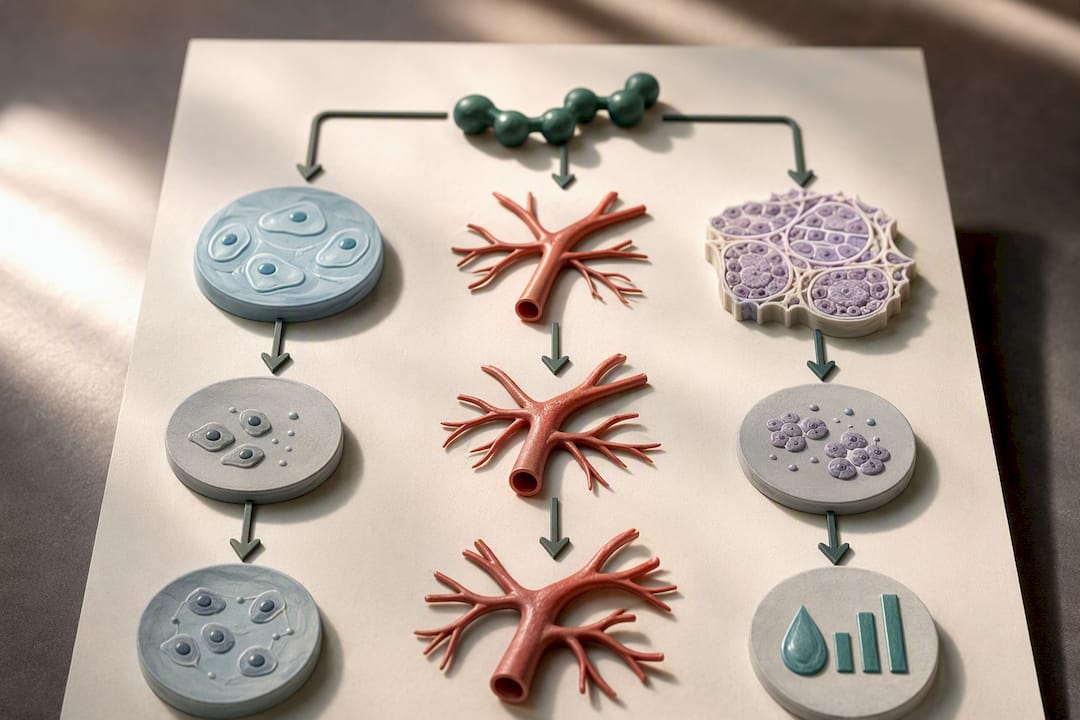
Chondrocytes. Huang et al.'s work in expanded human chondrocytes showed clear reductions in senescence markers after FOXO4-DRI exposure. What it did not clearly demonstrate was that clearing senescent chondrocytes on its own restores cartilage-forming capacity. That distinction is worth sitting with if you're designing a cartilage repair study built on this peptide.
Endothelial cells. The 2026 Frontiers study found reduced senescent cell burden in endothelial populations alongside improved vasodilation and aortic function metrics in aged mice. This is one of the stronger functional pairings in the literature, since a vascular measurement is harder to attribute to a placebo-like artifact than a marker readout alone.
Leydig cells and testes. Zhang et al. reported decreased senescence markers in testicular interstitial tissue and a measurable improvement in the testicular microenvironment, with aged mice showing higher serum testosterone after treatment. This remains the clearest hormonal endpoint tied to FOXO4-DRI administration in any published study.
Fibroblasts and keloid tissue. Kong et al.'s 2025 work demonstrated selective apoptosis of senescent fibroblasts in keloid organ cultures, raising a genuinely underexplored application: using FOXO4-DRI to reduce recurrence risk after keloid excision by targeting the senescent fibroblast population thought to drive re-scarring.
Systemic mouse phenotypes. Baar's original 2017 paper remains the broadest functional dataset, with treated mice showing improved fur density, better renal markers, and increased physical activity relative to controls. It's the only study in this group that assessed multiple organ systems in the same animals simultaneously.
- Chondrocytes: marker clearance confirmed; functional cartilage recovery not established.
- Endothelial cells: marker clearance plus aortic function improvement.
- Leydig/testes: marker clearance plus serum testosterone increase.
- Keloid fibroblasts: selective apoptosis with potential anti-recurrence application.
- Systemic (mouse): multi-organ functional improvement in the founding study.
Safety Data and Translational Gaps in FOXO4-DRI Research
No published human clinical trials of FOXO4-DRI exist as of 2026, and no regulatory body has approved it for any clinical indication. Every result described above comes from cell culture or mouse models.
The animal studies that do exist report limited safety panels, generally liver and kidney function markers (ALT, AST, BUN) alongside basic histology. That's useful information, but it's a narrow slice of what a full toxicology workup would need to cover, and it says nothing about long-term or repeated-dose effects in a human system.
Several gaps stand between the current evidence and any clinical application:
- Human pharmacokinetics and pharmacodynamics. Absorption, distribution, metabolism, and clearance in humans are unknown; mouse dosing regimens don't automatically scale.
- Biodistribution to target tissues. Whether FOXO4-DRI reaches senescent cells in human joints, vasculature, or gonadal tissue at effective concentrations has not been mapped.
- Immunogenicity. D-amino acid peptides can be recognized differently by the immune system than natural L-peptides, and this hasn't been systematically studied for FOXO4-DRI.
- Repeated-dose and cancer-context effects. Because p53 is a tumor suppressor, any peptide that manipulates its localization deserves scrutiny in cancer models before broader use, particularly around whether repeated dosing carries unintended consequences in tissues with pre-malignant cells.
Pro Tip: If your research program is moving toward in vivo work, budget for GLP-style toxicology and an immunogenicity panel before you plan biodistribution studies. Skipping straight to efficacy endpoints without those safety layers is the most common reason preclinical peptide programs stall at the translational stage.
The honest summary: FOXO4-DRI is a well-characterized senolytic tool at the bench, and an unproven one anywhere near a clinic.
Sourcing Research-Grade FOXO4-DRI for Reproducible Results
Reproducibility problems in senolytic peptide research often trace back to reagent quality rather than experimental design. Peptastic Labs addresses this by independently testing its research-grade peptide catalog, verifying purity at 99% or higher via HPLC across more than 22 compounds. Quality control runs through sourcing checks, in-house verification, and third-party confirmation, with extensive batch documentation kept on file. Certificates of Analysis are available on request, giving researchers a paper trail to match against their own assay results.
Peptastic Labs also publishes technical breakdowns of peptide research data, including analysis of AOD-9604 fat loss mechanisms and clinical findings such as Tesamorelin's reported 27.7 cm² visceral adipose tissue reduction at six months, reflecting the kind of data literacy that matters when interpreting senolytic peptide studies.
Before placing an order for any research peptide, request:
- HPLC trace confirming purity
- Mass spectrometry (MS) confirmation of identity
- Certificate of Analysis (COA)
- Endotoxin testing results
- Storage and handling recommendations
- Suggested reconstitution solvent and concentration ranges
What FOXO4-DRI Research Still Needs to Answer
FOXO4-DRI is one of the cleaner mechanistic probes available for studying p53-dependent senescence, and that's precisely what it should be treated as right now, not a clinical candidate in waiting. The selectivity data across chondrocytes, endothelial cells, Leydig cells, and fibroblasts is genuinely convincing at the mechanistic level.
What the field needs next isn't more marker-clearance papers. It's GLP toxicology, biodistribution mapping, and immune-response studies, paired with standardized functional endpoints that actually connect senescent-cell death to tissue recovery rather than assuming one implies the other. A multi-lab consortium approach, using consistent reagent quality controls across sites, would do more for this field's credibility than another single-lab mouse study ever could.
— Tintastic
Where to Get Research-Grade Peptides for Senescence Studies
Reagent variability is one of the quieter reasons published senolytic results are hard to replicate across labs. Peptastic Labs supplies HPLC-verified, research-grade peptides across metabolic, cognitive, tissue repair, and longevity categories, with Certificates of Analysis and full batch documentation available on request.

Ordering starts with matching the compound to your protocol and requesting the documentation set that lets you reproduce, or directly compare against, published assay conditions: HPLC trace, MS confirmation, COA, and endotoxin testing. Researchers working on senescence and tissue-repair models can browse the full peptide catalogue or review documentation practices on individual product pages such as BPC-157. All products are intended for laboratory research use only and are not for human administration. If your protocol calls for a specific purity threshold or batch history, request the COA before your next order to keep your reagent documentation aligned with your data.
This article is general information, not a substitute for advice from a qualified doctor. Consult a qualified healthcare professional about your own circumstances before acting on anything here.
Sources
- Senolytic Peptide FOXO4-DRI Selectively Removes Senescent Cells From in vitro Expanded Human Chondrocytes
- FOXO4-DRI induces keloid senescent fibroblast apoptosis by promoting nuclear exclusion of upregulated p53-serine 15 phosphorylation
- PubMed record for FOXO4-DRI (chemical and identifier data)
FAQ
What are the benefits of FOXO4-DRI peptide in research settings?
Published preclinical data associate FOXO4-DRI with selective clearance of senescent cells and, in several mouse models, functional improvements including increased serum testosterone, improved aortic function, and better renal markers. These effects are documented in cell and animal studies only, with no human clinical data available.
What is the difference between FOXO4-DRI and FOXO4?
FOXO4 is the natural transcription factor that accumulates in senescent cells and sequesters p53 to block apoptosis. FOXO4-DRI is a synthetic D-retro-inverso peptide engineered to competitively displace that interaction, pushing p53 toward the mitochondria to trigger cell death instead of survival.
Is there a supplement that clears senescent cells from the body?
No over-the-counter supplement has published clinical evidence showing it clears senescent cells in humans the way FOXO4-DRI does in preclinical models. Compounds studied for senolytic activity, including FOXO4-DRI, remain confined to laboratory and animal research as of 2026.
Can senescent cells be reduced naturally without peptides?
Lifestyle factors such as exercise and caloric restriction have been associated with lower senescent-cell burden in some studies, but these effects are modest compared with the selective apoptosis reported for targeted senolytic peptides in cell and mouse models. No natural method has been shown to replicate the FOXO4–p53 disruption mechanism specifically.
Where can researchers source FOXO4-DRI for laboratory studies?
Researchers should source FOXO4-DRI from suppliers that provide HPLC verification, mass spectrometry confirmation, and a Certificate of Analysis, such as the peptides available through Peptastic Labs, to ensure reagent purity matches published experimental conditions.