
A metabolic peptide study protocol is defined as a pre-specified, hypothesis-driven document that maps targeted metabolic endpoints to compound selection, dosing, controls, and material documentation before a single animal is enrolled. The standard industry term for this process is experimental protocol design, and researchers working in GLP-1 signaling, adipose metabolism, or mitochondrial function need it to produce reproducible, mechanistic data. Getting this right requires more than a dosing schedule. It demands endpoint specificity, statistically powered group structures, confounder control, and verified materials. This article covers each layer in sequence, with practical guidance drawn from current metabolic peptide research guidelines.
How to design a metabolic peptide study protocol: start with endpoints
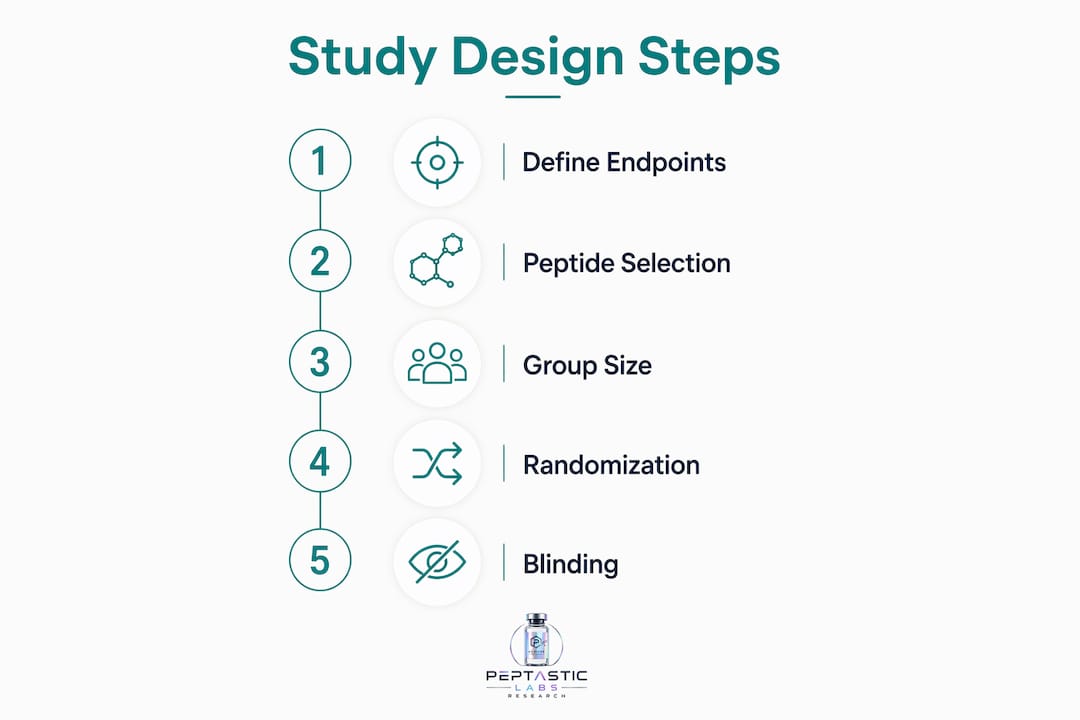
The single most common failure in peptide study design is selecting a compound before defining the endpoint. Endpoint definition before sourcing ensures experimental design follows the hypothesis rather than supplier marketing. That distinction matters because it determines which assays you run, which controls you need, and which statistical tests apply.
Metabolic endpoints fall into distinct families, and each one demands a different measurement strategy:
- GLP-1 receptor signaling: Insulin secretion, C-peptide levels, glucagon suppression, gastric emptying rate
- Adipose metabolism: Depot-specific fat mass, adipocyte size, lipolysis markers, adiponectin
- Mitochondrial function: Oxygen consumption rate, ATP production, citrate synthase activity
- Appetite regulation: Caloric intake, meal frequency, hypothalamic neuropeptide expression
Weight loss alone is too broad and can mislead conclusions. A peptide that reduces body weight through appetite suppression tells a completely different mechanistic story than one that drives fat oxidation directly. Conflating these endpoints produces data that cannot be interpreted cleanly.
Peptide selection follows endpoint selection, not the reverse. For GLP-1 receptor studies, semaglutide is the established reference compound. For dual incretin work, tirzepatide activates both GLP-1 and GIP receptors, making it the appropriate positive control when both pathways are under investigation. Matching the compound's mechanism of action to your endpoint family is the core logic of sound peptide study design.

Pro Tip: Write your primary claim sentence before you finalize peptide selection. If you cannot state the mechanism you expect to confirm in one sentence, your endpoint is not specific enough.
What experimental design elements does a metabolic study protocol require?
Statistically powered group sizes are non-negotiable. Rodent studies require 8–12 animals per group, and non-human primate studies require 3–6, based on power analysis targeting 80% power at alpha = 0.05. These numbers assume moderate effect sizes typical of metabolic peptide interventions. Smaller groups produce underpowered studies that cannot detect real effects or confirm null results with confidence.
Dose selection follows a structured logic. At least 3 distinct dose levels spanning a minimum 10-fold range between the no-observed-adverse-effect level (NOAEL) and the maximum tolerated dose are required to characterize a dose-response relationship. Standard titration schedules for metabolic peptides often start at 0.25 mg/wk and escalate to 2.4 mg/wk maintenance over 4 weeks, with study durations of at least 12 weeks to capture chronic metabolic adaptation.
Control group structure defines the internal validity of the entire study. A well-designed metabolic protocol includes:
- Vehicle control: Same injection volume, frequency, and route as treated groups, using the reconstitution vehicle only
- Sham control: Handles all procedural stress without injection, isolating handling effects
- Positive control: An established compound with a known effect size at the endpoint of interest
- Pair-fed control: Matched caloric intake to the highest-dose group, separating appetite-driven weight change from direct metabolic effects
Randomization must occur at the individual animal level, not the cage level. Randomization at the cage level without accounting for clustering inflates apparent sample size and produces false positives. Analyze clustered data with mixed-effects models that treat cage as a random effect.
Blinding in peptide injection studies is genuinely difficult. Visible pharmacological effects such as nausea, injection site reactions, or rapid weight loss can reveal treatment assignment to handlers. The practical solution is a placebo run-in period before randomization, combined with matching injection appearance across all groups. Assign a separate team member to prepare syringes and keep dose assignment masked from the assessors recording endpoints.
Pro Tip: Build a comparison table of your control arms before finalizing the protocol. If you cannot explain what each control isolates, you are missing a control.
| Control type | Variable isolated | When required |
|---|---|---|
| Vehicle | Reconstitution vehicle effects | Always |
| Sham | Handling and injection stress | Injection studies |
| Positive control | Assay sensitivity and effect size reference | All dose-response studies |
| Pair-fed | Caloric intake vs. direct metabolic effect | Weight or adipose endpoints |
How do you control confounders in a metabolic peptide protocol?
Confounders in metabolic research are not edge cases. They are the default condition. Food intake, locomotor activity, hydration status, circadian timing of dosing, and handling stress all affect metabolic endpoints independently of the peptide under study. Failing to document and control these variables produces results that cannot be attributed to the compound.
Body composition endpoints must distinguish fat mass, lean mass, water balance, and depot-specific tissues to support credible metabolic claims. DEXA scanning quantifies total fat and lean mass non-invasively at multiple time points. MRI provides depot-specific fat distribution, separating visceral from subcutaneous adipose. Adipocyte histology from tissue harvest confirms cellular-level changes in fat depots. Using only body weight as the outcome variable is insufficient for any mechanistic claim.
Sampling frequency and timing matter as much as the assay itself. Glucose tolerance tests require a defined fast duration, a fixed glucose dose per body weight, and blood draws at standardized time points (0, 15, 30, 60, 120 minutes). Collecting samples outside these windows produces area-under-curve values that cannot be compared across animals or studies.
Pair-fed controls are the most underused tool in metabolic peptide research. Without them, you cannot separate a peptide's direct metabolic action from the downstream effects of eating less. Every study claiming a direct effect on fat oxidation or insulin sensitivity without a pair-fed arm is making an inference the data cannot support.
Behavioral monitoring closes the loop on locomotor confounders. Automated home-cage activity systems record movement continuously without handler interference. A peptide that reduces body weight partly by reducing locomotion produces a different metabolic profile than one that preserves activity while reducing fat mass. Both outcomes are scientifically interesting. Only one supports a claim about direct metabolic action.
What documentation standards apply to research-grade peptide materials?
Material documentation is the reproducibility layer of any metabolic study protocol. Inadequate documentation of purity, salt form, and reconstitution vehicles is a primary cause of replication failures in the peptide literature. Systematic reviews consistently flag underreporting of these variables as a barrier to cross-study comparison.
A complete material record for each lot used in a study includes:
- Identity confirmation: Sequence verification or mass spectrometry confirmation matching the expected molecular weight
- Purity by HPLC: Research-grade peptides require ≥99% purity. Values below this threshold introduce unknown impurities that confound dose-response interpretation
- Salt form: Acetate and trifluoroacetate salts differ in bioavailability and can affect pH at the injection site
- Batch number and lot-specific COA: Batch-level Certificate of Analysis review covering identity, purity, fill, and storage conditions is standard best practice for reproducibility
- Reconstitution vehicle: Document solvent, concentration, pH, and any co-solvents used
- Stability data: Record storage temperature, freeze-thaw cycle limits, and in-use stability at dosing temperature
Peptasticlabs provides HPLC-verified compounds at ≥99% purity with lot-specific Certificates of Analysis available on request. That level of documentation satisfies the material record requirements above without additional third-party verification steps.
Pro Tip: Attach the COA as an appendix to the protocol document itself, not just to the final report. Reviewers and replication teams need it at the design stage, not after the fact.
Key Takeaways
A well-designed metabolic peptide study protocol requires endpoint-first thinking, statistically powered group structures, documented controls, and HPLC-verified materials at ≥99% purity.
| Point | Details |
|---|---|
| Define endpoints before selecting peptides | Endpoint specificity prevents generic outcomes and aligns compound choice with mechanism. |
| Power group sizes correctly | Use 8–12 rodents or 3–6 non-human primates per group at 80% power, alpha = 0.05. |
| Include pair-fed controls | Pair-fed arms separate direct metabolic effects from caloric restriction artifacts. |
| Document materials at the lot level | Record purity, salt form, reconstitution vehicle, and batch COA in the protocol itself. |
| Account for clustering in analysis | Use mixed-effects models when animals are housed in cages to avoid false positives. |
What I have learned from designing these protocols
The most consistent mistake I see in metabolic peptide protocols is endpoint drift. A study starts with a clear hypothesis about GLP-1-mediated insulin secretion, and by the time the data is collected, the team is reporting body weight as the primary outcome because the glucose data was noisy. That is not a scientific conclusion. That is a post-hoc pivot.
Writing the claim and methods paragraph before reviewing results is the single most effective discipline I know for preventing this. If your primary claim is written and locked before unblinding, you cannot retroactively promote a secondary endpoint to primary status. Reviewers notice. Replication teams notice even faster.
Pilot studies are undervalued and underused. A two-week pilot with four animals per group tells you whether your assay has the dynamic range to detect the effect size you expect. It also tells you whether your reconstitution vehicle is stable at dosing temperature and whether your blinding procedure holds under real conditions. Running a full study without a pilot is a resource gamble that rarely pays off.
The living document approach to protocol management is worth adopting. Every amendment, every deviation, and every lot change gets logged with a date and a rationale. That record becomes the audit trail that makes your final report defensible. Protocols that exist only as a static PDF at study start are missing the operational layer that reviewers and ethics boards increasingly expect.
— Tintastic
Peptasticlabs: research-grade materials for metabolic protocol design
Researchers who have invested in rigorous endpoint definition and experimental controls need materials that match that standard.

Peptasticlabs supplies research-grade metabolic peptides verified to ≥99% purity by HPLC, with lot-specific Certificates of Analysis available on request. The catalog covers compounds aligned with GLP-1 signaling, adipose metabolism, and mitochondrial function endpoints. Each batch includes full COA documentation covering identity, purity, salt form, and storage conditions. That traceability satisfies the material record requirements that reproducible metabolic research demands. Researchers can review available compounds and documentation at peptasticlabs.com.
FAQ
What is a metabolic peptide study protocol?
A metabolic peptide study protocol is a pre-specified document defining endpoints, compound selection, group structure, dosing, controls, and material documentation before study initiation. It ensures reproducible, mechanistic metabolic research data.
How many animals are needed per group in a metabolic peptide study?
Rodent studies require 8–12 animals per group and non-human primate studies require 3–6, based on power analysis at 80% power and alpha = 0.05.
Why is purity ≥99% by HPLC required for research peptides?
Purity below ≥99% introduces uncharacterized impurities that confound dose-response data and make results impossible to replicate. HPLC verification at the lot level is the accepted standard for research-grade compounds.
What controls are required in a metabolic peptide protocol?
A complete control structure includes a vehicle control, a sham control, a positive control, and a pair-fed control. Each arm isolates a specific variable, and omitting any one of them limits the mechanistic claims the data can support.
How do you handle blinding in peptide injection studies?
Blinding in injection studies is supported by matching injection appearance across all groups, using a placebo run-in period, and assigning separate personnel to dose preparation and endpoint assessment.