A fully auditable peptide research workflow requires a 15-step protocol, instrument parameter templates, and a FAIR-ready documentation package that makes every synthesis and analysis decision traceable and citable. This article delivers all three.
What you will have after reading:
- A 15-step numbered protocol covering synthesis through archiving
- Reagent and instrument parameter templates ready to adapt
- A QA/validation checklist with acceptance criteria
- A data-report template for peptide ID, PTMs, and quantification
- An inspectable research packet structure for DOI-ready archiving
Have ready before starting:
- Resin (Rink amide or Wang, depending on C-terminus requirement)
- Coupling reagents: DIC/OxymaPure or HATU/DIPEA
- TFA cleavage cocktail with appropriate scavengers (water, triisopropylsilane, thiol additives)
- Reversed-phase HPLC and LC-MS/MS system
- Data analysis software (e.g., Protein Metrics Byonic or equivalent search engine)
- Documentation repository: protocols.io for DOI assignment
- Research-grade peptides or starting materials from a verified supplier such as Peptasticlabs
Table of Contents
- What a peptide research workflow covers and when to use it
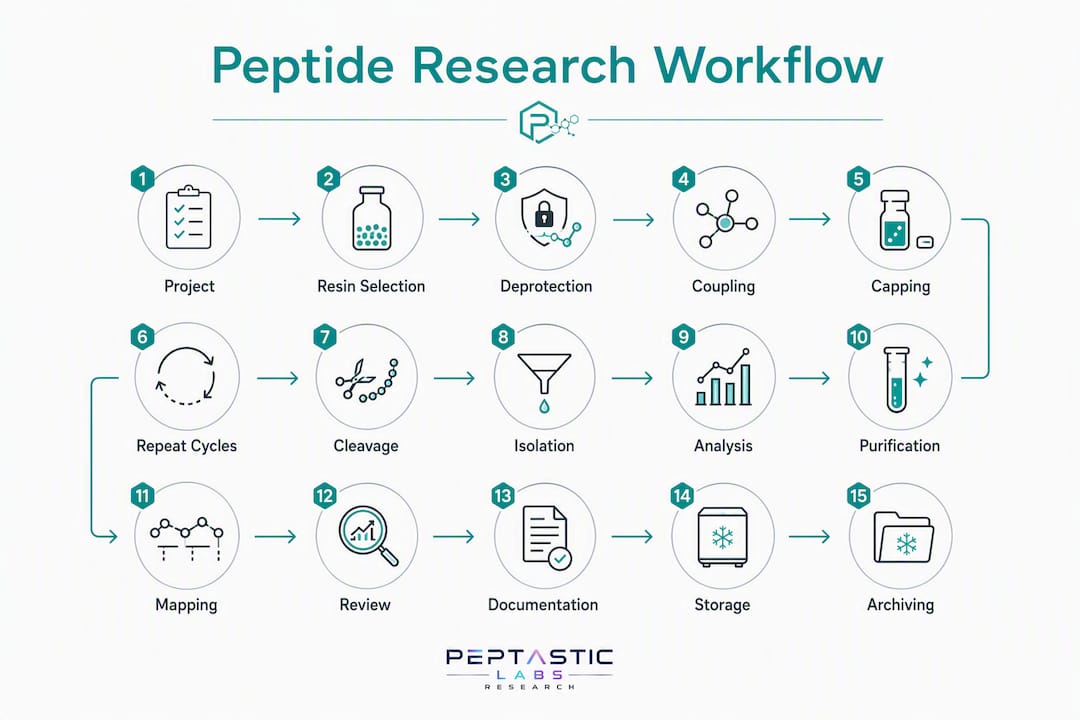
- How to document a peptide research workflow: 15 ordered steps
- LC-MS/MS peptide mapping: instrument parameters and system suitability
- From raw spectra to results: analysis pipeline and report templates
- QA/QC, validation, and traceability for research-grade peptides
- Making your workflow FAIR, citable, and auditable
- Troubleshooting common synthesis, purification, and LC-MS issues
- Key Takeaways
- Documentation is the experiment, not the afterthought
- Peptasticlabs: research-grade peptides with full batch documentation
- Useful sources to consult next
What a peptide research workflow covers and when to use it
A peptide research workflow is the ordered set of laboratory procedures, documentation checkpoints, and analytical steps that take a project from sequence design to a citable, reproducible data package. The term "workflow" here is distinct from process-scale manufacturing: this protocol targets small- to mid-length peptides (typically 5–40 residues) synthesized by solid-phase peptide synthesis (SPPS), characterized by LC-MS/MS peptide mapping, and documented for research-stage reproducibility.
Use this protocol when:
- Running SPPS-based synthesis for research-grade material
- Performing peptide mapping or LC-MS/MS characterization
- Preparing a reproducible data package for publication or internal audit
- Onboarding a new team member to a standardized synthesis-and-analysis pipeline
Not the right fit for: native chemical ligation of very long sequences, process-scale GMP manufacturing, or purely informatics-only studies with no wet-lab component.
Expected deliverables:
- Crude analysis report (HPLC trace + MS confirmation)
- Purified material meeting the project-defined purity threshold
- CoA-style data package with lot number, purity, and identity confirmation
- Versioned, citable protocol with DOI
Prerequisites: Access to an SPPS synthesizer or manual synthesis setup, a reversed-phase HPLC system, an LC-MS or LC-MS/MS instrument, and a documentation repository. Workflow documentation best practices recommend assigning a named owner to each workflow and scheduling periodic reviews so the protocol stays current.
Pro Tip: Separate your process documentation (the strategic "why" behind decisions) from your workflow documentation (the tactical "how" with owners and handoffs). Combining them creates cluttered guides that researchers stop consulting.
How to document a peptide research workflow: 15 ordered steps
Each step below includes its goal, critical materials, key parameters, responsible role, expected output, and a time estimate. Adapt parameters to your instrument and sequence before use.
Step 1: Project definition and sequence design
Goal: Lock the target sequence, purity specification, and end-use before ordering materials. Materials: Sequence analysis tool (e.g., ExPASy ProtParam), project brief template. Parameters: Confirm molecular weight, isoelectric point, hydrophobicity index. Owner: Principal investigator or project lead. Output: Signed project brief with sequence, purity target, and intended assay. Time: 0.5–1 day.
Step 2: Resin selection and loading
Goal: Choose resin chemistry matched to the required C-terminus (amide vs. free acid). Materials: Rink amide MBHA resin (C-terminal amide) or Wang resin (C-terminal acid); DMF for swelling. Parameters: Loading: 0.2–0.7 mmol/g; swell resin 30 min in DMF before use. Owner: Synthesis technician. Output: Swelled, loaded resin; recorded lot number and loading value. Time: 1–2 hours.
Step 3: Fmoc deprotection cycles
Goal: Remove the Fmoc protecting group before each coupling cycle. Materials: 20% piperidine in DMF. Parameters: Two treatments: 5 min + 15 min; wash 3× with DMF after each treatment. Owner: Synthesis technician. Output: Free amine confirmed by UV absorbance of dibenzofulvene-piperidine adduct at 301 nm. Time: 30–45 min per cycle.
Step 4: Amino acid coupling
Goal: Form the peptide bond with high per-step efficiency. Coupling yield compounds multiplicatively across a long sequence, so small drops in per-step efficiency dramatically reduce final crude yield. Materials: Fmoc-amino acid (3–5 equiv), DIC/OxymaPure or HATU/DIPEA. Parameters: Typical coupling times and reagent quantities, optimized for efficient peptide bond formation, adjusted per protocol Owner: Synthesis technician. Output: Coupling confirmed by Kaiser (ninhydrin) or TNBS test; negative result = complete coupling. Time: 1–2 hours per residue.
Step 5: Capping decision
Goal: Decide whether to cap unreacted amines with acetic anhydride/DIPEA. Materials: Acetic anhydride (5% v/v in DMF), DIPEA. Parameters: 5–10 min contact time if capping is applied. Owner: Project lead (strategic decision, not default). Output: Documented decision: cap or no-cap, with rationale recorded in the protocol log. Time: 10–15 min if applied.
Pro Tip: Capping is a strategic choice, not a default: it produces cleaner deletion profiles but generates truncated by-products that complicate purification. For sequences where full-length yield is the priority, high-efficiency coupling reagents and rigorous monitoring are often preferable to capping.
Step 6: Repeat deprotection-coupling cycles
Goal: Iterate Steps 3–5 for each residue until the full sequence is assembled. Materials: All Fmoc-amino acids in sequence order; Kaiser test reagents. Parameters: Monitor every 5th coupling (or every coupling for difficult sequences); document pass/fail per residue. Owner: Synthesis technician. Output: Completed resin-bound peptide; coupling log with test results per residue. Time: Variable; 1–3 days for a 15–30 residue peptide.
Step 7: Cleavage and global deprotection
Goal: Release the peptide from resin and remove side-chain protecting groups. Materials: TFA 90–95%, with scavengers matched to the side-chain protecting groups present: water, triisopropylsilane (TIS), and thiol additives (e.g., ethanedithiol for Met/Cys-containing sequences). Parameters: 2–4 hours at room temperature; filter resin; collect filtrate. Owner: Synthesis technician. Output: Crude peptide in TFA solution; scavenger cocktail and rationale documented. Time: 3–5 hours including filtration.
Step 8: Precipitation and isolation
Goal: Isolate crude peptide by precipitation from cold diethyl ether. Materials: Cold diethyl ether (10× volume), centrifuge. Parameters: Centrifuge at 3,000–4,000 × g, 10 min, 4°C; wash pellet 2–3× with cold ether. Owner: Synthesis technician. Output: Dried crude peptide pellet; mass recorded. Time: 1–2 hours.
Step 9: Crude analysis
Goal: Confirm identity and estimate purity before committing to purification. Materials: Analytical HPLC (C18 column), LC-MS (single quadrupole or TOF). Parameters: Gradient range optimized for peptide purification by reversed-phase HPLC; UV at 214 nm and 254 nm. Owner: Analytical chemist. Output: Crude HPLC trace, MS confirmation of [M+H]⁺ or [M+2H]²⁺; purity estimate. Time: 2–4 hours.
Step 10: Purification
Goal: Achieve target purity by preparative reversed-phase HPLC. Materials: Preparative C18 column (e.g., 10 × 250 mm, 10 µm), UV fraction collector. Parameters: Gradient optimized from analytical run; collect fractions at ≥95% purity (or project threshold); pool criteria and any repurification of side fractions must be defined and documented. Owner: Analytical chemist. Output: Purified fractions; pooling decision log; lyophilized material with mass. Time: 1–2 days.
Step 11: Peptide mapping by LC-MS/MS
Goal: Confirm sequence coverage, identify PTMs, and generate the primary characterization dataset. Materials: Trypsin or Lys-C (sequencing grade), reduction/alkylation reagents (DTT, iodoacetamide), LC-MS/MS system. Parameters: See Section 4 for full instrument parameter table. Owner: Mass spectrometry analyst. Output: Raw .raw/.wiff/.d files; peptide map with sequence coverage ≥80%; PTM table. Time: 1–2 days including sample prep.

Step 12: Data review and acceptance criteria check
Goal: Confirm the dataset meets release criteria before batch documentation is finalized. Materials: Data analysis software (Protein Metrics Byonic or equivalent), Sigma-Aldrich application notes as method references. Parameters: Purity ≥95% by HPLC; identity confirmed by ≥2 orthogonal methods per EMA guidance; mass accuracy ≤5 ppm for high-resolution MS. Owner: Project lead + analyst. Output: Signed acceptance checklist; pass/fail decision recorded. Time: 4–8 hours.
Step 13: Batch documentation
Goal: Compile the complete batch record for traceability and archiving. Materials: Batch record template (see Section 6), electronic lab notebook (ELN) or LIMS. Parameters: Record: lot number, operator, dates, reagent lot numbers, instrument IDs, raw data file names, protocol version and DOI. Owner: Project lead. Output: Completed batch record; CoA-style summary. Time: 2–4 hours.
Step 14: Storage
Goal: Preserve peptide stability under documented conditions. Materials: Lyophilized peptide, amber vials, desiccant. Parameters: Store at −20°C (short-term) or −80°C (long-term); record storage location, date, and conditions. Sterility and handling best practices apply throughout. Owner: Synthesis technician. Output: Labeled vials with storage log entry. Time: 1 hour.
Step 15: Archiving and protocol versioning
Goal: Archive raw data, batch record, and protocol version so the work is citable and reproducible. Materials: protocols.io account (for DOI assignment), institutional data repository or ELN. Parameters: Assign DOI to the protocol; link raw data files to the batch record; record protocol version number and date. Owner: Project lead. Output: DOI-linked protocol; archived batch record; citable data package. Time: 1–2 hours.
LC-MS/MS peptide mapping: instrument parameters and system suitability
For routine peptide mapping, the method below provides a starting point. Validate all parameters against your specific instrument and column before use.
| Parameter | Recommended Range | Notes |
|---|---|---|
| Use a C18 column with suitable particle size and temperature for peptide separation | ||
| Use LC-MS grade aqueous mobile phase with acid modifier | ||
| Use LC-MS grade organic mobile phase with acid modifier | ||
| Typical gradient conditions appropriate for peptide hydrophobicity range | ||
| Flow rate | 0.2 mL/min | Nano-LC: 0.5 µL/min |
| MS resolution | high resolution FWHM (Orbitrap/Q-TOF) | For high-confidence PTM assignment |
| Fragmentation | HCD (~30% NCE) or CID | HCD preferred for phospho and glyco PTMs |
| Dynamic exclusion | 20–30 s | Reduces redundant precursor selection |
| Mass accuracy | ≤5 ppm (MS1); ≤10 ppm (MS2) | Calibrate before each sequence |
| Scan range | m/z range optimized for peptide detection | Adjust for peptide MW range |
System suitability checklist (run before each analytical sequence):
- Retention time of reference standard within ±0.5 min of historical mean
- MS1 mass accuracy ≤5 ppm on calibration compound
- Signal-to-noise ratio ≥10 for lowest-concentration standard
- Injection-to-injection CV ≤5% for peak area of reference peptide
- Blank injection shows no carryover above 0.1% of standard signal
Pro Tip: Minimize in-solution artifact formation by keeping denaturation (6 M guanidine-HCl or 8 M urea, 56°C, 30 min) and alkylation (55 mM iodoacetamide, 45 min, dark) steps tightly timed. Extended alkylation generates over-alkylation artifacts that appear as false PTMs in database searches.
From raw spectra to results: analysis pipeline and report templates
Follow this minimal pipeline for reproducible peptide ID and PTM calls: database search → FDR filtering → manual validation of key identifications → quantification → structured report.
Parameters to document for every search:
- Search engine and version (e.g., Protein Metrics Byonic version number)
- Database used (UniProt accession, date downloaded)
- Enzyme specificity and missed cleavages allowed
- Fixed modifications (e.g., carbamidomethyl Cys) and variable modifications searched
- Precursor and fragment mass tolerance (ppm or Da)
- FDR threshold (typically 1% at peptide level)
- Score cutoff applied post-search
Sigma-Aldrich application notes for tryptic digestion and peptide mapping provide reference method parameters that can anchor your search settings and serve as a cited comparator in your methods section.
Compact report template:
| Report Section | Minimum Content |
|---|---|
| Methods | Instrument model, column, gradient, search engine, database, modifications, FDR |
| Peptide ID table | Sequence, charge, m/z observed, mass error (ppm), score, modifications |
| PTM table | Site, modification type, localization score, supporting fragment ions |
| Sequence coverage map | Visual map with covered peptides highlighted |
| Chromatograms | Base peak chromatogram + extracted ion chromatogram for key peptides |
| Raw data pointer | File names, instrument, acquisition date, repository path or DOI |
| Quantification | Method (label-free, TMT, or spectral counting), normalization approach, CV |
Visualization guidance: Include a sequence coverage map, a mass error distribution plot (should be centered near 0 ppm), and a score histogram showing the FDR cutoff. For PTM studies, add a site-localization probability plot. These four plots give reviewers immediate confidence in identification certainty without requiring them to re-examine raw spectra.
QA/QC, validation, and traceability for research-grade peptides
The direct answer: document every critical step, apply in-process controls at coupling and deprotection, and confirm final identity by at least two orthogonal analytical methods when preparing materials for regulated or translational contexts.
Validation checklist:
- Kaiser or TNBS test at each coupling cycle (or every 5th for routine sequences)
- UV monitoring of Fmoc deprotection (dibenzofulvene adduct at 301 nm)
- System suitability run before each analytical sequence
- Crude purity estimate before committing to preparative purification
- Final purity confirmed by analytical HPLC meeting project-defined criteria
- Identity confirmed by accurate mass spectrometry plus at least one orthogonal analytical method
- Report impurities above the defined detection threshold according to project standards
- Pooling and repurification decisions documented with clearly defined acceptance criteria
Regulatory context: The EMA guideline on synthetic peptides places structural verification under Section 3.2.S.3.1 and lists mass spectrometry, peptide mapping, amino acid analysis, NMR, and relative retention time as acceptable orthogonal methods. For research-stage work, two methods (MS + HPLC purity) typically suffice; for IND-enabling or filing contexts, consult the full guideline.
Acceptance criteria and CoA-minimum evidence:
| Parameter | Acceptance Criterion | Minimum Evidence in CoA |
|---|---|---|
| Identity | Accurate mass within ≤5 ppm of theoretical | MS spectrum + [M+H]⁺ or [M+2H]²⁺ confirmed |
| Purity | ≥95% by RP-HPLC (or project threshold) | HPLC chromatogram + area% table |
| Orthogonal ID | ≥2 methods when required | Second method report (e.g., AAA or NMR) |
| Impurities | All peaks ≥0.1% area reported | HPLC trace with integration table |
| Moisture/counterion | Reported if relevant to formulation | Karl Fischer or ion chromatography result |
Traceability template (per batch):
- Batch/lot number and date of synthesis
- Operator name and role
- Reagent lot numbers (resin, amino acids, coupling reagents, scavengers)
- Instrument IDs and calibration dates
- Raw data file names and storage path
- Protocol version number and DOI
- Acceptance checklist sign-off with date
For guidance on interpreting purity standards and building CoA documentation, the Peptasticlabs resource library covers both topics in detail.
Making your workflow FAIR, citable, and auditable
A combined package, protocol plus evidence log plus decision ledger plus raw data pointers, makes research FAIR (Findable, Accessible, Interoperable, Reusable) and auditable by any reviewer or collaborator.
Inspectable research packet template (adapted from structured research workflow best practices):
- Protocol (versioned): Step-by-step procedure with version number, author, date, and DOI
- Source log: Raw data file names, instrument IDs, acquisition dates, repository paths
- Claim ledger: Key assertions (e.g., "purity ≥95%") linked to the specific evidence file supporting each
- Decision log: Human judgment calls (capping decision, pooling criteria, repurification rationale) with the reasoning recorded
- Validation artifacts: Acceptance checklist, system suitability records, coupling test results
Assigning a DOI to your protocol: Upload the versioned protocol to protocols.io, which assigns a citable DOI and preserves the method long-term. Place the DOI in three locations: the batch record, the methods section of any resulting publication, and the file metadata of the raw data archive.
Versioning checklist:
- Increment version number for any change to reagents, parameters, or sequence of steps
- Record who made the change, who approved it, and the date
- Link each batch record to the exact protocol version used (by DOI or version number)
- Archive superseded versions; never delete them
Pro Tip: For complex informatics steps, embed a short screen-capture walkthrough (60–90 seconds) directly in the protocol record on protocols.io. Annotated screenshots or brief videos reduce interpretation drift when a new analyst inherits the workflow months later.
Workflow documentation is most effective when treated as a living tool that mixes formats: step-by-step text for procedural clarity, decision diagrams for branching logic, and video for instrument-specific operations. Best practices consistently recommend keeping documentation accessible within the flow of work rather than in a separate, rarely-consulted archive.
Troubleshooting common synthesis, purification, and LC-MS issues
The fastest fixes are reagent verification, simple system checks, and rerunning the relevant in-process monitoring test before escalating to sequence redesign.
Common issues and immediate checks:
- Low coupling yield (positive Kaiser test): Verify reagent freshness; repeat coupling with fresh reagent; increase equivalents or switch from DIC/OxymaPure to HATU for difficult couplings
- Unexpected mass in crude analysis: Check scavenger cocktail against side-chain protecting groups; look for incomplete deprotection or side reactions (aspartimide, oxidation)
- Poor MS signal in peptide mapping: Check desalting efficiency (C18 StageTip or SPE cartridge); verify injection solvent compatibility (avoid high organic at injection)
- High background in HPLC trace: Check mobile phase quality; run blank injection; inspect column for contamination
- Low sequence coverage in peptide map: Extend digestion time; add a second enzyme (Lys-C + trypsin); check for missed cleavages in search parameters
| Symptom | Probable Cause | Immediate Action |
|---|---|---|
| Positive Kaiser after coupling | Incomplete coupling | Repeat coupling; increase reagent equivalents |
| Mass +14 Da on product | Methylation side reaction | Check reagent purity; replace DMF (peroxide-free) |
| Mass −18 Da on Asp-containing peptide | Aspartimide formation | Add 0.1 M HOBt to deprotection; consider backbone protection |
| Broad HPLC peak | Aggregation or incomplete dissolution | Sonicate sample; add 10% DMSO to dissolution solvent |
| No MS signal | Suppression from salts | Repeat desalting; reduce injection volume |
| Retention time drift >0.5 min | Column degradation or mobile phase change | Run system suitability standard; replace mobile phase |
Persistent aspartimide formation (mass −18 Da on Asp-containing peptides) signals a sequence-level problem. If 0.1 M HOBt in the deprotection step does not resolve it, consider backbone amide protection (e.g., Hmb or Dmb) or sequence redesign before continuing synthesis.
Key Takeaways
A fully auditable peptide research workflow requires a numbered protocol, orthogonal identity confirmation, and an inspectable documentation packet archived with a DOI so every synthesis and analysis decision remains traceable and citable.
| Point | Details |
|---|---|
| Follow a numbered 15-step protocol | Cover synthesis through archiving; document reagent lots, parameters, and decisions at each step. |
| Confirm identity with orthogonal methods | Use ≥2 methods (e.g., accurate MS + RP-HPLC purity) per EMA guidance for regulated or translational contexts. |
| Archive with a DOI | Upload the versioned protocol to protocols.io; place the DOI in the batch record, publication methods, and raw data metadata. |
| Keep an inspectable research packet | Bundle protocol, source log, claim ledger, decision log, and validation artifacts for full auditability. |
| Source verified starting materials | Peptasticlabs supplies HPLC-verified, research-grade peptides with batch documentation and Certificates of Analysis on request, supporting reproducible documented studies. |
Documentation is the experiment, not the afterthought
The conventional view treats documentation as administrative overhead: something you complete after the real work is done. That framing is wrong, and it costs researchers reproducibility, publication credibility, and months of re-work.
The capping decision in Step 5 is a useful illustration. Many protocols list capping as a default step without recording the rationale. When a purification fails six months later and a new analyst inherits the project, the absence of a documented decision means the team cannot distinguish a deliberate choice from an oversight. The same logic applies to scavenger selection, pooling criteria, and FDR thresholds: each is a judgment call that shapes the result, and each needs a one-line entry in the decision log.
The payoff of treating documentation as a living tool is not just compliance. A well-maintained protocol with a DOI becomes a citable methods reference, which strengthens publications and accelerates peer review. A decision log reduces onboarding time for new analysts from weeks to days. A claim ledger makes it possible to answer a reviewer's question about a specific data point in hours rather than days of archive-digging.
One practical recommendation: assign a named protocol owner in every research group, set a quarterly review cadence, and require that any parameter change triggers a version increment with a one-line change note. That discipline costs almost nothing per experiment and compounds into a significant reproducibility advantage over a multi-year project.
Peptasticlabs: research-grade peptides with full batch documentation
Reproducible peptide research starts with verified starting materials. Peptasticlabs supplies independently tested, research-grade peptides, each verified to ≥95% purity by HPLC, with full batch documentation and Certificates of Analysis available on request. That documentation standard maps directly onto the traceability template in this protocol: lot numbers, purity data, and identity confirmation are already recorded so you can drop them into your batch record without additional testing overhead.
What Peptasticlabs provides for documented research workflows:
- Over 22 compounds across metabolic, cognitive, tissue repair, longevity, immunology, and cosmetic research categories
- HPLC-verified purity (≥95%) with third-party confirmation
- Batch documentation and Certificates of Analysis on request
- Bulk and wholesale options for multi-batch reproducibility studies
- Research support resources available at peptasticlabs.com/research
For researchers building a documented, auditable workflow, sourcing from a supplier whose own documentation meets the same traceability standard removes a significant variable. Review the full catalog and request batch documentation directly at peptasticlabs.com.
Useful sources to consult next
These sources back the key assertions in this protocol and are worth bookmarking for deeper reference.
-
EMA Guideline on the Development and Manufacture of Synthetic Peptides: Primary regulatory reference for orthogonal identity confirmation (Section 3.2.S.3.1), purification pooling criteria, and impurity reporting thresholds. Consult this before preparing IND-enabling or filing documentation.
-
protocols.io — DOI assignment for laboratory protocols: The standard platform for assigning citable DOIs to versioned protocols. Supports the archiving and versioning steps in this workflow (Steps 15 and the FAIR packet section).
-
Solid Phase Peptide Synthesis: A Complete Guide (peptidechemistry.org): Detailed reference for resin selection, coupling reagent choice, capping strategy trade-offs, and TFA cleavage scavenger selection. Backs Steps 2–7 of this protocol.
-
Peptide Synthesis — Wikipedia: Accessible overview of SPPS cycle mechanics and the compounding effect of per-step coupling yield on final crude yield. Useful for onboarding new team members to the efficiency rationale behind Steps 3–6.
-
Workflow Documentation Best Practices (Slack Blog): Covers mixed-format documentation (text, diagrams, video), ownership assignment, review cadence, and version control. Backs the living-protocol and versioning recommendations throughout this article.
-
USP Peptide Manufacturing Workflow Infographic: Visual overview of the full peptide manufacturing workflow from starting materials through drug substance testing and release. Useful as a reference map when aligning research-stage documentation with downstream manufacturing requirements.
Use the inspectable-packet template from Section 7 alongside these sources, and archive your protocol version and raw data together whenever possible. That combination is what makes peptide research genuinely reproducible and citable.