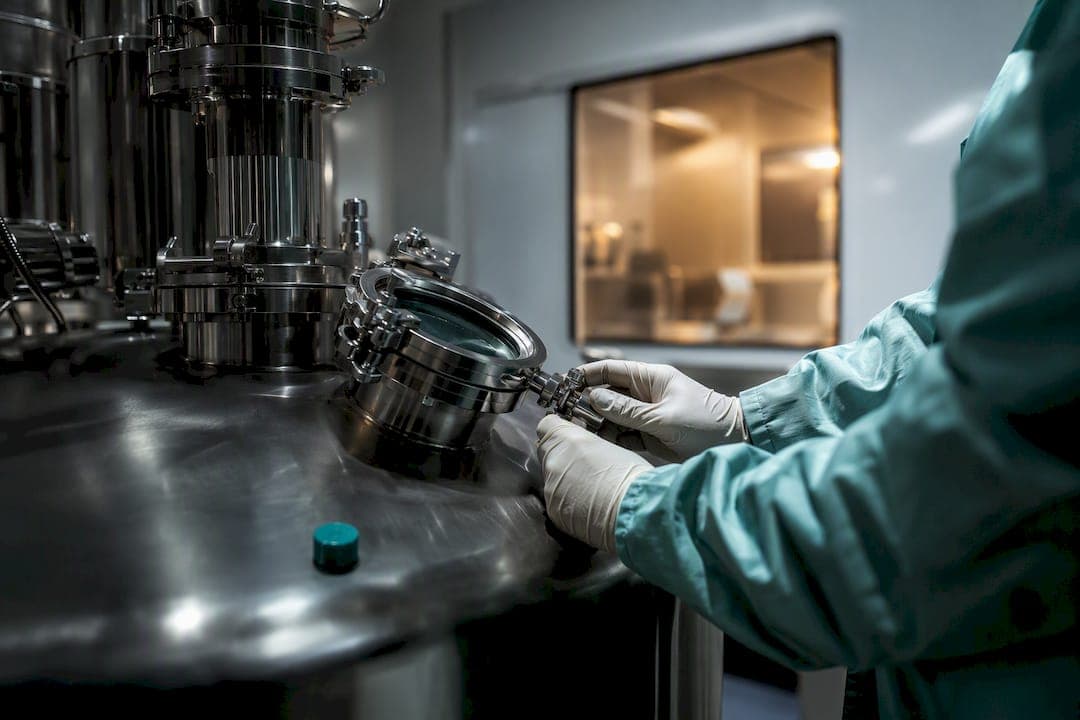
Use GMP peptides for any human, clinical, or diagnostic application; RUO peptides are appropriate for in-lab research, assay development, and early preclinical screening. GMP is a regulated quality system built on validated processes and full documentation, while RUO simply labels a product as intended for research use, not a purity claim. Moving from RUO to GMP later in a program means new supplier qualification, method validation, and added cost and lead time.
TL;DR:
- Moving from RUO to GMP requires supplier qualification, process validation, and increased documentation, adding both cost and lead time.
- GMP peptides are manufactured under validated, controlled processes with full batch records, unlike RUO which only provides a certificate of analysis for identity and purity.
- For early research stages like assay development and target validation, RUO peptides are appropriate, but GMP is necessary for human or diagnostic applications.
- The cost of GMP manufacturing is typically three to five times higher than RUO, driven by validation, environmental controls, and comprehensive documentation.
- Proper documentation from the outset, including supplier testing methods and lot-specific data, is crucial to avoid costly requalification if a project later transitions toward clinical development.
Table of Contents
- What GMP (cGMP) Means for Peptide Manufacture
- What RUO Peptides Are and Where the Label Stops Protecting You
- GMP vs RUO Comparison: The Dimensions That Actually Matter
- Matching Peptide Grade to Your Actual Project
- How to Transition From RUO to GMP Without Losing Time
- What to Request From a Peptide Supplier and Why It Matters
- The Real Cost of Getting the Grade Wrong
- Sources
- FAQ
What GMP (cGMP) Means for Peptide Manufacture
GMP, often written as cGMP for "current" Good Manufacturing Practice, is not a single test or certificate. It's a lifecycle quality system that governs how a peptide gets made, checked, and documented from raw material to finished vial. The TGA's GMP guidance frames it directly: GMP exists to ensure products are consistently produced and controlled to quality standards appropriate to their intended use, backed by validated processes, documentation, and traceability at every step.
For peptide manufacturers, that translates into specific, auditable controls:
- Validated synthesis processes with defined critical parameters, not just a repeatable recipe
- Environmental monitoring in classified cleanrooms for sterile or aseptic work
- Documented personnel training and qualification records
- Calibrated, maintained equipment with service logs
- Formal supplier qualification for raw materials and reagents
- Validated analytical methods, not just methods that happen to work
- Full batch records covering every processing step, deviation, and release decision
Pro Tip: Ask a supplier for a redacted batch record, not just a Certificate of Analysis. A CoA tells you the result; a batch record tells you how the result was produced and confirms it wasn't a one-off.
Regulatory frameworks like PIC/S and ICH guidelines set the technical expectations that TGA and comparable agencies build their inspection criteria around, which is why GMP compliance reads the same regardless of which country's regulator is asking.
What RUO Peptides Are and Where the Label Stops Protecting You
RUO stands for research-use-only, and the label carries a specific legal and practical meaning: the product is intended for laboratory research, not for administration to humans, not for diagnostic decision-making, and not for any application where patient outcomes depend on it. Promega's comparison of cGMP and RUO products makes this distinction the center of its guidance: RUO is about intended use, while cGMP is about meeting the manufacturing and documentation rigor that clinical or diagnostic applications require.
A reputable RUO supplier still tests its material, typically through:
- A Certificate of Analysis confirming identity and purity via HPLC and mass spectrometry
- Lot-specific results rather than generic specification sheets
What RUO documentation usually does not include is a full batch manufacturing record, validated methods suitable for a regulatory filing, or detailed environmental and process monitoring. That gap is fine for bench research. It becomes a liability if the material ends up in a regulated pathway later, forcing costly requalification or, worse, rejection during a regulatory review.
GMP vs RUO Comparison: The Dimensions That Actually Matter
The differences between GMP and RUO peptides sort into five practical categories, and confusing any one of them leads to either wasted budget or regulatory exposure.
| Dimension | RUO peptides | GMP peptides |
|---|---|---|
| Intended use / regulatory context | Research and discovery only | Clinical, diagnostic, or human-facing use |
| Documentation and traceability | CoA with lot number | Full batch records, deviation logs, release documentation |
| Testing scope | Purity, identity (HPLC/MS) | Adds sterility, endotoxin, residual solvents, stability data |
| Facility and process controls | Standard lab-grade production | Validated processes, cleanroom environmental monitoring |
| Cost and lead time | Lower cost, faster turnaround | Meaningfully higher cost, longer lead time |
The cost gap is not trivial. Industry estimates commonly put GMP manufacturing at three to five times the cost of non-GMP production, driven by validation studies, environmental qualification, and the documentation burden itself rather than the chemistry.
That last point matters more than most researchers assume: GMP is not a purity grade. The synthesis chemistry behind an RUO peptide and a GMP peptide can be identical, and both can reach comparably high purity levels. What GMP adds is the validated system and paperwork proving that purity was achieved consistently, batch after batch, under controlled conditions. Buying GMP for a discovery assay because it "sounds better" wastes money the research budget could use elsewhere.

Matching Peptide Grade to Your Actual Project
Picking the right grade comes down to what happens to the peptide after it leaves the vial. A few common scenarios illustrate where the line sits:
- Assay development and target validation — RUO is appropriate. You're characterizing binding behavior or optimizing a protocol, not making claims about a product.
- In vitro screening and early SAR work — RUO covers this. Structure-activity relationship studies need consistent material, not clinical-grade documentation.
- Reference standards for later clinical work — This is where GMP-like documentation starts paying off, even before a formal clinical program begins.
- Any peptide intended for human administration — GMP is required, full stop, whether it's a first-in-human study or an established clinical protocol.
- Diagnostic kits used for clinical decision-making — GMP applies here too, since a diagnostic result feeds directly into patient care decisions.
Between those extremes sits a practical middle ground. Suppliers offering GMP-like documentation, validated reference standards, or independent third-party testing on RUO-labeled material give research teams a hedge. Early adoption of GMP-compatible raw materials or process documentation often reduces the revalidation burden if a program eventually advances toward a clinical pathway.
Pro Tip: If there's even a moderate chance your project moves toward IND-enabling studies within two years, document your RUO supplier's testing methods now. Retroactively reconstructing that history is far harder than capturing it as you go.
How to Transition From RUO to GMP Without Losing Time
Moving a peptide program from RUO to GMP is a planning exercise as much as a procurement one. Four tasks anchor the process:
- Assess your regulatory pathway first. Determine where GMP needs to begin in your synthesis route. Regulators pay close attention to this starting point, and documenting the rationale for where GMP controls begin heads off pushback during later review.
- Select a GMP-capable manufacturer. Request evidence, not assurances: GMP certificates, recent audit history, and validated analytical method summaries.
- Plan validation activities on a realistic timeline. This includes method validation, stability studies, environmental qualification, documented personnel training, supplier audits, and a formal change-control process.
- Budget for contingency. Rework and additional qualification cycles are common, not exceptional.
A few practical items to fold into that plan:
- Recent PIC/S Annex 1 updates tightened microbial and contamination-control expectations for sterile products, with a transition period applying from September 2025.
- Choosing a supplier that offers both RUO and GMP tiers simplifies technology transfer since the underlying process is already familiar to the manufacturer.
- Build extra lead time into your project schedule; GMP timelines rarely compress well under pressure.
What to Request From a Peptide Supplier and Why It Matters
The documents you request should scale with how the peptide will be used, and each one proves something distinct:
- Certificate of Analysis (CoA) confirms identity and purity for a specific lot, not a general specification.
- HPLC and mass spectrometry reports verify the CoA's claims independently rather than taking a single number on faith.
- Endotoxin and sterility reports matter for anything touching cell culture or in vivo work, not just clinical use.
- Full batch records show manufacturing consistency across runs, essential once GMP is in play.
- Validated method summaries confirm the testing itself was scientifically sound, not just performed.
- Supplier audit summaries reveal whether a facility has been independently reviewed against GMP or quality-system standards.
Peptastic Labs structures its documentation around this exact logic: every compound in its catalogue is independently verified to ≥99% purity via HPLC, with batch-specific Certificates of Analysis available on request and third-party verification behind the in-house testing. That's a useful baseline for what to expect and what to verify yourself before treating any supplier's claims as settled. For a closer look at what separates a well-documented RUO supplier from one cutting corners, see how to assess a batch-tested peptide supplier.
Pro Tip: Don't just read a CoA. Cross-check the lot number against the batch documentation to confirm the two actually match. Mismatches happen more often than suppliers like to admit.
The Real Cost of Getting the Grade Wrong
Most of the guidance on GMP versus RUO peptides treats the decision as binary and static, and that's where it falls short. The more accurate framing is that grade selection is a moving target tied to where your project sits on the development timeline, not a fixed label you choose once and forget.
The conventional advice, "buy GMP to be safe," is expensive and often unnecessary. Early discovery work doesn't need a validated quality system behind it. What it needs is a supplier who tests honestly and documents what they did. The opposite mistake, sourcing RUO material for anything that might touch a clinical pathway, is far costlier because it surfaces late, usually during a regulatory review when there's no easy fix.
If there's one thing research teams should prioritize, it's documentation discipline from day one, regardless of grade. Capture supplier testing methods, lot numbers, and CoAs for every RUO purchase as if you might need to defend them later. You often will. The teams that struggle during a GMP transition aren't the ones that chose RUO peptides early; they're the ones that never kept records worth handing to an auditor.
— Tintastic
Sources
- Good manufacturing practice for medicinal products (TGA guidance, Part 1)
- Comparing cGMP and RUO products (Promega)
- GMP vs Research Grade Peptides — What you're actually buying (PeptideBondReviews)
FAQ
Is RUO Good for Peptides Used in Research?
Yes, RUO peptides are appropriate for laboratory research, assay development, and early screening work where the product will never be administered to humans or used for diagnosis. The key is confirming the supplier still provides lot-specific testing and a Certificate of Analysis, even though full batch records aren't typically included.
What Is a GMP Grade Peptide?
A GMP grade peptide is manufactured under a validated quality system that includes documented processes, environmental controls, calibrated equipment, and full batch records, as outlined in TGA's GMP guidance. It's required for any peptide intended for human administration or diagnostic use.
Are GMP and GLP the Same Thing?
No. GMP (Good Manufacturing Practice) governs how a product is manufactured and documented, while GLP (Good Laboratory Practice) governs how non-clinical safety studies are conducted and recorded. They cover different stages of development and are not interchangeable terms.
What Does RUO Mean in Biotech?
RUO means "research use only," a label indicating a product is intended solely for laboratory research and not for clinical, diagnostic, or therapeutic use. It signals intended use, not a specific purity or quality tier, since RUO and GMP products can share similar underlying chemistry.