
Endotoxin testing via the LAL assay is not optional for any peptide intended for injection. Before trusting a lot, request three things from your supplier: a batch-specific LAL value in EU/mL or EU/mg, the lab name and method used, and confirmation that lot numbers match across all documentation. Anything less leaves your protocol exposed to a risk that sterility testing alone cannot catch, a standard reinforced by decades of pharmacopoeial guidance under USP's harmonized endotoxin chapter.
TL;DR:
- Always verify that the endotoxin result is batch-specific, and confirm the testing lab, method, and lot number match all documentation before use.
- Be aware that endotoxins are heat-stable LPS that survive sterilization, posing a risk of fever and inflammation even in sterile products.
- Recognize that endotoxin contamination can occur at multiple manufacturing points, including raw materials, synthesis, lyophilization, or storage, regardless of sterility.
- Require lab reports to include the measured EU/mL, the assay's sensitivity, inhibition test results, and the MVD to ensure accurate dose safety assessment.
- Understand that filtration does not remove endotoxin, so validated depyrogenation processes or pyrogen-free handling are essential for safety.
Table of Contents
- Quick Checklist for Assessing a Peptide Lot
- What Endotoxins Are and Why They Matter for Peptide Injections
- How Peptides Become Contaminated During Manufacturing
- LAL Assay Methods, MVD, and How Preparatory Controls Work
- Reading the COA: Units, Thresholds, and Blank Fields
- Sterility Testing and Endotoxin Testing Are Not the Same Thing
- Step-by-Step Protocol: Sample Prep, Dilution, and Controls
- Troubleshooting Interference and Unexpected Results
- Filtration Does Not Remove Endotoxin: Depyrogenation Limits
- What Peptastic Labs Verifies Before a Lot Ships
- A Lab Perspective on Tightening Acceptance Criteria
- Order Documented, Independently Tested Peptides
- Sources
- FAQ
Quick Checklist for Assessing a Peptide Lot
Before you reconstitute anything, pull the Certificate of Analysis and run through a short verification pass. This takes about two minutes and catches most documentation gaps before they become lab problems.
- Confirm the LAL numeric result is present for this specific lot, not a generic batch range.
- Check that the testing lab is named, not just referenced as "third-party verified."
- Verify the method (gel-clot, turbidimetric, or chromogenic) is disclosed.
- Look for reagent sensitivity (labeled λ, typically within a low endotoxin sensitivity range defined by the reagent manufacturer) alongside the result.
- Confirm an inhibition/enhancement test was run and passed.
- Match lot numbers across the COA, shipping label, and vial.
Red flags include a blank LAL field, vague language like "meets endotoxin standards" with no attached number, or a COA that never names the testing facility. Recall notices for injectable products tied to endotoxin contamination have circulated in industry reporting for years, and they almost always trace back to a documentation gap rather than a testing failure. That gap is exactly what this checklist closes.
What Endotoxins Are and Why They Matter for Peptide Injections
Endotoxins are lipopolysaccharides (LPS), structural components of the outer membrane of gram-negative bacteria. They are pyrogens: molecules that trigger a fever response when they enter the bloodstream, even in the absence of any living organism. That distinction matters more than most people realize when they first encounter this topic.
Autoclaving and terminal sterilization kill bacteria, but LPS is heat-stable and survives standard sterilization cycles that would eliminate viable microbes. A vial can be certified sterile, meaning no living organisms remain, and still carry a dangerous endotoxin load left behind by bacteria that died during earlier manufacturing steps. Peer-reviewed toxicology literature confirms this persistence is a well-documented limitation of relying on sterility alone as a safety marker for parenteral products.
Clinically, endotoxin exposure produces fever, chills, inflammation, and in more severe cases hypotension, sometimes within one to two hours of parenteral administration. This rapid onset is why research protocols involving injectable peptides treat endotoxin control as a distinct, non-negotiable safety layer, not an extension of purity testing.
How Peptides Become Contaminated During Manufacturing
Endotoxin doesn't need a manufacturing failure to appear. It only needs one point in the process where gram-negative bacteria were present, even briefly, before inactivation.
- Raw materials: amino acids, resins, and solvents sourced without endotoxin controls can carry LPS into the synthesis stream from the start.
- Synthesis and purification: extended reaction times or inadequately cleaned equipment between batches allow bacterial buildup.
- Lyophilization: freeze-drying concentrates whatever was present in solution, including endotoxin, into the final powder.
- Fill-finish: non-sterile filling environments introduce contamination at the last controllable step.
- Storage and reconstitution: pyrogen-contaminated water or non-sterile vials at the point of use can undo every upstream control.
Small-batch or non-GMP sourcing carries materially higher risk here, since these process controls are exactly what formal quality systems are built to catch. A peptide purity standards certificate tells you almost nothing about endotoxin load. Purity by HPLC and endotoxin content are independent measurements testing entirely different contaminants.
LAL Assay Methods, MVD, and How Preparatory Controls Work
The Limulus Amebocyte Lysate (LAL) assay remains the reference method for detecting bacterial endotoxin, and the USP harmonized chapter defines three accepted variants.
- Gel-clot method: the oldest and simplest technique. LAL reagent forms a solid gel when endotoxin exceeds the reagent's labeled sensitivity. It's a pass/fail or semi-quantitative endpoint, read visually.
- Turbidimetric method: measures the cloudiness that develops as clotting protein activates, tracked photometrically over time for a quantitative EU/mL value.
- Chromogenic method: uses a synthetic substrate that releases a colored compound proportional to enzymatic activation, read spectrophotometrically for precise quantification.
Turbidimetric and chromogenic methods give you a number; gel-clot gives you a threshold. For research peptides where dose calculations matter, a quantitative method is worth requesting specifically.
Every valid LAL run also requires preparatory testing. Labs must confirm the reagent's labeled sensitivity (λ) through their own confirmatory test, and they must run an inhibition/enhancement test on the actual product matrix, not just water. This test spikes a known endotoxin concentration into diluted sample and checks whether recovery falls within 50 to 200 percent of the expected value. If it doesn't, something in the sample, a solvent, a buffer, a salt concentration, is interfering with the assay, and the raw result cannot be trusted without further dilution.
Maximum Valid Dilution (MVD) is the ceiling on how far a sample can be diluted before testing while still detecting endotoxin at a clinically meaningful level. MVD is calculated as:
MVD is calculated from endotoxin limits, product concentration, and the labeled reagent sensitivity according to standard practice
This is the bridge between a raw EU/mL lab result and a real EU-per-dose figure. Skipping this calculation is how a technically "passing" lab value ends up misapplied to a dosing decision it was never validated for.
Pro Tip: Ask your lab to report both the raw EU/mL result and the MVD used to reach it. A number without its dilution context is close to meaningless for dose-based risk assessment.
A properly reported COA states the method used, the reagent's labeled sensitivity, the inhibition test outcome (pass or fail), and the final EU/mL or EU/mg result tied to a specific lot number. Anything short of that is an incomplete document, regardless of how professional it looks.
Reading the COA: Units, Thresholds, and Blank Fields
Converting a lab's EU/mL result into something you can actually act on takes one more calculation: multiply the reported EU/mL by the total volume of your dose in milliliters. A vial reading 0.4 EU/mL, reconstituted and dosed at 0.5 mL, delivers an endotoxin dose calculated by multiplying concentration and volume.
| Reported Value | Dose Volume | EU per Dose |
|---|---|---|
| 0.4 EU/mL | 0.5 mL | 0.2 EU |
| 0.4 EU/mL | 0.5 mL | 0.2 EU |
| 0.4 EU/mL | 0.25 mL | 0.2 EU |
| — | 0.5 mL | 0.5 EU |
There's no universal regulatory endotoxin limit for research-use-only peptides the way there is for approved pharmaceuticals, so most labs adopt conservative internal cutoffs well below anything associated with pyrogenic response in the literature, and treat any result approaching that line as grounds for retest rather than acceptance.
A blank LAL field on a COA almost always means the assay was never run, not that the result was zero. Background analysis across supplier documentation consistently shows this pattern: a blank cell gets read by buyers as "clean" when it actually means "untested." Treat a blank field exactly as you would a failed result: request retest before use.
Before accepting any lot, confirm:
- The lot number on the COA matches the lot number on the vial and shipping documentation.
- The reported units (EU/mL vs. EU/mg) match how you intend to calculate your dose.
- The result was generated on this batch, not carried over from a prior production run.
Sterility Testing and Endotoxin Testing Are Not the Same Thing
Sterility testing answers one question: are viable microorganisms present in the sample? It's a culture-based method that grows the sample under conditions favorable to bacterial or fungal growth and checks for any colony formation over a defined incubation period.
Endotoxin testing answers a completely different question: is pyrogenic LPS residue present, dead bacteria or not? A product can pass sterility testing with zero viable organisms and still carry enough endotoxin to cause a febrile reaction, because LPS from bacteria that died weeks earlier in the manufacturing process remains chemically intact. This is a well-established limitation, not an edge case, and it's why sterility documentation alone has never been treated as a substitute for a batch-specific LAL result.
The practical rule for any injectable research peptide: require both a sterility statement and a numeric, lot-specific LAL value. One without the other is half a safety profile.
Step-by-Step Protocol: Sample Prep, Dilution, and Controls
Running or commissioning an LAL assay correctly comes down to a handful of disciplined steps.
- Select pyrogen-free consumables. Use endotoxin-free water, pyrogen-free glassware or single-use plasticware, and verify your reconstitution solvent has no independent endotoxin contribution, a factor covered in more detail in peptide solubility guidance.
- Calculate your MVD using the labeled reagent sensitivity, your product's endotoxin limit, and its concentration, before you dilute anything.
- Prepare a dilution series at and below MVD, typically in half-log or two-fold steps, so you have a valid range to test within.
- Run a positive product control (PPC) alongside your sample: spike a known endotoxin quantity into diluted product and confirm recovery falls within the 50 to 200 percent acceptance window.
- Run the assay (gel-clot, turbidimetric, or chromogenic) per the incubation conditions specified in the USP chapter, generally 37 ± 1°C for the reaction period.
- Document everything: method, sensitivity, dilution used, PPC recovery percentage, and final EU/mL result tied to the lot number.
Most individual labs are not equipped to run LAL testing in-house reliably, and that's fine. What matters is specifying the requirements clearly when outsourcing: name the method you want, require the labeled sensitivity to be stated, and require the inhibition/spike-recovery report as a deliverable, not an afterthought. A lab that balks at providing that report is telling you something.
Pro Tip: If you're outsourcing, ask for the PPC recovery percentage explicitly. A lab that only reports "pass" without the number is giving you a conclusion, not evidence.
Troubleshooting Interference and Unexpected Results
Not every high or erratic LAL reading means contamination. Certain substances interfere with the assay chemistry itself, producing false positives or masking true positives through inhibition.
Common interferents include organic solvents, high salt concentrations, chelating agents, and certain excipients used in peptide formulations. The spike-recovery test built into every valid LAL run is designed specifically to catch this: if a known endotoxin spike recovers outside the 50 to 200 percent window, the sample matrix is interfering with detection, and the result at that dilution cannot be trusted, a principle confirmed in published assay-validation research.
The standard troubleshooting sequence: dilute further and retest, since many interferents lose their effect at higher dilution; try an alternate LAL technique, since chromogenic and turbidimetric methods respond differently to certain matrix effects; or consider a recombinant Factor C assay, which uses a single recombinant enzyme rather than the full horseshoe crab lysate cascade and is less susceptible to some of the same interferents.
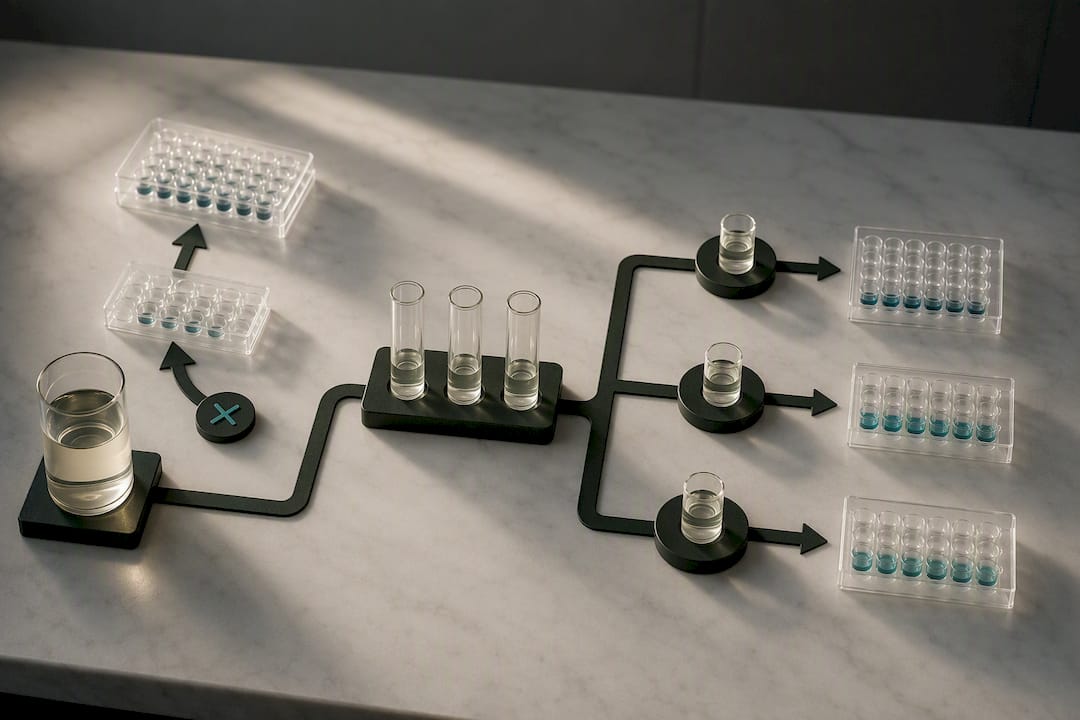
If recovery still fails after reasonable dilution adjustments, reject the lot or require a supplier retest with a documented resolution. Don't average a failing result against a passing one from a different dilution and call it acceptable.
Filtration Does Not Remove Endotoxin: Depyrogenation Limits
Sterile filtration through a 0.22-micron membrane removes bacteria. It does nothing meaningful to endotoxin, because LPS fragments and aggregates are small enough, and can pass through or shed from filter membranes regardless of pore size. This is one of the most persistent misconceptions in peptide handling, and published pharmacology literature is consistent on the point.
Validated depyrogenation methods exist, but they're process-level, not filter-level. Dry-heat treatment (typically 250°C or higher for a defined time) inactivates LPS on glassware and metal equipment. Sodium hydroxide (NaOH) rinses are used to depyrogenate certain manufacturing surfaces. Both require formal validation runs to confirm effectiveness, not just a general assumption that "clean" equals "depyrogenated."
At the lab level, the realistic mitigations are upstream: pyrogen-free water for injection, validated or single-use glassware, and controlled environments during reconstitution. None of this fixes a contaminated lot after the fact. It only prevents you from adding a second contamination source on top of one you didn't know existed.
What Peptastic Labs Verifies Before a Lot Ships
Peptastic Labs tests every catalog compound independently, verifying ≥99% purity by HPLC and maintaining full batch documentation with Certificates of Analysis available on request. When you request a COA, ask specifically for the LAL figure and confirm it matches the lot number on your vial. Our team can walk through testing methodology or help interpret a COA if you have questions before placing an order.
A Lab Perspective on Tightening Acceptance Criteria
Recall notices tied to endotoxin contamination in injectable products keep surfacing in industry reporting, and they rarely stem from exotic failures. They trace back to documentation nobody checked closely enough. Add a hard LAL requirement to your acceptance criteria now, not after a bad lot forces the conversation.
— Tintastic
Order Documented, Independently Tested Peptides
Peptastic Labs is built for researchers who need a documented answer, not a marketing claim, when they ask about endotoxin data. Every compound in the catalog ships with batch-specific documentation, and Certificates of Analysis are available on request, including HPLC purity verification at ≥99%.
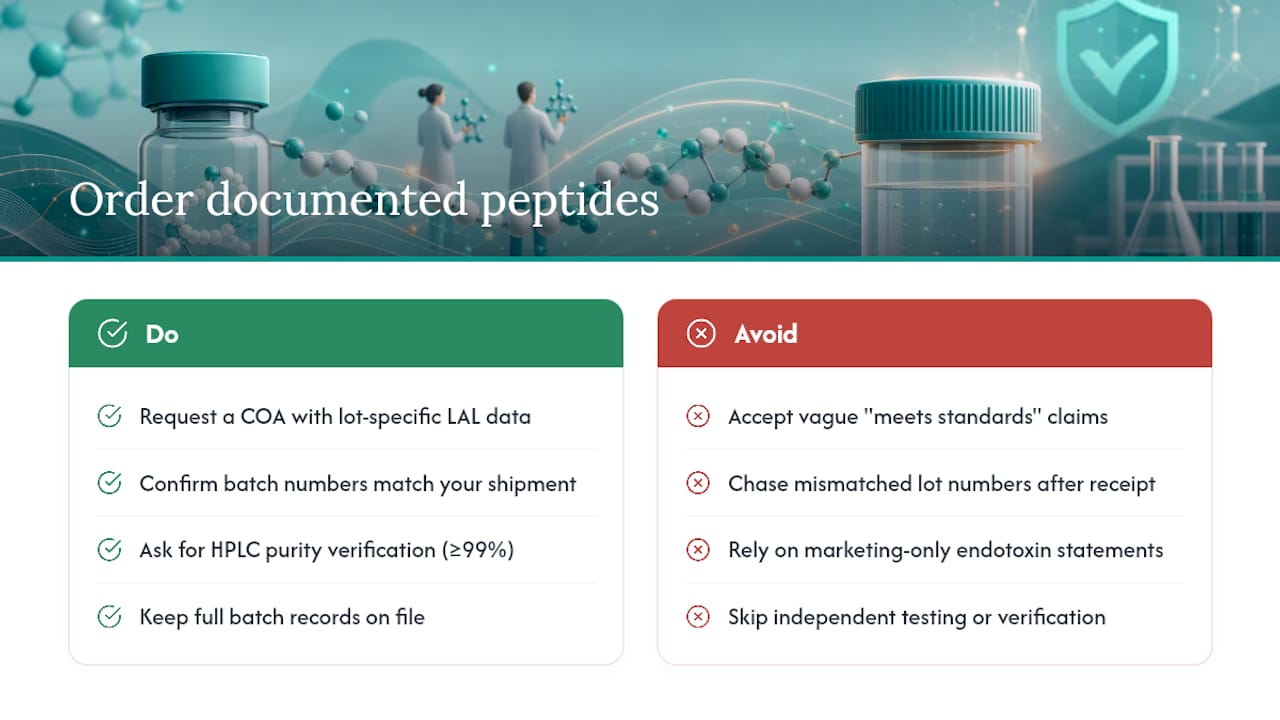
What that means in practice: no chasing a supplier for a lot number that doesn't match your shipment, and no guessing whether a "meets standards" claim actually carries a number behind it. Compounds like MOTS-c, CJC-1295 (no DAC) + Ipamorelin, and Tesamorelin are each independently tested with full batch records kept on file. For broader context on how independent verification fits into a procurement decision, see how third-party peptide testing works and what to request from any supplier.
If your lab's quality workflow extends beyond peptides, the dietary supplement workflow guidance from our partners at MyBestPharmacy covers related product safety practices worth reviewing.
Visit the Peptastic Labs product pages, request a COA with lot-specific LAL data for the compound you need, and confirm the numbers before you place your order.
Sources
For method-level detail, the USP harmonized endotoxin chapter is the reference standard for LAL procedures and preparatory testing. For clinical and toxicological context, peer-reviewed literature on PubMed covers pyrogenic effects and assay performance, alongside additional assay validation research. Clinicaltrials indexes trials relevant to injectable safety outcomes. Consult USP for how to run the test; consult peer-reviewed literature for what happens when contamination goes undetected.
This article is general information, not a substitute for advice from a qualified doctor. Consult a qualified healthcare professional about your own circumstances before acting on anything here.
FAQ
How do you test peptides for endotoxins?
Peptides are tested using the LAL assay, run as gel-clot, turbidimetric, or chromogenic method, with preparatory inhibition testing confirming the result is reliable at the dilution used, per USP standards.
What are acceptable endotoxin levels for peptides?
There's no single universal limit for research-use peptides, so most labs set conservative internal cutoffs based on EU per dose and reject any lot with a blank, missing, or unusually high LAL value rather than relying on a generic pass label.
Can you filter endotoxins out of peptides?
No. Standard sterile filtration removes bacteria but not endotoxin, since LPS fragments pass through or shed from filter membranes regardless of pore size; only validated depyrogenation processes like dry heat address this.
What are the symptoms of endotoxin exposure from peptides?
Fever, chills, and inflammation are the most common signs, sometimes appearing within one to two hours of injection, with hypotension possible at higher exposure levels according to peer-reviewed clinical literature.
Does Peptastic Labs provide LAL data on its Certificates of Analysis?
Peptastic Labs documents batch-specific testing and makes Certificates of Analysis available on request, so researchers can request the LAL figure tied directly to their lot number before use.