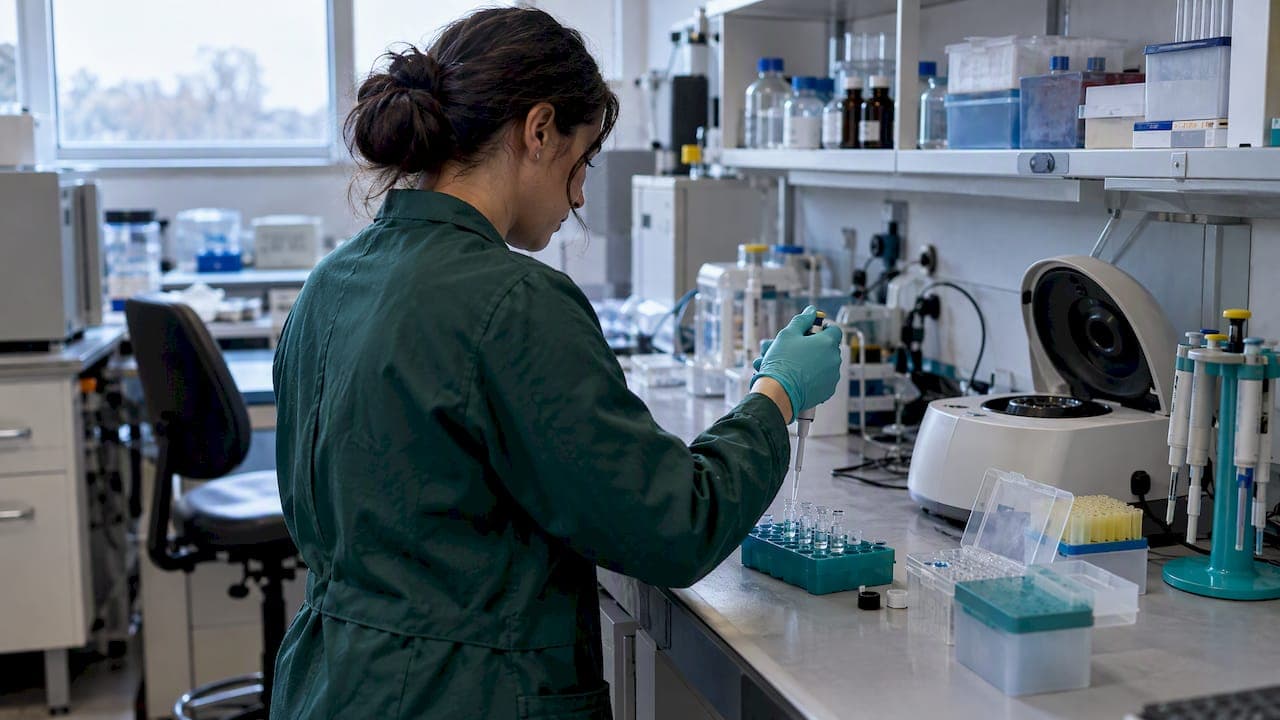
Hydrophilic peptides generally dissolve in sterile water or a mild buffer; hydrophobic sequences need a minimal volume of DMSO, DMF, or acetonitrile before dilution into buffer. For reversed-phase HPLC, start with water and acetonitrile plus an acidic modifier, trifluoroacetic acid (TFA) for peak shape, formic acid for LC-MS compatibility, weighing the trade-off. For any downstream assay, cap final DMSO concentration and run a vehicle control.
TL;DR:
- Peptides with high hydrophobic content generally require organic solvents like DMSO, DMF, or acetonitrile for initial dissolution, while charged peptides often go directly into water.
- The optimal acidic modifier in reversed-phase HPLC depends on the downstream analysis, with TFA providing sharper peaks but reducing mass spectrometry sensitivity.
- Buffer composition, especially high salts or pH shifts near the isoelectric point, can cause peptides to precipitate after reconstitution or during purification.
- It is best to perform small-scale solubility tests and record vehicle percentages to troubleshoot dissolution failures and prevent material waste.
- Reagent choice and solvent conditions should be re-evaluated for each new peptide batch, and independent testing with Certificates of Analysis helps avoid guesswork.
Table of Contents
- 1. Choosing a reconstitution solvent for assay compatibility
- 2. Reversed-phase HPLC mobile phases and acidic modifier trade-offs
- 3. Buffer, salt, and pH effects on peptide solubility during purification
- 4. How to troubleshoot a peptide that won't dissolve
- 5. Protocol checkpoints that cut solvent-compatibility troubleshooting time
- 6. What experienced lab techs do differently
- Order tested peptides with documentation built in
- FAQ
- Sources
1. Choosing a reconstitution solvent for assay compatibility
The right solvent depends on the peptide's amino-acid composition, not on habit. Sequences with a high proportion of hydrophobic residues resist water and usually need an organic co-solvent first; peptides with a substantial fraction of charged residues typically go straight into aqueous buffer. According to supplier solubility guidance, peptides shorter than five residues are usually water-soluble, while hydrophobic or high-hydrophobic-content sequences often require DMSO, DMF, or acetonitrile as the initial solvent.
A practical workflow for a new vial:
- Dissolve hydrophilic peptides directly in sterile water or a neutral buffer at low volume first, then adjust.
- For hydrophobic peptides, add the smallest volume of DMSO, DMF, or acetonitrile that produces a clear solution, then dilute stepwise into buffer while mixing.
- Keep acetonitrile under roughly 50% when it serves as the primary handling solvent, since it is highly volatile and less forgiving for storage.
- For cell-based assays, DMSO is generally the preferred organic solvent because of its comparatively low toxicity to cultures.
The same supplier guidance notes that assay tolerance for DMSO varies widely: some protocols cite roughly 1% as a general ceiling, but many cell-based assays tolerate far less. Always use the lowest final DMSO concentration that still achieves dissolution, and record that percentage in your notes.
Peptides containing methionine, cysteine, or tryptophan deserve extra caution, since oxidation-prone residues can degrade faster in the presence of air, light, or certain buffers. Store stock solutions cold, minimize freeze-thaw cycles, and avoid prolonged exposure to strong oxidizers during handling.
Documentation closes the loop. Every assay run should record the final vehicle percentage and include a matched vehicle control, since a shift in DMSO or buffer composition between runs can quietly change assay readouts. Our peptide solubility guide walks through sequence-based solubility prediction in more depth for readers building a standard operating procedure.
Pro Tip: Run a small-volume solubility test (10 to 20 microliters) before committing a full vial to a solvent choice; it costs little material and avoids wasted peptide.
2. Reversed-phase HPLC mobile phases and acidic modifier trade-offs
Most reversed-phase peptide separations start with water and acetonitrile, and the acidic modifier you add on top decides whether you get a clean chromatogram or a clean mass spectrum. A controlled study on automated blending for LC-UV-MS analyses found that TFA produced narrower peaks than formic acid, but caused significantly greater electrospray ionization suppression, meaning modifier choice forces a direct trade-off between chromatographic sharpness and mass spectrometry sensitivity.

A 2024 study found water had roughly five times greater effect on peptide retention than TFA, with the first 0 to 0.05% TFA addition sharpening peaks substantially and further increases up to 0.15% giving only minor additional benefit.
Practical tuning steps:
- Begin near 0.02 to 0.05% TFA and evaluate both peak shape and electrospray suppression before finalizing.
- Switch to formic acid when the downstream step is LC-MS and suppression is unacceptable, accepting some loss of peak sharpness.
- Consider ammonium formate or other buffered modifiers when ionic strength and column capacity matter more than raw peak shape, since nonvolatile buffers can behave differently than TFA or formic acid for basic peptides.
- Never assume the modifier that worked last time is still optimal: screen modifier and concentration for each new peptide or mixture.
Method transfer from analytical HPLC to preparative or FPLC work is where modifier choices get tested hardest. A 2026 HPLC-to-FPLC workflow study reported that changing the acidic modifier and optimizing flow rate strongly affected transferability, and that a correction approach reduced transfer error in elution percentage from roughly 17% to under 5%. Before scaling up, revalidate the gradient, adjust flow rate and temperature for the new system, and check for a mismatch between the diluent used to load your sample and the eluent used to run the separation, since that mismatch is a common cause of peak deformation after scale-up.
3. Buffer, salt, and pH effects on peptide solubility during purification
Buffer composition can undo a successful reconstitution. High phosphate concentration and elevated sodium chloride are common precipitants for peptides that carry a strong net charge or a cluster of hydrophobic residues, because both conditions reduce the electrostatic repulsion that keeps peptides in solution. Peptides near their isoelectric point are especially vulnerable, since even a small pH shift during buffer exchange can tip them out of solution.
When moving a peptide between buffers, three methods cover most lab needs:
- Size-exclusion chromatography works well for larger peptides and avoids harsh pH swings, though it dilutes the sample.
- Dialysis suits smaller batches where time is not critical and gentle, gradual exchange matters more than speed.
- Ultrafiltration concentrates and exchanges buffer quickly but risks peptide loss to membrane adsorption for highly hydrophobic sequences.
After any buffer exchange, check for a diluent-eluent mismatch before reinjecting onto HPLC: loading a sample in a solvent far weaker or stronger than the mobile phase at injection often causes peak fronting or splitting. Adding a small amount of organic co-solvent to the diluent, or switching to a diluent closer in composition to the mobile phase, usually resolves it. Confirm the result with a quick solubility check and an analytical injection before moving forward, and log the final buffer, pH, and any co-solvent used.
4. How to troubleshoot a peptide that won't dissolve
When a peptide resists its expected solvent, work through these steps in order rather than reaching for the strongest solvent first:
- Inspect the vial and Certificate of Analysis for the peptide's sequence, purity, and counter-ion before troubleshooting blindly.
- Warm the vial to room temperature in a desiccator before opening, since condensation introduces unwanted water.
- Attempt dissolution in sterile water or a neutral buffer first for peptides expected to be hydrophilic.
- If the peptide stays undissolved, add the minimum volume of DMSO, DMF, or acetonitrile needed to clear it, then dilute slowly into buffer with gentle mixing.
- Apply brief sonication or gentle heating below 40°C if needed, but avoid strong bases, since they can cause racemization of sensitive residues.
- If precipitation returns, consider re-lyophilizing from a DMSO-containing solution, or titrate pH gradually with a weak base and retest solubility.
- Confirm the result with a low-protein-binding filter if particulates remain, then verify by analytical HPLC or LC-MS before use.
Pro Tip: Document the final vehicle percentage and storage temperature on the vial label itself, not just in a notebook; it prevents the same peptide from being re-dissolved the wrong way next time. Our reconstitution and dosing guide covers volume calculations for this step in detail.
5. Protocol checkpoints that cut solvent-compatibility troubleshooting time
We ship every peptide with HPLC-verified purity and a Certificate of Analysis available on request, which gives a documented starting point before any solvent decision gets made.
A short checklist we recommend before reconstituting any new batch:
- Request the CoA and, where available, the raw chromatogram, so sequence and purity data are on hand before solvent selection.
- Run a small-volume solubility test in the intended vehicle before committing the full vial.
- Record the final vehicle percentage and run a vehicle control alongside any downstream assay.
- Re-check solubility and purity after any buffer exchange or dilution step, not only at first reconstitution.
Working from a supplier that documents purity and batch history by default removes one variable from troubleshooting: when a peptide fails to dissolve as expected, the question becomes a solvent-chemistry problem rather than a question mark over the material itself.
6. What experienced lab techs do differently
The techs who avoid repeat solvent problems share one habit: they treat every new batch as a fresh solubility test, even when the sequence looks familiar from a previous order. Skipping the vehicle control, or forgetting to log the final solvent percentage, is the most common gap we see traced back after an assay result looks off. One shortcut worth adopting broadly: run a quick analytical HPLC check on a new preparation before committing it to a full preparative purification run, since a five-minute injection can save an afternoon of rework.
— Tintastic
Order tested peptides with documentation built in
Solvent compatibility problems often start before the first reconstitution attempt, with uncertainty about what is actually in the vial. We supply independently tested, research-grade peptides across Metabolic, Cognitive & Neuro, Tissue & Repair, Longevity, Cosmetic Science, Blends, Hormone & Reproductive, and Ancillaries & Reagents lines, each verified to 99% purity or higher by HPLC, with Certificates of Analysis and raw chromatograms available on request.
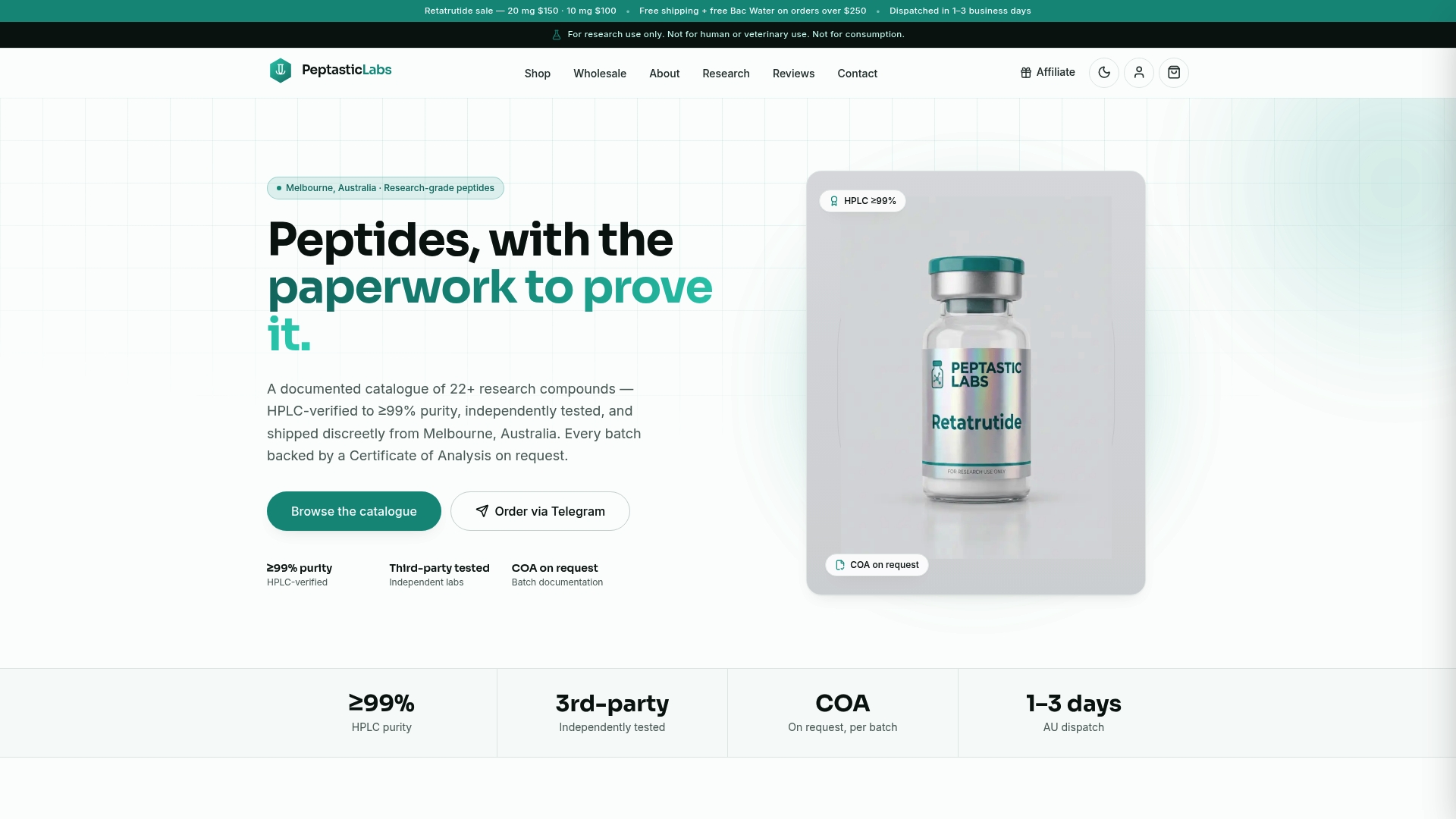
Ordering with a CoA in hand means you already know the sequence and purity going into your solubility test, which removes a major source of guesswork from the troubleshooting steps above.
- Request a Certificate of Analysis and raw chromatogram at the time of order.
- Run the small-volume solubility test described in this guide before scaling up reconstitution.
- Log vehicle percentage and purity data against each batch for future reference.
For water-quality considerations that affect reconstitution consistency, our partner guide on water quality in peptide research is a useful companion reference. Browse our catalogue to view documented batches and place an order.
FAQ
What shouldn't you mix with peptides?
Avoid strong bases and harsh pH extremes, since they can cause racemization or degradation of sensitive residues like methionine, cysteine, and tryptophan. High-salt or high-phosphate buffers can also precipitate peptides that carry a strong net charge, so introduce them gradually and check solubility at each step.
Can I use DMSO with peptides?
Yes, DMSO is a commonly used solvent for dissolving hydrophobic peptides and is generally preferred for cell-culture work because of its comparatively low toxicity, according to supplier solubility guidance. Keep the final DMSO concentration as low as the assay allows and always run a matched vehicle control.
Why won't my peptide dissolve?
The most common cause is a mismatch between the peptide's hydrophobicity and the solvent chosen: hydrophobic sequences resist water and need an organic co-solvent like DMSO, DMF, or acetonitrile first. Buffer composition, pH near the isoelectric point, and leftover salts from purification can also cause precipitation even after initial dissolution succeeds.
How to dissolve peptides?
Start with sterile water or a neutral buffer for hydrophilic peptides; for hydrophobic ones, dissolve in the smallest possible volume of DMSO, DMF, or acetonitrile, then dilute slowly into buffer while mixing. If the peptide still resists dissolution, brief sonication or gentle heating below 40°C can help, followed by a solubility and purity check by HPLC.
Sources
- Peptide solubility guidelines (Thermo/Pierce guidance)
- Optimization of reversed-phase peptide LC-UV-MS analyses using automated blending methodology
- Improvement of analysis and transferability in peptide purification: HPLC-to-FPLC workflow study (2026)
- Fundamental investigation of impact of water and TFA additions in peptide separations (2024)