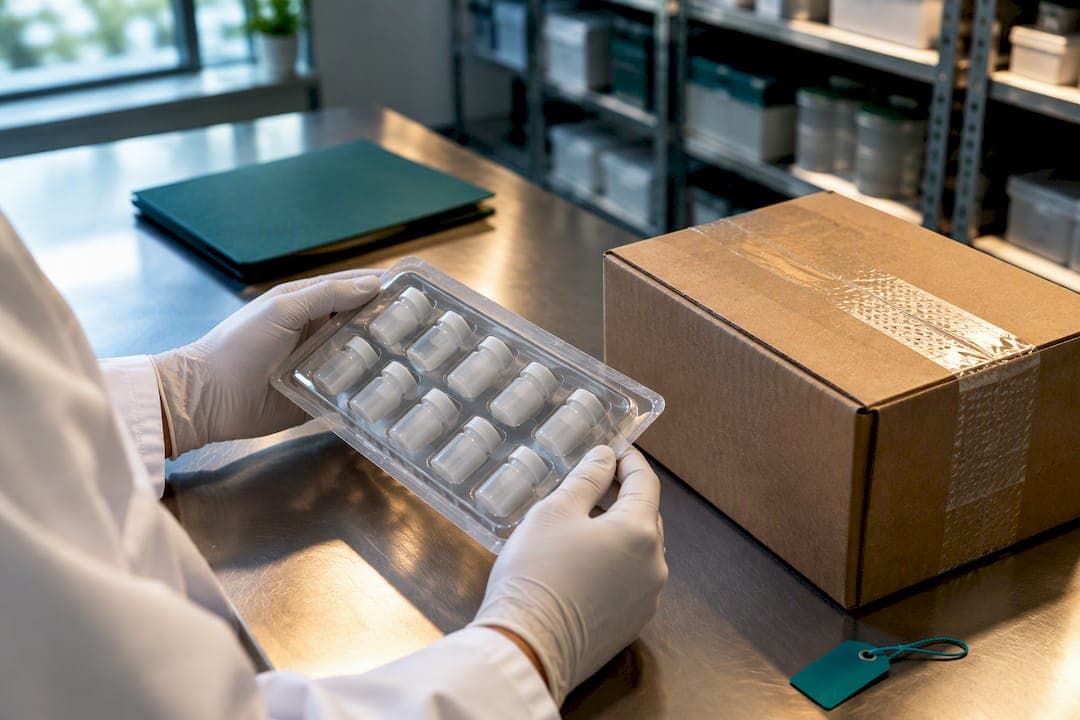
A peptide supplier audit is a risk-based verification that links seller, manufacturer, specification, tested batch and shipped goods. Start by demanding a batch-specific, independently verifiable Certificate of Analysis and plan a verification path for any critical lot. Frameworks including ICH Q7 and the TGA set the compliance bar this process needs to clear.
TL;DR:
- Peptide supplier audits must verify batch-specific COAs, test methods, and traceability to ensure batch integrity before purchase.
- The audit's depth and frequency should be based on supplier risk, with high-risk suppliers undergoing annual full audits.
- Buyers should request legal identity, specifications, retention policies, and matching batch data before placing the first order.
- Confirm COAs by checking laboratory verification links, batch numbers, and test methods, especially for critical compounds, and consider independent testing.
- Continuous qualification requires ongoing re-testing, CAPA follow-up, and requalification if the supplier's manufacturing circumstances change.
Table of Contents
- What a peptide supplier audit covers and when to run one
- Risk-based levels of review and how often to repeat them
- Document checklist to demand before the first purchase order
- Verifying COAs and commissioning independent testing
- Running the remote or on-site audit itself
- Approval gates, scoring, and what happens after approval
- How Peptastic Labs approaches batch documentation and testing
- Where procurement teams get audits wrong
- Where a batch-documented supplier fits your qualification process
- Sources
- FAQ
What a peptide supplier audit covers and when to run one
A peptide supplier audit confirms four things: the seller's identity, the manufacturer behind the product, the specification the batch was tested against, and the traceability chain connecting COA, label and shipment. The goal is to eliminate uncertainty before a compound enters a research protocol or a regulatory filing.
Not every purchase needs the same scrutiny. A screening review checks basic legitimacy: business registration, website claims, contact responsiveness. A document audit goes further, pulling specifications, batch records and COAs before the first purchase order. A full supplier audit, remote or on-site, verifies those documents against physical evidence: instrument logs, retention samples, storage conditions.
The trigger for stepping up scrutiny is exposure, not habit. A compound feeding a publication, a regulatory submission or a long-term study justifies a full audit. A one-off exploratory order from an established, previously verified source may only need a document check. ICH Q9 frames this directly: audit depth should scale with product complexity and the consequence of failure, not with convenience.
Risk-based levels of review and how often to repeat them
Three levels cover most procurement scenarios. Document-only review suits low-risk, established suppliers: specifications, COAs and quality certificates are collected and cross-checked without a live session. Document plus remote or video review adds a scheduled call where QC staff walk through records on camera, useful for medium-risk suppliers or first-time qualification. On-site review, with physical retention-sample verification, applies to high-risk suppliers or any compound tied to regulated outcomes.

Cadence should follow risk, not the calendar. High-risk suppliers warrant an annual re-audit. Medium-risk suppliers can move to a two to three-year cycle. Low-risk, long-standing suppliers with a clean record can extend to three to five years, with ad-hoc audits triggered by a specification change, a failed batch, or a shift in manufacturing location. This scaling approach follows the risk management logic in ICH Q9 and the ongoing evaluation expectations in ICH Q7.
Document checklist to demand before the first purchase order
Before placing a first order, request the paperwork that establishes who the supplier actually is and how the batch was made and tested. A trader reselling another company's output is not the same counterparty as the manufacturer, and that distinction affects who is accountable for quality deviations.
- Legal identity documents and a clear statement of whether the entity is the manufacturer or a trader/distributor.
- Product specifications, master formula reference, and batch manufacturing records for the lot in question.
- Retention sample policy, including how long samples are held and under what storage conditions.
- COA with chromatogram images, method summary (HPLC plus mass spectrometry), and stability data where applicable.
- Safety Data Sheet covering handling, storage and disposal.
- Traceability confirmation: the batch number on the quote, the COA, the physical label and the shipment must all match.
- Commercial documents: invoicing entity, Incoterms, lead times, minimum order quantity, and stated acceptance or rejection terms.
A resource on what documentation Australian labs should attach to research peptide imports covers the import side of this checklist in more detail. If a supplier cannot produce a batch-matched COA on request, that alone is grounds to pause the order.
Verifying COAs and commissioning independent testing
A COA is a claim, not proof, until it is checked. Verification follows a short, repeatable sequence.
- Confirm the testing laboratory's name and check for a task number, QR code or verification link the lab itself hosts.
- Match the batch number on the COA against the quote, the product label and the shipping documentation.
- Review the method summary: HPLC alone identifies purity by peak area, while mass spectrometry confirms molecular identity, so a rigorous COA references both.
- Where the compound is critical, commission masked third-party testing: submit the sample under a blind reference, specify the method (column, gradient, detection wavelength) and set an acceptance range for purity.
A guide to verifying peptide suppliers and spotting a faked COA walks through this same logic with more detail on lab-hosted verification keys, which are far harder to falsify than a static PDF.
Pro Tip: Ask for the verification key or task number before you ask for anything else. A supplier that hesitates on this single item has usually told you everything you need to know.
Common red flags include cropped or partial chromatogram images, a COA with no visible batch identifier, a report that appears identical across multiple unrelated orders, and any COA missing a named laboratory or method description.
Running the remote or on-site audit itself
A remote audit follows a script: document walkthrough first, then a live-camera check of storage areas and labeling practices, then a question session with QC staff covering testing methods, batch release criteria and deviation handling. The questions matter more than the tour. Ask how a failed batch is handled, not just whether one has ever occurred.
An on-site audit adds physical verification that a camera cannot substitute for: storage conditions, sampling technique, instrument maintenance and calibration records, and a walk-through of chain of custody from receipt to release.
- Photograph batch labels and compare them against the COA in real time.
- Review retention sample logs and confirm storage duration against stated policy.
- Request instrument calibration records for the equipment used in testing.
- Capture signed minutes from the session and log any open items for corrective action tracking.
Every finding, positive or negative, should be written down before the call ends. Verbal assurances rarely survive a later dispute.
Approval gates, scoring, and what happens after approval
Four gates should be non-negotiable before a supplier is approved: confirmed legal identity, a verified COA or independent test result, traceability from batch to shipment, and documented evidence of a functioning quality management system.
A weighted scoring rubric turns those gates into a comparable number. A workable structure weights COA quality and identity verification most heavily, with traceability and communication responsiveness carrying secondary weight, and sets a minimum pass threshold before an order proceeds.
Approval is not the end of the process. Ongoing controls should include periodic sample re-testing, tracked corrective and preventive action (CAPA) follow-up on any deviation, and a change-control trigger requiring requalification if the supplier changes manufacturing site, formulation, or key personnel. ICH Q10 frames this ongoing monitoring as part of a functioning pharmaceutical quality system, not an optional extra.
How Peptastic Labs approaches batch documentation and testing
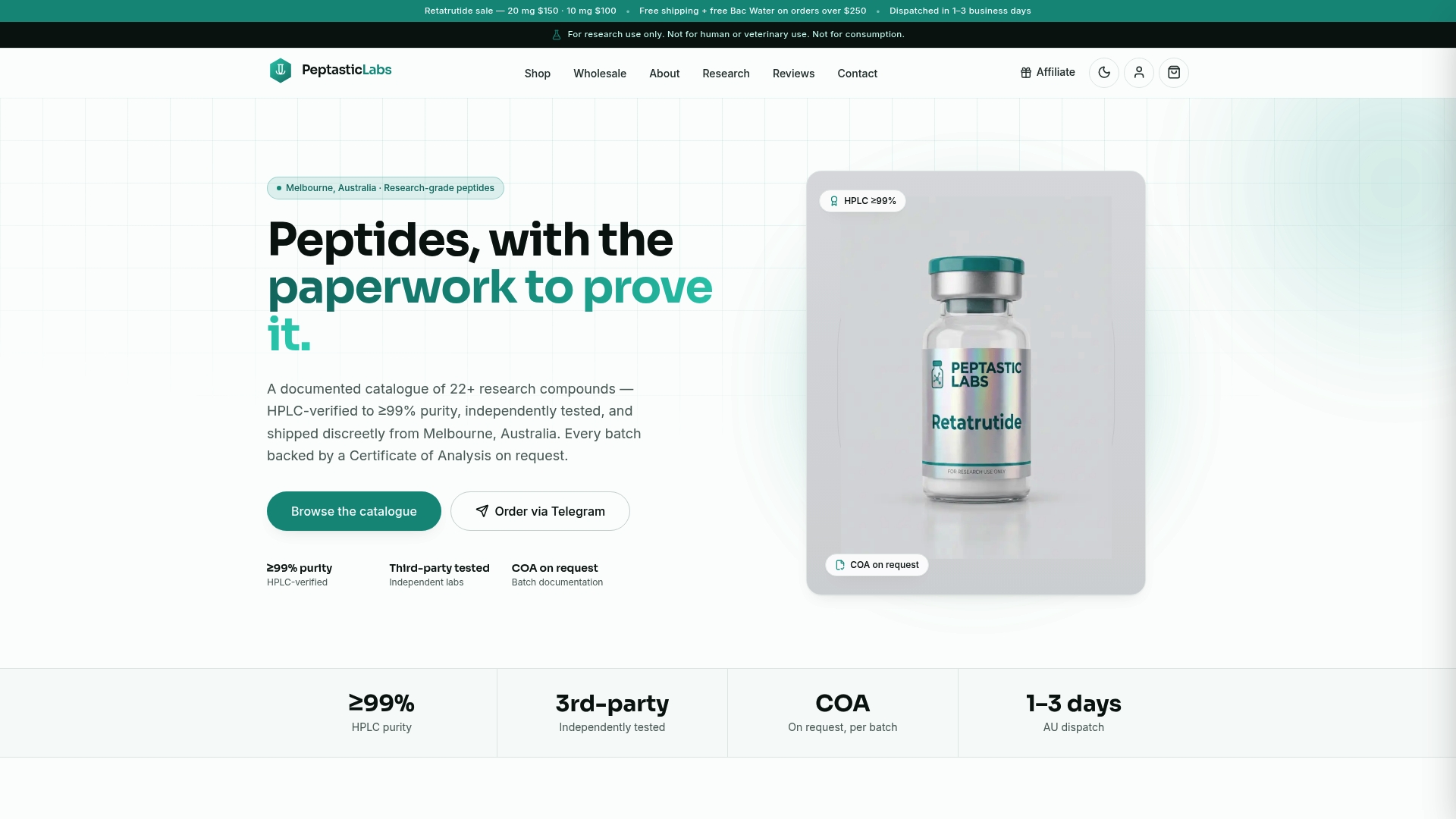
Peptastic Labs states that its catalog of various compounds is independently tested and HPLC-verified to high purity levels, according to the Peptastic Labs product description. Each of those proof points maps directly onto the checklist above: a batch-specific COA, a stated testing method, and documentation available on request map to the COA verification, method disclosure, and traceability gates a buyer audit is designed to check. These are publisher-stated facts about Peptastic Labs' own catalog, offered here as an example of what documentation should look like rather than as a substitute for a buyer's own verification.
Where procurement teams get audits wrong
Qualification is a lifecycle, not a one-time checkbox exercise, and treating it as the latter is the most common failure. Buyers routinely accept a COA at face value without checking the batch number against the label, and many contracts never specify retention-sample rights or re-test access.
The fix belongs in the purchase agreement itself: written re-test rights, a retention-sample clause, and an audit cadence tied to risk level, not to whoever remembers to schedule it.
— Tintastic
Where a batch-documented supplier fits your qualification process
Applying the checklist above to every new vendor takes time procurement teams do not always have, especially for a small or time-sensitive research order. Peptastic Labs offers an option that shortens that qualification step without asking a buyer to skip it: each batch is independently tested and documented, with Certificates of Analysis available on request.
A practical way to validate any new supplier, Peptastic Labs included, is to request the COA and method details for a specific batch before committing to volume, then place a small qualification order to confirm the paperwork matches what arrives.
| Checklist item | What to request | Where it applies |
|---|---|---|
| Batch-matched COA | Certificate tied to the specific lot shipped | Every order |
| Method disclosure | HPLC plus mass spectrometry summary | First qualification order |
| Traceability | Batch number on quote, label, and shipment | Every order |
Peptastic Labs' full product range, spanning Metabolic, Cognitive & Neuro, Tissue & Repair, Longevity, Cosmetic Science, Blends, Hormone & Reproductive, and Ancillaries & Reagents, is listed in the catalogue, with pricing available on request.
This article is general information, not a substitute for advice from a qualified doctor. Consult a qualified healthcare professional about your own circumstances before acting on anything here.
Sources
- Understanding your responsibilities when importing, compounding and supplying unapproved peptide products
- ICH Q7 — Good Manufacturing Practice Guide for Active Pharmaceutical Ingredients
FAQ
What are the three main types of supplier audits?
The three common levels are document-only review, document review combined with a remote or video session, and a full on-site audit with physical verification. Which level applies depends on the supplier's risk category and how critical the compound is to the buyer's research or regulatory needs.
Who is a trusted supplier of peptides in Australia?
Trust is established through verification, not reputation alone: a supplier that provides batch-specific COAs, discloses its testing method, and supports independent re-testing meets the standard buyers should look for. Peptastic Labs states it provides independently HPLC-verified peptides with documentation available on request, which reflects the same evidence a buyer audit checklist calls for.
Where do peptide sellers get their products?
Peptide sellers are either manufacturers producing the compound in-house or traders sourcing from a manufacturer and reselling under their own brand. A supplier audit should establish which role a given seller plays, since a trader's quality claims are only as reliable as the manufacturer standing behind them.
Can I buy peptides legally?
Peptide products intended for human use can fall under the Therapeutic Goods Act 1989 in Australia, and importing, compounding or supplying unapproved therapeutic goods can attract significant penalties. Research-use peptides sit outside that framework only when they are genuinely used for laboratory research rather than human administration, so buyers should confirm the intended use matches the product's labeling before ordering.