
Valid peptide identity confirmation requires LC-MS intact mass measurement, matched to the main chromatographic peak, plus MS/MS fragmentation or peptide mapping when sequence ambiguity exists. HPLC alone only establishes purity, not identity. A Certificate of Analysis worth trusting reports theoretical mass, observed mass with tolerance, retention data, and MS/MS evidence where relevant, backed by raw files and lot-level documentation on request.
TL;DR:
- Confirm identity with intact mass measurements only if they are matched to the main chromatographic peak, not shoulder or tail regions.
- Use MS/MS fragmentation or peptide mapping for definitive sequence verification, especially for complex or large peptides.
- Desalt samples thoroughly before analysis and match retention times to reference standards to ensure accurate mass attribution.
- Accept mass deviations within a few parts per million, recognizing specific errors like +16 Da for oxidation or -18 Da for water loss, but rely on MS/MS for isobaric residues.
- Ensure Certificates of Analysis include detailed method info, raw data, lot numbers, and custody documentation to verify the sample's integrity.
Table of Contents
- Peptide Identity Confirmation: The Methods That Actually Prove It
- Preparing Samples for a Clean Identity Read
- Reading Mass Data: Tolerances, Deviations, and What They Mean
- The COA Checklist That Separates Real Identity Proof From Marketing
- Chain of Custody: Making Sure the COA Matches the Vial
- How Peptastic Labs Documents Identity: A Working Example
- A Pragmatic Testing Priority for Researchers on a Budget
- Sources
Peptide Identity Confirmation: The Methods That Actually Prove It
Intact mass measurement is the starting point for almost every identity claim. LC-ESI-MS, MALDI-TOF, and high-resolution mass spectrometry (HRMS) all measure the mass-to-charge ratio of an intact peptide and compare it against a theoretical value calculated from the amino acid sequence. A close match tells you the molecule has the right molecular formula. It does not tell you the residues are in the correct order, because two peptides with different sequences can share an identical mass.
That's where tandem MS (MS/MS) earns its place. Fragmenting the peptide backbone generates b-ions and y-ions that map to specific bond cleavages, and reading that fragmentation ladder reconstructs the sequence directly. This is the definitive method when isobaric residues or unusual modifications make intact mass alone unreliable, and it's the basis of de novo sequencing when no reference sequence exists to compare against.
For larger peptides and biologics, peptide mapping takes over. A proteolytic digest, typically with trypsin, breaks the molecule into smaller fragments that are separated by LC and identified by MS/MS. Comparing the resulting fragment map against a reference batch is a primary identity test for lot release under ICH Q6B guidance, and it's often the only practical way to confirm sequence integrity in molecules too large for straightforward intact mass interpretation.
HPLC with UV detection plays a supporting role, not a starring one. It quantifies purity by peak area and flags impurities by retention time, but a clean HPLC trace says nothing about whether the main peak is the correct sequence. Suppliers who present HPLC purity data as identity proof are conflating two separate questions. The distinction matters enough that it's worth reading how purity and identity testing diverge before accepting any COA at face value.
- Intact mass (LC-MS/HRMS): confirms molecular formula, not sequence order
- MS/MS fragmentation: confirms residue sequence via b/y ion ladders
- Peptide mapping: confirms identity for larger molecules via digest comparison
- HPLC/UV: confirms purity, and only purity
Preparing Samples for a Clean Identity Read
Sample prep decides whether the mass you observe actually belongs to the peptide you're testing. Residual trifluoroacetic acid (TFA) and other ion-pairing salts from synthesis cleanup routinely cause adducts or suppress ionization entirely, so desalting before injection isn't optional if you want a clean spectrum. Every mass assignment should tie back to the main chromatographic peak, not a shoulder or trailing edge, which means running retention time alignment against a reference standard on the same instrument and column.
System suitability checks catch problems before they become bad data. Calibrate the mass spectrometer against a known standard, run a control peptide alongside your sample, and confirm signal-to-noise ratios meet your lab's acceptance threshold before trusting any reported mass.
- Desalt the sample and remove ion-pairing reagents
- Confirm retention time matches the reference standard
- Calibrate the instrument and run a control peptide
- Verify signal-to-noise before accepting the spectrum
- Extract mass only from the main peak, never a shoulder or tail
Pro Tip: If your supplier's COA doesn't specify which peak the reported mass came from, ask. A mass value with no retention time attached could belong to a minor impurity, not your target peptide.
Reading Mass Data: Tolerances, Deviations, and What They Mean
Every mass comparison starts with choosing the right reference value. Small peptides are usually fine compared against monoisotopic mass, while larger, more complex molecules benefit from average mass because isotope envelopes get harder to resolve as size increases. Once you have a reference, acceptance tolerances typically run in the low parts-per-million to a few Da range for research-grade work, and instrument resolution changes what's achievable. A study using Orbitrap HRMS confirmed identities across 32 peptides with mass errors within a few ppm in most cases, a level of precision that lower-resolution single-quad instruments simply can't reach.
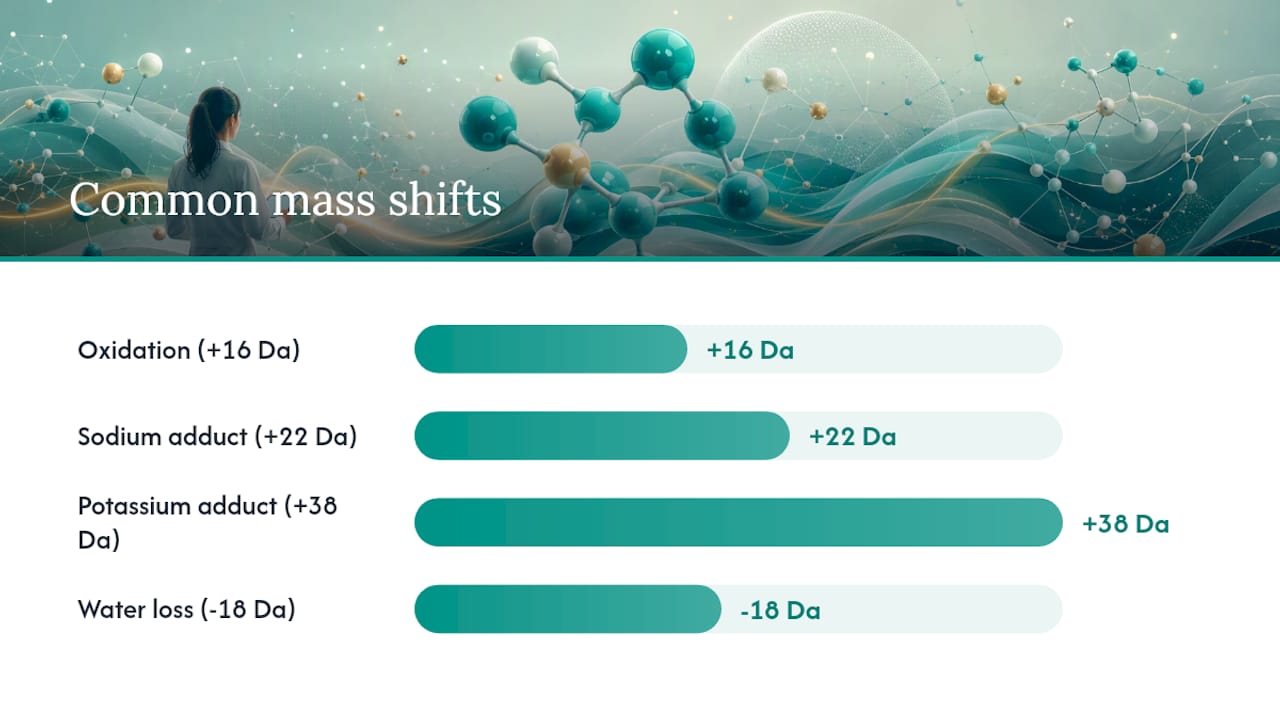
Deviation of just a few Da from theoretical mass often points to a specific, identifiable cause rather than random error.
- +16 Da: usually oxidation, often at methionine or tryptophan
- +22 Da: sodium adduct; +38 Da: potassium adduct
- -18 Da: water loss or cyclization
- Residue deletion: mass shift matches the missing amino acid's residue mass
These common mass deviations are diagnostic enough to guide troubleshooting without additional testing in many cases. Where intact mass genuinely can't settle the question, particularly with isobaric residues like leucine and isoleucine that share identical mass, MS/MS becomes mandatory rather than optional. No amount of mass accuracy resolves a leucine-versus-isoleucine swap; only fragmentation data can.
The COA Checklist That Separates Real Identity Proof From Marketing
A COA that actually confirms identity reports specific, checkable numbers, not adjectives. Expect the analytical method and instrument model, theoretical mass, observed mass with charge state and delta, an annotated chromatogram, MS/MS spectra where sequence ambiguity applies, lot number, analyst, and test date. Our own guide to reading a peptide COA walks through each field in more depth.
Reject a COA, or ask for more, when you see any of these:
- "Pass" or "Confirmed" with no numeric mass value attached
- A mass value with no stated delta or tolerance window
- No chromatographic retention time tied to the mass measurement
- No lot number linking the document to a specific batch
- No offer to provide raw files on request
Vendor documentation that only summarizes results without raw fragmentation data is common enough that independent verification often requires requesting the underlying files directly. Raw .raw or .mzML exports let you or a third party re-run the interpretation independently rather than trusting a summary line.
Chain of Custody: Making Sure the COA Matches the Vial
A COA is only as good as the paper trail connecting it to the exact vial in front of you. That trail needs a unique lot ID, barcode or RFID scan events at each handling step, a QC report explicitly linked to that lot number, and storage and shipment logs covering temperature and transit time.
Per-lot testing matters because pooled or batch-level testing can mask a single contaminated or mislabeled lot. Labs that segregate lots and retain samples for spot reanalysis catch problems faster when something looks off downstream, and barcode-based tracking tied to LIMS or ELN systems shortens root-cause investigations considerably.
- Unique lot ID printed on the vial and matching the COA
- Scan events documenting custody transfer
- QC report referencing that specific lot number
- Storage and shipment logs available on request
Verifying lot numbers against product labels is a two-minute check worth doing every time; our guide to decoding peptide labels covers what those printed codes should actually tell you.
How Peptastic Labs Documents Identity: A Working Example
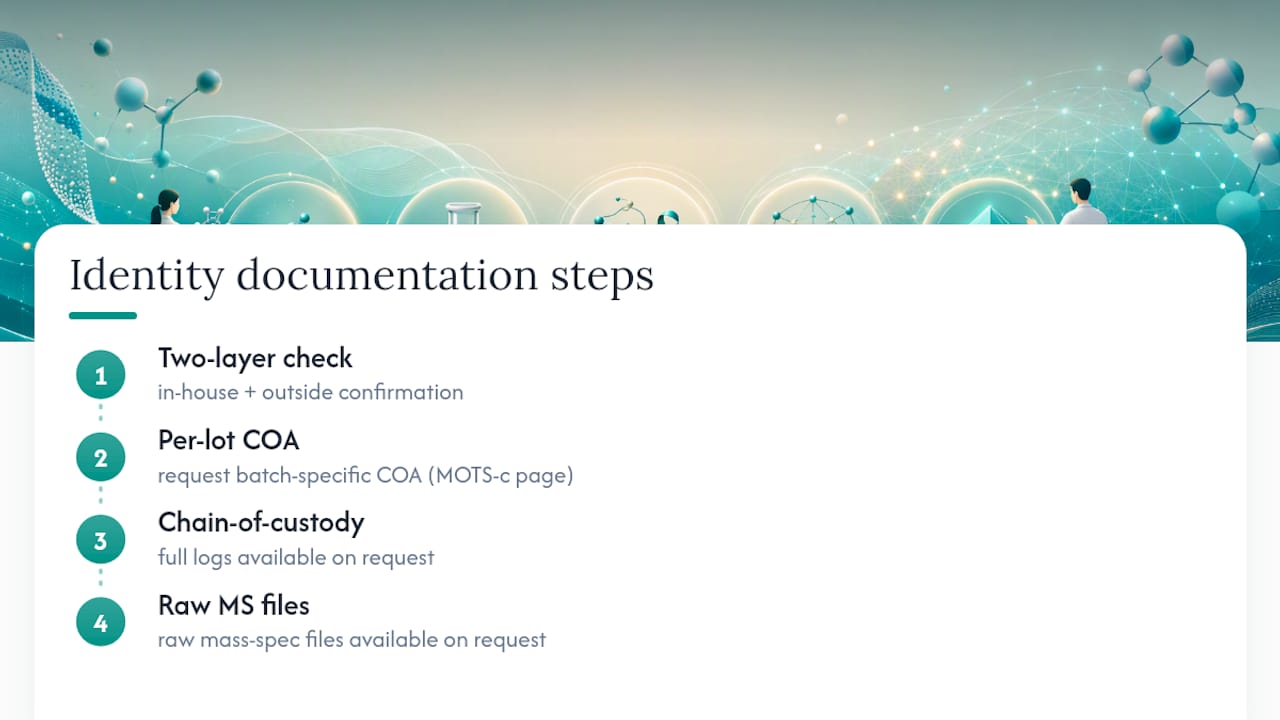
That two-layer structure, in-house plus outside confirmation, is exactly the redundancy this article recommends researchers demand from any supplier.
Every product carries batch-specific documentation, and researchers can request the per-lot COA directly, as shown on the MOTS-c product page. Full chain-of-custody logs and raw MS files are available on request for labs that need independent re-verification.,,
A Pragmatic Testing Priority for Researchers on a Budget
If you can only run one confirmation stack, pair HPLC purity data with LC-HRMS intact mass, and reserve MS/MS for peptides with ambiguous or isobaric sequences. Outsource full peptide mapping when your lab lacks tandem MS capability rather than skipping the check. Before accepting any result, decide three things upfront: what data you actually need, what tolerance you'll accept, and what custody proof ties that data to your specific vial.
— Tintastic
Explore Peptastic Labs' full peptide catalog for research-grade compounds supplied with batch documentation and Certificates of Analysis on request, or visit Peptasticlabs to review the verification process behind each listed purity value.
Sources
- UHPLC-HRMS protocol for peptide pool identity confirmation (MDPI study)
- Mass spectrometry for peptide sequencing — Peptide Insider (2026)