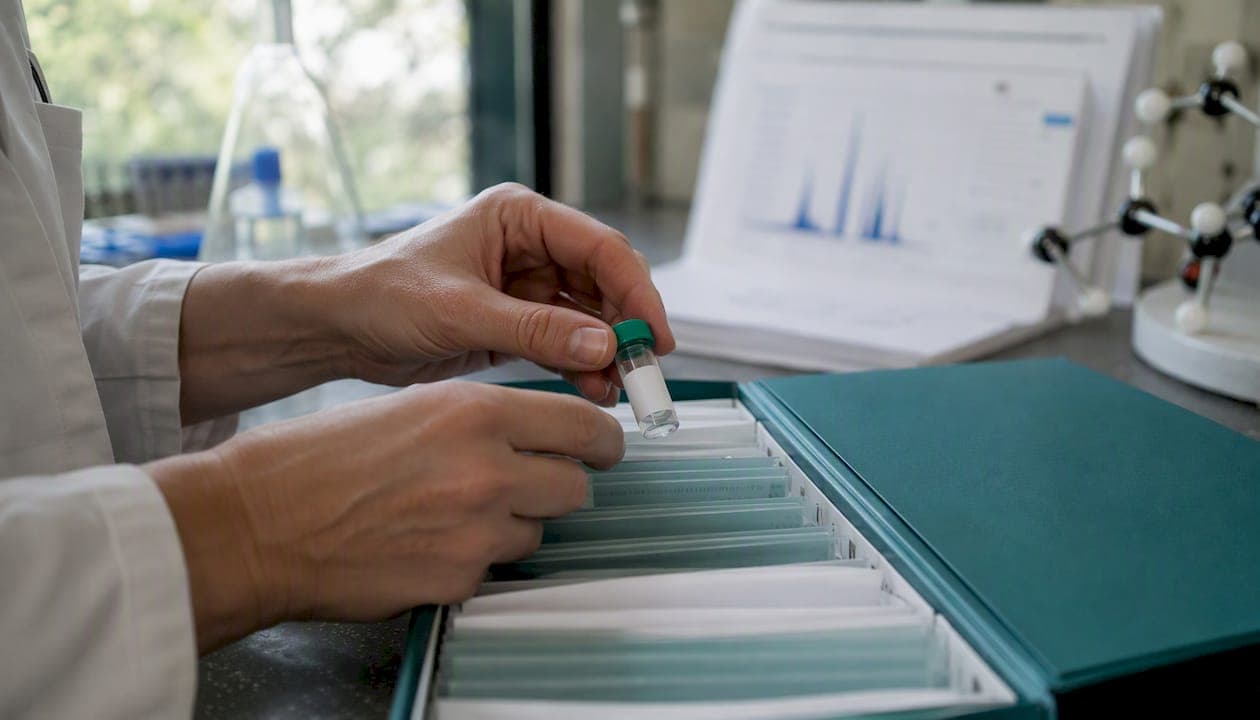
A complete peptide batch file requires identity evidence, batch linkage across every document, a Certificate of Analysis paired with raw analytical outputs (HPLC chromatogram, LC-MS), assay/net peptide content, water and counter-ion data, a defined impurity profile, stability and storage history, retention sample records, traceability logs, and reviewer sign-off. Any file missing one of these cannot be verified independently.
Before accepting a batch, request:
- The batch-specific COA with matching lot number
- Raw HPLC chromatogram and LC-MS identity data
- Water content and counter-ion analysis
- Stability/storage documentation and retention sample reference
Check one thing first: do the batch numbers on the COA, the HPLC output, the LC-MS data, and the physical label all match? If they don't, stop there. Nothing downstream matters until that's fixed.
Key Takeaways
Complete peptide batch documentation requires identity evidence, matched batch numbers across every document, and raw analytical data supporting every reported result.
| Point | Details |
|---|---|
| Verify batch linkage first | Confirm the batch number matches across the COA, HPLC chromatogram, LC-MS data, and physical label before anything else. |
| Demand raw data, not summaries | A COA without an attached chromatogram or spectrum can't be independently verified. |
| Correct for water and counter-ion | Net peptide content requires subtracting water (Karl Fischer) and counter-ion mass from the total weight. |
| Document split or pooled batches | Written justification and sub-lot to commercial-lot mapping are required for traceability. |
| Choose a supplier with third-party verification | Peptastic Labs pairs in-house QC with independent verification and provides COAs with matching batch documentation on request. |
Where to Verify These Standards Directly
- EMA's synthetic peptide guideline: batch traceability, splitting/pooling justification, and impurity comparability
- USP's reference standard guidance: value assignment and fill-weight homogeneity targets
- Peptide Research Glossary: plain-language definitions for technical terms used across batch documentation
Table of Contents
- What Belongs in a Peptide Batch Documentation Checklist?
- How Do You Document Peptide Identity?
- Which Purity and Impurity Data Should Appear on a COA?
- How Do You Report Water Content, Counter-Ion, and Net Peptide Content?
- Which Analytical Methods Should Appear on a COA?
- How Should Lot Release and Traceability Records Work?
- How Do You Set Acceptance Criteria and Handle Comparability?
- What Stability and Storage Records Belong in the Batch File?
- What Documentation Gaps Show Up Most Often?
- How Does Peptastic Labs Structure a Batch File?
- Frequently Asked Questions
- Sources
What Belongs in a Peptide Batch Documentation Checklist?
A release file is only as useful as its structure. Reviewers waste time hunting through unorganized folders, and that delay compounds when a paper is under revision and an editor wants supporting data fast.
Build the file around six components: a cover sheet and batch summary, the COA with its raw data, method descriptions, a stability and storage log, traceability and production history, and a retention-sample record with any deviation or CAPA notes attached.
Some of this belongs on a public-facing document a customer receives; some stays internal. The COA and batch summary go out with the product. Raw instrument files, internal deviation reports, and retention sample logs stay with the lab or manufacturer, linked by lot number so they can be produced on request.
A minimal file structure for your electronic lab notebook (ELN) or QC system:
- Cover sheet with batch number, product name, release date, and reviewer signature
- COA plus raw HPLC chromatogram and LC-MS spectra
- Method descriptions and instrument metadata
- Water content, counter-ion, and net peptide content calculations
- Stability and storage log
- Retention sample ID and storage location
This mirrors the document checklist framework that treats the COA as central but never sufficient on its own.
How Do You Document Peptide Identity?
Identity evidence has to stand on its own, independent of any purity number. A COA that states "identity confirmed" without supporting data is not verifiable.
Include these items in every batch file:
- The full sequence, including any modifications (acetylation, amidation, disulfide bridges)
- Theoretical monoisotopic and average mass
- Raw and annotated LC-MS spectra
- Peptide mapping or MS/MS fragmentation data, when the synthesis route calls for it
- Chromatographic retention time under the stated method conditions
Batch linkage is what turns scattered files into a defensible record. The label, the COA lot number, the analysis date, and the instrument run ID all need to point to the same event. If your LC-MS file is dated three weeks after the COA, that's a discrepancy worth resolving before release, not after.
Pro Tip: Name LC-MS files with the batch number, analysis date, and instrument ID in the filename itself (e.g., BT2409-LCMS-20260214-QE01.pdf). Annotate the spectrum directly on the image with observed mass, theoretical mass, and mass error in ppm, so the file is self-explanatory five years from now without needing the original analyst.
Which Purity and Impurity Data Should Appear on a COA?
Three numbers do most of the work on a peptide COA: main peak percentage by HPLC, the sum of related peptide impurities, and total impurities. Each should be reported with the method and wavelength used to generate it, not just the final figure.
Unknown peaks need a policy, not a shrug. If a peak can't be identified, report it by relative retention time and area percentage rather than omitting it. Combined-peak limits are acceptable when baseline separation isn't achievable, but that has to be stated explicitly rather than buried in a footnote.
- Main peak % (HPLC) at the stated wavelength
- Related peptides, individually and summed
- Total impurities, including unidentified peaks by relative retention time
- Any peaks excluded from purity calculation and the justification
When a batch shows unresolved peaks that can't be baseline-separated, reporting them as a combined limit is standard practice rather than a red flag, provided the chromatogram is included so a reviewer can see the resolution problem directly. Reading the chromatogram alongside the stated purity value is the only way to catch a co-eluting impurity that a summary number would otherwise hide.
How Do You Report Water Content, Counter-Ion, and Net Peptide Content?
Peptide salts absorb water and carry counter-ions (acetate, trifluoroacetate, hydrochloride) that add mass without contributing peptide.
- Karl Fischer titration for water content, reported as a percentage by weight
- Ion chromatography or a validated counter-ion assay where the synthesis route uses TFA or acetate salts
- Net peptide content calculated by subtracting water and counter-ion mass from total mass, then correcting against HPLC purity
Net peptide content lands closer to 82% to 85% of the vial's total weight once both corrections are applied. Record physical state (lyophilized powder vs. solution) on both the label and the COA so downstream users know which basis the numbers use.
Which Analytical Methods Should Appear on a COA?
A results table without method context is unverifiable. List the instrument model, column type and dimensions, mobile phase composition, gradient profile, run time, injection volume, and detector wavelength for every method cited. Add the calibration or standardization approach and a run ID that ties back to the raw data file.
Raw chromatograms and mass spectra should travel with the COA, not sit in a drawer somewhere. A method SOP reference lets an independent lab attempt to reproduce the result, which is the entire point of documentation in the first place. This is also where USP's reference standard framework becomes relevant.
- Instrument model, column, and mobile phase composition
- Gradient, run time, and injection volume
- Detector wavelength and calibration approach
- System suitability results tied to the run ID
Pro Tip: The minimum a later reviewer needs to reproduce your interpretation: retention time acceptance windows, mass tolerance in ppm for MS identity confirmation, and the system suitability pass/fail criteria used at the time of the run. Without those three, a reviewer is just trusting your conclusion instead of checking it.
How Should Lot Release and Traceability Records Work?
A defensible release process follows a fixed sequence, and each step should leave a timestamped record: receiving inspection, analytical testing, QC review, reviewer sign-off, and release to inventory. Skipping the sign-off step, or leaving it undated, is one of the more common gaps that surfaces during publication review.
Retention samples anchor the whole system. Keep at least one to two vials per batch, stored under the same conditions stated on the label, labeled with the batch number and retention date, and referenced directly in the release file.
- Log receipt with date, quantity, and supplier lot reference
- Complete analytical testing and attach raw data to the batch file
- QC review against pre-set specifications
- Reviewer sign-off with name, date, and decision
- Release to inventory with retention sample ID recorded
When batches are split or pooled, EMA guidance expects a written justification and a clear map from sub-lot IDs back to the commercial batch number, preserving single-source traceability. Standardized ELN fields for vendor, internal lab ID, and aliquot tracking make this far less error-prone than free-text notes.
How Do You Set Acceptance Criteria and Handle Comparability?
Specifications should come from data, not assumption. Support proposed purity and impurity limits with results from representative batches, and if the compound has preclinical or clinical history, tie the limits to what those batches actually showed rather than a round number that looks tidy on paper.
Impurity qualification follows a similar logic: an impurity gets qualified against safety data at the observed level, and combined-peak limits are acceptable when individual quantification isn't feasible, as long as that's documented.
- Base limits on data from multiple representative batches
- Qualify new impurities against the level actually observed, not a worst case
- Document any method change and its effect on the impurity profile before treating results as comparable
EMA guidance on synthetic peptides states that when analytical methods improve and reveal new impurities, manufacturers must compare the impurity profile across batches and discuss the impact on quality, drawing on any supporting nonclinical data available.
What Stability and Storage Records Belong in the Batch File?
Stability data justifies how long a batch stays usable and under what conditions. The batch file should include accelerated and real-time stability summaries where available, temperature logs for storage, transport condition records if the material shipped internationally, and a stated retest or expiry date.
- Accelerated and real-time stability data summaries
- Storage temperature logs from receipt through use
- Transport condition records, especially for cold-chain shipments
- Retest or expiry date with the evidence supporting it
Stability data from earlier production batches can support a retest date on a new batch, provided the manufacturing process hasn't changed. Record the sample's age and full storage history at T=0 receipt, then log ongoing storage conditions rather than assuming the cover sheet date tells the whole story. Poor storage documentation is one of the more overlooked reasons batches fail retesting.
What Documentation Gaps Show Up Most Often?
The same handful of gaps account for most publication-stage delays: missing batch linkage between the COA and the label, a COA with no chromatogram attached, mismatched analysis dates or instrument IDs across documents, no retention sample on file, and split or pooled batches with no written justification.
Run this before accepting any batch for use:
- Confirm batch number matches across COA, HPLC output, LC-MS data, and label
- Verify the COA includes a raw chromatogram, not just a summary purity value
- Check analysis dates against instrument run logs for consistency
- Confirm a retention sample exists and is linked to the batch record
- Request written justification if the batch was split or pooled
On delivery, a five-minute check of these five items catches the majority of problems before they become a reviewer's question during peer review, when fixing them is far more disruptive.
How Does Peptastic Labs Structure a Batch File?
Every Peptastic Labs batch file follows the same field structure: cover sheet with batch and product identifiers, COA mapped directly to the HPLC method that generated it, retention sample ID with storage location, method references for each analytical test, and stability notes tied to storage conditions.
That mapping is what lets a reviewer move from a COA line item straight to the method that produced it, without a follow-up email. In-house QC combined with third-party verification supports the numbers on the certificate rather than leaving them as an unverified claim.
- Cover sheet fields: batch number, product name, release date, reviewer
- COA mapped to method ID and raw chromatogram
- Retention sample ID cross-referenced to storage log
Pro Tip: Keep file names and metadata tags consistent across every document in a batch (same batch number, same date format) so the entire set stays searchable years later, whether it's sitting in a shared drive or an ELN.
How Did Better Documentation Change Review Speed in Practice?
Standardizing batch linkage across COAs, chromatograms, and retention records cuts the back-and-forth that used to eat up peer review. A reviewer who can trace a purity number straight to its chromatogram in one file rarely comes back with a second question. That's the entire value of the checklist: fewer follow-up emails, faster sign-off, and a file that still makes sense to someone reading it two years later.
Get Batch Documentation and Independently Tested Peptides
Peptastic Labs supplies research-grade peptides at ≥99% purity, HPLC-verified, with full batch documentation and Certificates of Analysis available on request. Every compound in the catalog runs through in-house QC and third-party verification before it ships.
If your current supplier can't produce a chromatogram to match their COA, that's worth addressing before your next order. Visit Peptastic Labs to request batch documentation for a specific lot or ask about custom testing for an upcoming study.
Frequently Asked Questions
What's the difference between a batch report and a Certificate of Analysis? A batch report typically covers the full production and testing history for a lot, while a COA is the summary document showing test results against specifications for that specific batch. The COA is what ships with the product; the fuller batch report often stays with the manufacturer for internal or audit purposes.
Does a COA need to include the actual chromatogram? The COA itself usually reports summary values, but the supporting raw chromatogram should be available on request or attached as supplementary documentation. A purity percentage without the chromatogram behind it can't be independently checked.
How long should retention samples be kept? Retention timelines vary by lab policy and intended use, but keeping at least one to two vials per batch under label-stated storage conditions until the study or publication cycle concludes is standard practice.
What should I do if I find an out-of-specification result? Document the deviation immediately: batch number, the specific test, the result, the specification it failed, and the investigation into root cause. Don't release the batch until QC review resolves whether the result reflects a real quality issue or a testing error.
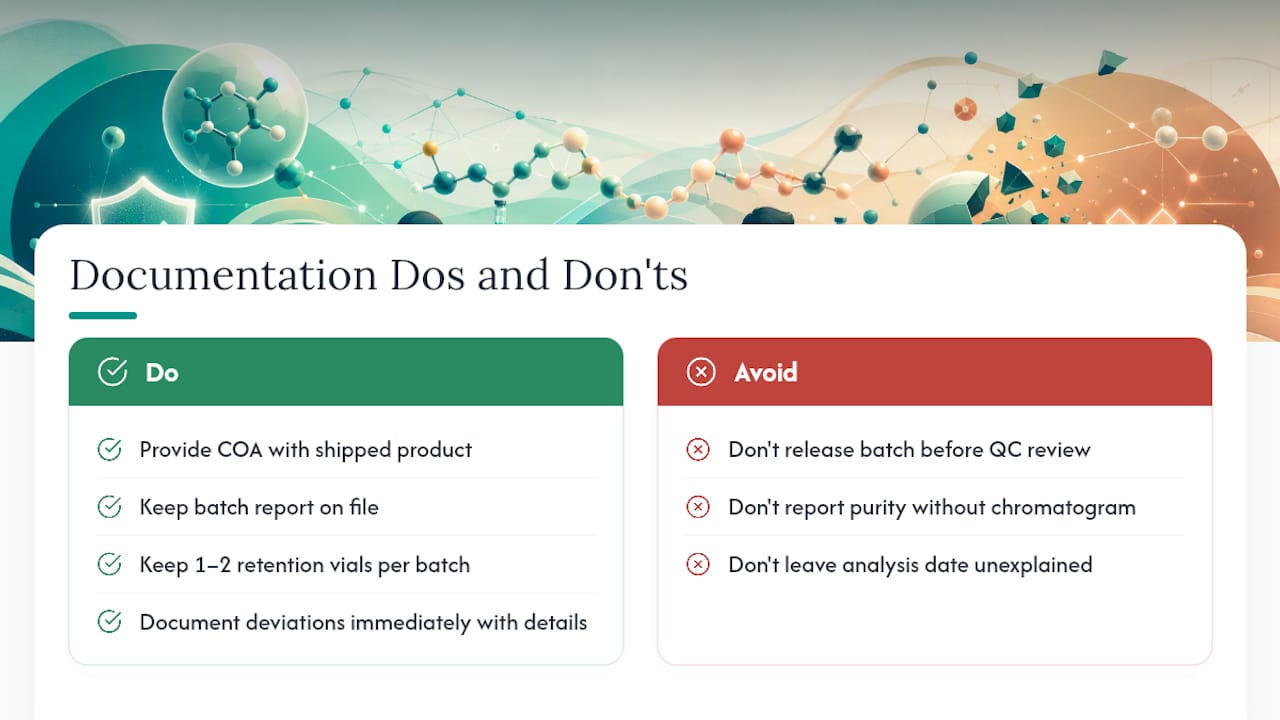
Is a mismatched analysis date across documents always a problem? Not always, but it needs an explanation. Retesting, re-analysis after a method change, or delayed data entry can all produce a date mismatch. The issue is an unexplained mismatch with no note in the batch file.
Sources
- Guideline on the Development and Manufacture of Synthetic Peptides
- Reference Standards to Support Quality of Synthetic Peptide Therapeutics
- Research-Grade Peptide Shipment Documents Checklist | WUMO Peptide