
Selank research shows reproducible anxiolytic effects across clinical and preclinical studies, along with measurable, time-dependent changes in brain gene expression tied to GABAergic signaling and immune-related pathways. Evidence spans psychometric clinical trials, RNA-seq and PCR transcriptomic work, and rodent behavioral models, including combination studies with diazepam. Selank holds regulatory approval in Russia but remains investigational elsewhere, available to qualified researchers as a research-grade compound rather than an approved therapeutic.
TL;DR:
- Rapid responders to Selank exhibit EEG changes within days, including increased beta activity and decreased theta and alpha power, indicating reduced cortical arousal.
- Dosing in human studies typically involves 2,700 micrograms per day intranasally over two weeks, with early effects often appearing within three days for some patients.
- Selank's gene expression effects peak around one to three hours after administration, with changes affecting GABAergic and immune-related genes, particularly during early treatment windows.
- Safety profiles in small trials are favorable, with no noticeable side effects reported, but the limited sample sizes mean rare adverse events cannot be ruled out.
- Larger, blinded trials with comprehensive early biomarker and gene-expression sampling are needed to confirm clinical efficacy and solidify Selank’s mechanism of action.
Table of Contents
- Clinical Evidence for Selank in Generalized Anxiety Disorder
- How Does Selank Affect Gene Expression in the Brain?
- What Do Animal Studies Show About Selank's Anxiolytic Effects?
- What Is the Typical Selank Dosage Used in Research?
- Is Selank Safe? Adverse Effects and Regulatory Status
- Where Does Selank Research Need to Go Next?
- Why Documented Peptide Sourcing Matters for Selank Studies
- What the Research Actually Supports
- Sourcing Research-Grade Selank for Reproducible Studies
- Primary Sources on Selank Research
- Sources
- FAQ
Clinical Evidence for Selank in Generalized Anxiety Disorder
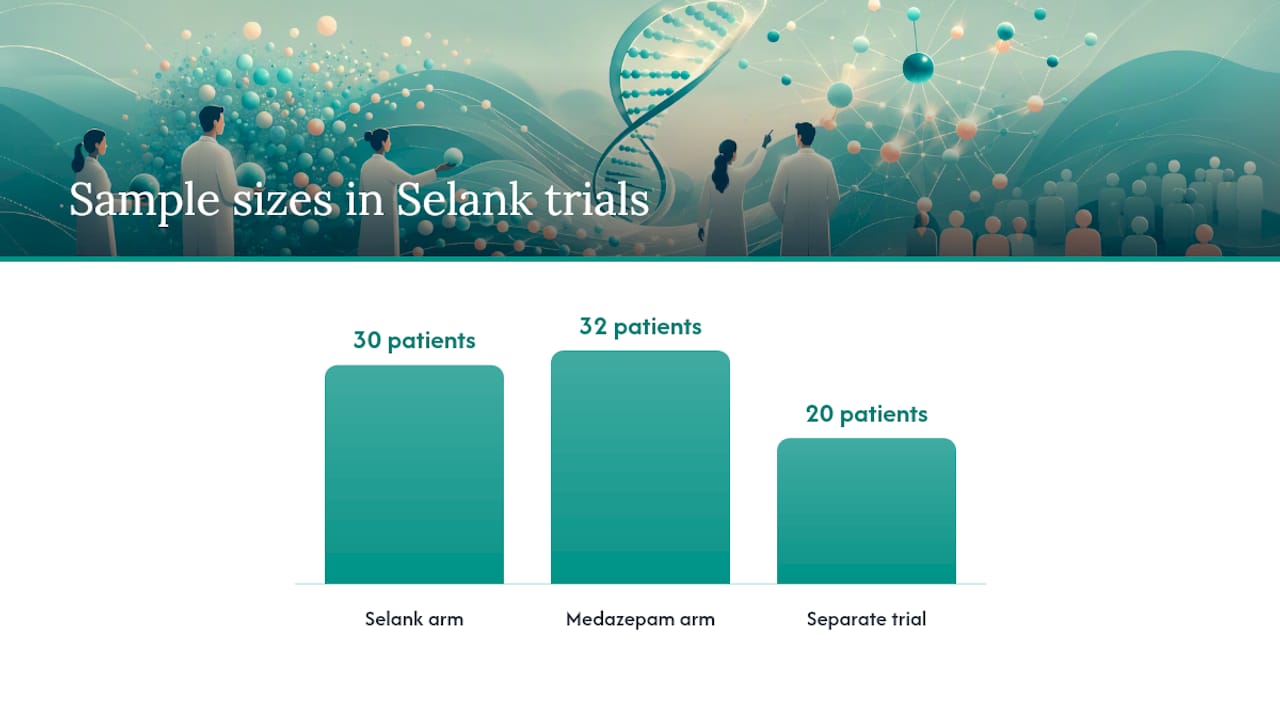
The strongest human data on Selank comes from a comparative trial pitting it against medazepam, a benzodiazepine already established for anxiety treatment. Researchers enrolled 62 patients split into two arms, 30 receiving Selank and 32 receiving medazepam, and tracked outcomes using the Hamilton Anxiety Rating Scale, the Zung Self-Rating Anxiety Scale, and the Clinical Global Impression scale. The comparative study of Selank's efficacy and mechanisms found anxiolytic effects comparable between the two treatments, but Selank also produced antiasthenic and mild psychostimulant effects that medazepam did not.
That last point matters for anyone designing a follow-up trial. A benzodiazepine sedates; Selank appears to calm without the same drag on alertness. The study also tracked serum tau(1/2) leu-enkephalin, an opioid peptide fragment, and found increases correlated with symptom improvement. That's a biomarker candidate worth carrying into future protocols, since it gives researchers something objective to measure alongside subjective scale scores.
Selank shows in one clinical series that response speed varies dramatically between patients, and that variability has a physiological signature. A separate trial of 20 patients with generalized anxiety disorder tested intranasal Selank at 2,700 micrograms per day and split responders into two groups. The rapid and slow responder study reported:
- A subset of patients were rapid responders, with HARS scores dropping substantially within the first three days.
- The remaining patients were conventional responders, reaching a comparable reduction over a longer treatment period.
- Rapid responders showed distinct EEG changes, specifically increased beta activity and decreased theta and alpha power, a pattern that tracks with reduced cortical arousal rather than sedation.
That EEG signature is one of the more interesting findings buried in Selank studies. It suggests rapid response isn't random. It has a measurable brain-wave correlate, which means EEG could eventually serve as a screening tool to predict who responds fast and who needs a longer treatment window.
The critical caveat here is scale. A trial of 20 or 62 patients tells you a treatment effect exists, not how robust it is across a broader population. Neither study used the double-blind, placebo-controlled design that regulators in the United States or the European Union expect before granting approval. The reported absence of noticeable side effects in the Selank vs medazepam trial is encouraging, but a sample that small can't rule out rarer adverse events.
For researchers building on this evidence base, the practical takeaway is timing. Rapid responder EEG changes appeared within days, not weeks, which means any trial evaluating Selank benefits for anxiety should schedule assessments early, not just at the conventional two week or four week marks that most anxiolytic trials default to. Missing the early window means missing the subgroup that actually distinguishes Selank's mechanism from a standard benzodiazepine's.
How Does Selank Affect Gene Expression in the Brain?
Selank's most distinctive research signal isn't behavioral. It's transcriptomic. Real-time PCR and RNA-seq studies in rat frontal cortex show that Selank alters expression of dozens of genes tied to GABAergic neurotransmission, and the direction and timing of those changes follow a pattern distinct from GABA itself.
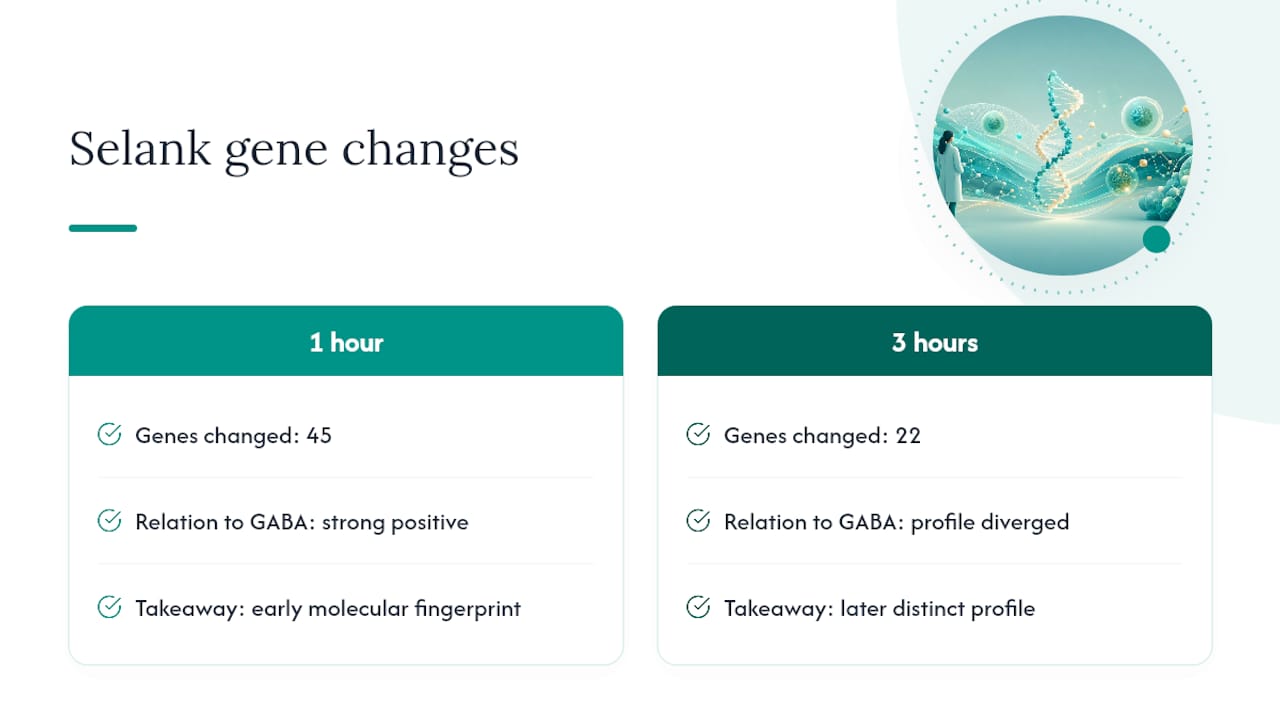
The PCR study on Selank and GABAergic gene expression found 45 genes changed one hour after administration and 22 genes changed at the three-hour mark, a sharp drop-off that points to a narrow window for capturing Selank's early molecular fingerprint. Selank's early-phase changes correlated strongly and positively with GABA-induced changes, but the three-hour profile diverged, suggesting Selank isn't simply mimicking GABA's transcriptional footprint over time.
A separate line of research pushes the transcriptomic picture into injury models. In a rat middle cerebral artery occlusion (tMCAO) stroke model, RNA-seq identified 118 differentially expressed genes at 4.5 hours after Selank administration, using a threshold of fold change greater than 1.5 and adjusted p-value below 0.05. Ninety-nine of those genes were downregulated, and Selank counteracted the ischemia-driven upregulation of genes tied to neuroreception and immune signaling, including Cd68 and Cd74, both markers associated with microglial activation and antigen presentation.
That immune angle isn't a side note. Selank derives from tuftsin, an immunomodulatory peptide fragment, and its transcriptomic effects during cerebral ischemia consistently surface complement and antigen-presentation genes alongside the expected neurotransmission targets. Researchers running Selank transcriptomics without an immune-gene panel are likely missing part of the mechanism.
What does this mean mechanistically? The prevailing interpretation is that Selank acts as a positive allosteric modulator of GABA-A receptors, adjusting the receptor's affinity for GABA rather than binding as a direct ligand the way classic benzodiazepines do. That distinction would explain why Selank produces benzodiazepine-like calming effects in clinical trials while avoiding the sedation and dependence risk associated with direct GABA-A agonists, though this mechanistic model still needs confirmation through receptor-binding studies rather than transcriptomic inference alone.
For translational work, the timing lesson is the one to internalize. A single-timepoint transcriptomic study, sampled only at 24 hours or a week out, would miss both the 1 hour downregulation phase and the 3 hour reversal entirely. Any human study attempting to bridge Selank's mechanism of action to gene-expression biomarkers needs multiple early sampling points, not a single post-treatment draw.
What Do Animal Studies Show About Selank's Anxiolytic Effects?
Rodent behavioral studies back up the transcriptomic story with functional outcomes, and one combination study stands out for what it implies about Selank's place alongside existing anxiolytic drugs.
- In elevated plus maze testing under unpredictable chronic mild stress (UCMS), Selank alone reduced anxiety-like behavior in rats, measured by increased time spent in open arms.
- Combining Selank with diazepam produced a stronger anxiolytic effect than either compound administered alone, particularly under chronic stress conditions, according to the Selank and diazepam combination study.
- The tMCAO stroke model showed Selank's transcriptomic neuroprotection extended to immune-gene compensation, with the peptide dampening the injury-driven surge in microglial activation markers rather than simply blunting anxiety-related circuits.
The diazepam combination data raises a real clinical question: could Selank allow lower benzodiazepine doses in patients under sustained stress, reducing dependence risk while preserving efficacy? The rodent data supports that hypothesis, but no human combination trial has tested it yet.
Doses in these animal studies were administered intranasally or via injection at microgram-per-kilogram ranges scaled to rodent body weight, a scaling approach that doesn't translate cleanly to the 2,700 microgram daily doses used in the human GAD trial. Body-surface-area scaling and species differences in nasal mucosa absorption both complicate direct extrapolation, which is one reason preclinical anxiolytic signals, however consistent, haven't yet produced a large-scale human confirmation.
What Is the Typical Selank Dosage Used in Research?
Intranasal administration dominates the Selank literature, largely because the peptide's short half-life and poor oral bioavailability make nasal delivery the practical route for both rodent and human studies.
- The clinical rapid/slow responder trial used 2,700 micrograms per day, delivered intranasally, over a 14-day treatment course.
- Separate EEG-focused work has evaluated single doses around 900 micrograms to characterize acute electrophysiological effects.
- Rodent studies typically use microgram-per-kilogram dosing scaled to body weight, administered once or across repeated sessions depending on the behavioral protocol.
Onset varies by responder type. Rapid responders in the GAD trial showed measurable HARS score drops within one to three days, paired with the beta-up, theta-alpha-down EEG shift described earlier. Conventional responders needed the full 14-day window to reach a comparable reduction. That split is the single most reproducible pharmacodynamic finding in the human literature, and it should shape how any new trial defines its primary endpoint window.
Robust human pharmacokinetic data, absorption curves, distribution, metabolism, and elimination profiles, remain thin. Most published work focuses on pharmacodynamic outcomes (anxiety scores, EEG, gene expression) rather than tracking Selank's plasma concentration over time. That gap is one of the more consequential blind spots in the field.
Pro Tip: If you're designing a Selank protocol, don't rely on a single endpoint measurement. Layer psychometric scales (HARS or Zung) with EEG readings and, where feasible, transcriptomic sampling at multiple early time points, since the one-hour and three-hour gene-expression windows shown in PCR studies suggest a fast-moving biological effect that a single 24-hour check will miss entirely.
Is Selank Safe? Adverse Effects and Regulatory Status
Reported safety signals across published Selank trials are reassuring but thin. The Selank vs medazepam comparison specifically noted no noticeable side effects in the Selank arm, and other clinical reports describe a similarly clean tolerability profile. That's a meaningfully different picture from benzodiazepines, which carry well-documented sedation, dependence, and withdrawal risks.
- No major adverse events have been reported in the published Selank trials reviewed here, though sample sizes remain small.
- The absence of classic benzodiazepine side effects (sedation, motor impairment) is consistent with the proposed allosteric, rather than direct-ligand, mechanism at GABA-A receptors.
- Regulators outside Russia have not approved Selank, primarily because the existing trials lack the scale, blinding, and standardized methodology that agencies like the FDA or EMA require for a new anxiolytic.
Selank is approved in Russia for generalized anxiety disorder, a status that reflects the country's own regulatory pathway rather than an international consensus on safety and efficacy. In markets where Selank isn't approved, including Australia, it is available only as a research compound, not as a treatment, and should be sourced and handled accordingly by qualified researchers working within institutional or laboratory settings. Anyone considering off-label or unregulated Selank sourcing outside a research context should recognize that quality control, purity, and dosing accuracy are not guaranteed outside documented research-grade supply chains.
Where Does Selank Research Need to Go Next?
The evidence base is promising but narrow. Closing the gap between preclinical mechanism and clinical confidence requires a specific set of next steps:
- Run larger, blinded randomized trials. Phase II or III designs with placebo controls and sample sizes well beyond the 20 to 62 patients seen so far would let regulators evaluate Selank on the same footing as existing anxiolytics.
- Characterize human pharmacokinetics. Absorption, distribution, metabolism, and elimination data are largely missing and would clarify dosing precision.
- Standardize transcriptomic sampling. Future studies should sample at 1 hour, 3 hours, and 4.5 hours post-dose to capture the full early gene-expression arc already documented in rodent work.
- Track EEG and serum enkephalin together. Pairing electrophysiology with biomarker data could turn rapid-responder prediction into a validated screening tool.
- Test combination protocols formally. The diazepam synergy seen in rodents deserves a human trial designed around dose-reduction outcomes, not just anxiolytic efficacy alone.
Why Documented Peptide Sourcing Matters for Selank Studies
Transcriptomic and behavioral endpoints are sensitive to contamination and purity variance in ways that blunt or distort results. A batch of Selank with unverified purity can introduce noise into RNA-seq data that looks like biological variability but is really a sourcing artifact.
Peptastic Labs supplies research-grade Selank verified to 99% purity or higher via HPLC, with full batch documentation and Certificates of Analysis available on request. For researchers designing gene-expression or behavioral protocols, that documentation isn't paperwork for its own sake. It's the baseline that keeps an unexpected result attributable to biology, not to an unverified compound.
A basic procurement checklist before ordering:
- Request the Certificate of Analysis and confirm HPLC purity percentage.
- Ask for the material safety data sheet and storage/stability guidance.
- Confirm batch traceability, especially if the study spans multiple orders over time.
- Verify reconstitution instructions match the intended administration route (intranasal delivery has specific solvent and concentration requirements).
What the Research Actually Supports
The honest read on Selank research is that the mechanistic story is more convincing than the clinical story, at least for now. The transcriptomic work, particularly the time-resolved PCR and RNA-seq findings, gives a coherent, reproducible picture of how Selank interacts with GABAergic and immune-related gene networks. That's not something you see in every peptide with anxiolytic claims attached to it.
The clinical trials are a different matter. They're real, they're published, and the responder-timing and EEG data are genuinely useful. But two trials totaling roughly 80 patients combined can't carry the weight some marketing claims put on them. The rapid responder EEG signature deserves replication in a larger cohort before anyone treats it as established.
If you're building a research program around Selank, prioritize the gene-expression timing data as your most trustworthy foundation, and treat the clinical efficacy claims as a strong hypothesis rather than settled fact. The next meaningful advance in this field will come from someone running a properly powered, blinded trial that finally connects the transcriptomic signal to a clinical endpoint at scale.
— Tintastic
Sourcing Research-Grade Selank for Reproducible Studies
Research labs require Selank at documented purity to ensure compound reliability before experiments, avoiding batch variability that can confound RNA-seq results. Every listing includes HPLC verification at 99% purity or above, with Certificates of Analysis available on request, so variability in your results traces back to biology rather than an unverified supply chain.
This positioning is strictly for qualified researchers working in laboratory or institutional settings. Peptastic Labs does not market Selank as a treatment, and nothing here substitutes for the regulatory pathway a compound needs before clinical use. What Peptastic Labs offers is the documentation layer that reproducible research depends on: batch traceability, purity verification, and paperwork that holds up if a reviewer asks where your material came from.
If your next protocol needs Selank sourced with that level of documentation, the Selank product page lists current specifications and purity data, and the full research-grade peptide catalog covers related compounds if your study design expands. Request a Certificate of Analysis before your next order and build your sourcing paperwork into the protocol from day one.
Primary Sources on Selank Research
- PCR study on GABAergic gene expression: time-resolved changes in GABA-related genes at 1 and 3 hours post-dose.
- Selank and diazepam combination study: rodent UCMS behavioral data on Selank's anxiolytic and diazepam-enhancing effects.
- Rapid and slow responder clinical trial: responder-timing and EEG correlate data in GAD patients.
- Selank vs medazepam comparative trial: psychometric outcomes and serum enkephalin biomarker findings.
- PubMed Central database: gateway to the broader primary literature on Selank pharmacology.
This article is general information, not a substitute for advice from a qualified doctor. Consult a qualified healthcare professional about your own circumstances before acting on anything here.
Sources
- Selank administration affects the expression of some genes involved in GABAergic neurotransmission
- Peptide Selank enhances the effect of diazepam in reducing anxiety in unpredictable chronic mild stress conditions in rats
- P-1114 - Rapid and slow response during treatment of generalized anxiety disorder with peptide anxiolytic Selank
- Efficacy and possible mechanisms of action of a new peptide anxiolytic Selank in the therapy of generalized anxiety disorders and neurasthenia
FAQ
What Are the Risks of Taking Selank?
Published clinical trials report no noticeable side effects in small cohorts, but sample sizes remain too limited to rule out rarer risks, and no large-scale safety trial exists yet. Selank should be treated as a research compound with an incomplete safety profile outside its Russian regulatory approval.
Why Is Selank Not FDA Approved?
Existing human trials are too small and lack the blinded, placebo-controlled design that the FDA requires, with the largest studies enrolling around 20 to 62 patients combined. Until a properly powered Phase II or III trial is completed, Western regulators have no basis for approval.
What Does Selank Do to Your Body?
Selank appears to act as a positive allosteric modulator at GABA-A receptors, producing anxiolytic effects without the sedation typical of direct-acting benzodiazepines. Transcriptomic studies also show it alters expression of genes tied to GABAergic signaling and immune regulation, including microglial markers like Cd68 and Cd74.
How Long Does Selank Take to Work?
Rapid responders showed distinct EEG changes, including increased beta activity, that conventional responders did not display at the same early timepoint.