GHK-Cu is the glycyl-L-histidyl-L-lysine copper(II) complex, an endogenous regenerative peptide first isolated from human plasma and now one of the most extensively reviewed copper-binding tripeptides in dermal repair research. Its relevance to peptide sciences rests on three findings researchers keep returning to: plasma concentrations of the native peptide decline with age, from roughly 200 ng/mL at age 20 to about 80 ng/mL by age 60; its clearest experimental support comes from topical skin and wound-healing models rather than systemic administration; and it exerts wide-ranging effects on gene transcription that are genuinely useful but easy to overstate without careful context.
That last point matters more than most summaries admit. Broad claims about GHK-Cu "activating thousands of genes" circulate constantly in both cosmetic marketing and peer-reviewed literature, but the number traces back to specific Connectivity Map array analyses, not a universal biological constant. A researcher designing an experiment needs to know which claims hold up under which conditions, not just that the peptide is "active."
Here is what this article covers in detail:
- The biochemical identity of GHK-Cu and its endogenous role
- Mechanisms tying it to extracellular matrix remodeling, angiogenesis, and antioxidant signaling
- A calibrated review of in vitro, animal, and human evidence
- Formulation and stability considerations for topical versus injectable work
- Safety and regulatory boundaries relevant to research use
- Sourcing and quality-control practices for reproducible experiments
Key Takeaways
GHK-Cu's regenerative activity in topical and wound-healing models is well-documented, while systemic and injectable applications remain mechanistically supported but clinically unconfirmed.
| Point | Details |
|---|---|
| Strongest evidence is topical | Human trials support skin density and collagen improvements from topical application; injectable claims remain extrapolated. |
| Gene-expression figures need context | The often-cited "4,000 genes" claim comes from specific array studies and shouldn't be treated as universal. |
| Mechanisms center on ECM and angiogenesis | Collagen I/III/V, decorin, VEGF, FGF-2, and SOD upregulation are the best-replicated effects. |
| Formulation determines outcomes | Vehicle, pH, and Cu:peptide stoichiometry must be validated before results can be trusted. |
| Documentation prevents confounds | Batch-specific CoA and HPLC verification, such as those Peptastic Labs provides on its research-grade catalog, reduce the risk of impurity-driven artifacts. |
Table of Contents
- What Is GHK-Cu Peptide Sciences Studying, Exactly?
- How Does GHK-Cu Affect Gene Expression and Tissue Remodeling?
- What Does the Human and Animal Evidence Actually Show?
- How Should GHK-Cu Be Formulated and Stored for Research Use?
- Is GHK-Cu Safe, and What Is Its Regulatory Status?
- Where Should Researchers Source Research-Grade GHK-Cu?
- Primary Literature and Reviews Worth Consulting Next
- A Lab-Practice Note on Working With GHK-Cu
- Where to Source Documented Research-Grade GHK-Cu
- Frequently Asked Questions
- Sources
What Is GHK-Cu Peptide Sciences Studying, Exactly?
Peptide sciences research on GHK-Cu centers on a deceptively small molecule: a three-amino-acid chain (glycine, histidine, lysine) that binds copper(II) with unusually high affinity. That copper coordination isn't incidental. It's the functional core of the molecule. Free GHK has some biological activity on its own, but the copper-bound complex is the form found endogenously and the form driving most of the regenerative signaling documented in the literature.
GHK-Cu occurs naturally in human plasma, saliva, and urine. Its concentration in plasma is one of the more precisely quantified figures in this field: research measuring plasma GHK levels documented a drop from approximately 200 ng/mL in young adults to lower levels in older adults, a decline that tracks with the loss of tissue-repair capacity and collagen density seen across the same age range. This correlation is the biological rationale behind most exogenous GHK-Cu research: if the native molecule is falling off with age and its decline maps onto reduced regenerative capacity, restoring local concentrations becomes a testable hypothesis rather than a marketing claim.
A few structural details matter for anyone designing experiments:
- The Cu(II) complex forms with a stoichiometry that is sensitive to pH and to competing metal-binding proteins in solution.
- Human serum albumin carries a comparable copper-binding site, and albumin can compete with GHK for available copper in physiological fluids, which complicates interpretation of serum-based assays.
- The tripeptide is small enough that it's vulnerable to protease degradation in unbuffered biological media, so stability during an assay window is not something to assume.
- Analytical confirmation before use should include HPLC retention time matching against a reference standard and mass spectrometry to confirm molecular identity, not just a supplier's stated purity number.
Pro Tip: Before running any dose-response experiment, verify your working stock by HPLC on the same day you prepare dilutions. Copper peptide complexes can shift in Cu:peptide ratio during freeze-thaw cycles, and a stock that looked correct three weeks ago may no longer match its original Certificate of Analysis.
How Does GHK-Cu Affect Gene Expression and Tissue Remodeling?
The dominant mechanism reported across the literature is that GHK-Cu shifts cell populations away from inflammatory, catabolic programs and toward regenerative, matrix-building ones, largely by modulating gene transcription and delivering bioavailable copper to enzymes that need it. That framing, gene expression plus extracellular matrix (ECM) remodeling, is the throughline connecting nearly every downstream effect researchers report.
The 4,000-gene figure needs context, not repetition. The claim that GHK-Cu modulates several thousand genes originates from array and Connectivity Map-based analyses run in specific cell models under specific conditions. It is not a fixed property of the molecule that will replicate identically in every tissue type, every species, or every concentration range. Treat it as evidence that GHK-Cu has unusually broad transcriptional reach, not as a number you can cite as though it applies universally to your own experimental system.
Within that broad footprint, several effects recur consistently enough to be considered well-supported:
- Collagen synthesis. GHK-Cu upregulates collagen types I, III, and V in dermal fibroblast models, along with decorin, a small proteoglycan that regulates collagen fibril assembly and is often reduced in aged or damaged skin.
- Matrix metalloproteinase modulation. Specific MMPs associated with excessive matrix breakdown are downregulated in treated cell populations, tilting the balance toward net matrix accumulation rather than degradation.
- Angiogenesis. GHK-Cu increases expression of VEGF and FGF-2 in dermal fibroblasts, including irradiated fibroblast models, and stimulates endothelial cell proliferation in HUVEC assays at low nanomolar concentrations, a functionally relevant finding for wound-healing applications where new vessel formation is rate-limiting.
- Antioxidant activity. Superoxide dismutase (SOD) expression rises in treated cells, consistent with GHK-Cu's role as a functional copper chaperone supporting antioxidant enzyme activity.
- Anti-inflammatory signaling. Suppression of NF-κB and p38 MAPK pathway activity has been reported, mechanisms that would explain the shift away from chronic inflammatory signaling toward repair-oriented gene programs.
If you're designing a mechanistic study, the practical question is which assay actually captures which effect. qPCR panels targeting collagen isoforms, decorin, and specific MMPs give you transcript-level confirmation. Proteomic approaches or ELISA-based quantification confirm that transcriptional changes translate into protein output. Functional enzyme activity assays, particularly for SOD, tell you whether antioxidant capacity actually increased rather than just the mRNA coding for it. Angiogenic claims require functional endpoints like tube formation or endothelial proliferation assays, not just VEGF transcript counts.
The nanomolar concentration range reported for angiogenic effects in fibroblast and HUVEC models is worth flagging as a concrete data point: activity at low nanomolar levels suggests a genuinely potent signaling interaction rather than a bulk pharmacological effect requiring high local concentrations.
What Does the Human and Animal Evidence Actually Show?
The strongest human evidence for GHK-Cu sits squarely in topical skin and wound applications. Systemic or injectable use rests on a much thinner and more mechanistic evidence base, extrapolated largely from cell culture and animal data rather than confirmed in controlled human trials. That distinction should shape how you read every downstream claim about the peptide.
In vitro cellular work is where the mechanistic story is best documented: fibroblast and keratinocyte assays consistently show increased collagen synthesis, altered MMP expression, and angiogenic factor upregulation, as reviewed extensively across multiple independent labs. Animal wound-healing models add functional confirmation, showing accelerated wound closure and improved tissue architecture when GHK-Cu is applied locally, though study designs vary widely in dose, vehicle, and wound type, which limits direct comparison across papers.
Human data cluster almost entirely around topical cosmetic and dermatological applications, generally small controlled trials measuring skin thickness, collagen density, or wound-healing rate as endpoints, not large randomized trials with hard clinical outcomes. That's an important calibration point: topical outcomes like improved skin density are supported by real controlled human data, while injectable systemic claims remain extrapolated from mechanistic and animal work and would need larger randomized trials to move from plausible to confirmed.
| Model type | Typical endpoints | Evidence strength | Key limitation |
|---|---|---|---|
| In vitro fibroblast/HUVEC assays | Collagen/decorin transcription, VEGF/FGF-2 expression, SOD activity | Strong mechanistic support | Cell-model conditions don't always translate to tissue |
| Animal wound-healing models | Wound closure rate, tissue architecture, collagen deposition | Moderate functional support | Wide variation in dosing, vehicle, and species |
| Human topical/cosmetic studies | Skin density, collagen content, wound-healing rate | Best-documented human evidence | Small sample sizes, short durations, mostly industry-adjacent trials |
| Human injectable/systemic use | Largely absent controlled data | Weak, mechanistic extrapolation only | No large randomized trials confirming systemic efficacy |
A few experimental parameters consistently alter outcomes across this literature: concentration (effects can be biphasic, with excess copper sometimes producing pro-oxidant rather than antioxidant behavior), vehicle composition in topical formulations, timing relative to injury or procedure, and co-treatment with other actives that may compete for the same signaling pathways. None of these are footnotes. Get one wrong and a replication attempt can look like a null result when it's actually a formulation problem.
How Should GHK-Cu Be Formulated and Stored for Research Use?
Formulation choices are not a downstream detail. They materially determine whether GHK-Cu retains activity between preparation and use, and a poorly validated vehicle can produce a false negative that has nothing to do with the peptide's actual biology. Vehicle, pH, preservative system, and the presence of competing chelators all affect whether the copper stays bound to the peptide or dissociates into a different, less predictable chemical state.
Topical delivery is by far the best-characterized route. Aqueous serums and cream-based vehicles dominate the cosmetic and wound-care literature, often paired with standard penetration considerations for stratum corneum permeability. Clinical translation guides describe common regimens such as topical application beginning 24 to 48 hours post-procedure, continued over several weeks during the active healing phase. Parenteral and injectable preparations appear almost exclusively in mechanistic or animal research, formulated as buffered aqueous solutions, with far less published data on long-term stability or optimal buffer systems for human use.
Stability is where a lot of otherwise well-designed experiments quietly fail. Copper's oxidation state can shift under storage or light exposure, and peptide hydrolysis accelerates at room temperature or in the presence of trace proteases. Cold storage in the recommended temperature range, protection from light, and use of chelator-free buffers to avoid uncontrolled copper exchange with contaminating metals are baseline precautions, not optional extras.
| Formulation approach | Typical use case | Practical consideration |
|---|---|---|
| Topical serum/cream | Cosmetic and wound-healing research, human trials | Vehicle composition and pH affect penetration and stability |
| Buffered aqueous solution | Injectable/animal mechanistic studies | Requires validated buffer to prevent copper dissociation |
| Liposomal or encapsulated delivery | Experimental delivery-enhancement studies | Improves stability but adds formulation complexity and cost |
Before any experiment, confirm three things independently of the supplier's paperwork: peptide purity by HPLC, molecular identity by mass spectrometry, and Cu:peptide stoichiometry, since a shifted ratio changes redox behavior in ways that can masquerade as a biological effect. A related resource on peptide purity standards walks through how to set acceptance criteria for incoming lots.
Pro Tip: Run a blank buffer control alongside every GHK-Cu concentration series. Trace copper contamination from glassware or reagents can independently trigger oxidative stress readouts, and without a matched blank you won't be able to tell whether an effect came from your peptide or your labware.
Is GHK-Cu Safe, and What Is Its Regulatory Status?
GHK-Cu carries a long topical safety record, largely from decades of cosmetic formulation use, but it is not an FDA-approved therapeutic drug, and injectable or systemic applications remain in mechanistic and preclinical territory rather than validated clinical use. That distinction should govern how any research protocol is designed and documented.
Reported toxicology in topical contexts is reassuring but narrow: studies generally report mild or no local irritation at typical cosmetic concentrations, with systemic absorption from topical routes considered minimal. That safety profile does not automatically extend to injectable use, where systemic exposure, dosing frequency, and copper handling by the body raise separate questions that the current literature has not answered with controlled human trials.
Regulatory classification also splits along the same line. In cosmetic formulations, GHK-Cu is treated as a cosmetic ingredient, subject to cosmetic-industry standards rather than drug approval pathways. Once a researcher moves toward investigational or therapeutic framing, whether injectable, oral, or otherwise systemic, that use falls into a different regulatory category requiring appropriate institutional review, informed consent documentation, and adherence to the research protocols your institution or jurisdiction requires. This article is general scientific information, not a substitute for regulatory or medical guidance specific to your jurisdiction and protocol.
Lab-level safety practices worth building into any protocol:
- Handle copper peptide stocks with standard PPE and avoid skin contact with concentrated solutions during formulation work.
- Dispose of copper-containing waste according to your institution's heavy-metal waste protocols, not standard biological waste streams.
- Use dedicated, metal-free glassware or plasticware where possible to avoid trace copper contamination affecting redox-sensitive assays.
- Maintain a documentation file for every batch used: Certificate of Analysis, HPLC chromatogram, and, for any in vivo or injectable work, endotoxin testing results.
Where Should Researchers Source Research-Grade GHK-Cu?
The single most reliable safeguard against confounded results is sourcing GHK-Cu that comes with batch-specific documentation, not a generic purity claim. Impurities from poorly controlled synthesis, whether residual solvents, incomplete coupling byproducts, or unbound free copper, can independently generate the oxidative or inflammatory signals a study is trying to measure, making contamination indistinguishable from a real biological effect if you're not checking for it.
A practical sourcing checklist for any lab bringing in new GHK-Cu stock:
- Require a Certificate of Analysis specific to the batch you're receiving, not a generic product-line document.
- Confirm purity is independently verified by HPLC at ≥99% for work where impurity-driven artifacts would be unacceptable.
- Request third-party verification data where available, separate from the supplier's in-house testing.
- Retain batch identifiers for every lot used in a study, and report them in any resulting publication so results can be traced back to a specific, verifiable source.
- Confirm Cu:peptide stoichiometry is documented, not assumed from the peptide sequence alone.
On the methodology side, working concentrations vary considerably by model. In vitro fibroblast and keratinocyte assays commonly use micromolar-range stocks diluted to test nanomolar-to-low-micromolar final concentrations, consistent with the nanomolar activity reported for angiogenic signaling. Animal dosing in topical wound models typically follows concentration ranges established in the cosmetic and wound-care literature, applied at defined intervals post-injury. Whatever range you choose, include vehicle-only and copper-only controls alongside your GHK-Cu treatment groups so you can separate peptide-specific effects from copper-alone effects, since copper ions have their own independent biological activity.
Three steps worth building into every protocol for reproducibility:
- Retain frozen aliquots of every working stock used in a study so a questioned result can be re-tested from the original material rather than a fresh, potentially different batch.
- Run a stability check (HPLC repeat analysis) at the start and end of a multi-week experiment to confirm the stock hasn't degraded mid-study.
- Report batch identifiers, supplier documentation, and storage conditions in the methods section of any resulting publication, not just the peptide name and concentration.
Pro Tip: If you're comparing results against another lab's published data, ask whether their peptide came with independently verified Cu:peptide stoichiometry. A surprising number of discrepancies in this literature trace back to formulation differences rather than genuine biological variability.
For labs establishing internal QC standards, Peptastic Labs documents its testing and verification practices, including third-party verification and batch-specific documentation, as one example of what a fully traceable sourcing chain looks like in practice. A broader primer on what qualifies as research-grade material is useful reading for any lab setting acceptance criteria for the first time.
Primary Literature and Reviews Worth Consulting Next
- The PMC review on GHK plasma concentrations for the quantified age-related decline data underlying most replacement-hypothesis research.
- The potential of GHK as an anti-aging peptide, the most comprehensive synthesis of preclinical and clinical evidence across skin remodeling, angiogenesis, and antioxidant effects.
- The gene-expression review explaining the origin and proper interpretation of the widely cited transcriptional-modulation figures.
- Pickart and colleagues' review, an authoritative historical account of decades of GHK-Cu skin biology research.
- PubMed's indexed literature for expanding a search beyond the core review articles into primary study data.
- The PeptidePrescriber clinical guide for practical topical regimen details used in cosmetic and wound-care translation.
- For broader mechanistic grounding in how tissue actually rebuilds itself after injury, this overview of natural tissue repair offers useful background on the ECM remodeling processes GHK-Cu is thought to influence.
A Lab-Practice Note on Working With GHK-Cu
Working with GHK-Cu across formulation and mechanistic studies teaches you fairly quickly that the peptide's reputation problem isn't the biology, it's the inconsistency in how source material gets documented. The molecule itself behaves predictably when the copper stoichiometry is right and the stock hasn't degraded. Most of the frustrating, hard-to-replicate results in this space trace back to a formulation or sourcing variable nobody flagged, not to genuine biological unpredictability.
My baseline recommendation for any lab starting GHK-Cu work: never accept a peptide lot without a batch-specific Certificate of Analysis, an independent HPLC trace, and documented Cu:peptide stoichiometry. That's not excessive caution, it's the minimum needed to trust that an observed effect came from the peptide and not from a contaminant or a shifted copper ratio. Author credentials and background to be added.] For further reading on what that documentation should look like in practice, the Peptastic Labs [research page outlines the verification steps worth requiring from any supplier.
Where to Source Documented Research-Grade GHK-Cu
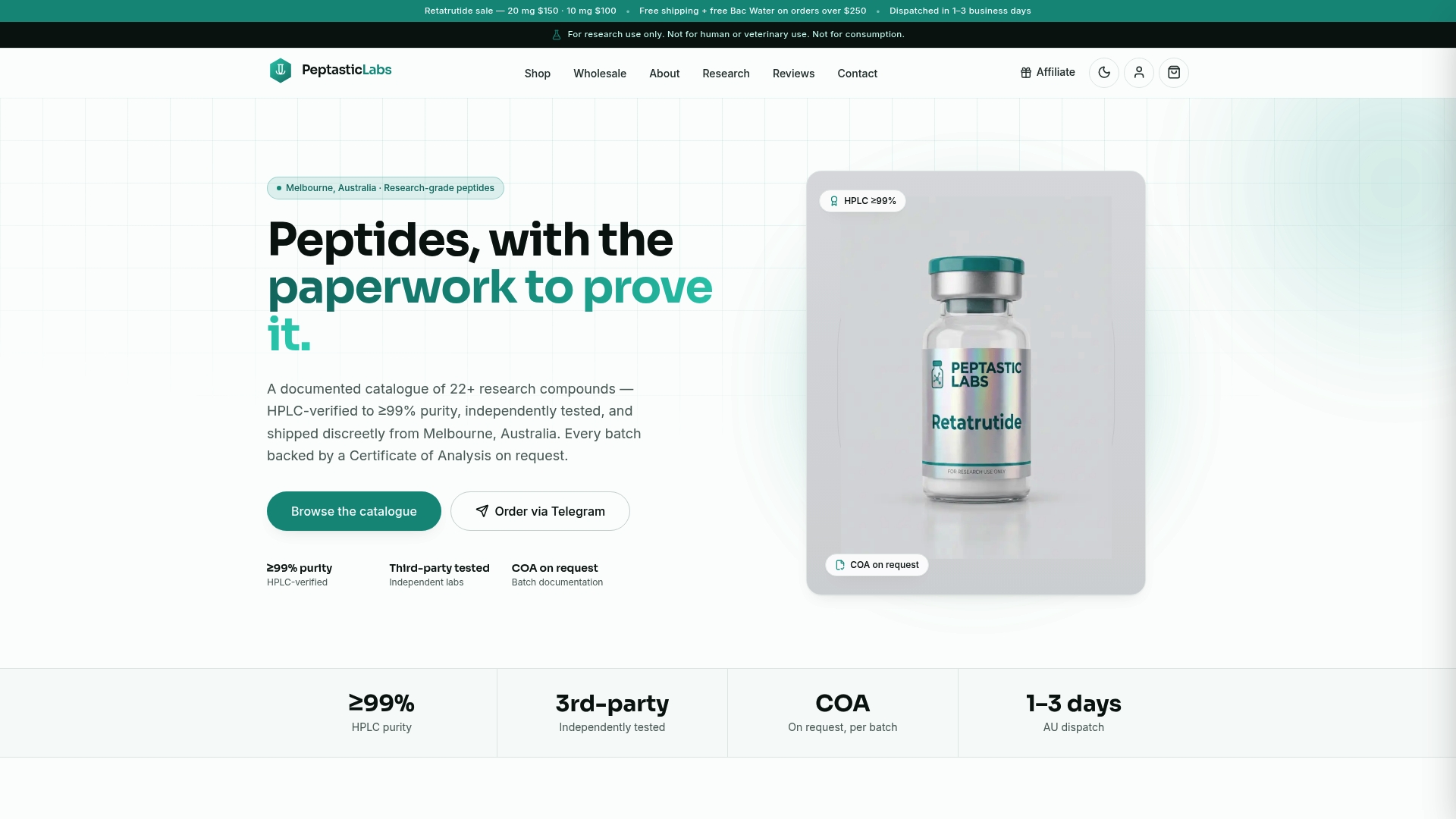
For a peptide where formulation and stoichiometry errors can quietly generate false positives, working with a documented, third-party-verified lot removes one of the biggest sources of unexplained variability between labs. Qualified researchers and institutions can order directly, with full batch documentation provided alongside the shipment rather than buried behind a support request. Visit the Peptastic Labs GHK-Cu product page to review current specifications, request a Certificate of Analysis for your batch, or contact the team for technical documentation before placing an order.
Frequently Asked Questions
What is GHK-Cu peptide sciences focused on studying?
Peptide sciences research on GHK-Cu concentrates on its gene-expression and extracellular matrix effects, particularly collagen synthesis, angiogenesis, and antioxidant signaling, along with calibrating where human clinical evidence is strong (topical) versus extrapolated (systemic).
Is GHK-Cu the same as GHK copper peptide?
Yes. GHK-Cu, GHK copper peptide, and copper peptide GHK-Cu all refer to the same glycyl-L-histidyl-L-lysine copper(II) complex. Using one canonical term throughout your documentation avoids confusion when comparing results across studies.
Does GHK-Cu really modulate thousands of genes?
The figure comes from specific Connectivity Map array analyses and reflects genuinely broad transcriptional reach, but it is model-specific rather than a fixed universal value. Treat it as evidence of wide biological activity, not a number that will replicate identically in every experimental system.
Is injectable GHK-Cu supported by clinical evidence?
Not yet at the level of controlled human trials. Current injectable and systemic claims rest on mechanistic and animal data, while the strongest human evidence remains topical. Confirming systemic efficacy would require larger randomized trials specifically designed to test that route.
What purity level should researchers require for GHK-Cu?
How should GHK-Cu be stored to maintain stability?
Cold storage, protection from light, and chelator-free buffers to prevent uncontrolled copper exchange are standard precautions. Confirm stability with a repeat HPLC check at the start and end of any multi-week experiment.