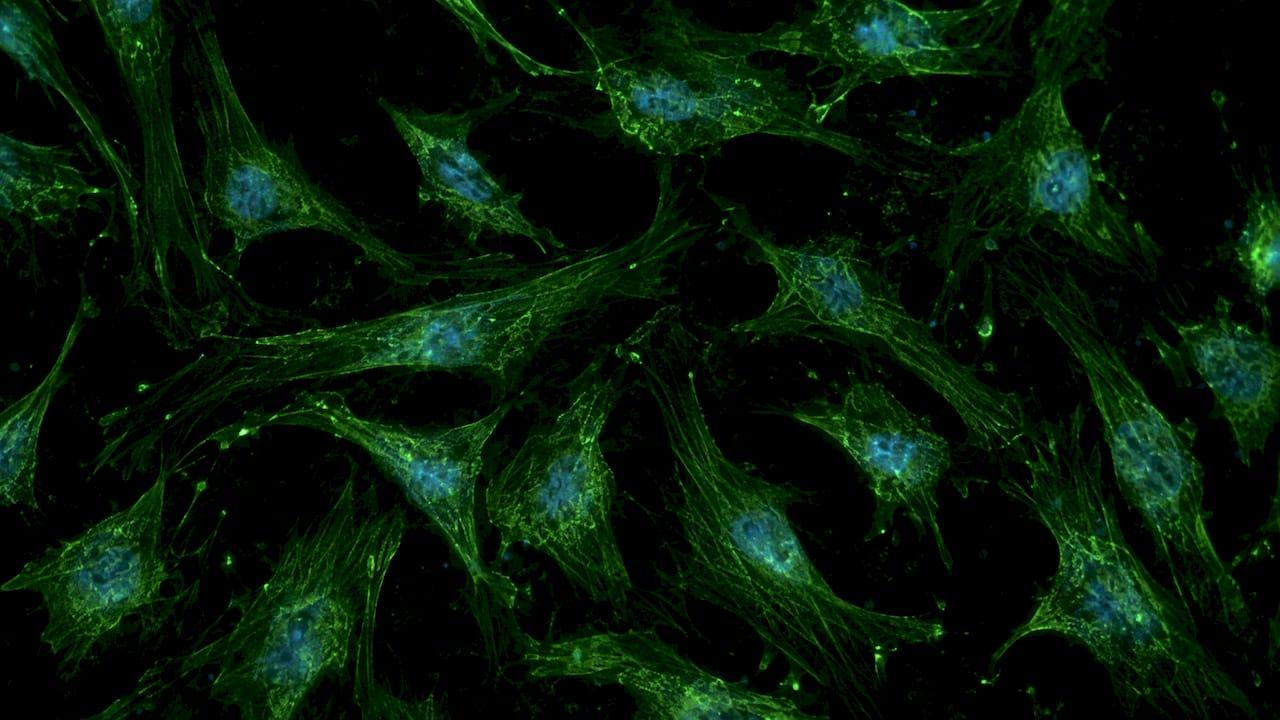
Senolytic peptides are short, designed amino acid chains studied for their ability to trigger cell death in senescent cells, the damaged cells that stop dividing but do not die. The best-characterized candidates are FOXO4-DRI, ES2 and, in a related senotherapeutic role, Peptide 14. Evidence is preclinical: cell cultures, ex vivo skin and mice. For a researcher the practical question is reproducibility, which depends on verified peptide identity and purity. Peptastic Labs supplies research-grade peptides with ≥99% purity verified by HPLC and Certificates of Analysis on request, documentation that a senolytic assay needs before any result can be interpreted.
This guide covers the mechanism, the studied peptides, the findings by model, the scientific limits, and the Australian regulatory position.
TL;DR
- Senolytic peptides aim to remove senescent cells selectively. FOXO4-DRI and ES2 act on the FOXO4-p53 interaction; Peptide 14 acts through a different route, modulation of PP2A.
- Data come from in vitro, ex vivo and mouse studies. Human efficacy is not validated.
- Reproducible work depends on batch-level identity and purity data: HPLC, mass spec, Certificate of Analysis.
- In Australia the TGA states that "research use only" labels do not change the regulatory status of unapproved peptide products. Check obligations before importing, supplying or advertising.
Table of Contents
- What senolytic peptides are
- The peptides studied
- What the studies show
- Design questions in senolytic peptide work
- Why peptide identity and purity decide the result
- Limits and open questions
- Australian rules for peptide research and supply
- Perspective
- Ordering research-grade material
- FAQ
- Sources
What senolytic peptides are
A senescent cell is a cell in permanent growth arrest. It stays in tissue and secretes inflammatory factors, known as the senescence-associated secretory phenotype (SASP). Senolytics are agents that kill these cells while sparing healthy ones.
The core principle: senescent cells resist apoptosis (programmed cell death) because they rely on pro-survival networks. A 2024 npj Aging review calls these Senescent Cell Anti-Apoptotic Pathways (SCAPs) and describes senolytics as agents that disable them. Peptides are one design route. Unlike small molecules found by repurposing existing drugs, a peptide can be built to block one specific protein-protein contact.
The 2025 review in PMC summarizes the aim as triggering apoptosis selectively while sparing non-senescent tissue, and notes that FOXO4-DRI disrupts the nuclear retention of p53.
The peptides studied
| Peptide | Length | Proposed target | Notes |
|---|---|---|---|
| FOXO4-DRI | 46 amino acids | p53 transactivation domain | Cell-permeable; first described by Baar et al. |
| ES2 | 35 amino acids | FOXO4 CR3 domain | Designed by Le et al. |
| CPP-CAND | 28 amino acids | FOXO4 forkhead domain | Listed in an ACS Journal of Medicinal Chemistry supplement |
| Peptide 14 | Not a FOXO4 binder | PP2A holoenzyme modulation | Senotherapeutic; studied in skin models |
Lengths and targets for the first three are from the ACS supplement cited above.
FOXO4-DRI and the p53 mechanism
In senescent cells FOXO4 expression rises. FOXO4 binds p53 in the nucleus and keeps it from triggering death. A 2020 review by Al-Naggar and colleagues describes how Baar et al. designed a cell-permeable peptide, FOXO4-DRI, that excludes p53 from the nucleus and sends it to the mitochondria. The result is transcription-independent apoptosis in senescent IMR-90 fibroblasts, validated in three in vivo senescence models.

The 2023 FEBS Journal review states the same logic: FOXO4 sequesters nuclear p53, and the peptide releases it to the cytosol, where it induces apoptosis.
ES2 and the CR3 domain
ES2 was designed to bind FOXO4 with higher affinity than p53 does. A 2021 commentary reports that ES2 peptides target the FOXO4 CR3 domain and are 3 to 7 times more effective than FOXO4-DRI in vitro and in vivo, with demonstrated safety combined with dabrafenib in preclinical mouse melanoma models.
A US patent application, US20200255489A1, discloses 245 rationally designed senolytic peptide sequences. It describes blocking the FOXO4 CR3 domain from interfering with p53 phosphorylated at Serine 46, while minimizing interaction with the p53 DNA-binding domain, other FOXO proteins and DNA. It also describes suitability for intermittent administration.
Peptide 14
Peptide 14 came from a two-step screening for peptides that reduce senescence in human dermal fibroblasts, reported by Zonari et al. in npj Aging (2023). It is relevant to skin research and works by a different route from the FOXO4 peptides.
What the studies show
Cell culture
- ES2: according to the 2024 Cellular Oncology review, ES2 cut viability of doxorubicin-induced senescent A375 melanoma cells more than threefold versus proliferating cells, at an IC50 of 8 µM. The same review reports minimal apoptotic effects on non-senescent cancer cells.
- Peptide 14: reduced senescence burden in human dermal fibroblasts from Hutchinson-Gilford Progeria Syndrome, chronological aging, UVB exposure and etoposide treatment, without significant toxicity (Zonari et al., 2023).
Ex vivo human skin
In the same 2023 study, Peptide 14 applied to aged ex vivo human skin decreased senescence markers, including SASP, and reduced DNA methylation age. This is the result behind most skin-aging search interest in the topic. It is a tissue-model finding, not a clinical outcome. Researchers working on the skin side can continue with our guides on skin signal peptides and peptides and collagen production.
Mouse models
- Disrupting the p53-FOXO4 interaction induced apoptosis of senescent cells in vitro and in vivo and improved fitness, hair growth and renal function in progeroid and aged mice (Robbins et al., 2020).
- FOXO4-DRI selectively killed senescent Leydig cells and alleviated age-related hypogonadism in aged male mice, and eased skin phenotypes and renal function in Xpd TTD/TTD and naturally aged mice (FEBS Journal review).
- In mice with idiopathic pulmonary fibrosis, FOXO4-DRI reduced senescent cells and slowed fibrosis, and appeared more selective toward senescent cells than ABT-737 (npj Aging, 2024).
- ES2 with dabrafenib increased survival time by 50% (750,000 cells) and 65% (25,000 cells) in mouse melanoma models (Cellular Oncology, 2024).
Design questions in senolytic peptide work
Several features of this field shape how an experiment is built.
Intermittent dosing. The Al-Naggar review describes "hit-and-run" dosing: damaged cells take 2 to 6 weeks to become senescent, so a short exposure followed by a gap can clear the existing population without continuous treatment. Peptide candidates in the patent are described as suitable for this pattern.
Low target abundance. The same review notes that senescent cells make up only 0.5 to 20% of tissues in vivo. Assay sensitivity and clean controls matter because the signal comes from a minority population.
Biomarker choice. SA-β-gal, p16 and p21 are not universal markers, and there is no standard sensitive and specific one. Use several markers per model.
Working concentration. In the Peptide 14 work, a 12.5 µM working dose was used, with fluorescence-tagged uptake peaking at 24 hours and mainly cytoplasmic distribution. Genotoxicity screens (Ames test, micronucleus assay, karyotyping) showed no toxicity, carcinogenesis or chromosomal instability (Zonari et al., 2023).

Why peptide identity and purity decide the result
FOXO4-DRI is 46 amino acids long. Synthesis errors, truncations and impurities in a chain of that length are the usual reason one lab's data differ from another's. When a viability curve shifts, the researcher needs to know whether the biology or the batch changed.
The controls that make a batch usable:
- HPLC purity: a quantified main peak, not a label claim.
- Mass spectrometry: confirms the molecular weight matches the intended sequence.
- Batch traceability: a lot number linked to its own analysis.
- Certificate of Analysis: the document filed with the experiment record.
Peptastic Labs tests every catalogue compound independently to ≥99% purity by HPLC, with mass spec identity checks, traceable batch documentation and Certificates of Analysis on request. Our step-by-step reference on lab protocols and sourcing to reproduce FOXO4-DRI findings covers handling in detail, and our peptide types and uses overview helps place longevity compounds among other classes.
Limits and open questions
The field is early. Four limits recur across reviews:
- Human efficacy is unvalidated. The 2024 npj Aging review says first-generation senolytics showed activity in vitro and in vivo but human efficiency remains unvalidated.
- Heterogeneity. The 2025 review by Barthet and Lowe lists senescent-state heterogeneity, limited biomarkers, off-target toxicities and frailty of aged patients as the translation challenges, and points to precision approaches using surface markers and engineered immune therapies as a more selective path.
- Unknown long-term effects. A 2022 Lancet Healthy Longevity review states that short- and long-term side effects of senotherapeutics are largely unknown and that there are no standardized timing, dose or route guidelines.
- Model dependence. Most senescent-cell knowledge comes from in vitro models (Al-Naggar et al.).
For readers weighing clinical translation and the limited human data, independent peptide vendor reviews add context on how material is tested and graded across the market.
The practical reading: treat senolytic peptides as research tools for mechanism and model studies, not as established interventions. Gym and wellness readers should note that none of the studies above tested these peptides for performance, body composition or anti-aging in healthy people.
Australian rules for peptide research and supply
This section matters to every Australian reader, including those in Melbourne. The Therapeutic Goods Administration (TGA) is the national regulator for therapeutic goods. Its recent statements:
- 9 April 2026 safety alert: products not on the Australian Register of Therapeutic Goods (ARTG) are promoted online with weight loss, muscle growth, anti-ageing and cognitive claims. The TGA says "research use only" disclaimers do not change a product's regulatory status, do not permit importation and do not remove advertising or supply obligations. Promoting unapproved peptide products, especially through social media or influencers, is likely to breach advertising law (TGA alert).
- Personal Importation Scheme: the same alert says imports identified only by codes, or missing active ingredient, strength or dosage, cannot be assessed and will not be considered for release.
- 10 June 2026: the TGA expanded its priority focus areas to include unapproved peptide products after increased detection of unlawful importation, supply and advertising.
- 17 August 2026: the TGA stated that it is unlawful to import, advertise, manufacture and supply unapproved peptide products, and that influencers, affiliates and online sellers promoting them may be held accountable.
What follows for your work: confirm your institution's obligations before ordering, keep batch documentation and Certificates of Analysis with your records, and make no therapeutic claims about any peptide. Questions about your specific situation go to the TGA or your institution's compliance office.
Perspective
Senolytic peptide papers share one weakness: the sequence is rarely the variable that fails. The batch is. A 46-residue chain such as FOXO4-DRI can carry truncations that no label shows.
Our position is that identity and purity data come first. Each Peptastic Labs batch is independently tested by HPLC and mass spec, documented and traceable, and a Certificate of Analysis is available on request. A researcher who files that document with the protocol can defend the dataset.
We also hold that the literature should be read at its actual level: cell, ex vivo and mouse data. Within that scope, verified material is the most direct way to make a result repeatable.
Tintastic
Ordering research-grade material
Peptastic Labs lists eight product lines: Metabolic, Cognitive & Neuro, Tissue & Repair, Longevity, Cosmetic Science, Blends, Hormone & Reproductive, and Ancillaries & Reagents. All compounds in the catalogue are independently tested to ≥99% purity by HPLC, and bulk and wholesale options are available. Orders can be placed online, including pre-filled Telegram or WhatsApp checkout. Browse the full catalogue or start from the Peptastic Labs homepage.
Request the Certificate of Analysis for your batch and store it with your protocol.
FAQ
Are senolytic peptides proven to work in humans?
No. The evidence is from cell cultures, ex vivo human skin and mice. Reviews state that human efficiency is unvalidated and that short- and long-term side effects are largely unknown.
What is the difference between FOXO4-DRI and ES2?
Both disrupt the FOXO4-p53 interaction. FOXO4-DRI binds p53, while ES2 targets the FOXO4 CR3 domain. A 2021 commentary reports ES2 as 3 to 7 times more effective than FOXO4-DRI in preclinical studies.
Does Peptide 14 work like FOXO4-DRI?
No. Peptide 14 was found by screening in human dermal fibroblasts and acts by modulating the PP2A holoenzyme. It reduced senescence markers and DNA methylation age in aged ex vivo human skin.
Does a "research use only" label make peptides legal in Australia?
No. The TGA states that such disclaimers do not change a product's regulatory status, do not permit importation and do not remove advertising or supply obligations. Contact the TGA or your institution's compliance office for your case.
Sources
- Targeting Senescence: A Review of Senolytics (PMC, 2025)
- Senolytics: from pharmacological inhibitors to immunotherapies (npj Aging, 2024)
- US20200255489A1, Novel Senolytic Peptides
- Peptide inhibitors targeting FOXO4-p53 interactions (ACS supplement)
- Development of a novel senolytic by precise disruption of FOXO4-p53 (PMC, 2021)
- Senolytics: charting a new course (Cellular Oncology, 2024)
- Senolytics: targeting senescent cells for age-associated diseases (PMC, 2020)
- Senotherapeutic peptide treatment reduces biological age (npj Aging, 2023)
- Senolytic Drugs: Reducing Senescent Cell Viability (PMC, 2020)
- Targeting cellular senescence with senotherapeutics (FEBS Journal)
- Killing wisely: precision senolytics in the age of frailty (PMC, 2025)
- The costs and benefits of senotherapeutics (Lancet Healthy Longevity, 2022)
- TGA: Understanding your responsibilities when importing unapproved peptide products
- TGA strengthens compliance focus on unapproved peptide products
- TGA flexes its muscle against illegal peptides and steroids