Amino acid residue masses run from roughly 57 to 186 Daltons, and the practical average residue mass used across proteomics is about 110 Da. This page gives you both monoisotopic and average residue masses for all 20 standard amino acids, the exact steps for converting those residues into a neutral peptide or protein mass, and guidance on which mass type your instrument actually needs. If you work in high-resolution mass spectrometry, note now: monoisotopic mass is your default, not average mass.
Key Takeaways
Amino acid residue masses range from about 57 to 186 Da, and accurate peptide mass calculation requires the correct mass type, terminal group correction, and modification adjustments applied consistently.
| Point | Details |
|---|---|
| Residue mass range | Monoisotopic residue masses span ~57.021 Da (Gly) to ~186.079 Da (Trp) across the 20 standard amino acids. |
| Average residue rule-of-thumb | Use ~110 Da per residue to quickly estimate total protein molecular weight from sequence length. |
| Terminus correction | Add 18.015 Da to summed residue masses to account for the N-terminal H and C-terminal OH. |
| Match mass type to instrument | Use monoisotopic mass for high-resolution MS and average mass for bulk or lower-resolution calculations. |
| Verify against documentation | Peptasticlabs provides HPLC-verified purity and Certificates of Analysis with observed mass data on request. |
Table of Contents
- What Are the Molecular Masses of the 20 Standard Amino Acids?
- Should You Use Monoisotopic Mass or Average Mass?
- How Do You Calculate Peptide or Protein Molecular Mass?
- Why Do People Confuse Da and kDa?
- What Should You Check Before Reporting a Mass Spec Result?
- Why Residue Mass Documentation Matters When Sourcing Peptides
- Consistent Mass Reporting Is a Reproducibility Problem, Not a Trivia Problem
- Order Research Peptides With Full Mass Documentation
- Where to Verify These Mass Values
- Sources
What Are the Molecular Masses of the 20 Standard Amino Acids?
Every calculation you run on a peptide sequence starts with residue mass, not free amino acid mass. A residue is what remains of an amino acid once it's locked into a peptide chain and has lost a water molecule during bond formation. The table below lists monoisotopic and average residue masses for all 20 standard amino acids, sourced against the UW Proteomics Resource and cross-checked with Thermo Fisher's amino acid reference data.
| Amino Acid | 3-Letter | 1-Letter | Monoisotopic (Da) | Average (Da) |
|---|---|---|---|---|
| Glycine | Gly | G | 57.021 | 57.021 |
| Alanine | Ala | A | 71.037 | 71.079 |
| Serine | Ser | S | 87.032 | 87.032 |
| Proline | Pro | P | 97.053 | 97.053 |
| Valine | Val | V | 99.068 | 99.068 |
| Threonine | Thr | T | 101.048 | 101.048 |
| Cysteine | Cys | C | 103.009 | 103.009 |
| Leucine | Leu | L | 113.084 | 113.084 |
| Isoleucine | Ile | I | 113.084 | 113.084 |
| Asparagine | Asn | N | 114.043 | 114.043 |
| Aspartate | Asp | D | 115.027 | 115.027 |
| Glutamine | Gln | Q | 128.059 | 128.059 |
| Lysine | Lys | K | 128.059 | 128.059 |
| Glutamate | Glu | E | 129.043 | 129.043 |
| Methionine | Met | M | 131.040 | 131.040 |
| Histidine | His | H | 137.059 | 137.141 |
| Phenylalanine | Phe | F | 147.068 | 147.177 |
| Arginine | Arg | R | 156.101 | 156.188 |
| Tyrosine | Tyr | Y | 163.063 | 163.176 |
| Tryptophan | Trp | W | 186.079 | 186.213 |
These are residue masses, meaning each value already accounts for the water lost when the amino acid joined a peptide chain. Do not substitute free amino acid molecular weight for these figures when calculating peptide mass. The UW Proteomics Resource and RIKEN's residue mass table are both good places to cross-check individual values before publication, especially for less common residues like selenocysteine or pyrrolysine, which carry nonstandard masses and only apply when your sequence explicitly contains U or O.
Should You Use Monoisotopic Mass or Average Mass?
Monoisotopic mass is the mass calculated using the single most abundant isotope of each element (carbon-12, hydrogen-1, nitrogen-14, oxygen-16, sulfur-32). Average mass is the isotopically weighted average across an element's natural isotope distribution, which is why it's always slightly heavier than the monoisotopic value.
Which one you need depends entirely on your instrumentation:
- High-resolution mass spectrometry (Orbitrap, FT-ICR, most modern QTOFs) resolves individual isotopic peaks cleanly, so monoisotopic mass is the correct value to report.
- Lower-resolution methods, bulk stoichiometry calculations, and rough molecular weight estimates typically use average mass instead.
- Mixing the two types in one calculation is a common source of peak misassignment in proteomics workflows.
Take Alanine as an example: monoisotopic residue mass is 71.037 Da, average residue mass is 71.079 Da. That 0.042 Da gap looks trivial for one residue, but it compounds fast across a 300 residue protein, and using the wrong type against a high-resolution spectrum will shift your predicted peak enough to miss the match entirely.
How Do You Calculate Peptide or Protein Molecular Mass?
Residue mass and free amino acid mass are not the same number, and confusing them introduces a systematic error of exactly 18.015 Da per amino acid, the mass of one water molecule. Free amino acids carry a full amino group and a full carboxyl group. Once peptide bonds form, each bond releases one water molecule, so the chain's total mass is always less than the sum of its free amino acid components.
Here's the calculation sequence proteomics search engines like MASCOT actually follow:
- Choose your residue masses (monoisotopic for high-res MS, average for bulk work), and read them from the MASCOT reference table if you need a second source.
- Sum the residue masses for every position in your sequence.
- Add 18.015 Da to restore the N-terminal H and C-terminal OH lost during chain formation.
- Adjust for any post-translational or chemical modifications (disulfides, phosphorylation, tags).
- Convert to kDa by dividing by 1,000 if you're reporting a full protein.
Worked example: a tripeptide of Glycine, Alanine, and Serine sums to 57.021 + 71.037 + 87.032 = 215.090 Da using monoisotopic residues. Add 18.015 Da for the termini, and your neutral peptide mass is 233.105 Da.
Pro Tip: Always state which mass type you used in your methods section. "Peptide mass calculated using monoisotopic residue masses" takes five words and prevents a reviewer from wondering whether your reported mass already accounts for isotope averaging.
Why Do People Confuse Da and kDa?
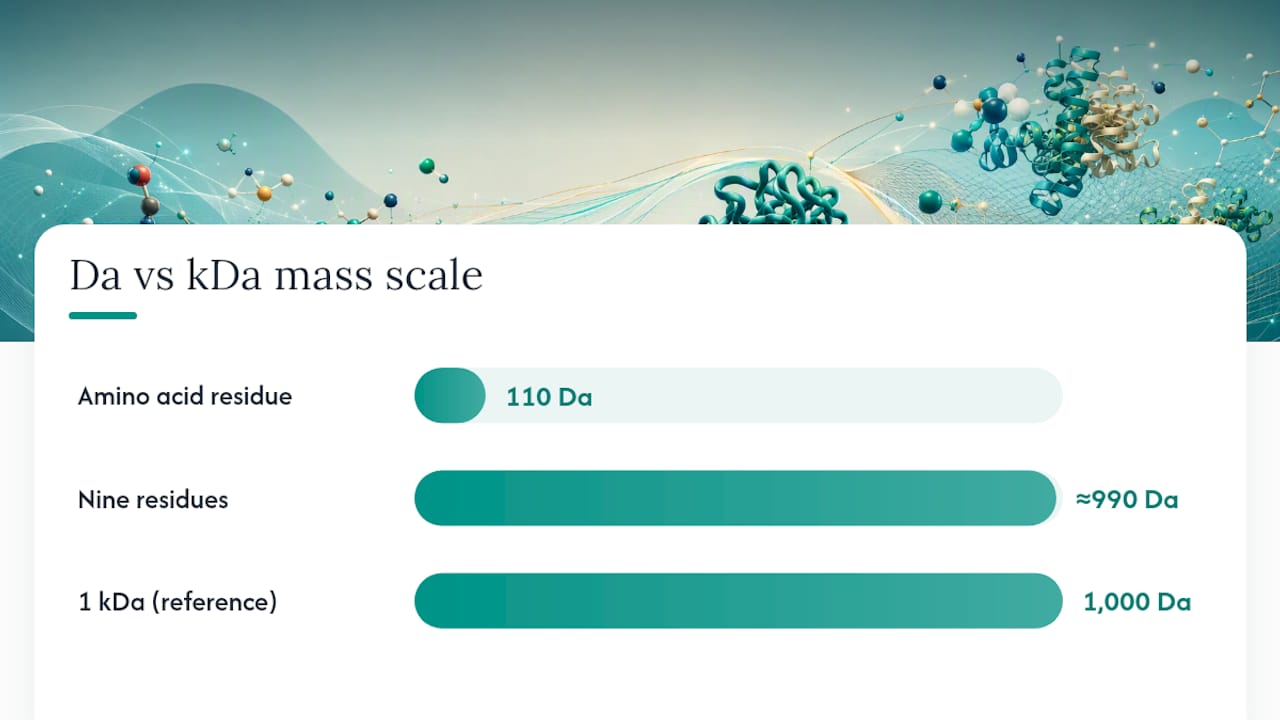
A Dalton (Da) measures the mass of a single atom or small molecule; a kilodalton (kDa) is simply 1,000 Da. The mix-up that trips up students most often: assuming one amino acid residue equals roughly 1 kDa. It doesn't. The average residue mass of ~110 Da is less than one-ninth of a kDa, so you'd need about nine residues strung together before you approach 1 kDa of mass.
Three quick rules for reporting: state units explicitly in every figure caption, never abbreviate kDa as "kD," and round to a consistent number of decimal places across an entire methods section.
What Should You Check Before Reporting a Mass Spec Result?
Before you submit a mass value in a manuscript or lab report, run through a short checklist:
- Confirm your mass type (monoisotopic or average) matches your instrument's resolution class.
- Include terminal group mass (18.015 Da) unless you're deliberately reporting residue-only mass for a database entry.
- List every fixed modification explicitly, with its exact mass delta, sourced from a registry like Unimod.
A common modification worth knowing by heart: carbamidomethylation on cysteine, used to block free thiols during sample prep, adds +57.021 Da per modified Cys residue. If your peptide contains two cysteines and both were alkylated, your theoretical mass needs +114.042 Da before you compare it to an observed peak. Skip this step and your predicted mass will be off by enough to reject a correct match.
Pro Tip: When you're validating a synthesized peptide, always cross-check your calculated mass against the observed mass on the vendor's Certificate of Analysis before you trust either number in isolation.
Why Residue Mass Documentation Matters When Sourcing Peptides
Peptasticlabs tests its catalog of 22+ research peptides independently via HPLC to confirm ≥99% purity, with full batch documentation behind every listing. When a Certificate of Analysis states the observed mass alongside purity data, you can verify your theoretical calculation against real analytical output instead of trusting a label alone.
Ask any peptide vendor for three things before you order:
- A residue mass table or calculated molecular weight for the exact sequence you're purchasing
- Explicit confirmation of which mass type (monoisotopic or average) was used
- A COA showing the observed mass peak, not just a purity percentage
Consistent Mass Reporting Is a Reproducibility Problem, Not a Trivia Problem
Most methods sections bury mass type in a footnote, if they mention it at all. That's backward. A reviewer or downstream lab trying to reproduce your MS result needs to know immediately whether you calculated monoisotopic or average mass, whether you included terminal groups, and whether any modifications were factored in before the number ever reaches a figure caption.
The fix costs one sentence per manuscript. State the mass type, state the terminal group assumption, state every modification delta you applied. Request the same specificity from any peptide supplier before you order: a residue mass table, a stated mass type, and a COA with an observed mass peak. Reproducibility failures in proteomics rarely come from bad instruments. They come from unstated assumptions.
— Tintastic
Order Research Peptides With Full Mass Documentation
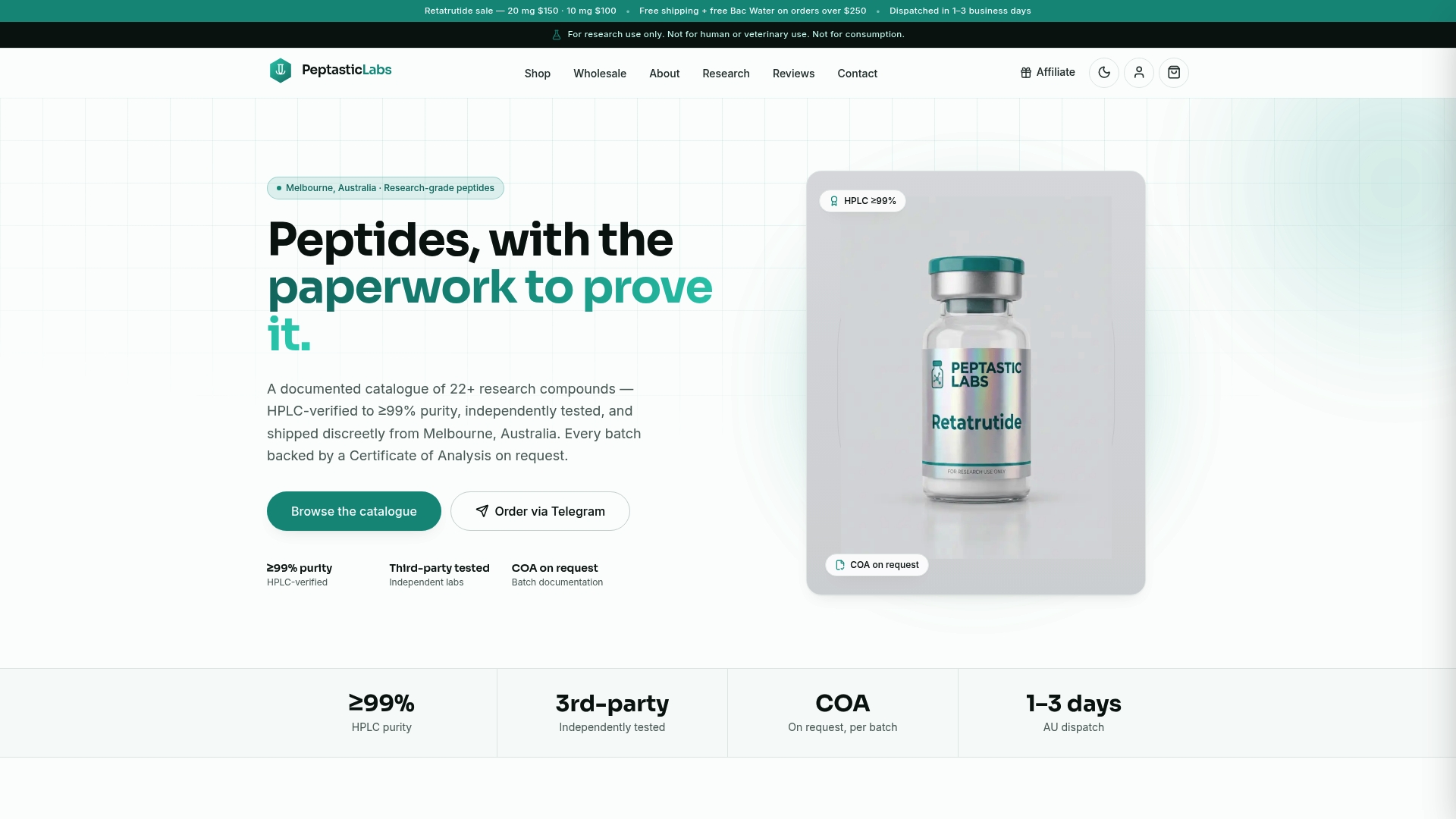
Peptasticlabs supplies research-grade peptides at ≥99% purity, HPLC-verified, with batch documentation and a Certificate of Analysis available on request for every order. That means you can request the observed mass peak and residue-level documentation before you commit to a purchase, rather than reverse-engineering purity from a generic label.
If your protocol depends on knowing exact mass values for peptide amino acid chains before you start bench work, request the COA and residue mass table alongside your quote. Browse the Peptasticlabs research catalog and reach out through checkout to confirm mass type and batch documentation before you place your order.
Where to Verify These Mass Values
- The UW Proteomics Resource offers downloadable monoisotopic and average residue mass tables used across proteomics labs.
- Thermo Fisher's amino acid reference page corroborates average mass columns with manufacturer-grade data.
- RIKEN's residue mass table lists both mass types plus composition detail for less common residues.
- Promega's amino acid reference chart documents the ~110 Da rule-of-thumb used for quick protein weight estimates.
- MASCOT's amino acid reference help page explains residue-to-peptide mass conversion as used in proteomics search engines.
Sources
- Amino Acid masses (monoisotopic and average) — UW Proteomics Resource
- Proteins and Amino Acids — Thermo Fisher Scientific (AU)
- Amino Acid reference data — MASCOT proteomics