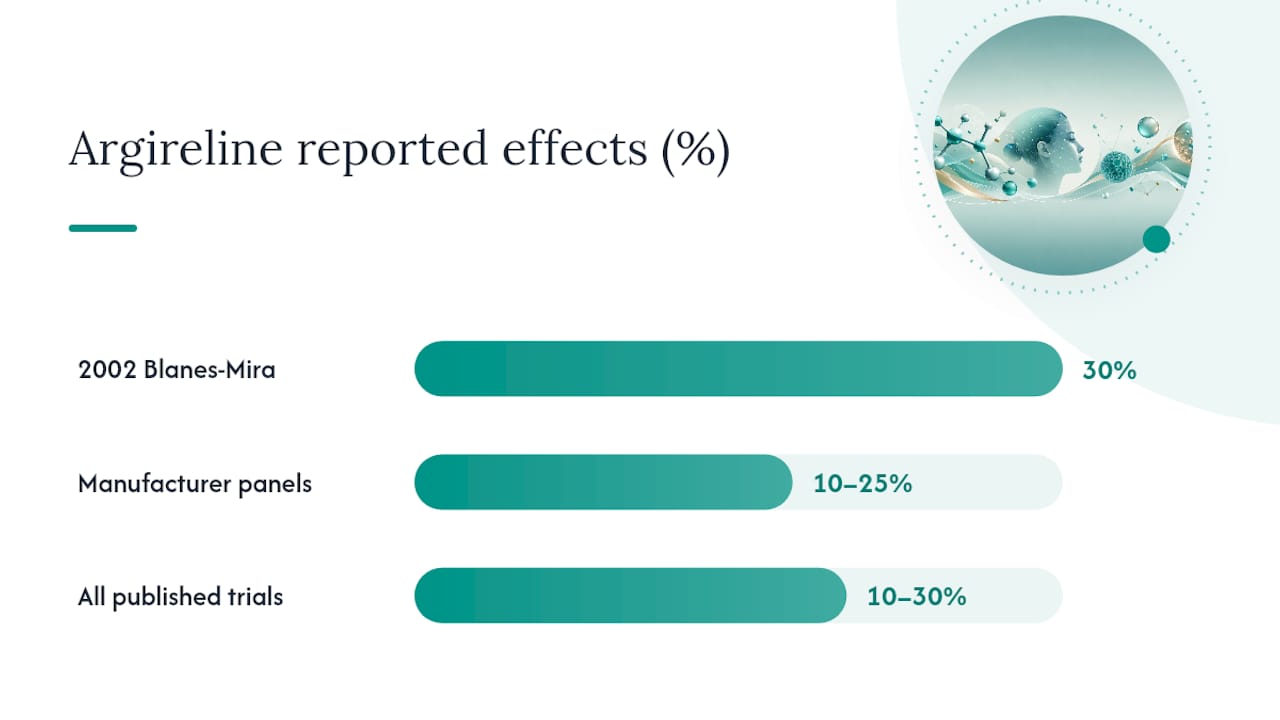
Argireline produces modest, instrument-measured reductions in fine expression lines, typically in the 10%–30% range over about four weeks in small trials, with some manufacturer-sponsored studies reporting figures near 30%. It is not equivalent to injectable neuromodulators. The mechanism is real at the cellular level, but skin penetration limits how much of that mechanism translates to a finished topical product, and the safety profile across published trials remains clean.
TL;DR:
- Clinical effects of Argireline typically range from 10% to 30% wrinkle reduction after about four weeks, with larger effects seen in higher concentration emulsions.
- The peptide's large molecular weight and hydrophilic nature severely limit skin penetration, which explains why actual topical efficacy remains modest despite a well-documented cellular mechanism.
- Most studies are small, manufacturer-sponsored, and measure short-term outcomes, leaving long-term and cumulative effects unconfirmed.
- Argireline is safe with only mild, temporary skin irritation reported, and no evidence indicates systemic or serious adverse effects.
- Product formulation variables like vehicle, pH, and permeation enhancers significantly influence how much peptide reaches the skin, so labeled concentration alone is unreliable for predicting effectiveness.
Table of Contents
- What Does Argireline Research Say About Its Mechanism?
- How Strong Is the Clinical Evidence for Argireline?
- Why Are Argireline's Real-World Effects So Modest?
- Is Argireline Safe? What Do Trials Report on Side Effects?
- What Concentrations and Delivery Methods Does the Research Support?
- How Does Peptide Sourcing Affect Argireline Research Reliability?
- Does Argireline Keep Working With Long-Term Use?
- How Stable Is Argireline in a Formulation Over Time?
- Is Argireline Approved and Regulated for Cosmetic Use?
- Author Perspective: Where Argireline Actually Fits
- Sourcing Verified Peptides for Your Own Argireline Studies
- Sources
- FAQ
What Does Argireline Research Say About Its Mechanism?
Argireline is the trade name for acetyl hexapeptide-8, a synthetic peptide built to imitate a fragment of SNAP-25, one of the proteins that forms the SNARE complex. SNARE proteins dock and fuse vesicles carrying acetylcholine at the neuromuscular junction. When acetylcholine reaches a muscle fiber, it triggers contraction. Injectable neuromodulators work by cleaving SNAP-25 outright, disabling that release for months. Argireline takes a different, gentler route: it competes for the same binding sites without cleaving anything, theoretically dampening the signal rather than shutting it off.
Foundational mechanistic work by Blanes-Mira and colleagues demonstrated this in PC-12 cell cultures, showing that Argireline reduced SNAP-25 phosphorylation and neurotransmitter release in a dose-dependent manner. That finding matters because it establishes the biological plausibility of the peptide's design. It does not, by itself, prove that a cream applied to the face achieves comparable concentrations at the relevant nerve terminals.
That gap between cell-culture concentration and topical reality is where most of the skepticism in Argireline research originates. In vitro studies typically bathe cells directly in the peptide at controlled concentrations, with no skin barrier to cross. A topical formulation has to survive the stratum corneum, avoid degradation, and reach superficial nerve terminals in concentrations high enough to matter, a much harder problem.
A few molecular facts explain why that barrier is so stubborn:
- Molecular weight: Argireline runs at roughly 889 Daltons, well above the informal 500 Dalton threshold many dermatology researchers use as a rule of thumb for passive skin penetration.
- Hydrophilicity: the peptide is water-loving, which helps it dissolve in aqueous serums but works against it when crossing the lipid-rich stratum corneum.
- Charge: acetyl hexapeptide-8 carries polar groups that further reduce its ability to passively diffuse through skin's outer layers.
- Stability in solution: peptide bonds are vulnerable to hydrolysis and enzymatic breakdown, which affects how much intact Argireline survives from formulation to application.
None of this means the mechanism is fiction. It means the mechanism described in cell models and the effect measured on a human forehead are two different questions, and clinical trial data has to answer the second one on its own terms.
How Strong Is the Clinical Evidence for Argireline?
The clinical record on Argireline is consistent but thin. Multiple small trials point in the same direction, yet almost none of them are large, independent, or long enough to satisfy a strict evidence hierarchy.
- The 2002 foundational trial. The study most often cited in Argireline marketing and research alike applied a 10% Argireline emulsion twice daily and reported up to a 30% reduction in wrinkle depth after 30 days. This is the number that launched the "topical Botox" comparisons, and it remains the largest reported effect size in the published literature.
- Manufacturer panels through the mid-2000s. A series of industry-sponsored studies using concentrations between 0.5% and 1%, closer to what actually appears in retail serums, reported more modest reductions of 10% to 25%, generally measured through photographic grading, profilometry, or corneometry, alongside improvements in skin hydration.
- Modern instrumented studies. A 2023 trial examined a hyaluronic-acid-based serum containing Argireline using Visia® complexion analysis, an objective imaging system that photographs skin under standardized lighting and quantifies texture, wrinkle count, and surface irregularities without relying on a clinician's visual judgment.
Each measurement method captures something different. Profilometry uses a silicone replica of the skin surface, scanned and quantified for depth and roughness, a physical rather than photographic measure. Clinician grading is fast and cheap but introduces observer bias, especially in unblinded manufacturer studies. Visia imaging sits closer to the objective end of the spectrum because it standardizes lighting and captures repeatable digital data, which is likely why more recent Argireline clinical studies favor it.
The bigger issue is study architecture, not measurement choice. Sample sizes in the published Argireline literature typically run in the range of 15 to 40 participants, trial durations cluster around 28 to 30 days, and a large share of the funding traces back to peptide or cosmetic manufacturers. That does not invalidate the findings. Small, sponsored trials can still detect real effects, especially when several independent labs report similar magnitudes. But it does mean the confidence interval around "how much does Argireline actually help" is wide, and no large-scale, independently funded randomized controlled trial has closed that gap.
Statistic snapshot: Across the published trials reviewed for this article, reported reductions in wrinkle depth or fine-line appearance cluster between 10% and 30%, with the 2002 Blanes-Mira trial at the high end and most later panels reporting toward the lower half of that range. No study in the current literature reports a placebo-controlled effect size outside that band.
The pattern itself is informative. As one review of the accumulated trial data notes, the repetition of similar, modest effect sizes across separate manufacturer studies suggests a genuine, if small, biological signal rather than pure marketing noise. That is a meaningfully different conclusion than "Argireline works like Botox," and a meaningfully different conclusion than "Argireline does nothing."
Why Are Argireline's Real-World Effects So Modest?
Here is the paradox at the center of Argireline research: the mechanism is well-documented at the cellular level, yet clinical effect sizes stay well below what injectable neuromodulators achieve. The most likely explanation is the skin barrier itself.
The 500 Dalton rule is a heuristic, not a hard law, but it holds up reasonably well as a predictor of passive skin permeation. At roughly 889 Daltons, Argireline sits comfortably above that line, and its hydrophilic, charged structure compounds the problem. Permeation research from Lim and colleagues confirms that formulation and delivery method materially change how much peptide actually gets through skin, meaning two products with identical Argireline concentrations can behave very differently depending on how they are built.
So why do trials detect any effect at all? A few hypotheses circulate in the research community:
- Superficial nerve terminal exposure. Some sensory and autonomic nerve fibers sit close enough to the skin surface that even limited penetration could produce a localized effect without full transdermal delivery.
- Hydration and barrier effects. Serums and emulsions carrying Argireline often improve skin hydration independently, which can soften the visual appearance of fine lines regardless of the peptide's neuromodulatory action.
- Measurement sensitivity. Instrumented tools like Visia imaging and profilometry can detect subtle texture changes that a casual observer would miss, which may inflate perceived efficacy relative to what a person notices in the mirror.
Formulation variables explain much of the inconsistency between products claiming the same "Argireline inside" story. Vehicle choice (gel versus emulsion versus serum), pH, the presence of penetration enhancers, and even preservative systems all shift how much intact peptide reaches the skin and how long it stays active there.
Pro Tip: *When comparing two Argireline-containing products, the labeled concentration tells you almost nothing on its own. Ask whether the brand discloses the vehicle, pH, and any permeation-enhancement method.
Is Argireline Safe? What Do Trials Report on Side Effects?
Safety is the one area where Argireline research shows genuine consensus. Across published trials, reported adverse events are limited almost entirely to mild, local, and transient issues rather than anything systemic.
- Mild skin irritation at the application site, typically resolving without treatment.
- Transient redness, especially in the first days of use as skin adjusts to a new formulation.
- No published reports of systemic absorption-related side effects, consistent with the peptide's poor transdermal penetration.
- No documented drug interaction concerns specific to Argireline itself, though combining it with strong actives like retinoids can increase overall irritation risk unrelated to the peptide.
No trial in the current literature reports serious adverse events tied specifically to Argireline. That tracks with expectations: a molecule too large and too hydrophilic to penetrate efficiently is also too large and hydrophilic to reach systemic circulation in meaningful amounts.
Practical guidance follows directly from that safety record. Patch-test any new Argireline formulation on a small area of skin before full facial application, particularly if combining it with exfoliating acids or retinoids. Avoid applying it to broken or compromised skin, since the barrier that normally limits penetration is exactly what is compromised in that scenario. For researchers designing new trials, tracking basic dermatologic endpoints like erythema and transepidermal water loss alongside efficacy measures remains standard practice and has not surfaced safety signals worth escalating.
What Concentrations and Delivery Methods Does the Research Support?
Trial concentrations in the published Argireline literature range from 0.5% up to 10%, and the relationship between concentration and outcome is not as clean as marketing copy suggests. The original 2002 trial used a relatively high 10% emulsion and reported the largest effect size in the literature. Higher concentration does appear to correlate loosely with larger measured effect, but no dose-response curve has been rigorously established across a single controlled trial spanning multiple concentrations.
Combining Argireline with enhanced delivery methods, chemical penetration enhancers or physical techniques like microneedling, is a reasonable hypothesis given what permeation research shows about peptide delivery more broadly. Microneedling creates temporary micro-channels that bypass the stratum corneum's diffusion limits entirely, which in principle should let more intact peptide reach deeper tissue. The catch: controlled clinical trials that actually pair Argireline with microneedling or chemical enhancers and measure the outcome against Argireline alone are still scarce. The rationale is sound; the direct evidence is not yet there.
When evaluating a product or a study, a few formulation signals separate serious research from marketing dressing:
- Explicit concentration disclosure rather than vague "contains Argireline" claims.
- Published or requestable stability data showing the peptide survives the product's shelf life intact.
- A preservative system appropriate for a water-based peptide formulation, since contamination risk rises in aqueous vehicles.
- Any permeation testing data, even preliminary, showing how much peptide actually crosses a skin model under the product's specific formulation conditions.
How Does Peptide Sourcing Affect Argireline Research Reliability?
Confounded results in peptide research often trace back to the material itself, not just study design. A batch with unverified purity introduces variability that no amount of clever trial design can control for.
Certificates of Analysis are available on request, giving researchers a documented purity and identity record before a compound ever enters a study protocol.
For anyone running or evaluating Argireline research, a few sourcing habits reduce noise before it starts:
- Request the Certificate of Analysis for the specific batch, not a generic product-line document.
- Store peptides according to the manufacturer's stability guidance; degraded material behaves differently than fresh stock.
- Document the batch number and storage conditions alongside your results, so unexplained variance can be traced back to material rather than method.
Does Argireline Keep Working With Long-Term Use?
Most published Argireline trials run 28 to 30 days, which answers "does this produce a measurable early effect" but leaves the long-term question mostly unaddressed. No large, published trial currently tracks Argireline use past a few months with repeated instrumented measurement.
What limited signal exists suggests two plausible patterns. First, since Argireline's proposed mechanism is competitive and reversible rather than destructive, its effect likely depends on continued application. Stop using it and the modest reduction in fine-line appearance would be expected to fade over time as normal neuromuscular signaling resumes, unlike the more prolonged effect of injectable neuromodulators. Second, repeat use over months could theoretically compound hydration-related improvements to skin texture that are separate from the peptide's neuromodulatory claim, though this remains speculative rather than trial-confirmed.
For researchers, this is an open gap worth flagging rather than glossing over. A study measuring Argireline at 30 days and again at 90 or 180 days, with a washout period included, would answer a question the current literature simply has not tackled. Until that data exists, the honest position is that Argireline's benefits are best treated as maintenance-dependent rather than cumulative or permanent.
How Stable Is Argireline in a Formulation Over Time?
Peptide stability is a chemistry problem before it's a marketing one. Argireline is built from amino acid residues linked by peptide bonds, and those bonds are susceptible to hydrolysis, especially in aqueous formulations exposed to heat, light, or a poorly matched pH.

Manufacturers that test stability typically track intact peptide concentration over accelerated aging conditions, simulating months of shelf life in a matter of weeks under elevated temperature and humidity.
A few practical factors affect degradation risk in any Argireline formulation:
- pH extremes accelerate hydrolysis; formulations closer to neutral pH generally preserve peptide integrity longer.
- Light exposure, particularly UV, can degrade some peptide structures, which is why opaque or amber packaging is common for peptide-containing serums.
- Temperature during both manufacturing and consumer storage affects breakdown rate, with cooler storage generally slowing degradation.
- Preservative interactions can occasionally destabilize peptide structures depending on the specific preservative system used.
For researchers, this means concentration disclosure alone is an incomplete picture. Requesting stability data, or running basic accelerated-aging tests on a formulation before a clinical protocol begins, closes a gap that plenty of published Argireline studies leave open.
Is Argireline Approved and Regulated for Cosmetic Use?
Argireline is classified as a cosmetic ingredient, not a drug, in most jurisdictions, including Australia. That distinction shapes what claims a product can legally make and how much evidence a manufacturer needs before selling it. Cosmetic ingredient status means a product can market Argireline for improving the appearance of fine lines, but it cannot claim to treat wrinkles as a medical condition or claim equivalence to a prescription neuromodulator.
This regulatory framework is precisely why the "topical Botox" comparison, however common in marketing copy, misrepresents both the evidence and the ingredient's legal status. Injectable neuromodulators go through drug-level clinical trial requirements and regulatory approval processes; Argireline, as a cosmetic peptide, does not face that same bar. Reviews of the evidence consistently emphasize this point: a plausible mechanism and a modest measured effect do not add up to drug-grade equivalence, regulatory or clinical.
For researchers and formulators, this means Argireline sits in a lighter-touch regulatory category, which raises the burden on published trial quality rather than lowering it. Without mandatory large-scale approval trials, independent, well-designed clinical research is the only real check on inflated efficacy claims circulating in the cosmetic Argireline market.
Author Perspective: Where Argireline Actually Fits
The "Botox in a bottle" framing overstates Argireline's evidence base. The honest reading: a real, modest, mechanism-backed effect on early dynamic lines, best treated as a prevention tool rather than a correction tool. What the field needs now is fewer sponsored 30-day panels and more independent, longer trials with proper controls.
— Tintastic
Sourcing Verified Peptides for Your Own Argireline Studies
Reproducible results start with knowing exactly what's in the vial.
That documentation isn't an afterthought. Certificates of Analysis are available on request for any batch, giving you a verifiable purity and identity record before it enters your protocol, and technical questions about specific compounds or study design can be routed through the research support page. If you're planning a study involving Argireline or related cosmetic-science peptides, or comparing delivery methods against a documented baseline, browse the current peptide catalogue to see available compounds across metabolic, cognitive, tissue repair, and cosmetic science lines, and request documentation regarding batch purity and identity before ordering.
This article is general information, not a substitute for advice from a qualified doctor. Consult a qualified healthcare professional about your own circumstances before acting on anything here.
Sources
- Blanes‑Mira C, et al. (2002) acetyl hexapeptide‑8 trial
- Investigating the effects of Argireline in a skin serum containing hyaluronic acids on skin surface wrinkles (2023)
- Enhanced skin permeation of anti-wrinkle peptides via chemical and physical methods (Lim et al., 2018)
- Argireline: Research, Evidence & Safety | Peptidings
FAQ
Can Argireline Cause Sagging?
No published trial reports sagging as an adverse effect of Argireline. Its proposed mechanism dampens muscle signaling rather than paralyzing it, and reported side effects are limited to mild, transient local irritation.
Is Argireline Serum Worth the Hype?
It depends on the expectation you're setting. Trials report modest, real reductions in fine lines, generally 10% to 30% over about a month, which is meaningful for early prevention but far below what injectable neuromodulators achieve.
How Long Does Argireline Take to Work for Wrinkles?
Most published trials measure effects at 28 to 30 days of consistent twice-daily use. Effects appear to depend on continued application rather than accumulating permanently, based on the peptide's reversible mechanism.
Which Is Better for Wrinkles, Argireline or Matrixyl?
The two peptides work through different mechanisms entirely. Argireline targets neuromuscular signaling to soften expression lines, while Matrixyl-family peptides work more like collagen-stimulating signals, so the better choice depends on whether the concern is dynamic expression lines or overall skin texture and firmness.