Research-grade cosmetic peptides are high-purity, sequence-verified compounds used to probe collagen synthesis, extracellular matrix remodeling, and tissue-repair signaling in skin biology. Before any peptide enters a protocol, require a batch-specific Certificate of Analysis (COA) with mass spectrometry identity confirmation and an HPLC chromatogram showing the stated assay method.
Three checks before you order or open a vial:
- Lot match: the COA's lot number matches the vial label exactly.
- MS identity: observed mass falls within ±1 Da of theoretical mass.
- HPLC method disclosed: purity percentage comes with a stated method, such as RP-HPLC at 214 nm, and a raw chromatogram, not just a number.
Key Takeaways
Research-grade cosmetic peptides only earn a place in a skin biology protocol when their purity, identity, and lot traceability are documented and verifiable before use.
| Point | Details |
|---|---|
| Require batch-matched COAs | Confirm the lot number on the COA matches the vial before running any assay. |
| Separate HPLC purity from identity | HPLC shows chromatographic purity; MS confirms molecular identity within ±1 Da. |
| Match purity tier to the experiment | Reserve the highest purity tiers for dose-response and publication-grade work. |
| Handle for chemistry, not convenience | Counterion type and water content change net peptide content and dosing math. |
| Choose suppliers with public documentation | Peptastic Labs publishes batch-specific COAs with third-party verification on its research catalog. |
Table of Contents
- What Is the Role of Cosmetic Peptides in Skin Research?
- Which Peptide Classes Matter for Cosmetic Skin Research?
- What Should a Peptide Certificate of Analysis Include?
- What Purity Level Do You Actually Need for Skin Research?
- How Should You Handle and Store Research Peptides?
- How Do You Vet a Supplier and Validate a New Lot?
- What Safety and Regulatory Rules Apply to Research Peptides?
- Peptastic Labs Gives You the Documentation Your Protocol Depends On
- Frequently Asked Questions
- Sources
What Is the Role of Cosmetic Peptides in Skin Research?
Cosmetic peptides act on skin biology through a handful of mechanisms researchers can measure directly. Signal peptides bind fibroblast receptors and switch on transcriptional programs for procollagen I and III, which shows up in western blot or ELISA panels as increased collagen protein within days of exposure. Matrikines, fragments derived from extracellular matrix breakdown, feed back onto integrin receptors and alter matrix metalloproteinase (MMP) activity, a process tracked with zymography or MMP-specific fluorogenic substrates.
Growth-factor mimetics take a different route. They approximate the binding conformation of native growth factors like TGF-beta or EGF without the full protein, triggering downstream kinase cascades that qPCR panels can pick up as shifts in gene expression for collagen, elastin, or inflammatory cytokines. Enzyme inhibitors work by blocking collagenase or elastase activity directly, measurable through protease activity assays run alongside a scratch assay for fibroblast migration.
Matching mechanism to assay matters more than most protocols acknowledge:
- Collagen induction claims need procollagen I/III readouts, not just total protein stains.
- ECM remodeling claims need MMP or TIMP activity data, not gene expression alone.
- Migration and repair claims need a functional scratch or transwell assay, not indirect proxies.
Pro Tip: If a peptide's proposed mechanism involves receptor binding, run a dose-response curve before committing to a single working concentration. A flat response across doses often means the mechanism assumption was wrong, not that the peptide failed.
For a closer look at how specific sequences drive procollagen expression, see this breakdown of peptide-driven collagen synthesis.
Which Peptide Classes Matter for Cosmetic Skin Research?
Five classes cover most cosmetic-relevant skin research: signal peptides, matrikines, carrier peptides, enzyme inhibitors, and growth-factor mimetics.
- Signal peptides trigger fibroblast collagen synthesis directly; research-grade sequences in this class are commonly studied for procollagen I/III induction endpoints.
- Matrikines are ECM-derived fragments that modulate MMP activity and fibroblast signaling, typically studied for remodeling and wound-repair endpoints.
- Carrier peptides bind trace metals like copper and are studied for their role in supporting enzymatic wound-healing cascades.
- Enzyme inhibitors block collagenase or elastase directly, studied through anti-protease activity assays.
- Growth-factor mimetics approximate native growth-factor binding, studied for angiogenesis and dermal repair signaling.
Every one of these belongs in a lab, not a shopping cart. Treat any example sequence as research-grade material requiring its own batch-specific COA, never as a consumer cosmetic ingredient. Related tissue-repair mechanisms are covered in more depth in this piece on peptides in muscle and tissue repair.
What Should a Peptide Certificate of Analysis Include?
A usable COA answers two separate questions: what is this molecule, and how pure is it. Both require distinct data, and a COA missing either one is incomplete regardless of how confident the purity number looks.
The required fields: a unique lot number matching the vial, peptide name and sequence, observed versus theoretical molecular weight from mass spectrometry, HPLC purity percentage with the raw chromatogram and stated method (column type, mobile phase, gradient, detection wavelength such as 214 nm), physical appearance, water content, counterion type, the testing laboratory's name, and a release signature. A detailed guide to reading a COA breaks down each field's practical role, and independent third-party labs, ideally ISO 17025 accredited, remove the conflict of interest inherent in a supplier grading its own material.
HPLC area-percent and net peptide content are not the same measurement. HPLC quantifies chromatographic purity, the proportion of UV-absorbing peak area belonging to the target peptide. It says nothing about water, residual salts, or counterion mass sitting alongside that peptide. A supplier sourcing guide for cosmetic peptides recommends requesting net peptide content per gram separately, since a 98% HPLC purity figure on a dilute solution can translate to a fraction of that mass in actual peptide.
| What the COA states | What it actually proves |
|---|---|
| HPLC purity percentage | Chromatographic purity of the visible peak, not total sample mass |
| MS observed vs theoretical mass | Molecular identity, confirming the correct sequence was synthesized |
| Water content / counterion data | Net peptide content adjustment, needed for accurate dosing |
| Net peptide content (amino acid analysis) | Absolute peptide mass per gram, the number that should drive dilution math |
MS identity confirmation matters because HPLC alone cannot rule out co-eluting impurities that share retention time with the target peptide. A deviation of even 1 Da between observed and theoretical mass can flag deamidation or a truncated synthesis, both invisible on a purity chromatogram alone.
| COA field | Minimum standard to accept |
|---|---|
| Lot number | Matches vial label exactly |
| MS identity | Within ±1 Da of theoretical mass |
| HPLC method | Named column, wavelength, and gradient |
| Testing lab | Named, ideally third-party accredited |
Pro Tip: The fastest way to catch a recycled COA is to check whether the lot number on the document matches the lot printed on the vial. A generic document lacking that exact match is not evidence of anything, no matter how detailed the chromatogram looks.
What Purity Level Do You Actually Need for Skin Research?
Purity requirements scale with what the experiment is trying to prove, not with what looks impressive on a spec sheet.
- Screening or signal-finding work: lower purity tiers can be sufficient for preliminary in-vitro screens where you are looking for a directional signal, not a precise effect size.
- Quantitative analysis: higher purity reduces the noise from impurities that could confound dose-response curves or gene expression comparisons.
- Dose-response and publication-grade research: the highest purity available, paired with full traceable batch documentation, is warranted because impurity profiles directly affect reproducibility and peer-review scrutiny.
Impurities and counterion mass distort more than the purity number itself. A peptide loaded with TFA counterions carries extra mass that has nothing to do with biological activity, which throws off molar concentration calculations if you dose by weight alone. That miscalculation compounds across a dose-response series, making an experiment look less reproducible than the underlying biology actually is. For deeper guidance on matching purity tier to protocol, this purity standards resource walks through the tradeoffs by application.
How Should You Handle and Store Research Peptides?
Getting handling wrong ruins a well-sourced peptide before it ever reaches an assay plate.
- Reconstitute in sterile water or the solvent specified on the COA, then confirm pH sits near the target range for the peptide's stability profile.
- Filter through a 0.22 micron membrane if the downstream assay involves cell culture, since particulates and microbial contamination compromise fibroblast or keratinocyte work fast.
- Request endotoxin test results before any cell-based assay; endotoxin contamination can trigger inflammatory readouts that mimic or mask your actual treatment effect.
- Store lyophilized peptide at negative 20°C or colder, and reconstituted aliquots at 4°C for short-term use only, refreezing single-use aliquots rather than repeated freeze-thaw cycles.
- Start dilution series in the low micromolar range for most in-vitro skin assays, then run an on-receipt RP-HPLC or MS spot check if the peptide will anchor a multi-month study.
Pro Tip: Counterion form changes the molecular weight you calculate from. A TFA salt and an acetate salt of the same peptide sequence carry different total mass, so recalculate your molar concentration from the counterion-adjusted weight on the COA, not the peptide's base sequence weight alone. Sterility considerations for cell-based work are covered further in this guide to sterility in peptide research.
How Do You Vet a Supplier and Validate a New Lot?
Supplier selection determines whether every downstream QC step even matters. Look for a published batch-specific COA available before purchase, a named testing laboratory with third-party accreditation, a consistent research-grade catalog, explicit research-use-only labeling, and the option to request independent sample testing. A research peptide sourcing checklist frames these same criteria as the baseline for safe procurement, and they hold regardless of which supplier you're evaluating.
Once material arrives, run it through a fixed sequence rather than trusting the paperwork alone:
- Verify the lot number on the vial matches the COA exactly.
- Check every required COA field is present and internally consistent.
- Run an in-house RP-HPLC spot check, confirming MS identity if the peptide anchors a high-stakes protocol.
- Request endotoxin or sterility data for any cell-based application.
- Quarantine the lot until every check clears.
If a lot fails any check, three responses are acceptable: return the sample, send it for independent third-party retesting, or request a replacement lot from the supplier.
Pro Tip: For high-value lots, ask the supplier to include a sample chromatogram and MS spectrum directly with the purchase order, and negotiate for them to cover the cost of first independent verification. Suppliers confident in their third-party testing rarely hesitate on this. Peptastic Labs' catalog publishes batch documentation for exactly this reason, and a full batch documentation checklist is worth keeping alongside your incoming-goods SOP.
What Safety and Regulatory Rules Apply to Research Peptides?
A short set of rules governs responsible use of research-grade cosmetic peptides:
- Label every compound as research-use-only and never administer it to humans or animals outside an approved protocol.
- Secure institutional ethics or biosafety committee approval before starting work that involves cell lines, tissue, or animal models.
- Retain every COA and batch record for methods-section documentation and publication reproducibility requirements.
- Understand that research-grade peptides are not pharmaceutical-licensed medicines; clinical translation requires separate GMP manufacturing and regulatory clearance.
- Use appropriate PPE and sterile technique for any assay involving live cells or tissue, and monitor endotoxin levels throughout cell-based work.
A note from Peptastic Labs on applying these standards
Request a COA or sample through our research page.
Peptastic Labs Gives You the Documentation Your Protocol Depends On
Peptastic Labs solves the sourcing problem this article just walked through: a catalog built entirely around batch-specific COAs, ≥99% HPLC-verified purity, and third-party confirmation on every lot, rather than a generic purity claim you have to take on faith.
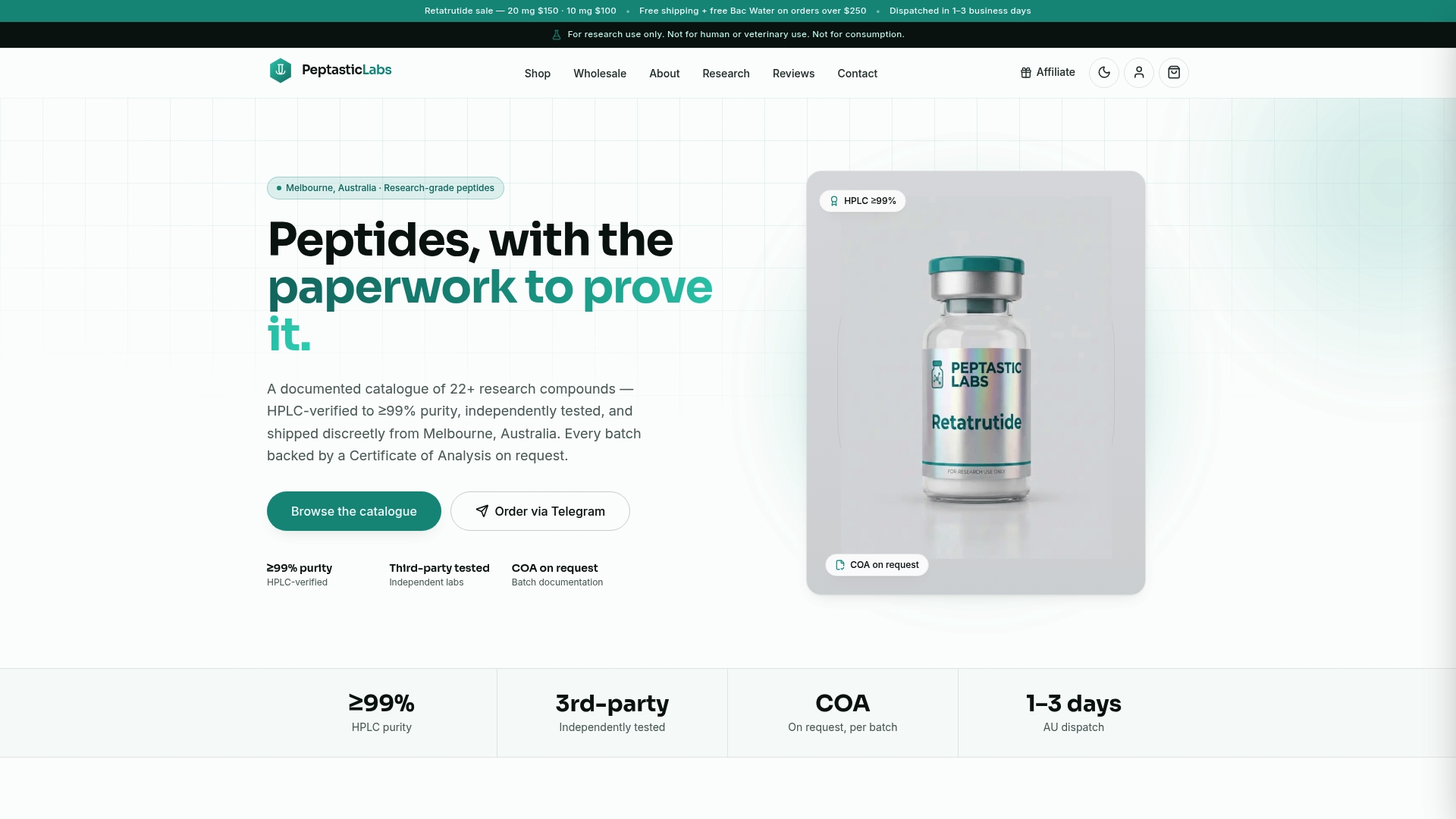
Every compound in the Peptastic Labs catalog ships with the documentation this article outlines: lot-matched COAs, mass spectrometry identity data, and stated HPLC methods, so your incoming-goods QC workflow starts with real numbers instead of a marketing percentage. Bulk and wholesale options are available for labs running multi-batch studies, and researchers can request additional documentation, including sample chromatograms, before committing to a purchase. If your next protocol needs a peptide with paperwork that survives peer review, browse the current research catalog and request a COA for the specific lot you'd be ordering.
Frequently Asked Questions
What is the role of cosmetic peptides in skin research explained simply? Cosmetic peptides act as signaling molecules that trigger measurable biological responses in skin cells, including collagen synthesis, matrix remodeling, and inflammatory modulation, which researchers quantify through assays like western blot, qPCR, and zymography.
What purity level should I require for dose-response studies? Dose-response and publication-grade work calls for the highest purity tier available, paired with full batch documentation, since impurities distort molar concentration calculations across a dilution series.
Why isn't HPLC purity enough to confirm a peptide is correct? HPLC measures chromatographic purity but cannot distinguish co-eluting impurities with similar retention times; mass spectrometry is required to confirm the observed mass matches theoretical mass within about 1 Da.
What's the difference between HPLC purity and net peptide content? HPLC purity reflects the proportion of UV-absorbing peak area belonging to the target peptide, while net peptide content accounts for water, salts, and counterion mass to state the actual peptide mass per gram of material.
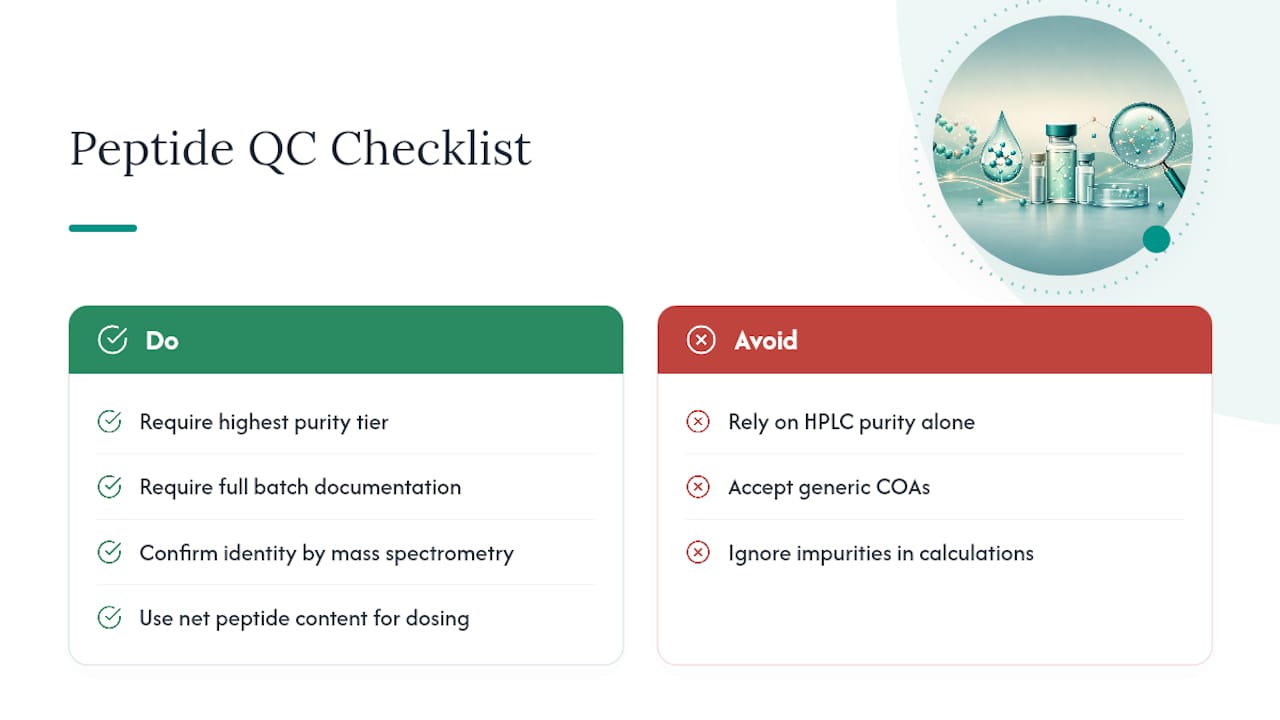
How do I know if a supplier's COA is legitimate? Check that the lot number on the COA matches the vial exactly, confirm a named third-party testing lab is listed, and verify the chromatogram and MS data correspond to that specific batch rather than a generic template.