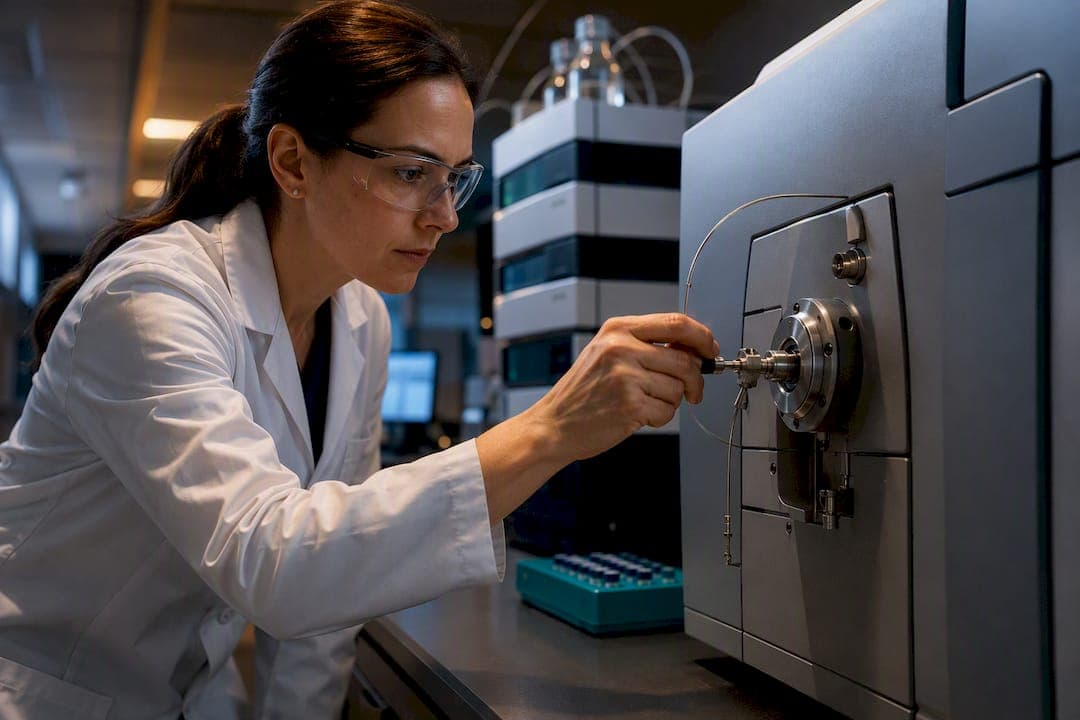
HPLC separates compounds and quantifies them with optical detection, making it the standard for purity and area% measurements. LC-MS adds mass detection on top of that separation, delivering molecular identity and sensitivity down to parts-per-billion or lower. Choose HPLC for routine purity assays; choose LC-MS when you need identity confirmation, trace-level detection, or you're chasing a non-UV-active impurity that HPLC alone cannot see.
TL;DR:
- HPLC provides reliable purity data with reproducible area% measurements, but cannot confirm molecular identity or detect non-UV-active impurities.
- LC-MS delivers highly sensitive molecular identification and trace-level detection but requires volatile mobile phases, low-background consumables, and source cleaning.
- Using LC-MS for peptide analysis demands careful method reoptimization, especially mobile phase chemistry and sample handling, to prevent ghost peaks and signal loss.
- Combining HPLC with an orthogonal technique like quantitative NMR or MS confirmation improves accuracy, especially for non-UV-active or co-eluting impurities.
- Routine peptide purity testing favors HPLC due to cost and speed, reserving LC-MS for identity confirmation and trace impurity analysis in regulatory or research settings.
Table of Contents
- HPLC Analysis Method: Components, Detection, and Validation Metrics
- HPLC vs Mass Spectrometry: How Ionization and Analyzers Work
- LC-MS Instrumentation: Coupling Chromatography With Mass Detection in Practice
- Comparing HPLC, Single-Quad LC-MS, and LC-MS/MS Side by Side
- Preventing Ghost Peaks, Column Bleed, and Sensitivity Loss
- Orthogonal Testing for Peptides: What a Reliable COA Should Show
- A Step-By-Step Checklist for Choosing Your Method
- The Bottom Line on HPLC vs LC-MS
- What the Bench Actually Teaches You About This Trade-Off
- Where Peptasticlabs Fits Into Your Peptide QC Workflow
- Sources
HPLC Analysis Method: Components, Detection, and Validation Metrics
High-performance liquid chromatography separates molecules based on how they partition between a stationary phase packed in a column and a mobile phase pumped through it. Reverse-phase HPLC, the workhorse mode for peptide work, uses a nonpolar stationary phase (typically C18-bonded silica) and a polar mobile phase, so more hydrophobic peptides retain longer. HILIC (hydrophilic interaction chromatography) flips that logic for very polar analytes that elute too fast under reverse-phase conditions. Column particle size matters more than most method developers admit: dropping from 5 µm to sub-2 µm particles sharpens peaks and improves resolution, but it also raises backpressure and demands a pump rated for ultra-high-pressure liquid chromatography.
Detection is where HPLC either shines or stalls. UV-Vis and photodiode array (PDA) detectors dominate peptide purity work because most peptides absorb around 214 nm through their amide backbone, giving a reliable, reproducible purity metric independent of side chain composition. Fluorescence detection pushes sensitivity further for analytes that fluoresce natively or after derivatization, but it's a poor fit for peptides that lack a fluorophore. The blind spot shows up when an impurity has no meaningful chromophore. A co-eluting degradant that doesn't absorb at your monitored wavelength simply disappears from the chromatogram, which is one reason orthogonal confirmation matters later in a QC program.
Quantitation in HPLC generally comes down to one of three approaches:
- Area percent: reporting each peak's area as a percentage of total peak area, common for purity claims.
- External calibration curves: running known standard concentrations to build a response curve for absolute quantitation.
- Internal standards: spiking a known compound into every sample to correct for injection or extraction variability.
Validated assays typically target relative standard deviation (RSD) under 2% for replicate injections, with tighter limits (often under 1%) expected for potency assays supporting release testing. HPLC earns its place as the default method for a straightforward reason: it's cheaper per sample, faster to validate, and universally accepted by regulatory bodies for routine purity and stability testing when the analyte is UV-active and the sample matrix is simple. When those two conditions hold, there's rarely a reason to reach for anything more complex.
HPLC vs Mass Spectrometry: How Ionization and Analyzers Work
Mass spectrometry identifies compounds by measuring the mass-to-charge ratio (m/z) of ionized molecules, not by how they interact with a stationary phase. That distinction is the entire reason HPLC and mass spectrometry answer different questions: one tells you how pure a sample is relative to itself, the other tells you what the molecule actually is.
Getting a molecule into the gas phase as an ion requires an ionization source, and the choice of source depends heavily on the analyte's polarity and volatility.
- Electrospray ionization (ESI): the dominant choice for peptides and other polar, thermally sensitive biomolecules, producing multiply charged ions directly from solution.
- Atmospheric pressure chemical ionization (APCI): better suited to smaller, less polar, moderately volatile compounds that don't ionize efficiently under ESI conditions.
- Atmospheric pressure photoionization (APPI): reserved for nonpolar analytes that resist both ESI and APCI, less common in peptide labs.
Once ionized, the mass analyzer determines what information you get back. A single quadrupole gives you a straightforward mass filter, useful for screening and confirming a expected mass but limited in selectivity. Triple quadrupole instruments running multiple reaction monitoring (MRM) fragment a precursor ion and monitor specific product ions, which is what gives triple-quad LC-MS/MS its exceptional sensitivity for targeted quantitation, often down to parts-per-billion or parts-per-trillion. High-resolution mass spectrometry (HRMS), including Orbitrap and time-of-flight instruments, measures mass with enough precision to assign elemental composition, which is the tool of choice for structural elucidation and unknown identification.
The m/z value, isotope pattern, and fragment ion spectrum together build a case for a compound's identity the way a fingerprint builds a case for a suspect. One caveat researchers new to LC-MS often miss: without an internal standard matched closely to the analyte, MS response is semi-quantitative at best. Ionization efficiency varies compound to compound and shifts with matrix composition, so a raw peak area on an MS trace isn't directly comparable to a UV peak area the way it is on HPLC.
LC-MS Instrumentation: Coupling Chromatography With Mass Detection in Practice
Bolting a mass spectrometer onto an HPLC system sounds simple. It isn't, mostly because the mobile phase chemistry that works fine for UV detection can wreck an ESI source or coat a vacuum system with residue.
Mobile phases for LC-MS need to be volatile. Ammonium acetate, ammonium formate, and formic acid are the standard modifiers because they ionize cleanly, evaporate in the source, and leave minimal residue. Phosphate buffers, a staple of classic reverse-phase HPLC methods, are effectively banned from LC-MS work; non-volatile salts foul the ion source and vacuum system and can force an expensive cleaning or repair. This is one of the most common reasons a perfectly good HPLC-UV method can't simply be run on an LC-MS instrument without redevelopment.
Column chemistry matters too. Low-bleed columns with minimal stationary-phase leaching keep background noise down, since anything that bleeds off the column ends up in the mass spectrum as a ghost signal. Sub-2 µm particles pair naturally with MS detection because narrower, sharper peaks concentrate the analyte into a shorter elution window, boosting signal intensity.
Sample handling carries its own requirements:
- Filter every sample through a 0.22 µm filter before injection to remove particulates that could clog capillaries or introduce noise.
- Use certified low-background, Type 5.0 glass vials with bonded PTFE/silicone septa to avoid metal ion adducts and plasticizer leaching.
- Confirm autosampler seals and tubing are compatible with the solvent system, since some elastomers degrade in high-organic mobile phases.
These consumable requirements exist because LC-MS sensitivity at the ppb and ppt level amplifies contamination that HPLC-UV would never even register.
Pro Tip: Before transferring any validated HPLC-UV method to LC-MS, budget time to reoptimize gradient slope, mobile phase pH, and buffer concentration. Treat it as new method development, not a detector swap.
Comparing HPLC, Single-Quad LC-MS, and LC-MS/MS Side by Side
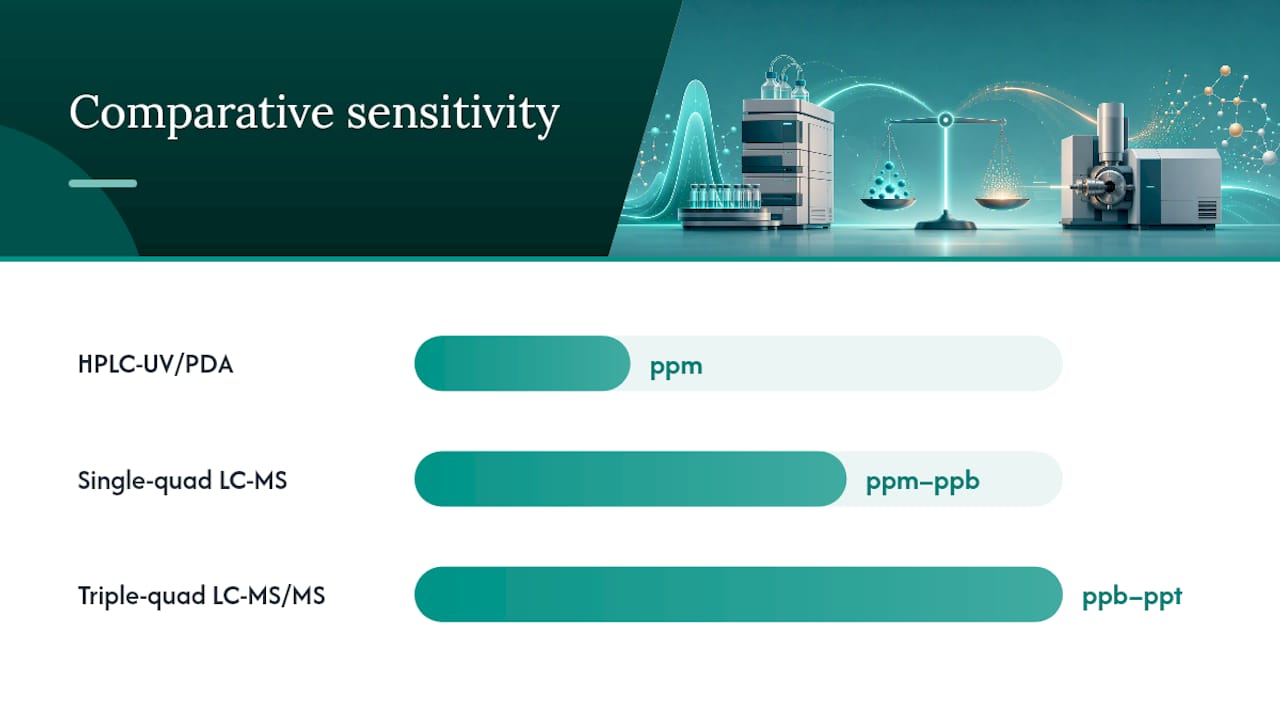
The three most common configurations in a peptide lab, HPLC-UV, single-quadrupole LC-MS, and triple-quadrupole LC-MS/MS, sit on a spectrum from simple and inexpensive to sensitive and complex.
| Dimension | HPLC-UV/PDA | Single-quad LC-MS | Triple-quad LC-MS/MS |
|---|---|---|---|
| Detection principle | Optical absorbance at fixed wavelength | Mass filtering by m/z | Precursor ion fragmentation, product ion monitoring |
| Typical sensitivity | Parts-per-million | Parts-per-million to parts-per-billion | Parts-per-billion to parts-per-trillion |
| Selectivity / information | Retention time + peak area; no structural data | Molecular weight confirmation | Structural fragments, highly selective quantitation |
| Typical applications | Purity, area%, stability testing | Identity screening, impurity flagging | Trace quantitation, pharmacokinetics, residue testing |
| Sample prep / consumables | Standard filtration, any HPLC-grade solvent | 0.22 µm filtration, volatile buffers required | 0.22 µm filtration, low-background vials, volatile buffers mandatory |
| Cost & maintenance | Lower capital cost, straightforward upkeep | Moderate capital cost, source cleaning required | Highest capital cost, frequent source and vacuum maintenance |
The jump in sensitivity from HPLC-UV to triple-quad LC-MS/MS isn't incremental. Moving from ppm-level detection to ppb or ppt sensitivity represents several orders of magnitude, which is exactly why trace-level impurity work and pharmacokinetic studies lean on triple-quad instruments rather than HPLC-UV.
That sensitivity gain has a cost beyond the instrument price tag. Ion suppression, where co-eluting matrix components interfere with an analyte's ionization efficiency, can quietly inflate your limit of quantitation (LOQ) even on a technically sensitive instrument. A dirty sample matrix running on triple-quad LC-MS/MS can produce worse real-world sensitivity than a clean sample on single-quad LC-MS, which is why sample cleanup often matters more than instrument specs when chasing trace analytes.
For most peptide purity release testing, HPLC-UV is genuinely adequate. It handles area% purity, gives reproducible RSD values run to run, and doesn't require the consumable discipline LC-MS demands. Where HPLC falls short is anywhere identity confirmation matters. That's a job for mass spectrometry, not optical detection, and it's the single biggest reason serious peptide QC programs run both techniques rather than picking one.
Preventing Ghost Peaks, Column Bleed, and Sensitivity Loss
Most HPLC and LC-MS troubleshooting traces back to consumables, maintenance timing, or mobile phase chemistry rather than the instrument itself.
Filter and vial choices deserve more attention than they typically get. Cheap, uncertified vials can leach plasticizers or introduce trace metals that show up as unexpected adducts on an MS trace. Certified low-background Type 5.0 vials with bonded septa and 0.22 µm low-extractable filters solve most of this before it starts, and the cost difference per vial is trivial next to the instrument time lost chasing a phantom peak.
Mobile phase discipline matters just as much:
- Never use non-volatile salt buffers (phosphate, borate) on any system that shares tubing or a source with an MS detector.
- Use LC-MS grade solvents, not general HPLC-grade, for any trace-level or MS-bound method.
- Degas and filter mobile phases consistently; dissolved gas causes baseline noise that mimics ghost peaks.
Routine maintenance cadence prevents most acute failures. Source cleaning on ESI interfaces should happen on a defined schedule, not reactively after sensitivity drops. Vacuum system checks and pump seal inspections catch slow degradation before it becomes a failed run. Any method transferred between instruments or labs should trigger a revalidation check, since even identical column chemistries from different lots can shift retention behavior slightly.
When something does go wrong, a short troubleshooting sequence usually finds the cause:
- Ghost peaks appearing between runs: suspect carryover from the autosampler or column bleed from an aging stationary phase.
- Unexpected adducts on MS spectra: check vial and cap quality first, then mobile phase purity.
- Sudden sensitivity loss: inspect the ESI source for contamination before assuming the analyte degraded.
Pro Tip: *Keep a maintenance log tied to specific symptoms, not just dates.
Orthogonal Testing for Peptides: What a Reliable COA Should Show
A multi-laboratory USP collaborative study comparing HPLC assay, quantitative NMR (qNMR), and amino acid analysis (AAA) for oxytocin found HPLC produced the lowest inter-lab variability of the three techniques, with a mean assay value of 1.807 mg against 1.798 mg for qNMR and 1.73 mg for AAA. That's a meaningful data point for anyone deciding how much weight to put on an HPLC purity figure: when a matched reference standard is available, HPLC's quantitative reproducibility across labs holds up better than either alternative technique tested.
HPLC alone still has a blind spot. That's where LC-MS earns its place in a peptide QC program: it confirms intact mass, flags unexpected mass shifts consistent with deamidation or oxidation, and can pick apart co-eluting compounds that appear as a single clean peak under UV detection.
The most defensible peptide characterization comes from combining chromatographic area% with an independent quantitative check like qNMR, since chromatographic purity alone can miss non-UV-active impurities that never show up as a separate peak.
A Certificate of Analysis worth trusting should include:
- HPLC chromatogram with area% purity and retention time data
- MS identity confirmation, including observed m/z and resolution
- Full method parameters (column, mobile phase, gradient, detection wavelength)
- Instrument model and analyst initials for traceability
- Raw chromatograms available on request rather than just a summary report
A Step-By-Step Checklist for Choosing Your Method
- Define what you actually need to know: purity percentage, molecular identity, or trace-level contamination.
- Match the required detection limit to the technique: ppm favors HPLC, ppb/ppt requires LC-MS/MS.
- Assess matrix complexity; dirty matrices push you toward MS for selectivity even at moderate concentrations.
- Check regulatory or publication requirements for method validation and acceptance criteria (RSD, recovery ranges).
- Confirm calibration strategy and internal standard availability before committing to a quantitative MS method.
- When requesting external testing, ask explicitly for COA fields including raw data access and instrument-level documentation, not just a summary number.
The Bottom Line on HPLC vs LC-MS
For routine peptide purity, HPLC is the right default: cheap, fast, and well validated. For identity confirmation or trace-level impurity detection, LC-MS is necessary. Anything headed for publication or regulatory submission deserves orthogonal confirmation across both techniques rather than a single method's word for it.
What the Bench Actually Teaches You About This Trade-Off
The extra prep work LC-MS demands, volatile buffers, certified vials, more frequent source cleaning, isn't overhead for its own sake. It's the price of information HPLC structurally can't provide. A lab that skips LC-MS because it's "more work" is usually a lab that's never had a clean-looking HPLC peak turn out to be two compounds wearing the same UV signature. The inverse mistake is just as common: running everything through LC-MS/MS because it's more sensitive, when a validated HPLC method would answer the actual question faster and cheaper. Match the tool to the question, not to whichever instrument happens to be free that week.
— Tintastic
Where Peptasticlabs Fits Into Your Peptide QC Workflow
Sourcing peptides without traceable analytical backing puts your own results on shaky ground before you've run a single assay.
That documentation isn't a summary line, it's method parameters, instrument details, and raw chromatograms you can request directly rather than take on faith. If you're building a QC comparison or writing a method section, start by reviewing the COA fields Peptasticlabs provides on a catalog product page, then request raw chromatogram data for the specific batch you're working with. Researchers placing larger orders can also inquire about bulk and wholesale terms. Browse the full peptide catalog to see documentation standards applied consistently across the product line, or head to the Peptasticlabs homepage to start a request.
Sources
- SURVEY OF PEPTIDE QUANTIFICATION METHODS AND COMPARISON OF THEIR REPRODUCIBILITY: A CASE STUDY USING OXYTOCIN
- HPLC vs. LC-MS/MS: Cost, Sensitivity and Certified Consumable Requirements — HPLC Vials
- HPLC vs LC-MS: Choosing the Right Analytical Method — ILS Laboratories
- Quantitative NMR (qNMR) for Peptide Reference Standard Characterization and Purity Assignment — Resolve Mass