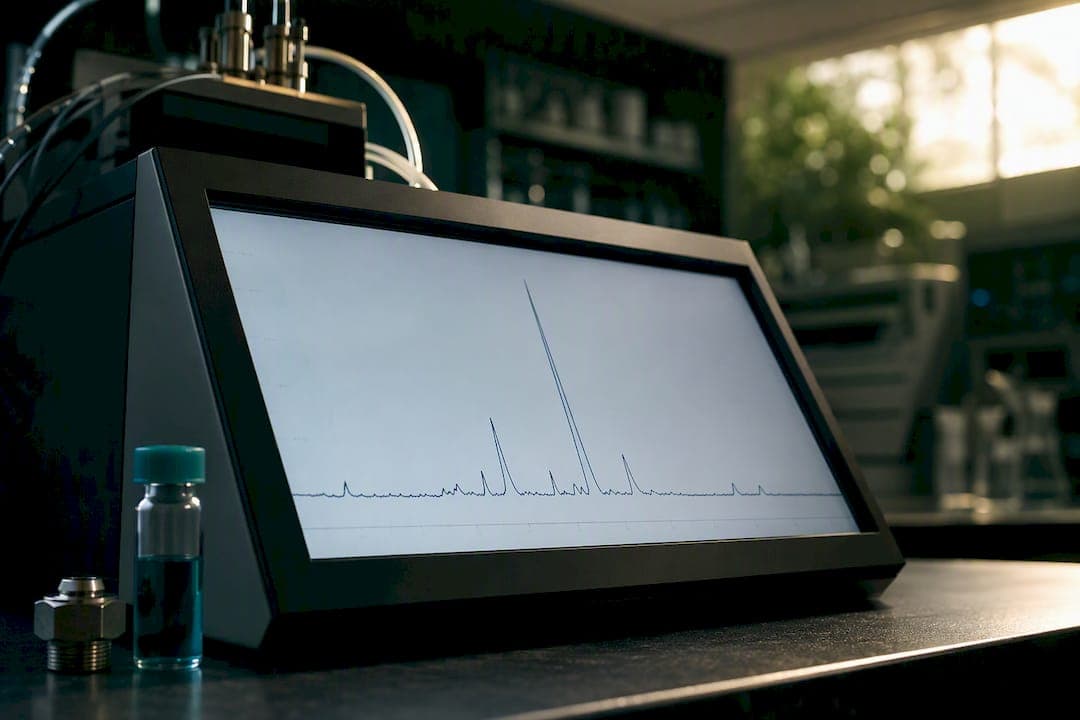
HPLC peptide testing, almost always run as reversed-phase HPLC, measures the UV-detectable purity of a peptide sample. It reliably flags synthesis-related impurities and truncation byproducts, but it cannot alone confirm total peptide content or identity. Method validation should follow ICH Q2(R2) and FDA analytical guidance; Peptastic Labs makes Certificates of Analysis available on request for every lot it releases.
TL;DR:
- HPLC purity measures peak area ratios and does not directly reflect the actual peptide weight or content in a sample.
- Mobile-phase additives, gradient slope, temperature, and flow rate significantly influence peptide separation quality and consistency.
- System-suitability checks like resolution, injection precision, and plate count are essential before trusting chromatogram results.
- Validating HPLC methods requires specific tests for specificity, accuracy, precision, linearity, and forced degradation to ensure reliability.
- Complementary techniques such as LC-MS and amino acid analysis are necessary to confirm peptide identity and content beyond UV-HPLC purity.
Table of Contents
- What HPLC purity actually measures versus peptide content
- How reversed-phase HPLC separates peptides
- Reading the chromatogram: purity math and system suitability
- Method validation: what a defensible dataset requires
- Sample preparation mistakes that quietly bias results
- What HPLC can't tell you: orthogonal testing
- Peptastic Labs: what to request before trusting a lot
- Why researchers overtrust a single purity number
- Sources
What HPLC purity actually measures versus peptide content
A Certificate of Analysis reporting "99% pure by HPLC" is describing peak-area percentage, not the fraction of the vial that is actual peptide. The calculation divides the target peak's area by the total area of all detected peaks, assuming every impurity absorbs UV light at a similar rate to the main compound. That assumption breaks down fast.
Peptide content is a different number entirely: the actual mass fraction of peptide in the material, accounting for water, residual acetate or TFA salts, and bulking agents like mannitol. A lyophilized peptide can post 99% HPLC purity and still contain only 80% peptide by weight once salt and moisture are factored in, which is exactly why Vanguard Laboratory's guide to HPLC peptide testing treats purity and content as separate claims that both belong on a CoA.
RP-HPLC chromatograms typically reveal these synthesis-related impurities:
- Deletion sequences, where an amino acid was skipped during solid-phase synthesis
- Truncated fragments from incomplete coupling cycles
- Oxidized variants, especially at methionine or tryptophan residues
- Diastereomers from racemization during activation
- Aggregates or dimers formed through disulfide mispairing
Researchers comparing vendor claims should read the peptide purity standards guide alongside any CoA to understand which number they are actually looking at.
How reversed-phase HPLC separates peptides
C18 stationary phases dominate peptide separation because their hydrophobic alkyl chains retain peptides long enough to resolve closely related sequences, and this reversed-phase approach is the accepted standard for peptide chromatography. Shorter, more hydrophilic peptides sometimes need a C8 or C4 phase instead, since a C18 column can over-retain them and blur peak shape.
Mobile-phase additives change the outcome as much as the column does. Trifluoroacetic acid (TFA) sharpens peak shape and improves resolution for most peptides, but it suppresses ionization if the same sample is headed to a mass spectrometer downstream. Formic or acetic acid trades some peak sharpness for MS compatibility, which is why labs running LC-MS confirmation often switch additives between the two runs rather than trying to force one mobile phase to do both jobs.
Three other levers shape every separation:
- Gradient slope: a shallower gradient buys resolution between closely eluting impurities at the cost of run time
- Column temperature: raising it a few degrees can sharpen peaks and shorten runs, but drift between sessions ruins retention-time reproducibility
- Flow rate: too fast and resolution drops; too slow and peak diffusion widens the base
Pro Tip: If a method looks fine on paper but keeps producing inconsistent retention times, check column temperature control first. A 2 to 3 degree Celsius swing in ambient lab temperature is a common, overlooked cause of drift that gets misdiagnosed as a mobile-phase problem.
Reading the chromatogram: purity math and system suitability
Main-peak purity is calculated as that peak's area divided by total peak area, but co-elution silently inflates the number. If an impurity shares nearly the same retention time as the target peptide, the integrator may report them as one peak, and the resulting CoA overstates purity without any error appearing in the raw data.
Three system-suitability checks tell you whether to trust the run at all:
- Resolution (Rs) between the main peak and its nearest neighbor should generally exceed 1.5 to confirm baseline separation
- Injection precision, measured as relative standard deviation (RSD) across replicate injections, should stay low, with well-run methods routinely holding RSD near or below 1%
- Plate count (N), a measure of column efficiency, should meet the threshold set in the method's own SOP before results are accepted
A UV-Vis spectral overlay across the peak's rising and falling edges adds a layer of identity confidence that a single-wavelength trace cannot. If the spectrum shifts shape from one edge of the peak to the other, that is a co-elution flag, not a clean single-component peak.
Method validation: what a defensible dataset requires
A chromatogram by itself proves nothing to a reviewer unless the method behind it has been validated. ICH Q2(R2) lays out the characteristics that matter for peptide HPLC methods: specificity, accuracy, precision, limit of detection and quantification (LOD/LOQ), and linearity across the expected concentration range.
Practical validation work for a peptide method usually includes:
- Specificity testing against known degradation products and process-related impurities
- Precision studies across multiple injections, days, and sometimes analysts
- Linearity checks across a concentration range wide enough to cover expected sample dilutions
- Forced-degradation studies (heat, light, pH stress) to confirm the method can actually detect breakdown products
System suitability should be evaluated every session it's run, not just at method validation. At minimum that means an injection precision check, a resolution check between closely eluting peaks, and a plate-count efficiency check, each with acceptance criteria written directly into the method's standard operating procedure.
For regulatory-grade work, HPLC data rarely stands alone. Chromatographic fingerprints are typically paired with orthogonal techniques like LC-MS or amino acid analysis to support CMC sections in a submission, since a single detection method leaves too many blind spots for a regulator to accept on its own.
Sample preparation mistakes that quietly bias results
The dissolution solvent and any ion-pairing reagent in the sample can shift peptide retention and, if the run feeds into MS, tank sensitivity. Studies on sample and mobile-phase composition show that even small mismatches between sample solvent and mobile phase can cause peak splitting or fronting that looks like a column problem but isn't.
Filtration versus centrifugation matters more than most protocols acknowledge. Filtering through the wrong membrane material can adsorb a meaningful fraction of a hydrophobic peptide before it ever reaches the column, and that adsorption problem extends to vials and needles too. Poor dissolution and plasticware adsorption are consistently underestimated sources of low apparent recovery in peptide assays.
Standard pre-analysis controls worth building into every run:
- Bracket standards before and after the sample set to catch instrument drift
- Match the sample diluent to the mobile-phase composition wherever feasible
- Run a solvent blank to check for carryover from the previous injection
- Use low-adsorption vials for hydrophobic or low-concentration peptides
Pro Tip: Consult the peptide solubility protocols before assuming a low recovery is a chromatography failure. Nine times out of ten in a busy lab, it's a dissolution or adsorption issue upstream of the column.
What HPLC can't tell you: orthogonal testing
UV-HPLC has a structural blind spot: it only detects compounds that absorb light at the chosen wavelength. Mannitol, simple sugars, many buffer salts, and some solvents used in synthesis pass through the column invisible to a UV detector, which means peptide content can differ substantially from HPLC purity whenever those excipients are present.
Closing that gap requires pairing HPLC with other techniques:
- LC-MS confirms molecular identity by mass, catching sequence errors that share a retention time with the correct peptide
- Amino acid analysis or ELSD/CAD detection quantifies peptide content directly, including non-UV components HPLC misses entirely
- Endotoxin (LAL) and sterility testing are required, not optional, for any peptide material intended for injectable research use
| Test | What it confirms | What HPLC alone misses |
|---|---|---|
| LC-MS | Molecular identity and mass | Sequence errors sharing a retention time |
| Amino acid analysis / ELSD/CAD | True peptide content by mass | Non-UV excipients like mannitol |
| Endotoxin/sterility (LAL) | Microbiological safety | Any biological contamination |
Peptastic Labs: what to request before trusting a lot
Peptastic Labs verifies every peptide in its catalog to ≥99% purity by HPLC, backed by third-party checks and full batch documentation. That documentation model gives researchers a template for what to demand from any supplier, not just Peptastic Labs.
Before using a peptide lot in a study, request:
- The raw chromatogram, not just a summary purity percentage
- Full method details: column, mobile phase, gradient, and detection wavelength
- A separate peptide content figure distinct from HPLC purity
- Third-party verification reports covering the same lot number
- Endotoxin test results if the material will touch any biological system
The CoA guide and third-party testing explainer both walk through how to read these documents line by line, and a resolution reference like the calibrated protein marker from ABMIUM is worth keeping on hand for related molecular weight verification work in the same lab.
Researchers ready to source verified material can review Peptastic Labs' research documentation or browse the current catalog at Peptasticlabs for lot-specific CoAs and batch records.
Why researchers overtrust a single purity number
The biggest failure mode in peptide research isn't a bad chromatogram. It's treating a single HPLC purity percentage as a complete answer when it was never designed to be one. A method can pass every system-suitability check and still hide a co-eluting impurity or a non-UV excipient that changes the real content of the vial.
Conventional advice tells researchers to "check the purity" before ordering. That's necessary but nowhere near sufficient. The more useful habit is asking which orthogonal method would catch what HPLC structurally cannot see, given the specific peptide and its likely impurities. A cyclic peptide with poor UV absorbance needs a different scrutiny than a linear sequence loaded with aromatic residues.
If there's one priority shift worth making, it's this: stop asking suppliers for a purity number and start asking for the raw chromatogram plus the method parameters behind it. A number without the method that produced it tells you almost nothing about whether the run was actually clean, or just quiet.
— Tintastic
Sources
- Peptide analysis and RP‑HPLC (PMC article)
- ICH Q2(R2) guideline (2023)
- FDA guidance — analytical procedure validation examples
- The Ultimate Guide to HPLC testing for peptides — Vanguard Laboratory