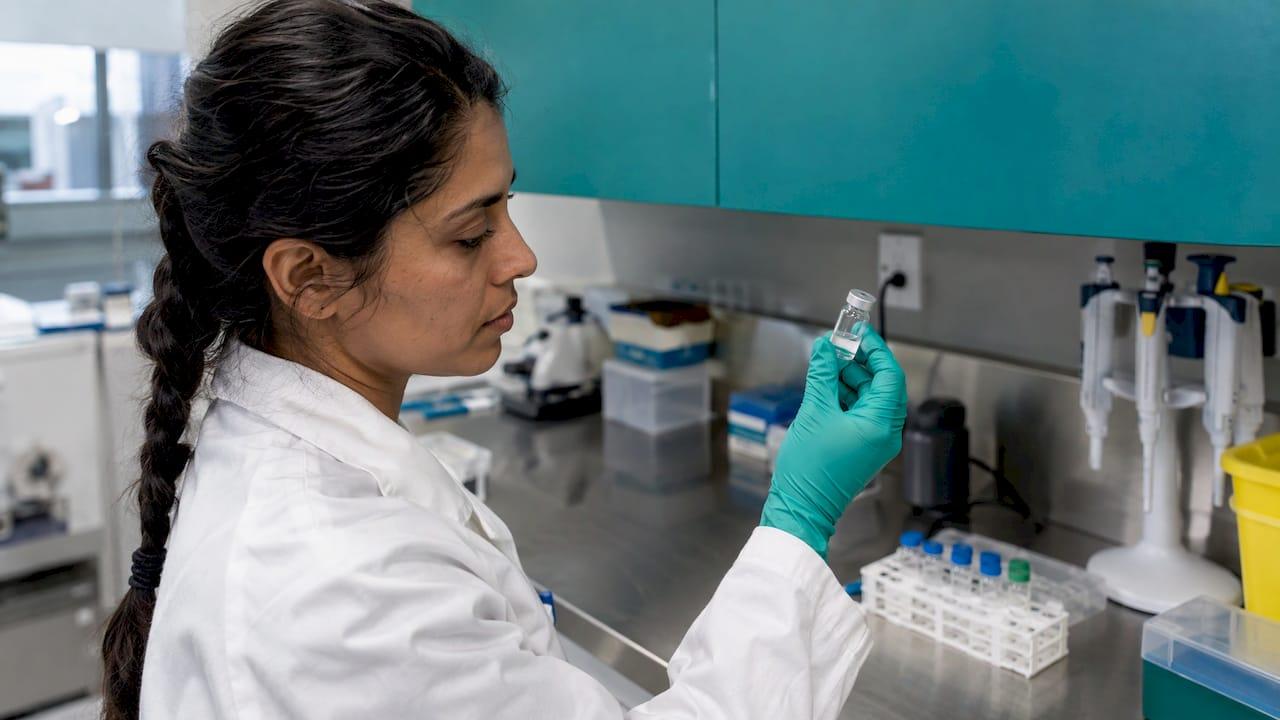
MOD GRF 1-29 (modified GRF 1-29, often sold as CJC-1295 without DAC) is a synthetic fragment of growth hormone-releasing hormone, studied in laboratory settings for how it stimulates the GHRH receptor. Direct published evidence on this exact compound is thin. Most of what circulates is borrowed from sermorelin and from CJC-1295 with DAC. For a researcher in Australia, the practical questions are therefore three: is the molecule what the label says, what does the evidence actually cover, and what do local rules allow. Independently tested material with batch documentation, including HPLC-verified purity of ≥99% and a Certificate of Analysis on request, is what answers the first question. That is the standard Peptastic Labs applies across its catalogue.
TL;DR
- MOD GRF 1-29 is the 1-29 fragment of GHRH with four amino acid substitutions. It is not the same molecule as CJC-1295 with DAC, even though listings often blur the two.
- Published human efficacy data for the no-DAC form is not available. Frequently cited human CJC-1295 work concerns the DAC version.
- In Australia, GHRH analogues fall under the Poisons Standard, and a "research use only" label does not settle a product's legal status. Intended purpose does.
- Identity and purity should be confirmed from batch-specific HPLC and mass spectrometry results, not from a label or a listing.
Table of Contents
- What MOD GRF 1-29 is
- Proposed mechanism
- What the evidence covers
- Questions a study design should settle first
- Safety notes for laboratory handling
- Australian rules
- How to verify a batch
- Perspective
- Sourcing for research programs
- FAQ
- Sources
What MOD GRF 1-29 is
Growth hormone-releasing hormone (GHRH) is a 44-amino-acid hypothalamic peptide. Its first 29 residues carry the activity at the GHRH receptor, so that fragment, GRF 1-29, became a standard research scaffold. MOD GRF 1-29 is that fragment with four substitutions (D-Ala2, Gln8, Ala15 and Leu27) that slow enzymatic breakdown. According to a peptide reference library, the substitutions change how long the peptide survives, not what it binds.
The working summary for a laboratory:
| Attribute | MOD GRF 1-29 |
|---|---|
| Also called | Modified GRF 1-29, Mod GRF, CJC-1295 without DAC, CJC-1295 no DAC |
| Class | GHRH analogue (29-residue fragment) |
| Receptor | GHRH receptor on anterior-pituitary somatotrophs |
| Albumin binding | None (no DAC moiety) |
| Typical research use | Receptor binding, signaling and half-life studies in vitro and in animal models |
How it differs from CJC-1295 with DAC
DAC stands for drug affinity complex. It is a chemical addition that lets the peptide bind albumin in blood, which extends duration of action dramatically. Products labelled "CJC-1295" may contain either form. The same reference library notes that the two differ in duration of action by more than two orders of magnitude, and that commercial listings frequently transpose the molecular weights and registry numbers of the two forms.
This is the single most common source of error in the literature a researcher reads. A half-life of days belongs to the DAC form. A short half-life, widely repeated as about 30 minutes, belongs to the no-DAC form, and a dedicated human pharmacokinetic study of that figure was not identified in the sources reviewed for this article. Treat it as an estimate. The comparison between the two forms and a related secretagogue is covered in our piece on CJC-1295 vs Ipamorelin.

Proposed mechanism
The accepted model is straightforward. The peptide binds the GHRH receptor on pituitary cells, which activates a stimulatory G protein, raises cyclic AMP, drives growth hormone gene transcription and releases stored GH granules. Because the substitutions affect stability rather than binding, the signaling pathway matches that of native GHRH fragments.

In animal work with the DAC analogue, the rat data reported in the same library show roughly a fourfold rise in GH area under the curve over two hours compared with hGRF 1-29. That number is an animal result for a different form. It describes what a modified GHRH analogue can do in a model system. It does not describe MOD GRF 1-29 in humans.
What the evidence covers
It helps to separate three bodies of work that often get merged under one name.
- Sermorelin (GHRH 1-29 amide, no substitutions). This molecule has published pharmacokinetics and trial data, and was once an approved product. Its record belongs to sermorelin, not to the modified fragment.
- CJC-1295 with DAC. The best-known human study is Ionescu and Frohman, published in the Journal of Clinical Endocrinology and Metabolism in 2006. It reported prolonged GH and IGF-I stimulation after a single administration in healthy adults. The effect persisted for days because of albumin binding, which the no-DAC form lacks.
- MOD GRF 1-29 itself. Evidence is limited to in vitro and animal studies and mechanistic inference. No published human efficacy trial of the no-DAC form was identified.
A researcher designing a study should therefore cite the right body of work for the right molecule. Numbers from the DAC literature cannot be carried across, and a protocol that does so will not survive review.
Why search-result pages disagree
The top-ranking pages for this compound range from database profiles to product listings. Several state plainly that the compound has no regulatory approval and little primary literature. Others describe effects in language that implies established outcomes. When pages conflict, return to the primary paper, check which molecule it studied, and note the species, dose and sampling schedule.
Questions a study design should settle first
- Which form? State DAC or no-DAC in the methods, with the molecular weight, so a reader can verify it.
- Which model? In vitro receptor assay, cell line, or animal model. Each answers a different question.
- Which endpoint? GH release, cAMP accumulation, receptor binding affinity or stability. Short half-life compounds need dense sampling.
- Which comparator? Native GRF 1-29 or sermorelin is the logical reference for a stability study.
- Which controls? Vehicle, reconstitution buffer and a verified reference lot.
Safety notes for laboratory handling
No human safety study of MOD GRF 1-29 was identified. Compounds that raise GH and IGF-1 raise the questions that apply to that axis, and published discussion of this peptide class mentions pituitary desensitization with repeated stimulation and unknown effects of sustained IGF-1 elevation. These are reasons the compound belongs in controlled laboratory work and not in personal use.
Practical handling points:
- Store lyophilized material according to the batch documentation and keep reconstituted solutions under the conditions your protocol specifies.
- Record reconstitution date, diluent and volume against the lot number.
- Keep the compound away from anyone who is pregnant, has a pituitary or growth-related condition, or has a cancer history, and direct any health question to a doctor.
- Never use research material on people or animals outside an approved ethics framework.
Australian rules
Australia treats this class cautiously. The Poisons Standard lists growth hormone releasing hormones and analogues in Schedule 4 (prescription only) alongside growth hormone secretagogues and releasing peptides, as shown in TGA scheduling documents. That classification is the starting point for any import, storage or supply decision.
Two points matter for researchers:
- Research use only is a purpose, not a label. A product intended exclusively for non-clinical laboratory work sits outside the therapeutic goods framework. Regulators look at intended purpose across labelling, advertising, distribution and customer communications, not at a printed disclaimer alone.
- Documentation travels with the shipment. Import clearance, tariff classification and GST all depend on accurate paperwork. See our guides on TGA peptide rules, research peptide compliance, the three documents labs must attach, HS codes and import GST.
For questions about prescriptions and therapeutic use, the route is a doctor and the law, covered in the prescription requirements guide. Confirm current requirements with the TGA and Australian Border Force before importing, as scheduling and import rules change.
How to verify a batch
Because listings mix up the DAC and no-DAC forms, the batch record is the real specification. Two methods carry most of the weight. Mass spectrometry confirms identity by measuring molecular mass and, with fragmentation, sequence. HPLC confirms purity by showing a single dominant peak and quantifying impurities. Clinical-trial documentation for synthetic peptides uses exactly this pairing: identity by mass spectrometry and purity by HPLC.
A useful Certificate of Analysis contains:
| Item | What to check |
|---|---|
| Lot or batch number | Matches the vial label and your records |
| Compound name and form | States modified GRF 1-29 or no-DAC explicitly |
| Molecular weight | Observed mass matches theoretical mass for the 29-residue modified sequence |
| HPLC purity | Reported percentage with the chromatogram or method |
| Testing party | In-house and independent results identified separately |
| Date | Test date falls close to manufacture |
A mass that fits a DAC-modified molecule on a vial sold as no-DAC is the exact error the transposed listings produce, and the mass spectrum catches it immediately.
Perspective
Our view is that most confusion around this compound is a documentation problem before it is a science problem. The same name covers two molecules with very different behavior, and a label cannot tell a researcher which one is in the vial.
That is why we build around batch records. Each peptide batch is HPLC and mass spec tested, with traceable batch documentation, and our catalogue is verified to ≥99% purity. Certificates of Analysis are available on request. A study is only as sound as the identity of the material in it, and we would rather a researcher check our paperwork against their protocol than rely on a product page.
Our catalogue spans metabolic, cognitive, tissue repair, longevity, immunology and cosmetic research lines, with bulk and wholesale options for larger programs. We supply research material for qualified laboratory work, and we say so plainly.
Tintastic
Sourcing for research programs
Peptastic Labs supplies independently tested, research-grade peptides in lines that include Metabolic, Hormone & Reproductive, Blends and Ancillaries & Reagents, with bulk and wholesale options. Order through the full catalogue, including pre-filled Telegram or WhatsApp checkout, and request the Certificate of Analysis for the batch you receive so it sits in your records beside the lot number.
For budgeting a program, our overview of peptide costs in Australia sets out the price ranges seen locally. For how research use is documented in practice, see examples of Australian peptide research use.
FAQ
Is MOD GRF 1-29 the same as CJC-1295?
Not necessarily. MOD GRF 1-29 is CJC-1295 without DAC. CJC-1295 with DAC is a different molecule that binds albumin and acts for days, so the name alone does not tell you which form you have. Confirm with the molecular weight on the Certificate of Analysis.
Is there human research on MOD GRF 1-29?
No published human efficacy trial of the no-DAC form was identified. The well-known human study concerned the DAC version. Evidence for MOD GRF 1-29 itself comes from in vitro and animal work and from inference based on sermorelin.
Is MOD GRF 1-29 legal in Australia?
GHRH analogues sit under Schedule 4 of the Poisons Standard, and no TGA approved product information was found for MOD GRF 1-29. Material sold for research is meant solely for non-clinical laboratory use, and intended purpose decides its status. Check current TGA and Border Force requirements before importing.
What does research use only mean?
It means the product is intended exclusively for non-clinical laboratory research and is not for diagnostic, therapeutic or personal use. Regulators judge intent from labelling, advertising and how a product is distributed, not from the disclaimer alone.
How do I confirm purity and identity?
Read the batch Certificate of Analysis. HPLC gives the purity percentage and mass spectrometry gives the observed molecular mass, which should match the modified 29-residue sequence. Request this document for every lot.
Sources
- Mod GRF 1-29: Evidence, Identity, Safety & FDA Status
- Prolonged Stimulation of GH and IGF-I Secretion by CJC-1295 in Healthy Adults
- TGA scheduling delegates interim decisions (Poisons Standard, GHRHs)
- Peptide vaccine trial protocol: identity and purity testing by mass spectrometry and HPLC