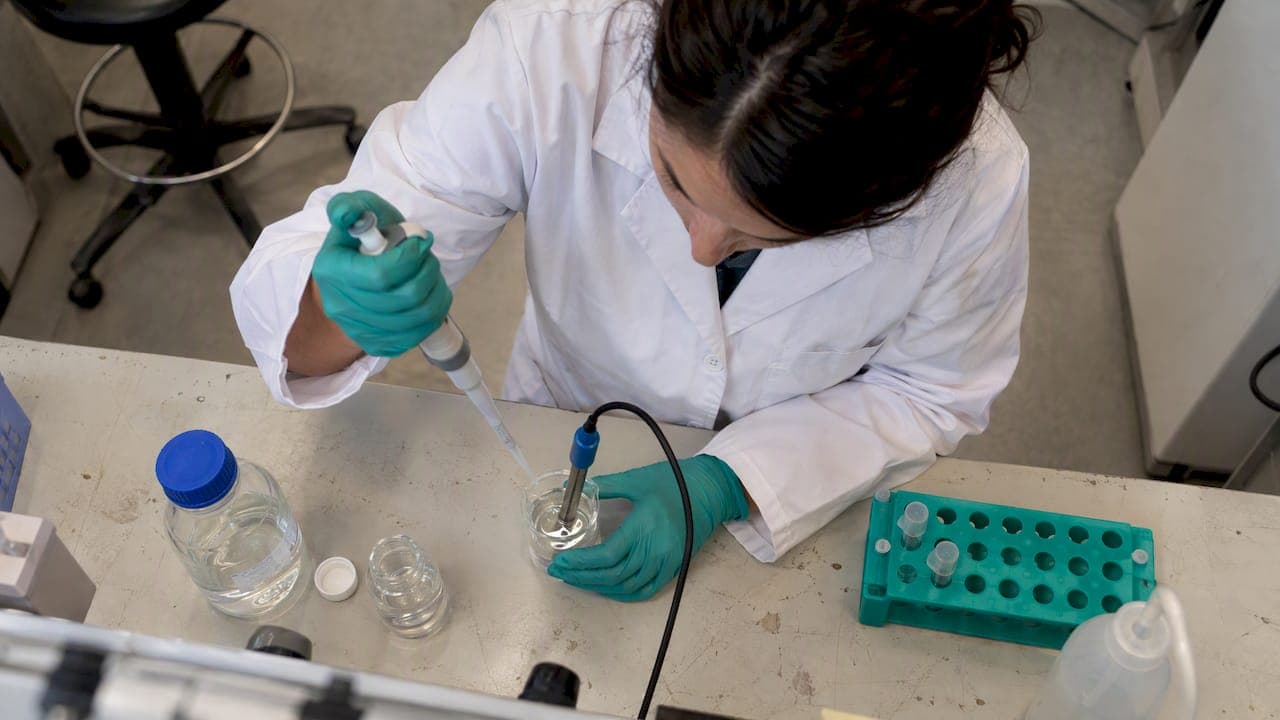
Set your working pH about two units away from the peptide's calculated isoelectric point (pI) when the sequence allows, and never push below pH 4 for Asn-sensitive sequences. Dissolve the peptide first in a small volume of solvent set away from pI, then move gradually into a buffer with real capacity rather than titrating with one-off acid or base. Confirm integrity by HPLC. We supply CoA-backed material from Peptastic Labs to remove one variable.
TL;DR:
- Asn containing peptides face different degradation pathways across pH: below pH 4, direct hydrolysis predominates, while above pH 6, deamidation can form Asp and iso Asp.
- A 2023 review favors pH 3 to 5 for limiting deamidation and oxidation in many peptides, but sequence specific testing should determine the final window.
- Calculate pI from sequence, then inspect fitted residue pKa values; any near target can make charge and solubility shift sharply with small pH drift.
- Check samples immediately and after incubation; repeat HPLC at 24 hours and 7 days for stored solutions, using mass spectrometry to identify mass shifts.
Table of Contents
- How to adjust peptide pH step by step
- Why pH changes peptide solubility and stability
- Choosing a buffer and buffer concentration
- Estimating peptide pI before you touch the pH
- Lab safeguards that prevent irreversible loss
- Quick QC checks after pH adjustment
- Why we start small and document everything
- How we support researchers working on pH-sensitive peptides
- FAQ
- Sources
How to adjust peptide pH step by step
The sequence below assumes you already have an estimated pI (see the pI section further down). Work on a small aliquot first. Scale only after the micro-trial passes.
Materials checklist
- Calibrated pH meter with a small-volume or micro probe
- Concentrated acid and base stocks, such as HCl and NaOH
- Filter-sterile solvents and buffer stocks at defined molarity
- Low-retention tips and clean glassware
- A magnetic stirrer or a mixing method that keeps the solution moving
Procedure
- Calculate the target pH from the sequence and set it roughly two units from the estimated pI, as experts recommend for solubility and lower aggregation risk.
- Calibrate the pH meter against fresh standards bracketing your target.
- Dissolve the lyophilized peptide in a small volume of solvent whose pH sits well away from pI: acidic for basic peptides, basic for acidic peptides. This avoids local crossing of pI during dissolution. Our peptide solvent compatibility guide covers co-solvent choices.
- Prepare the final buffer at enough molarity to resist drift, with its pH already at or near the target.
- Dilute the dissolved peptide into the final buffer, not the other way around, so the peptide never sees a large pH jump.
- If trimming is still needed, add concentrated acid or base in small aliquots to a well-stirred solution and read the meter after each addition.
- Take a micro-scale sample: check clarity, spin it at low speed, and run HPLC before committing the full batch.
Reconstitution volumes and concentration math are covered in our peptide reconstitution guide, and general dissolution technique in the peptide solubility guide.
Pro Tip: Make the micro-trial a fixed first step for every new sequence. A small test can help avoid losing a full batch to precipitation.
Why pH changes peptide solubility and stability
pH moves two things at once: physical behavior (charge, solubility, aggregation) and chemical behavior (degradation). Solubility and stability are not the same thing. Moving away from pI raises solubility, but it can accelerate pH-dependent chemistry, which is why practitioners test both.
- Net charge and pI. Near pI a peptide carries minimal net charge, so electrostatic repulsion between molecules drops and aggregation becomes more likely. Aggregation kinetics also depend on ionic strength, specific ions and concentration, and general rules have common exceptions.
- Asn deamidation. The mechanism changes with pH. Below pH 4, direct side-chain hydrolysis predominates. Above pH 6, deamidation yields Asp and iso-Asp products that complicate stability and analysis.
- Side-chain ionization. Residue pKa values shift with hydrogen bonding or burial in the peptide, sometimes by several pH units, which changes the effective pI.
- Oxidation and disulfide exchange. Both are pH-sensitive in certain ranges and matter for Met, Cys and Trp-containing sequences.
A 2023 review recommends testing pH-dependent degradation across pH 3–10 with several buffers and concentrations, and notes that pH 3–5 is often preferred to limit deamidation and oxidation for many peptides. Treat this as a starting window, then let your sequence decide.
Reading the sequence first is what lets you adapt the protocol. An Asn-Gly motif may warrant testing under acidic conditions. For peptides with free cysteines, consider limiting time at higher pH and excluding air.
Choosing a buffer and buffer concentration
A buffer holds the pH you set while you handle the solution. Pick one whose useful range covers your target, and use enough concentration that dilution and CO2 uptake do not move it.
- Acetate: useful in the mildly acidic range, a common choice for pH 4–5 work.
- Citrate: covers a wide acidic range but can interact with metal ions.
- Histidine: may suit some peptide formulations.
- Phosphate: the neutral workhorse near pH 7, though it can interact with certain chemistries and metals.
- Tris: may be useful under slightly basic conditions.
- Glycine: useful at both acidic and basic extremes and a sensible alternative when citrate or phosphate misbehave.
For concentration, the review above recommends testing several buffer strengths rather than assuming one. Choose a molarity high enough that adding the peptide stock does not move the pH, and low enough to keep ionic strength modest. Prefer pre-made, sterile buffer stocks to buffers mixed at the bench from scratch.
Divalent cations such as Zn2+ or Ca2+ can help some disulfide-containing peptides, and the same review lists them among excipients that can improve aqueous stability. Introduce them last, in small steps, and watch for cloudiness, since cations can also promote aggregation.

Pro Tip: Always set the buffer's pH at the temperature you will use it. A Tris buffer set at room temperature will read differently in a cold room.
Estimating peptide pI before you touch the pH
Estimate first, adjust second. A calculated pI from sequence is a good planning number, but residue context shifts individual pKa values, so keep a margin. Older graphical and computational methods for determining peptide pI and charge versus pH make the same point: actual pK values in peptides can deviate from single-amino-acid values.
- Plan the margin. Aim for about two pH units from the estimated pI where the sequence tolerates it.
- Use a titration tool. pepKalc returns fitted pKa constants, total peptide charge versus pH and downloadable titration curves.
- Read the outputs. Look for the pH where total charge crosses zero, and for any fitted residue pKa sitting inside your planned working range. A pKa near the target means small pH drift will change charge a lot.
- Save the curve. Export or screenshot it and keep it with the batch record so the target pH has a documented basis.
Our post on peptide isoelectric points goes deeper on how far to trust a calculated value.
Lab safeguards that prevent irreversible loss
Most pH-related losses are handling errors, not chemistry surprises.
- Mixing. Add titrant slowly to a stirred solution. Heavy vortexing or dropping concentrated acid into a still vial creates microenvironments that cross pI locally, even when the bulk pH looks fine.
- Ionic strength. Add salts gradually. Screening of charge by salts can speed aggregation in some systems, and specific ion effects are real.
- Temperature. Hold temperature steady during adjustment and keep solutions cool where the sequence is labile.
- Oxygen. Exclude air when Met, Cys or Trp residues are present, and keep freeze-thaw cycles to a minimum. Our storage and degradation guide covers solution storage.
- If precipitate forms. Centrifuge it and analyze the supernatant by HPLC. Do not assume the peptide is recoverable or intact because the pellet looks small.
Pro Tip: Record the pH after the peptide is fully dissolved, not before. Peptide salts, especially TFA or acetate forms, can shift the reading.
Quick QC checks after pH adjustment
Run the cheap checks every time and the analytical ones when the peptide matters to the experiment.
- Immediately: inspect for clarity, then spin at low speed to look for insoluble aggregates.
- Short incubation: hold a small aliquot at working temperature and watch for delayed precipitation.
- HPLC: run it post-adjustment to detect degradation products or loss of the main peak. Use MS when HPLC shows new peaks and you need to identify a mass shift.
- Scheduled rechecks: repeat at 24 hours, then at 7 days if the peptide will be stored in solution.
Why we start small and document everything
Our view is conservative: micro-scale testing first, one variable at a time, every pH and buffer choice written down. General rules about pI margins and deamidation windows are good priors, but exceptions are common, so the sequence in your vial decides. Well-documented starting material removes avoidable guesswork. Check the batch CoA before you plan a pH.
— Tintastic
How we support researchers working on pH-sensitive peptides
pH work goes faster when you know what is in the vial. Our approach is documentation you can use before the first adjustment:
- Independently tested peptides, with purity verified by HPLC
- Certificates of Analysis available on request
- Bulk and wholesale options for routine, repeat experiments, where batch documentation can reduce repeat QC
Browse the full range of Metabolic, Cognitive & Neuro, Tissue & Repair and further research lines in our peptide catalogue, and request the CoA for the batch you plan to work with.
FAQ
What pH should I use to dissolve a peptide?
Start about two pH units away from the peptide's calculated pI where the sequence allows. Acidic peptides generally dissolve better at higher pH and basic peptides at lower pH, but check for labile residues first.
How fast should I change a peptide's pH?
Change it gradually, in small aliquots, into a well-stirred and buffered solution. Passing quickly or unevenly through the pI can cause local precipitation that does not redissolve.
Is a pH of 3 to 5 always best for peptide stability?
No. A 2023 review notes this range is often preferred to limit deamidation and oxidation, but the best pH depends on the sequence. Test across a range with several buffers.
How do I know if pH adjustment damaged my peptide?
Check clarity, centrifuge for aggregates, and compare an HPLC trace against the starting material. New peaks or a smaller main peak indicate degradation, and MS can identify mass shifts.
Sources
- Pmc
- Designing Formulation Strategies for Enhanced Stability of Therapeutic Peptides in Aqueous Solutions: A Review - PMC
- Pmc
- Factors affecting the physical stability (aggregation) of peptide therapeutics | Interface Focus | The Royal Society
- pepKalc