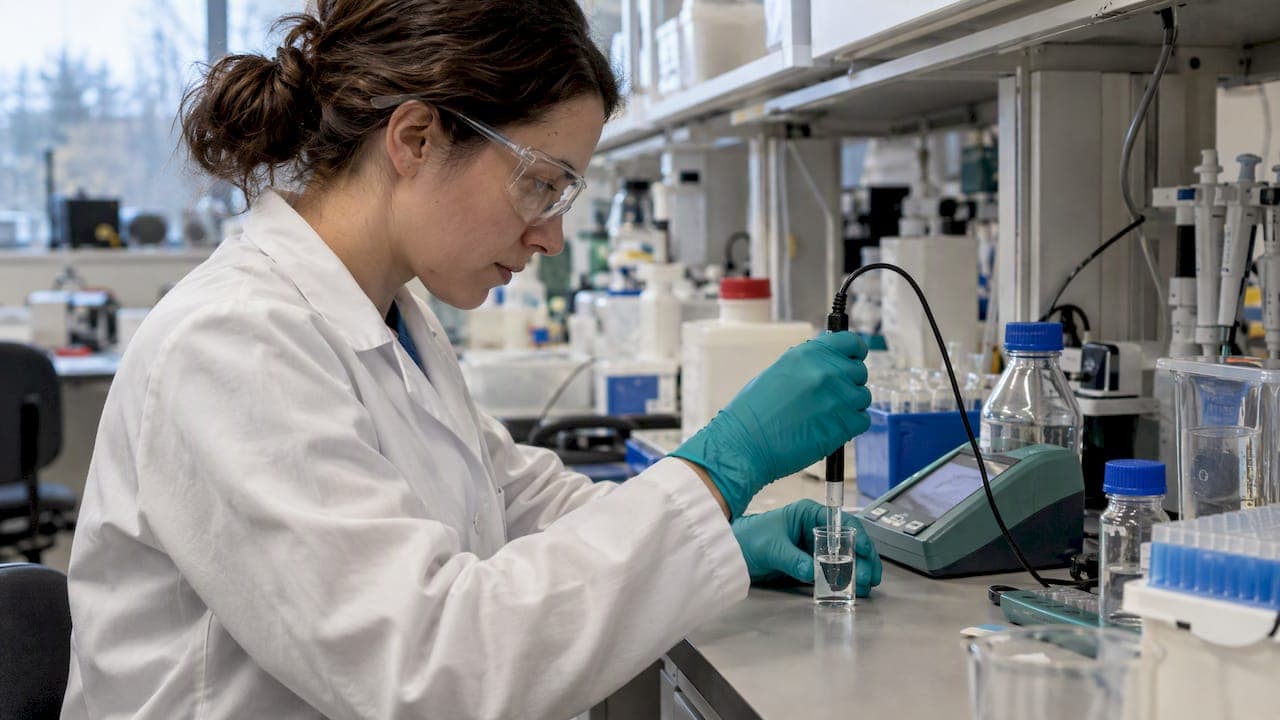
Dissolve charged peptides in an appropriate aqueous buffer. For hydrophobic sequences, pre-dissolve a small aliquot in DMSO, then dilute it into buffer. Always test a tiny sample before committing the full vial. Read the solvent SDS first, and work with ventilation and proper PPE for volatile or toxic solvents. Dissolved peptides are less stable, so aliquot and freeze if you must store them.
TL;DR:
- Net charge at working pH predicts solubility: use water or buffer for charged peptides, and first dissolve hydrophobic sequences in DMSO before dilution.
- Test a tiny sample before treating the full vial, add solvent gradually, and record each solvent, volume, and mixing step to diagnose failures.
- Read each solvent’s SDS before use, and use ventilation for volatile solvents such as methanol, isopropanol, and DMF, with PPE matched to its hazards.
- Dissolved peptides can aggregate or degrade, so make single use aliquots, freeze them, avoid repeated thawing, and limit oxygen for oxidation prone sequences.
Table of Contents
- How peptide properties determine your peptide solvent safety choices
- A step-by-step workflow for dissolving peptides
- Solvent hazards and workplace controls
- Storage and stability for peptide solutions
- Troubleshooting insoluble peptides safely
- How we support safe solvent selection
- A lab-first view on peptide solvent safety
- COA-backed peptides and technical support from Peptastic Labs
- FAQ
- Sources
How peptide properties determine your peptide solvent safety choices
Start with the sequence. Peptides rich in charged residues (Lys, Arg, Asp, Glu) usually dissolve in water or a buffer, because the charges interact favorably with the aqueous phase. Hydrophobic peptides, heavy in Leu, Val, Phe, or Trp, resist water and often need an organic co-solvent. Net charge at your working pH is the quickest predictor of which route to take.
Common solvent categories:
- Water or buffer: first choice for charged and polar sequences.
- DMSO: pre-dissolve hydrophobic peptides, then dilute into assay buffer.
- Methanol and isopropanol: volatile alcohols, used when the assay tolerates them.
- DMF: an alternative for stubborn sequences, with stricter handling because of its toxicity.
A stronger solvent is not automatically a better one. A 2023 review of peptide formulation strategies recommends pH and buffer optimization as core stabilization measures, and formulation literature notes that strong organic solvents may rescue solubility but do not control aggregation or degradation in the final assay environment.
Pro Tip: Check the Certificate of Analysis and supplier notes for batch-specific solubility guidance before choosing a solvent.
A step-by-step workflow for dissolving peptides
Follow the same order every time so results stay reproducible. Our peptide solubility guide covers the bench protocol in more depth.
- Inspect the vial for intact seals and visible powder.
- Weigh out or set aside a tiny test sample, not the full vial.
- Choose the initial solvent from the peptide's charge and hydrophobicity.
- Add solvent gradually, a small volume at a time.
- Vortex, rotate, or sonicate briefly to aid dissolution.
- Centrifuge if the solution is cloudy, and check for a pellet.
- Dilute into the final assay buffer while keeping the organic solvent fraction low.
For cell-based work, keep the final DMSO concentration as low as the assay allows. If a volatile co-solvent has to be removed, lyophilize the peptide and reconstitute it in the target buffer. Our guide to reconstitution and volume math helps with the arithmetic.
Pro Tip: Record every volume, solvent, and mixing step. A written trail turns a failed dissolution into a diagnosable one.
Solvent hazards and workplace controls
Treat the safety data sheet as the authority on any solvent. Safe Work Australia guidance on solvent exposure directs workers to read the SDS, use engineering controls and ventilation to limit vapor exposure, and match PPE and storage to the SDS.
- Read the SDS first: it lists health hazards, PPE, storage, and spill instructions for that specific solvent.
- Use a functioning fume hood or local exhaust for volatile solvents such as methanol, isopropanol, and DMF.
- Choose lower-toxicity or lower-volatility solvents where the experiment permits, and treat PPE as the last line of defense.
- Select chemical-resistant gloves by permeation data, wear eye protection, and use respirators only when the SDS requires them.
- Store flammables in appropriate cabinets, away from ignition sources.
- Contain spills promptly per the SDS, and dispose of solvent-contaminated materials as hazardous waste.
Storage and stability for peptide solutions
Dry lyophilized peptide is generally easier to preserve than peptide in solution. Once dissolved, a peptide becomes vulnerable to degradation and aggregation, and the 2023 review advises against long-term storage in solution.
If you must store a solution:
- Aliquot into single-use volumes so you never refreeze the same tube.
- Freeze rather than relying on refrigeration, which does not stop aggregation or chemical degradation on its own.
- Minimize freeze–thaw cycles.
- Limit oxygen exposure for oxidation-sensitive sequences.
- Take extra care with vulnerable residues: Asn, Gln, Cys, Met, and Trp raise instability.
Our article on peptide degradation and storage goes further. For batch-specific advice, consult the COA and product notes.
Troubleshooting insoluble peptides safely
When the first attempt fails, escalate in small, reversible steps:
- Pre-dissolve a small portion in a minimal volume of DMSO, then dilute slowly into buffer.
- Apply gentle warming or brief sonication, avoiding prolonged heat.
- Adjust pH within the limits your assay tolerates.
- Avoid reactive or strongly acidic or basic solvents, which can modify amino-acid side chains unless you have validated them.
- Document each attempt and contact the supplier's technical support with the batch and COA details.
The same discipline applies to batch records elsewhere. A partner resource on COA and storage practices shows how batch documentation feeds into QC.
How we support safe solvent selection
We supply Certificates of Analysis and batch documentation with our peptides, and that paperwork can include solubility and reconstitution notes. Starting from documented steps shortens troubleshooting and keeps solvent selection reproducible from one run to the next. Our post on COA-backed solvent compatibility explains how we approach it. If a peptide resists dissolution, send our technical support the batch details and the steps you have already tried.

A lab-first view on peptide solvent safety
Our editorial stance is conservative: pick the mildest solvent that works, change one variable at a time, and write everything down. Convenience is a poor reason to swap in an unfamiliar solvent. Whenever you change a solvent, concentration, or procedure, involve your institution's environmental health and safety office. Small procedural changes can introduce hazards, as the prudent laboratory practices guidance cautions.
— Tintastic
COA-backed peptides and technical support from Peptastic Labs
We offer independently tested peptides, each with a Certificate of Analysis and batch documentation to inform your solvent choice. That documentation means fewer blind trials at the bench.
- Browse our research-grade lines in the Peptastic Labs catalogue.
- Contact our technical support for batch-specific reconstitution notes and troubleshooting help.
FAQ
Are peptide compounds safe to handle in the lab?
Peptides themselves are usually handled with standard lab precautions, but the solvents used to dissolve them often carry the greater hazard. Read the SDS for each solvent and work under proper ventilation with suitable PPE.
What shouldn't you mix with peptides?
Avoid reactive or strongly acidic or basic solvents unless validated, since they can modify amino-acid side chains. Be cautious with oxidizing conditions for sequences containing Cys, Met, or Trp.
Why do peptides have to be kept in the fridge?
Cold slows degradation, but it does not stop aggregation or chemical breakdown in solution. For longer storage, aliquot and freeze, and keep lyophilized peptide dry.
How do you dissolve a peptide?
Test a tiny sample first. Use a buffer for charged peptides, or pre-dissolve hydrophobic ones in a small volume of DMSO before diluting into buffer.
Sources
- Designing Formulation Strategies for Enhanced Stability of Therapeutic Peptides in Aqueous Solutions: A Review - PubMed
- Pmc
- Information Sheet: Managing risks of exposure to solvents in the workplace