
For most U.S. research labs purchasing research-grade peptides with HPLC-verified ≥99% purity, a flexible standing order or blanket purchase order (BPO) is the best default procurement model. One-time or sample orders are the correct choice for discovery-phase work, custom sequences, and unpredictable demand. The primary tradeoffs are pricing stability versus flexibility, inventory and expiry risk, and procurement admin overhead. Peptasticlabs supplies documented, ≥99% HPLC-verified peptides with full batch documentation and Certificates of Analysis (COA) available on request, covering HPLC traces and, where applicable, NMR and MS verification.
Table of Contents
- How do subscription/BPO and one-time peptide orders compare?
- When does a standing order or BPO make sense for peptides?
- When should you use one-time, sample, or bulk orders instead?
- What quality documentation must every peptide order include?
- How do you set up standing orders, BPOs, or one-time peptide orders?
- How do you manage inventory, waste, and risk under each model?
- Decision checklist: which model fits your lab's current needs?
- Key Takeaways
- What procurement teams often get wrong about recurring peptide supply
- Peptasticlabs supports both recurring and one-time peptide orders
- Useful sources and further reading
How do subscription/BPO and one-time peptide orders compare?
The table below maps the dimensions that most affect procurement decisions for research-grade peptides.
| Dimension | Standing Order / BPO | One-Time / Bulk Order |
|---|---|---|
| Unit cost / pricing stability | Locked pricing; predictable budget | Variable; bulk discounts possible but not guaranteed |
| Flexibility to change sequences or quantities | Moderate; requires contract amendment | High; each order is independent |
| Reagent waste / expiry risk | Higher if shipment cadence is not expiry-aware | Lower; order only what the project needs |
| Lead time / turnaround | Scheduled; faster for routine SKUs | Dependent on synthesis queue; longer for custom sequences |
| Documentation and COA availability | COA delivery cadence defined in contract | COA requested per lot; must be specified in PO |
| Procurement admin overhead | Low; fewer POs and invoices | Higher; each order requires a new PO |
| Minimum order quantities | Defined at contract setup; often lower per release | Varies by supplier; bulk orders may require larger MOQ |
| Supplier technical support | Ongoing relationship; faster escalation | Transactional; responsiveness varies |
Blanket purchase orders reduce admin work and invoice volume for predictable consumables and are best suited to steady-use items with standing releases sized to typical usage. For peptides, that means pre-qualifying sequences, packaging formats, and COA expectations before the blanket order is signed.
When does a standing order or BPO make sense for peptides?
Recurring supply models deliver the most value when demand is predictable and the peptide sequences are stable across multiple experiments or assay panels.
Conditions that favor a standing order or BPO:
- Routine assay panels using the same peptide sequences across multiple runs
- Institutional budgeting cycles that benefit from consolidated invoicing and a single PO
- High-volume consumable peptides where locked pricing reduces total cost of ownership
- Projects with defined timelines and storage capacity for scheduled shipments
- Agreements that include COA delivery cadence and lot traceability requirements
Standing orders combine predictability with supplier tailoring and are recommended when usage is recurring but may need customization. Unlike a rigid fixed-interval subscription, a standing order lets you adjust release quantities and timing as project needs shift.
Pro Tip: Schedule shipments against peptide expiry dates, not calendar intervals. For hygroscopic peptides, set a maximum stockpile quantity in the contract to prevent accumulating material beyond your storage and usage capacity.
Checklist to justify a standing order or BPO to finance:
- Document a 3–6 month demand forecast with projected quantities per SKU.
- Confirm available cold-chain storage capacity for scheduled releases.
- Specify COA requirements (HPLC ± NMR ± MS) and lot traceability in the contract.
- Define cancellation terms and a process for sequence changes or substitutions.
- Attach a pricing schedule with index caps to protect against cost escalation.
Smart use of standing orders reduces processing cost and administrative overhead and is recommended for recurring consumables under institutional thresholds.
When should you use one-time, sample, or bulk orders instead?
Discovery-phase research and custom peptide work rarely fit a standing order model. Order flexibility matters more than pricing stability when sequences change between experiments.
Scenarios that favor one-time or bulk orders:
- Discovery-phase chemistry where sequences shift between experimental rounds
- Custom or novel peptides being synthesized for the first time
- Small-batch validation or pilot studies with uncertain continuation
- Hygroscopic or unstable peptides where storage life limits stockpiling
- Projects with irregular funding cycles or grant-dependent purchasing
Bulk orders can reduce unit cost, but they raise expiry and traceability risk. A large bulk purchase only makes financial sense when your storage capacity, documented SOPs, and project timeline can absorb the full quantity before expiry. Automating peptide supply through fixed subscriptions can increase storage and expiry risks for high-purity peptides; strict lot-level provenance and expiry monitoring are required regardless of order size.
Pro Tip: Before committing to any bulk purchase, request a small qualification lot with a full COA covering HPLC traces, MS confirmation, and NMR where applicable. Verify purity and sequence integrity against your acceptance criteria before releasing the bulk order.
What quality documentation must every peptide order include?
COA requirements apply regardless of whether you are placing a standing order or a one-time purchase. Procurement checklists specify verifiable quality criteria including third-party COAs with NMR, MS, and HPLC, a purity expectation of ≥98% HPLC area normalization, Karl Fischer water content checks, and lot traceability.
| Verification element | What it demonstrates | Minimum acceptance criteria |
|---|---|---|
| HPLC (area normalization) | Peptide purity relative to total UV-absorbing material | ≥98% (industry standard); Peptasticlabs listed at ≥99% |
| Mass spectrometry (MS) | Correct molecular weight; sequence confirmation | Observed mass matches theoretical ± tolerance |
| NMR | Structural integrity and absence of major impurities | Consistent with expected structure |
| Karl Fischer titration | Water content in hygroscopic peptides | Reported as % w/w; within supplier specification |
| Lot traceability | Links batch to synthesis, QC, and shipping records | Lot number traceable to full COA and storage history |
Every incoming lot's COA and lot number should be linked to your LIMS or procurement records before the first experiment. This is the step most labs skip, and it is the one that creates audit failures and reproducibility gaps. Sequence integrity verification through MS confirmation is particularly critical for custom peptides where synthesis errors are harder to detect visually.
How do you set up standing orders, BPOs, or one-time peptide orders?
For standing orders and BPOs:
- Define the approved SKU list: sequences, purity specifications, packaging format, and quantity per release.
- Set a total contract ceiling and term with a pricing schedule and index caps.
- Specify COA delivery cadence (per lot, per shipment, or on request) and lot traceability requirements.
- Define call-off procedures: who authorizes releases, minimum notice period, and maximum release frequency.
- Include cancellation terms and an escalation process for sequence changes or out-of-spec lots.
For one-time orders:
- Require a qualification lot with a full COA before authorizing bulk release.
- Specify packaging format, refrigeration requirements, and acceptable shipping conditions in the PO.
- Set lead-time expectations in writing; custom sequences typically require longer synthesis queues.
AP and finance items to include in both models:
- Invoice cadence and three-way match requirements (PO, receipt, invoice)
- A technical hold clause: no lot released to experiment until lab verification is complete
- Credit or remanufacture terms for out-of-spec material
Pro Tip: Build a short SLA for supplier technical responsiveness into the contract. Specify a maximum response time for QA queries and a defined remedy (expedited remanufacture or credit) for lots that fail acceptance criteria.
Procurement platforms with closed-loop ordering can automate call-offs based on inventory and consumption forecasts, reducing admin and improving reorder accuracy for standing order programs.
How do you manage inventory, waste, and risk under each model?
Controls for standing orders and BPOs:
- Schedule shipments against projected consumption and peptide expiry dates, not fixed calendar intervals
- Implement lot rotation: oldest verified lots used first, with expiry dates logged in LIMS
- Link each incoming COA to the corresponding lab log entry before material is placed in storage
- Monitor cold-chain compliance on receipt; document temperature excursions immediately
Controls for one-time and bulk orders:
- Run immediate lot qualification on receipt: HPLC purity check against COA, MS confirmation for custom sequences
- Request split packaging (multiple smaller vials) to reduce freeze-thaw cycles and contamination risk
- Document storage conditions and expiry dates in procurement records at the time of receipt
Pro Tip: Integrate procurement call-offs with your inventory management system so shipments trigger only when current stock falls below a defined threshold and project timing confirms the material will be used before expiry. Flexible, assay-aware recurring supply models outperform rigid subscriptions precisely because they allow this kind of usage-based scheduling.
Decision checklist: which model fits your lab's current needs?
Work through these steps before placing your next peptide order.
- Forecast demand. Estimate quantity per sequence over the next 3–6 months. Predictable, steady demand favors a standing order; irregular or unknown demand favors one-time orders.
- Evaluate storage capacity. Confirm cold-chain storage volume for the projected shipment cadence. Insufficient capacity is a hard stop for any recurring model.
- Request a sample COA and qualification lot. Verify HPLC purity (≥98% minimum; ≥99% preferred), MS confirmation, and lot traceability before committing to any volume.
- Calculate total cost of ownership. Compare unit price under each model against storage, waste, and admin costs. Locked pricing only saves money if expiry waste is controlled.
- Set procurement terms. For standing orders: pricing caps, call-off process, COA cadence, and cancellation terms. For one-time orders: lead time, packaging specs, and acceptance criteria.
- Create approval and verification checkpoints. Assign a named approver for each release or PO. Attach COA and lot number to project records before the first experiment runs.
Stop/go criteria:
- Subscription or BPO: demand is predictable, storage is adequate, sequences are stable, and COA requirements are contractually defined.
- One-time order: sequences are new or changing, demand is uncertain, storage is limited, or the project is in discovery phase.
See the peptide buying guide checklist for a full pre-purchase supplier verification framework.
Key Takeaways
For recurring peptide needs, a standing order or BPO with contractually defined COA delivery and lot traceability reduces cost and admin while protecting quality; one-time orders remain the correct choice for discovery work, custom sequences, and unpredictable demand.
| Point | Details |
|---|---|
| Default model for stable demand | Standing orders or BPOs lock pricing, reduce PO volume, and support scheduled COA delivery. |
| One-time orders for discovery work | Custom sequences, pilot studies, and irregular demand are better served by independent orders. |
| COA requirements are non-negotiable | Every lot requires HPLC (≥98% minimum), MS confirmation, and lot traceability regardless of order model. |
| Expiry risk scales with order size | Bulk and standing orders require expiry-aware scheduling and cold-chain storage documentation. |
| Peptasticlabs for documented supply | Peptasticlabs supplies ≥99% HPLC-verified peptides with full batch documentation and COAs on request, supporting both recurring and one-time orders. |
What procurement teams often get wrong about recurring peptide supply
The conventional framing of "subscription vs. one-time" misses the more useful distinction: fixed-interval versus usage-triggered. A standing order that ships on a calendar schedule regardless of consumption is not materially better than a one-time bulk purchase from an expiry and waste standpoint. The advantage of a recurring model only materializes when releases are tied to actual consumption data and project timelines.
Labs that set up BPOs without defining call-off triggers end up with the same stockpiling problem they were trying to avoid. The contract structure matters as much as the procurement model. COA handling is the other gap. Incoming lots get logged in procurement systems but never linked to LIMS records or experiment files, which means the traceability that justified the standing order in the first place is never actually used. Attaching the COA and lot number to the project record before the first experiment is a two-minute step that most labs skip and auditors consistently flag.
Peptasticlabs supports both recurring and one-time peptide orders
Researchers who need documented, ≥99% HPLC-verified peptides without the uncertainty of unverified sourcing have a direct option. Peptasticlabs supplies over 22 independently tested compounds with full batch documentation, third-party COAs available on request, and bulk or wholesale options for institutional purchasers.
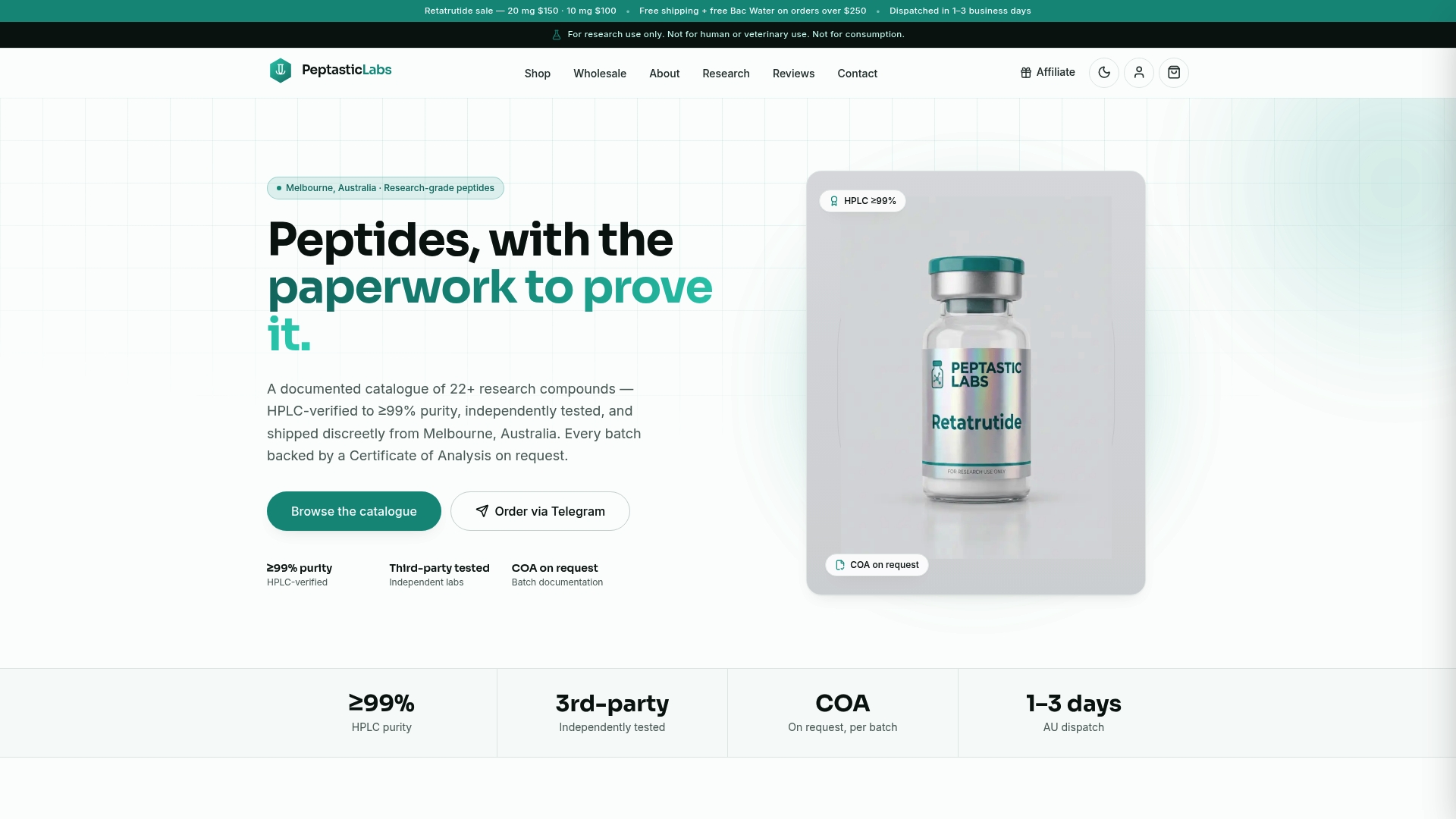
COA delivery and lot traceability are built into the ordering process, whether you are placing a single qualification lot or setting up a recurring supply arrangement. Procurement teams can request an institutional quote or procurement pack directly through Peptasticlabs, where bulk pricing and documentation requirements can be confirmed before committing to volume.
Useful sources and further reading
Procurement guidance references:
- Looking for Enzyme Assay Consumable Subscription Services? Here’s What to Know Before You Commit - BellBrook Labs
- A procurement reference guide for laboratory managers, principal investigators, and research compound procurement officers (UltraRawz Research Library)
- Blanket Purchase Orders for Labs: Cut Consumables Costs - Westlab
- Laboratory procurement best practices for research teams - Vareum
- Standards — Institutional procurement frameworks (CompoundReview)
- Lab Budget Optimization: Procurement Strategies to Save 15-30% on Supplies – Innovative Bioscience
- Standing Orders in the Lab: Smart Planning for Smooth Research – Innovative Research
- Peptastic Labs — Research-grade peptides, documented & verified
QC and standards references:
- A procurement reference guide for laboratory managers and principal investigators — UltraRawz Research Library; COA checklist covering NMR, MS, HPLC, Karl Fischer, and lot traceability.
- Standards — Institutional procurement frameworks — CompoundReview; lot-level provenance monitoring and expiry risk for high-purity peptides.
- Peptide purity standards for U.S. researchers — Peptasticlabs blog; HPLC interpretation and COA reading guidance.