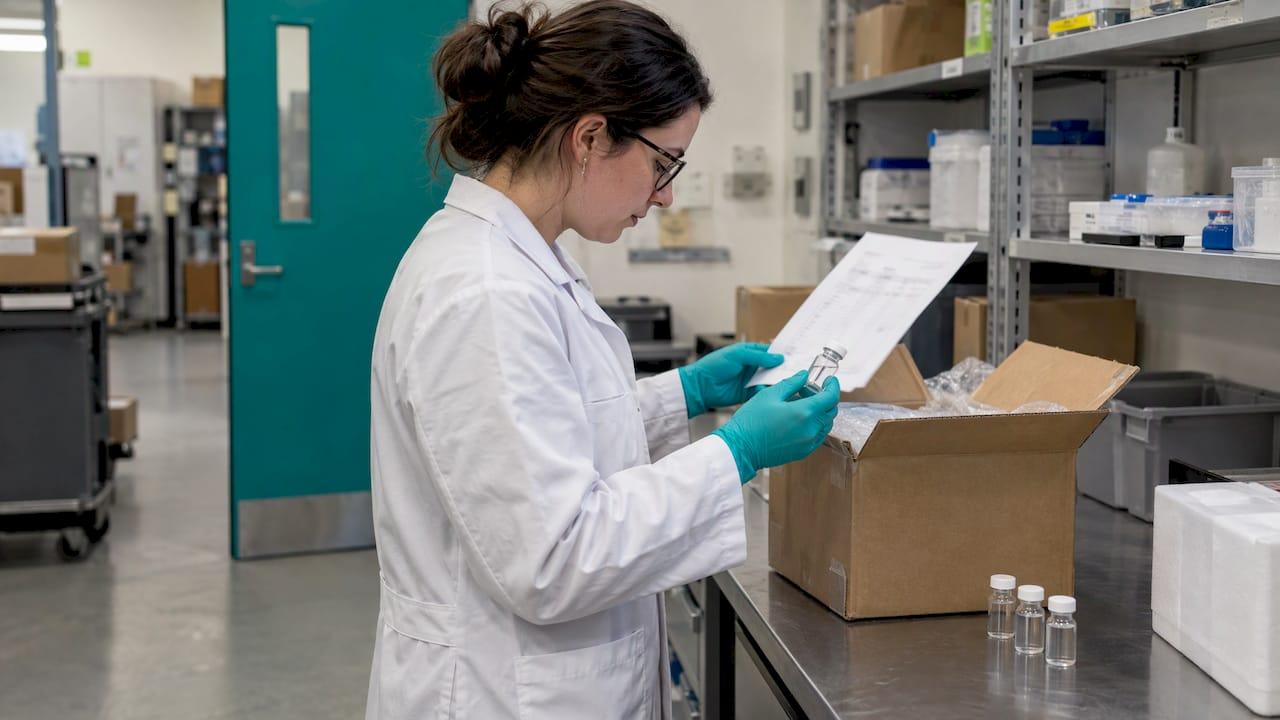
A wholesale research peptide order in Australia runs in six stages: qualify as a research buyer, request the batch documentation, confirm the compound and quantity, place the order, arrange shipping and customs, and keep records. Each stage has a compliance side, because the TGA treats "research use only" labels as having no effect on a product's regulatory status. Peptastic Labs supplies research-grade peptides, each batch HPLC and mass spec tested to ≥99% purity, with bulk and wholesale options available. This guide sets out the process and the Australian rules that sit around it.
TL;DR
- Wholesale ordering is a documentation process first and a purchase second: buyer details, intended research use, batch Certificates of Analysis (COA), then the order.
- Verify every batch by identity (mass spec), purity (HPLC) and batch traceability before committing to volume.
- The TGA states that "research use only" disclaimers do not change a product's regulatory status or permit importation.
- Unmarked vials and code-only labels are major red flags under TGA guidance. Labelling must name the compound and concentration.
- Peptastic Labs offers bulk and wholesale options across its catalogue, with COAs on request.
Table of Contents
- Who wholesale ordering is for
- The wholesale ordering process, step by step
- Documents to have ready
- Verifying identity, purity and batch quality
- The Australian rules that sit around wholesale supply
- Shipping, customs and cost planning
- Wholesale from Peptastic Labs
- Perspective
- FAQ
- Sources
Who wholesale ordering is for
Wholesale means buying in volume for onward laboratory use or for supply to a research group. In practice the buyers are university and institute labs, contract research teams and organisations purchasing for several projects. Volume pricing is the usual reason to buy this way. Consistency is the better reason: one batch, one set of documentation, repeatable results across a study.
This guide is written for researchers and for Australians weighing whether bulk purchasing applies to them. Two things should be clear from the start:
- Wholesale supply is not a route to personal-use stock. The TGA's personal importation conditions cover individual use only, and they are separate from research supply.
- Gym and fitness use is outside the scope of research supply. Anyone considering a peptide for personal use should see a doctor first. For injectable products in particular, the TGA recommends talking to a doctor or health professional.
The wholesale ordering process, step by step
1. Define the research need and compound list
List each compound, the research area (metabolic, cognitive, tissue repair, longevity, immunology or cosmetic science) and the expected quantity over the study period. Peptastic Labs organises its catalogue in those research lines, plus blends, hormone and reproductive compounds, and ancillaries and reagents, so a multi-compound list can usually be mapped to one supplier.
Where it goes wrong: ordering by nickname or abbreviation. Peptides are often sold under shorthand names. Write the full compound name and the sequence or catalogue identifier on your request. That avoids mismatches and matches what customs and the TGA expect to see on labels.
2. Confirm your buyer status
A supplier needs to know who is buying and why. Prepare:
- Organisation name and ABN, or institutional affiliation
- Named contact and delivery address
- Description of the research use
- Evidence that the work is laboratory research, such as an ethics or project reference where one applies
This is the step where a research supplier differs from a retail shop. Qualification is part of keeping supply inside research channels.
3. Request batch documentation before you order
Ask for the Certificate of Analysis for the batch you will receive. A COA is the lab report for a specific batch. It should show the compound, the batch or lot number, the HPLC purity result and the mass spectrometry identity result. Peptastic Labs supplies COAs on request and maintains traceable batch documentation, so this request is routine.
Check three things on the COA:
- The lot number matches the number that will be on your vials.
- Purity is reported by HPLC, with the method and result stated.
- Mass spec confirms the molecular weight expected for that compound.
4. Agree quantity and format
Confirm vial size, number of vials, and whether the order is a single compound, a blend or includes ancillaries and reagents. Wholesale orders benefit from planning against a study timeline, because reconstituted peptide has a limited working life and unopened lyophilised (freeze-dried) stock is the form you hold in reserve. Storage conditions for your compound should come from its documentation.
5. Place the order
Orders are placed online at checkout. Peptastic Labs also supports a pre-filled checkout through Telegram and WhatsApp, which suits repeat and multi-line orders because the item list arrives already composed. For bulk and wholesale quantities, state the volume on the order so it can be handled as a wholesale request.
6. Arrange shipping, customs and receipt checks
Imported goods are subject to Australian customs and TGA rules, covered in the next sections. On receipt, check each vial against the COA: name, concentration, lot number and intact packaging. Record the date, the lot numbers and the storage location.
7. Keep a purchase and use record
Keep the invoice, the COA, shipping documents and a note of what each lot was used for. A clean record is what an institution's compliance office, an auditor or a regulator would ask for.
Documents to have ready
| Document | Purpose | When needed |
|---|---|---|
| Buyer details and ABN or institutional affiliation | Qualifies the order as research supply | At enquiry |
| Research use statement | Describes the intended laboratory use | At enquiry |
| COA for each batch | Shows identity and HPLC purity | Before ordering and on receipt |
| Invoice with full compound names | Supports customs entry | At shipping |
| Storage and use log | Traceability after receipt | After delivery |
Our guide to the 3 documents Australian labs must attach to import research peptides goes through the import paperwork in more detail.
Verifying identity, purity and batch quality
Peptide quality claims are only as good as the testing behind them. Three terms matter:
- HPLC (high-performance liquid chromatography): separates the sample into its components and shows what share of the material is the target peptide. A result of ≥99% means at least 99% of the detected material is the target compound.
- Mass spectrometry: measures molecular mass, confirming that the peptide is the compound named and not a different sequence.
- Batch traceability: the link from a vial's lot number to the test report for that exact lot.
Peptastic Labs tests each batch by HPLC and mass spec, with in-house checks and third-party verification, and publishes the result in batch documentation. All three should come together. A purity figure without identity confirmation tells you how clean a sample is, not what it is. Our article on peptide vial contamination covers causes and warning signs worth knowing before any handling.
The Australian rules that sit around wholesale supply
Australian peptide regulation is a Commonwealth and state matter, and it has tightened through 2026. The points below come from the regulator and from a legal publication.
"Research use only" does not change legal status
In its 13 April 2026 safety alert, the TGA stated that "research use only" disclaimers do not change a product's regulatory status, permit importation, or remove advertising and supply obligations. It also stated that people and businesses that import, supply, manufacture, export, advertise, prescribe or compound peptide products must comply with Commonwealth and state or territory law. For a buyer, the practical consequence is that the supplier's label is not a substitute for your own compliance check. Confirm the rules with your institution and the TGA before ordering.

Many peptide products are unapproved therapeutic goods
The TGA's peptide products page states that some peptide products are approved in Australia, while many promoted online are unapproved therapeutic goods that may be unlawful to import, supply or advertise. Significant penalties apply to unlawful dealings.
Labelling is a stated red flag
The TGA's 7 May 2026 warning identified imported products suspected to be peptides that arrive as powders or injectables in unmarked vials, labelled only with codes or abbreviations, or missing the active ingredient name, concentration or dosing instructions. It stated such products cannot be released under the Personal Importation Scheme. For a wholesale buyer, this is a reason to insist on full compound names and concentrations on every vial and on the invoice.
Penalties
The Law Society Journal reported on 6 July 2026 that:
- Importing peptides into Australia without proper permission is a criminal offence under Commonwealth legislation, with up to 5 years' imprisonment.
- In NSW, peptides are a prescribed restricted substance. Possession without a valid prescription carries up to $2,200 and/or 6 months' imprisonment, and unlawful supply, including wholesale distribution for therapeutic use, carries up to $2,200 and/or 2 years' imprisonment.
- The definition of supply in NSW is broad and includes an offer to sell, so a social media post offering peptides for sale without authorisation could itself be an offence.
State and territory rules differ. If you are in Victoria or elsewhere, check your own jurisdiction's poisons legislation. Our guides to TGA peptide rules and research peptide compliance in Australia track the framework as it changes.
The Personal Importation Scheme is not a wholesale route
The TGA's Personal Importation Scheme page sets out conditions for individuals: personal or immediate family use only, a valid Australian prescription or written authority held at the time of importation for prescription-only goods, no more than a 3-month supply per order and a 15-month supply per 12 months. It states that imports not meeting the conditions may be seized and destroyed, with possible fines or civil or criminal proceedings. A written authority must come from an Australian registered medical practitioner and carry specific details, and eScripts are not accepted as written authority for importation. Volume purchasing for a lab does not fall under this scheme. Anyone considering peptides for personal use should speak to their doctor. Our peptide prescription requirements guide explains the prescription side.

Shipping, customs and cost planning
Plan for three items on any wholesale shipment to Australia:
- Tariff classification. The correct HS code on the invoice avoids hold-ups with the Australian Border Force and the TGA. See HS codes for peptides in Australia.
- GST and duty. Imports carry GST considerations that affect landed cost. See peptide import GST in Australia.
- Transit time and tracking. Allow lead time for customs processing. Request tracked shipping and schedule orders ahead of the study start, not on it.
For budgeting, our peptide cost in Australia article compares vial costs with clinic pricing. Wholesale quantities are quoted on request, and the catalogue lists no fixed prices.
Wholesale from Peptastic Labs
Peptastic Labs supplies research-grade peptides across metabolic, cognitive and neuro, tissue and repair, longevity, cosmetic science, blends, hormone and reproductive lines, and ancillaries and reagents. Over 22 compounds are independently tested, each verified to ≥99% purity by HPLC, with COAs on request and bulk and wholesale options available.
Researchers can browse the full peptide catalogue, list the compounds and quantities needed, and place the order online or through the Telegram or WhatsApp pre-filled checkout.
Perspective
Our view is that a wholesale order is only as good as its paperwork. A purity figure on a web page is a claim. A batch COA that matches the lot number on your vial is evidence.
That is why each Peptastic Labs batch is tested by HPLC and mass spec, checked in-house, verified by a third party and documented so it can be traced. Researchers get identity, purity and batch history in one place, and can request the COA before they commit to volume.
Australian rules are clear that a label does not settle legality. We recommend every buyer confirm their own obligations with their institution and the TGA, keep full records and insist on fully labelled vials. Documentation is what lets a lab show its supply chain is controlled.
Tintastic
FAQ
Can you buy peptides wholesale in Australia?
Research buyers can order peptides in bulk from suppliers that serve laboratories, but the goods remain subject to Australian law. The TGA states that many peptide products promoted online are unapproved therapeutic goods that may be unlawful to import, supply or advertise. Confirm your obligations with your institution and the TGA before ordering.
Does a "research use only" label make an import legal?
No. The TGA's 13 April 2026 alert states that such disclaimers do not change a product's regulatory status or permit importation. Labelling still has to identify the compound and concentration, or the product may not be released.
What documents does a wholesale peptide order need?
Prepare buyer details, a research use statement, the batch COA, and an invoice listing full compound names. Peptastic Labs provides COAs on request. Keep these with your delivery and use records.
Can a GP prescribe peptides?
In NSW, peptides are a prescribed restricted substance that must be prescribed by a registered medical practitioner, according to the Law Society Journal. Whether a particular peptide is suitable for you is a question for your doctor. Wholesale research supply is a separate channel and not a route to personal use.
How do I check the quality of a peptide batch?
Read the COA for the lot you receive. Confirm the lot number matches your vials, the HPLC purity is stated (≥99% for Peptastic Labs compounds) and mass spec confirms identity.
Sources
- TGA: Understanding your responsibilities when importing, compounding and supplying unapproved peptide products (13 April 2026)
- TGA: Peptide products
- TGA: Warning on the risks of importing unapproved peptide products (7 May 2026)
- TGA: Personal Importation Scheme
- Law Society Journal: Injectable peptides, where does the law stand? (6 July 2026)