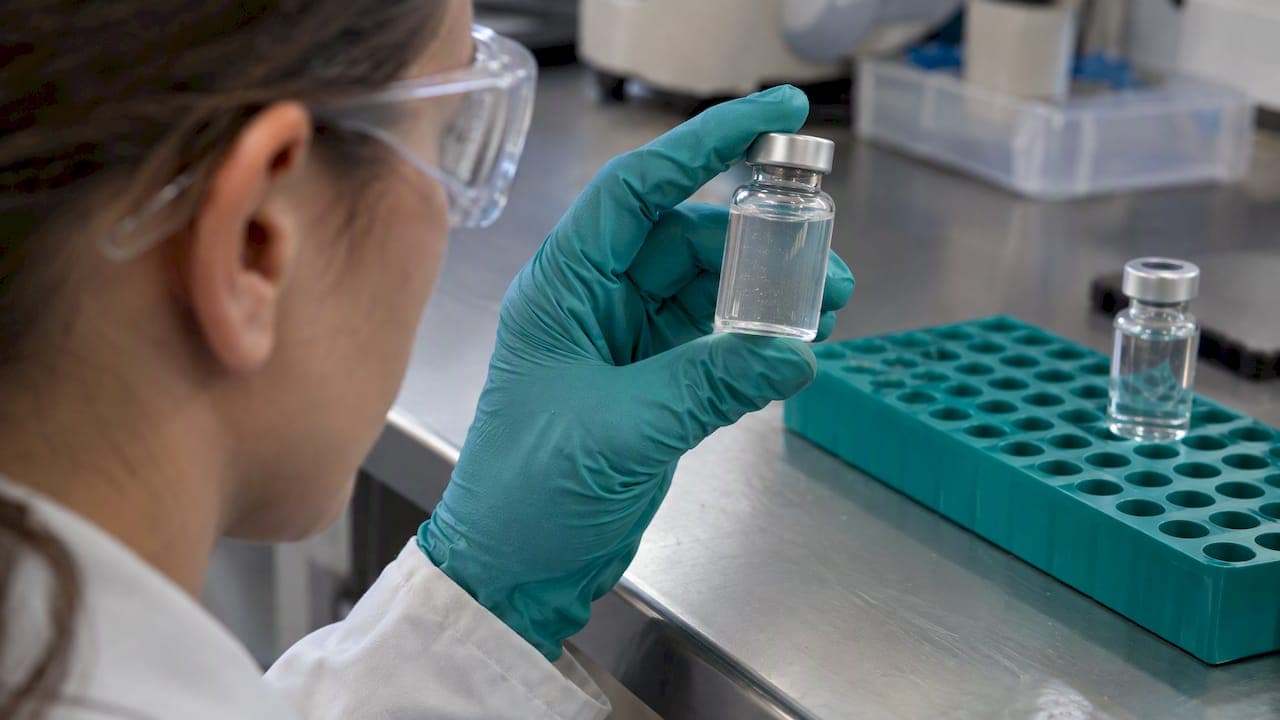
Peptide vial contamination comes from three places: the manufacturing process, the supplier's documentation gaps, and handling in the lab. Each needs a different control. Manufacturing and documentation risks are reduced by lot-specific testing. Handling risks are reduced by aseptic technique and strict discard rules. This guide covers all three for researchers in Australia, and states plainly what a purity figure does and does not tell you.
Peptastic Labs supplies research-grade peptides for laboratory use only. Nothing here is guidance for human or animal administration.
TL;DR
- Contamination enters at synthesis (residual reagents, wrong sequences), in the supply chain (mislabeling, unverified documents) and at the bench (reconstitution, septum punctures, storage).
- ≥99% HPLC purity does not exclude endotoxin, heavy metals, residual solvents or under-dosing. Identity (mass spec), endotoxin and sterility data matter too.
- Visible particles, cloudiness, color change or an unexpected odor mean discard. No visible change does not mean sterile.
- In Australia, "research use only" labels give no regulatory exemption for products used on people. The TGA treats unapproved injectable peptides as a contamination and infection risk.
- Match every Certificate of Analysis (CoA) to the lot number on your vial before opening it.
Table of Contents
- What contamination in a peptide vial actually means
- How common is the problem?
- Why 99% HPLC purity is not the whole story
- The CoA problem
- Warning signs at the vial
- Preventing contamination during handling
- The Australian regulatory context
- Our perspective
- Sourcing for research use
- FAQ
- Sources
What contamination in a peptide vial actually means
The word covers several different problems. Mixing them up leads to the wrong control.
| Type | Typical source | Detected by |
|---|---|---|
| Synthesis impurities (truncated or deleted sequences, residual reagents) | Solid-phase synthesis and cleavage | HPLC with mass spectrometry |
| Cross-contamination | Poorly cleaned glassware or shared equipment | HPLC, MS |
| Counter-ions, salts, water | Purification and lyophilization | Net peptide content assay |
| Heavy metals | Raw materials, uncontrolled processing | Elemental analysis (ICP-MS) |
| Endotoxin | Bacterial cell wall fragments from water or reagents | LAL assay |
| Microbial growth | Non-sterile fill, or handling after opening | Sterility testing, visual checks |
| Mislabeling or wrong content | Supply-chain failure | Identity testing by MS |
A peer-reviewed analysis of impurities in commercial synthetic peptides is the usual starting point for the synthesis side. Its core finding for lab buyers is that impurity profiles can differ more between batches than between vendors. A good result on one lot says little about the next.
How common is the problem?
Recent testing of unregulated peptides is not reassuring. A U.S. laboratory reported that almost 30% of the peptide samples it analyzed were mislabeled, under-dosed, over-dosed or contaminated with toxins or bacteria. The same report describes samples with inorganic arsenic well above injectable limits, and vials where the active peptide was a small fraction of the contents.

Australia has its own data. Laboratory tests of three vials of counterfeit retatrutide obtained from black-market users, commissioned by the ABC and the University of Queensland, are described in an RNZ report on dangerous dosing levels.
Treat these figures as indicators of gray-market risk, not as measurements of every supplier. They show why lot-level verification matters.
Why 99% HPLC purity is not the whole story
HPLC separates components of a sample and reports the target peptide's share of the detected UV signal. That is useful and necessary. It is also narrow.
- Purity is not content. A vial can be 99% pure by HPLC and still hold much less peptide than labeled, because salts, counter-ions and water add weight. Experts quoted in the NBC4 Washington report make exactly this distinction between purity and concentration.
- Purity is not identity. A clean single peak confirms nothing about which molecule it is. Mass spectrometry confirms molecular weight. Even a small structural error, such as the wrong C-terminal modification, can change biological activity, as the UGent literature on impurities discusses.
- Purity is not sterility or endotoxin status. HPLC-UV does not detect bacterial endotoxin. Pharmacopoeial practice for sterile injectables uses the Limulus Amebocyte Lysate (LAL) assay, and the CDC injection safety guidance is the standard reference for why contaminated injectables cause serious harm.
- Purity does not exclude metals or solvents. These need separate analytical methods.
For in vitro work, endotoxin is the contaminant most likely to ruin an experiment without any visible sign. Endotoxin can distort cell-based assay results, so a peptide that looks fine on a CoA can still produce artifacts in culture. Our guide to peptide purity standards for research covers which grades suit which applications.
The CoA problem
A CoA is only as good as its verifiability. Rina Dukor of BioTools told NBC4 that there is no central authority auditing these documents, and that some are misleading. Treat any CoA as a claim to check, not proof.
Check these fields before accepting a document:
- Lot number matches the label on the vial in your hand, not a generic product page.
- Test date and the name of the testing laboratory are stated.
- Raw chromatogram is attached, not just a percentage. Our note on requesting raw chromatograms in HPLC testing explains what to look for in peak shape and integration.
- Mass spec result gives observed against theoretical molecular weight. See the COA fields that confirm peptide identity.
- Additional assays are listed where relevant: endotoxin, sterility, net peptide content.
- Independence of the testing laboratory can be established, and the lab will confirm the report if asked.
A step-by-step version is in our guides on verifying COAs for research versus clinical peptides and reading a Certificate of Analysis for peptide research.
Warning signs at the vial
Inspect every vial on receipt and again before each use.
- Lyophilized powder: should be a uniform cake or fine powder. Discoloration, collapsed or melted appearance, or moisture inside the vial points to storage or seal failure.
- Reconstituted solution: should be clear. Floating particles, cloudiness, haze or color change mean discard.
- Seal integrity: cracked glass, a loose crimp cap, a damaged stopper or a missing tamper seal.
- Label: missing lot number, name or quantity. The TGA notes that imported unapproved vials are often poorly labelled, which makes verifying contents impossible.
Absence of these signs is not proof of sterility. Endotoxin and many bacteria produce no visible change in the early stages. Our broader checklist, how to spot low-quality peptide products, covers supplier-side red flags.
Preventing contamination during handling

Many contamination events occur at reconstitution, not in storage. The vial is opened, solvent goes in, and pressure changes draw air back through the stopper. A disciplined routine removes most of that risk.
Preparation
- Work in a clean, dedicated area. Use a biosafety cabinet or laminar flow hood for any work that needs sterility, such as cell culture.
- Perform hand hygiene and wear gloves.
- Allow the lyophilized vial to reach room temperature before opening, so condensation does not form.
- Use sterile, single-use syringes and needles for every access. Never reuse them.
- Use sterile diluent from a sealed container, such as bacteriostatic water or sterile water, according to your protocol.
Accessing the vial
- Scrub the stopper with 70% isopropyl alcohol and let it air dry before every puncture. This is standard CDC injection safety practice.
- Never leave a needle in the septum between uses. It creates a direct path for microorganisms into the fluid.
- Add solvent slowly down the glass wall. Swirl gently rather than shaking, which can foam and denature some peptides.
- Label the vial with reconstitution date, concentration and solvent.
Storage
- Store lyophilized peptide at the temperature on the product documentation, protected from light and moisture.
- Keep reconstituted solutions refrigerated and aliquot them if repeated access is expected, so a single vial is not punctured many times.
- Do not refreeze repeatedly unless your protocol validates it.
When to discard
The CDC advises discarding multi-dose vials within 28 days of opening unless the manufacturer specifies otherwise, and any vial with suspected contamination at once. Research peptides have no manufacturer in-use period, so set your own conservative limit, record it in the protocol and apply it consistently. Discard on any of these:
- a visible change in clarity or color;
- a needle or septum contact that broke aseptic technique;
- a dropped vial with any crack or seal damage;
- an unlabeled or ambiguous vial;
- expiry of your internal in-use window.
Preservatives such as phenol or benzyl alcohol reduce some bacterial growth but do not protect against high contamination loads or certain resilient organisms, and they are not a substitute for technique.
The Australian regulatory context
The legal position affects how you should think about contamination. The TGA states that unapproved peptide products, especially injectables, carry risks of contamination, infection and tissue damage, and that importing or supplying them can breach the Therapeutic Goods Act 1989. It also says labels such as "for research use only" do not remove that responsibility when a product is used therapeutically. The regulator has since escalated its compliance focus, pointing to unlawful advertising and supply through online platforms and overseas sites.
Two practical points follow.
- "Unapproved" does not mean "safe" or "banned". It means no regulator has assessed quality, safety or effectiveness. Contamination controls therefore rest on the supplier's testing and on you.
- Research peptides are for laboratory use. Human use falls under prescription and compounding rules, which we outline in our guide to peptide prescription requirements in Australia. Anyone considering a peptide for personal use should speak with a doctor, not a supplier. Examples of legitimate laboratory work are in Australian peptide research use.
Our perspective
We supply research peptides, so we have a stake in this topic and prefer to state our position directly.
A purity number alone is a weak basis for trust. We test each batch independently by HPLC and mass spectrometry, keep traceable batch documentation, and issue a Certificate of Analysis on request. Our catalog compounds are verified at ≥99% purity by HPLC. That addresses identity and purity. It does not by itself address every contamination route discussed above, and we do not present it as if it did.
Our advice to any lab buyer, from us or anyone else:
- ask for the CoA before ordering, and match it to the lot on the vial at receipt;
- ask which assays beyond HPLC were run for that lot, and request those that your application needs, such as endotoxin for cell work;
- treat handling as part of quality. A verified vial contaminated at reconstitution is a failed vial;
- document your own in-use limits and discard rules, and follow them without exceptions.
The contamination problem in this market is real and the verification gap is real. Suppliers should expect to be asked hard questions, and labs should ask them.
— Tintastic
Sourcing for research use
If you need research-grade peptides with batch documentation, the Peptastic Labs catalogue covers metabolic, cognitive and neuro, tissue and repair, longevity, cosmetic science, blends, hormone and reproductive compounds, and ancillaries and reagents. Each compound is HPLC-verified at ≥99% purity, with a CoA available on request and bulk options for institutions. Request the CoA for your lot before you order.
FAQ
How do you know when a peptide has gone bad?
Look for cloudiness, floating particles, color change, a collapsed or discolored lyophilized cake, or an unusual odor. Absence of these signs does not confirm sterility, so apply a fixed in-use window and discard when it ends.
How long can a reconstituted peptide vial last in the fridge?
There is no universal figure, because stability depends on the sequence, solvent, pH and storage. The CDC rule for multi-dose medication vials is 28 days after opening unless the manufacturer states otherwise, and many labs set shorter limits for peptides. Validate stability for your own protocol.
Is it a problem if I dropped the vial?
If the glass, stopper or crimp seal is cracked, loose or damaged, discard the vial. If the vial looks intact, inspect the contents and the seal closely. When in doubt, discard, because a compromised seal cannot be verified by eye.
What happens if you shake a peptide vial?
Shaking can cause foaming and aggregation in some peptides and introduces air that may carry contamination. Swirl gently or roll the vial instead. If the solution turns cloudy or particles remain after gentle mixing, do not use it.
Does a 99% HPLC purity CoA mean a vial is uncontaminated?
No. HPLC purity measures the target peptide's share of the detected signal. It does not establish net peptide content, endotoxin level, sterility or heavy metal content. Ask for identity data by mass spectrometry and any further assays your work requires.
Sources
- Peptides: Lab finds risks, problems in 30% of vials tested, NBC4 Washington
- Understanding your responsibilities when importing, compounding and supplying unapproved peptide products, TGA
- TGA escalates compliance focus on unapproved peptide products, Aesthetic Medical Practitioner
- Safe Injection Practices to Prevent Transmission of Infections to Patients, CDC
- Peptide impurities literature, Ghent University repository
- New testing of black-market peptides reveals dangerous dosing levels, RNZ